
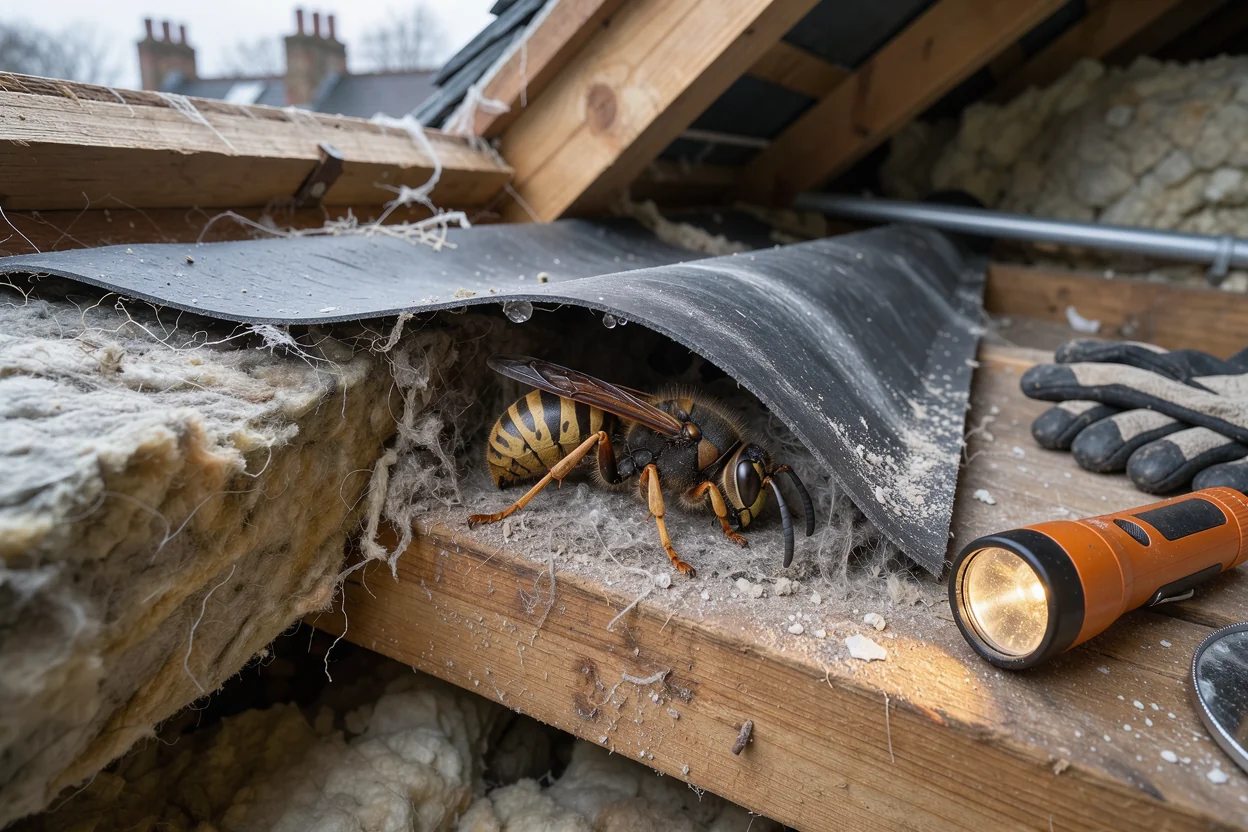
An old paper nest is usually a poor place to look for a winter queen. If you’re searching for unhatched wasp queen winter hibernation spots, the correction matters: a queen that survives winter is already an adult. She may be tucked into a sheltered crevice while the nest that produced her stands empty.
Finding a large, motionless wasp among Christmas decorations or beside the loft hatch can be unsettling. A single resting insect does not, by itself, establish that a working colony is overhead.
The seven places below are potential shelters to notice during ordinary loft access. I’ve ordered them by how easily you can observe them safely, starting with accessible belongings and ending with concealed roof edges. This is an inspection order, rather than a claim about which locations queens use most often. You do not need to dismantle the loft to check them.
A winter queen has already left the old colony
For the familiar social wasps around UK homes, winter survival belongs to the new generation of queens. In the usual annual cycle, these females mate before seeking shelter. Workers, males and the old queen generally die as the season ends.
The surviving queens enter diapause, a seasonal resting state with greatly reduced activity. People commonly call this hibernation. A sheltered, unheated space can provide somewhere to remain through cold weather without the disturbance of a busy room.
An overwintering queen is therefore neither an unhatched egg nor a grub waiting inside last summer’s comb. The old paper nest is usually abandoned. Its presence tells you that wasps used the building previously; it does not prove that they are living there now.
Winter sightings also need identification. A large insect is not automatically a queen, and groups of resting flies can cause confusion. If your discovery involves several flies around a loft window, the guide to cluster flies in lofts addresses that separate problem.
Before investigating any hiding place, establish whether you are looking at one resting insect, several unidentified insects or repeated wasp traffic.
1. Stored boxes and folded fabrics
A queen sheltering among stored belongings is worth noticing first because those belongings may soon enter a heated room. Cardboard overlaps, loosely folded covers and the spaces behind stacked items can create small, sheltered recesses.
The useful signal is the insect itself. A dry cardboard box, dust or a dark corner cannot establish that a queen is present. From a stable position, look at accessible box edges and exposed folds before lifting the item. Avoid putting fingers into concealed spaces.
This location earns first place because you can often change your handling without changing the building. Suppose you are bringing decorations downstairs: checking the outside of the container before moving it is more useful than searching distant roof timbers.
The common mistake is to unpack everything beside a radiator. Warmth may bring a resting insect into activity, and an unexpected flying wasp is harder to manage among open belongings.
If you see a motionless wasp, stop moving that item. Leave it in its original sheltered position if you can do so without approaching the insect. Do not shake fabric, squeeze cardboard folds or assume gloves make direct handling safe.
For future storage, inspect empty containers before filling them and use sound lids where suitable. The practical priority is the box you are about to move, rather than every unopened box in the loft.
2. Loft hatch recesses and nearby frame joints
A queen may find shelter in a quiet recess around loft access, particularly on the unheated side of the hatch. Small frame joints and the backs of nearby timber ledges deserve a glance before you reach past them.
This ranks second because it lies directly along your access route. You can usually observe the immediate opening without walking deeper into the roof space.
Look for a whole insect resting against the frame or within an exposed corner. A wasp walking across the hatch may simply be moving through the area; its position alone cannot establish where it spent the winter.
Repeatedly slamming the hatch or poking a narrow joint is the wrong response. Neither helps identification, and both bring disturbance close to your hands and face. Keep children and pets away from the opening while you assess what is visible.
There is also a practical limit to this check. If the insect sits where you need to grip the frame, do not stretch around it while balancing on a ladder. Safe access takes priority over getting a closer photograph.
I’d leave a sheltered insect alone when the hatch can still be used safely. If its position prevents safe access, stop using that route until you have identification and advice.
3. Rafter joints and cracks in roof timbers
A sheltered joint between roof timbers is another possible resting place for an adult queen. The relevant feature is a protected recess, rather than any particular age or style of roof.
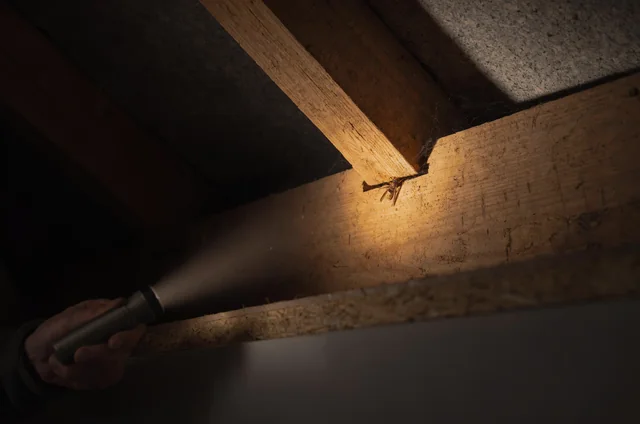
This comes after storage and hatch framing because useful observations depend more heavily on your viewing position. A joint may be visible from the boarded walkway yet impossible to inspect safely from elsewhere.
Use a torch from where you are standing securely. You are looking for an identifiable insect against the timber, rather than interpreting every dark mark as a wasp. There is no reliable dust pattern that confirms a queen occupies a crack.
Finding a resting wasp in a timber joint does not establish rot, structural damage or an active nest. Those are separate questions. Avoid turning one insect sighting into a diagnosis of the roof.
The common mistake is probing cracks with a screwdriver or pulling at adjoining material. That adds disturbance and can damage parts of the roof without resolving what you have seen.
Keep the inspection visual. Do not step between joists, stand on insulation or lean across an unsupported area for a better angle. Where the joint cannot be seen from safe boarding, record its position and leave the close inspection to someone with suitable access.
4. Sheltered edges around loft insulation
The quiet boundary between insulation and a solid surface can conceal a resting insect. A queen might occupy an accessible sheltered edge, but insulation itself is not evidence that she is there.
This location sits midway down the list because a surface glance can be straightforward, while searching beneath insulation quickly becomes disruptive. The distinction matters.
Look only at exposed margins beside boarding or timbers that you can already see. If an insect is visible, note the location without trying to uncover the surrounding area. A photograph from a safe distance may help with identification.
Pulling up rolls to hunt for queens is a common overreaction. It can disturb resting insects, expose irritating fibres and leave the insulation poorly positioned. Walking on it also risks stepping onto a ceiling that cannot support you.
Neither a gap in the insulation nor a patch of loose fibres confirms wasp activity. If you discover other signs of a building or pest problem, record those separately rather than attributing everything to the same insect.
Leave a motionless wasp undisturbed if the area can remain safely unused. Where electrical work or insulation replacement is planned, tell the contractor exactly where you saw it before work begins. There is no reason to strip insulation simply because one queen has been spotted nearby.
5. Loose folds beside roof felt or lining
A sheltered fold or overlap beside the roof lining can provide a concealed recess. Roof lining is the material beneath the outer roof covering, and it needs to remain intact.
This ranks below insulation edges because the temptation to lift or peel material can turn a minor insect enquiry into a building repair.
From an existing safe walkway, you may be able to see an insect beside an exposed fold. Often you will see only the lining. A hidden space behind it remains an unknown space, however suitable it appears.
Do not pull the material away to check. Avoid pushing tools into overlaps or trying to open a gap with your fingers. An inaccessible recess does not become worth investigating simply because a wasp could fit inside it.
The same caution applies to spraying blindly behind the lining. Without knowing what is present, you cannot tell whether you are addressing a resting insect, an active colony or an empty void.
If the lining is already loose, torn or damp, document that as a roof-maintenance issue. A photograph can show the position without further disturbance. Ask whoever inspects the roof to assess the defect on its own merits.
The practical verdict is to observe exposed edges and preserve the lining. A possible hiding place is not a reason to peel back a working part of the roof.
6. Dry crevices in gable walls and chimney breasts
A small crevice in exposed loft masonry may provide shelter for a winter queen. In some properties, possible recesses occur around gable walls or the masonry of a chimney breast within the roof space.
These places rank sixth because depth and occupancy are difficult to judge from the surface. A visible insect can support identification; a dark hole cannot.
Look from a stable, accessible position. Note whether the insect is resting in a recess or repeatedly travelling into a deeper opening. Those observations describe different situations and should not be treated as interchangeable.
The common mistake is sealing the nearest gap immediately. Some openings are building defects, while others may relate to ventilation or another part of the structure. Filling an unidentified opening can create a separate problem.
Do not scrape out mortar, insert a wire or disturb a chimney component to investigate. A queen sighting also does not establish that the masonry needs extensive repair.
For a landlord or letting agent, a dated photograph and a precise location are more useful than a report that simply says “wasps in the roof”. Include whether anyone has seen repeated movement through the opening.
If repair is needed, arrange identification before closing a gap with current insect activity. The useful action here is documenting an accessible sighting, rather than testing every crevice with a tool.
7. Eaves, soffits and roof-edge voids
Sheltered spaces at the roof edge can provide potential winter refuges. The eaves are the lower roof edges, and soffits are the panels beneath an overhang.
These areas come last because access is often poor. Their position also makes it easy to confuse a possible winter shelter with an entrance used by a developing colony later in the year.
A single resting insect visible from inside the loft is limited evidence. Repeated journeys through the same opening provide a stronger reason to investigate current activity. Record what you can observe safely, including when it happens.
Do not reach into the eaves or climb outside to inspect a suspected queen. Removing soffit panels or blocking roof ventilation creates risks that outweigh the value of finding one hidden insect.
The guide to autumn loft sealing covers a related prevention issue. Any repair still needs to preserve the ventilation the building requires, and the insect present should be identified before a gap is closed.
If repeated activity develops into a confirmed nest problem, access affects the work involved. The discussion of wasp nest removal costs is relevant at that stage.
For a quiet winter roof edge, observation is enough. Leave concealed voids closed and arrange suitable access if current activity needs investigation.
Handling a winter discovery without waking the whole loft
Your response to a possible queen should depend on what you can see and whether the space can remain safely undisturbed. A dormant insect in an unused corner presents a different practical problem from a moving wasp beside the only handhold.
Keep the inspection within safe reach
Use sound access equipment, adequate lighting and established boarding. Inspect only what you can see from there. Nobody needs to crawl into the eaves or move insulation to complete this shortlist.
Stop handling any object that contains a resting wasp. Avoid breathing closely over it, warming it deliberately or touching it to test whether it moves. Queens can sting if handled or trapped.
If the insect becomes active, step back and keep other people away. Give yourself room to leave safely rather than trying to catch it while balancing at the hatch.
A useful interactive sighting checklist would record the location, date, movement and any repeated traffic through one opening. A photograph beside those answers would help you compare later sightings without relying on memory.
Separate identification from building repairs
Once the insect has been identified, decide whether anything needs to change. A sheltered queen may be left alone where she is not creating a practical risk. Repeated activity or an inaccessible discovery beside planned work may need assessment.
BuzzKill Pest Control is one local option for assessment. Useful information includes the exact location, whether the insect is moving and whether the same opening has shown repeated traffic.
For prevention, the guide to rooms to seal first can support a wider property check. Keep any repair proportionate to an identified defect and retain required ventilation.
Do not arrange blanket spraying of the loft solely because one resting wasp has appeared.
What a winter wasp sighting means for your home
Is a motionless queen dead?
Stillness alone cannot distinguish a dormant wasp from a dead one. Cold conditions can leave an overwintering queen almost motionless.
There is no need to settle the question by touching her or applying heat. If she is sheltered and the object can remain in place, leave it undisturbed. When identification matters because work is due, use a photograph taken without moving the insect and explain where it was found.
Does one queen mean there is a hidden nest?
One resting queen does not establish that a working nest is nearby. A queen seeking winter shelter has different needs from a colony raising young.
Likewise, an old paper nest beside her does not prove that she occupies it. Look for current behaviour before drawing conclusions. Repeated journeys through the same opening deserve closer assessment; a still insect and an old structure need to be recorded as separate observations.
Will she build a nest in this loft in spring?
A queen may leave her winter shelter and choose a nesting site elsewhere. Her winter location does not predict exactly where a new nest will develop.
Spring activity therefore matters more than trying to guess from one cold-weather sighting. If you notice repeated visits to a particular gap, record them from a safe position. Avoid sealing that opening while activity is unresolved, and do not disturb a developing paper structure to check inside.
Should an old paper nest be removed straight away?
An old nest does not automatically need urgent removal. First establish whether there is current activity and whether the structure obstructs planned work or safe access.
Removing an abandoned nest also does not repair the opening through which insects previously entered. Treat removal, identification and building maintenance as separate decisions. If the nest is high, concealed or difficult to reach, leave it in place while its condition and accessibility are assessed.
Which hiding place deserves attention today?
Start with item 1 if you are about to carry stored belongings into a heated room. Inspect accessible box edges and fabric folds before moving them, then stop if you find a resting insect.
An old paper nest is the discovery easiest to overreact to. Establish whether there is current activity before arranging treatment, and leave inaccessible roof spaces intact.
Need professional help? BuzzKill offers fast, reliable pest control services across London and Essex.