
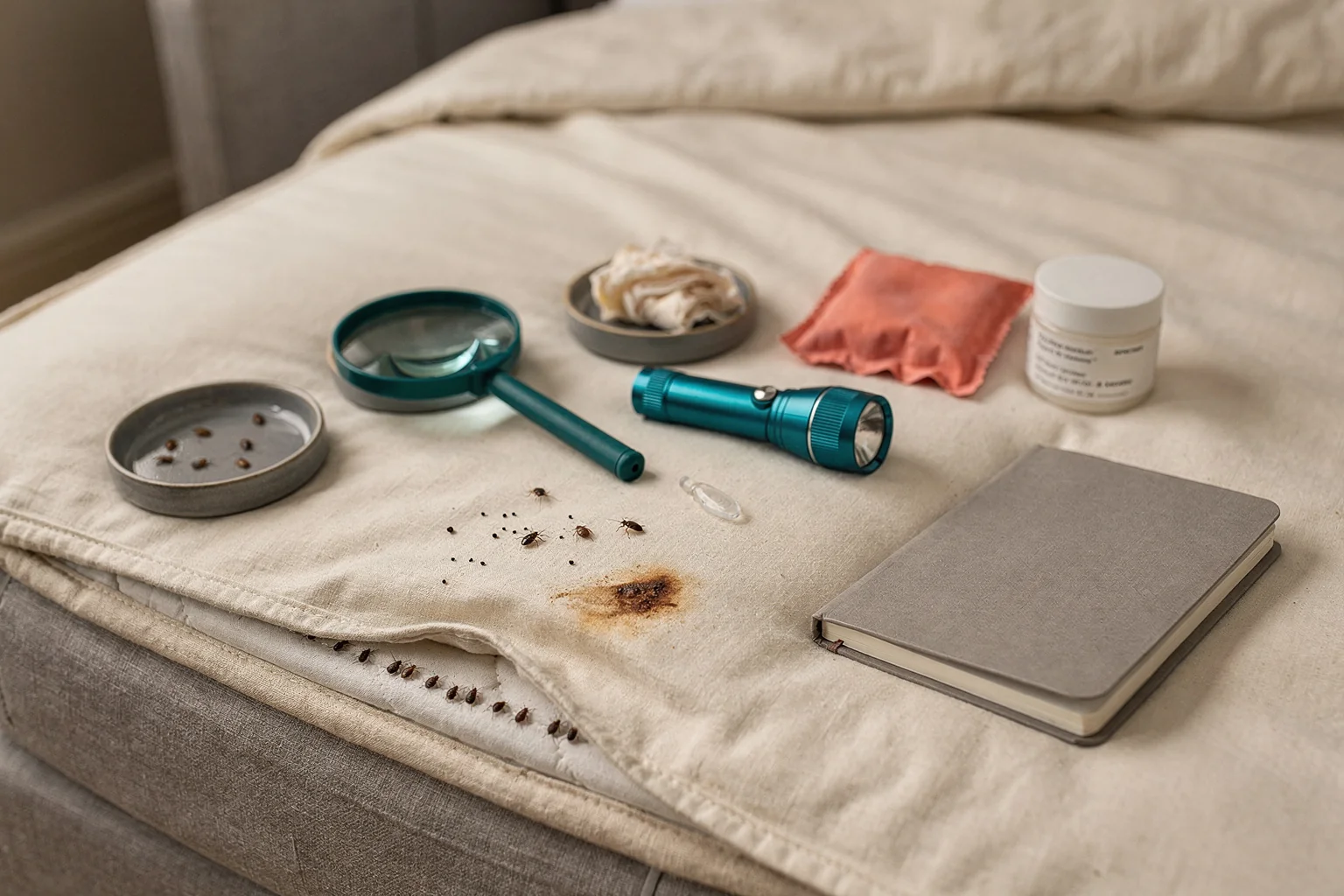
You wake up with a few angry red bumps on your arm. They weren't there when you went to bed, and now they itch like mad. Your first thought: bed bugs. But it could just as easily be a late-season mosquito, a stray flea from the neighbour’s cat, or even a mild reaction to new washing powder.
The thing about bed bug bites is that, taken one at a time, they look unremarkable. It's the pattern, the timing, and the supporting evidence around the bed that turn a vague suspicion into a near certainty. I'll walk you through the seven signs that usually mark the difference — ordered from what you'll notice first to the one that seals the diagnosis — so you don't waste a day worrying over nothing, or miss a problem that's easy to stop early.
Your Bites Follow a Line, Not a Scatter
If you see three or four raised bumps tracing a straight or zigzag line across your shoulder, that's the most famous bed bug calling card. The clinical literature describes the presentation as "clustered or linear distributions" on exposed skin, and in practise it is often called the "breakfast, lunch, dinner" pattern — one bug feeding several times as it moves a few millimetres between each probe.
This linear feeding habit is a consequence of the bug's search behaviour: a bed bug extends its beak-like mouthparts and probes the skin until it hits a capillary. If the first probe misses, it withdraws a millimetre and tries again, leaving a chain of punctures. It's not deliberate artistry — just efficient feeding. Mosquitoes, by contrast, often succeed on the first insertion and rarely create patterned bites. Flea bites can appear in groups, but they are typically scattered across the same general area like a shotgun blast, not a neat row.
Spider bites are almost always solitary, because a spider isn't looking for a second course. They can produce two puncture marks close together but never a line of three or four. A common mistake is to see any group of spots and assume a line. An allergic rash, heat bumps, or a scattering of midge bites can look grouped but rarely form a sharp geometric track.
Take a photo with your phone when you first notice the marks. A clear line that curves or zigzags across one body part is strong evidence. If the spacing between bumps is roughly 5mm to 20mm and they sit in one row, bed bugs move to the top of your suspect list. Still not convinced the pattern fits? The same site has a side-by-side guide to bed bug vs mosquito bite signs that can help you pin down the difference in five minutes.
The Bites Cluster on Skin That Touched the Mattress
Bed bugs feed at night, and they prefer areas that press against the bedding because the carbon dioxide and warmth concentrate there. Arms, shoulders, neck, face, and the back of the hands are the most common sites. If you sleep on your side, you might see a tight cluster on the outer thigh or hip.
Flea bites, by contrast, rarely venture above the knee unless a pet has been sleeping on your chest. Midge and mosquito bites can appear anywhere but usually show up on bare legs and arms exposed during an evening outdoors, not the small of your back. In warmer months, people often sleep with arms thrown outside the cover. Bites then show up on the outer forearm too. But a giveaway is the absence of bites on double-covered areas like the lower back and stomach if you sleep with a duvet tucked in.
One check I suggest: stand in front of a mirror and note every area that currently has fresh bumps. If every one of them maps to skin that was uncovered while you slept, and your lower legs are clean, you're looking at a classic bed bug distribution.
The limit here is that some people react slowly, so the bite you see this morning might actually be from two nights ago — and might have been made by a completely different pest. And if you share a bed, one partner may react while the other shows no marks at all, because sensitisation varies. This becomes especially tricky in London’s older terrace bedrooms, where higher humidity and the steady 21°C of a heated room create perfect conditions for bugs to feed undetected. Keep the distribution clue in your back pocket but don't treat it as a verdict on its own.
The Itch Takes Hours to Kick In
When a bed bug feeds, it injects saliva containing anaesthetic compounds and anticoagulants. You don't feel the prick itself. The itch usually develops gradually and peaks hours later — sometimes even a day after the bite.
This delayed response is one of the most reliable ways to sort bed bug bites from stings. Bee, wasp, and ant stings hurt immediately and often cause instant burning pain. A mosquito bite may tingle within seconds, and the bump forms while the insect is still on your skin. If you sat in a pub garden yesterday afternoon and felt a sharp nip followed by a near-instant bump, you are almost certainly not dealing with bed bugs.
The anaesthetic effect fades, but the real itching begins when your body mounts an immune response. For first-time victims, that response may be barely noticeable, leading some people to think they have no reaction. But with repeated exposure, the body can become sensitised, and later bites may swell into large, angry wheals. This is why, in shared accommodation, one occupant might be covered while another appears untouched — even though both are being fed on.
Where people get tripped up is waking from a deep sleep with itchy spots and assuming they happened five minutes ago. Bed bug bites typically pass unnoticed at the time they occur. The real time lag means you can't rely on when you first notice the itch to guess when you were bitten — you need the full context. The specialists behind early bed bug bite signs explain why noticing a fresh crop of marks several mornings in a row is often the first clear alarm bell.
The Bumps Have a Darker Centre
A fresh bed bug bite often resembles a tiny pimple, with a dark red or purplish dot in the centre where the stylets pierced the skin. The bite method, known as "pierce and suck," uses two needle-like projections that penetrate the skin. After the bug withdraws, a tiny droplet of blood may bead at the surface, forming the central scab over a few days — especially if you've scratched it.
Individual reactions vary enormously, which is one reason bed bug identification is so messy. The Harvard Health guide notes that bites "can look like red or discolored itchy bumps that appear in lines or clusters on exposed skin, though not everyone reacts to them." Some people get flat pink blotches; others develop angry, raised welts similar to hives. A small number of people show no visible reaction at all.
Because the look of a single bite is so variable, the dark-centre sign is useful only when paired with one of the stronger clues — especially the line pattern or evidence from the bed itself. A lone spot with a pinprick centre on an ankle? Could be a flea. A trio with dark centres across a shoulder blade? Much more suspicious. If the dark spot is not a single dot but a broader purple-black bruise, consider a spider bite. And if the centre is fluid-filled or yellow, it's more likely a pustule from a bacterial issue than a bed bug puncture.
One diagnostic pitfall: scratching any bite can roughen the centre and make it look like a bed bug puncture under a phone camera. Press a damp flannel against the bumps before you photograph them. If the central dot persists after the skin cools, it's a stronger signal.
You Keep Finding Fresh Bites Every Morning
A hungry adult bed bug feeds roughly once every five to seven days, but an established group contains multiple bugs at different life stages — so the biting often feels continuous. You go to bed clear and wake up with new spots, and when yesterday's bumps start to fade, tomorrow's crop appears on a different patch of skin.
Mosquitoes and fleas don't synchronise their feeding to your sleep cycle. You might get bitten by a mozzie on two consecutive evenings, but you'll usually notice it happening in real time, and the bites will appear on ankles or arms while you're watching television — not exclusively while you're unconscious.
If you have new bite marks at least three mornings in a seven-day window, and you haven't been sitting outside at dusk, bed bugs become the most likely explanation.
A subtle variant is the "holiday pattern." If bites appeared primarily in the first few days of a trip abroad, then followed you home and continue each morning, the infestation probably travelled in your luggage. In London's dense housing, the problem can also originate from a neighbouring flat. Where terraced houses or purpose-built blocks share party walls and heating pipe channels, bugs migrate through those cavities. So if fresh bites keep coming even after you've stripped and cleaned your own room, consider that the source might be next door.
At this point, many people do the wrong thing: they strip the bed, wash everything at 90°C, and spray a shop-bought insecticide around the mattress. The problem is that some UK bed bug populations now show significant resistance to common over-the-counter chemicals. DIY chemical treatments often scatter the bugs deeper into the room rather than eliminating them. You want a professional to look, and you want it before you spread the problem into the sofa.
You Spot Tiny Bloodstains on Your Sheets
After a bed bug feeds, a tiny amount of blood may seep from the bite wound or get squeezed out when the bug pulls back its mouthparts. On light-coloured bedding, this leaves rust-coloured spots — usually the size of a full stop. You might also find small faecal smears that look like dark brown ink dots, which are literally digested blood.
This sign is not exclusive to bed bugs; a scratched mosquito bite can bleed, and a rogue spider squashed in your sleep leaves a mess. But bed bug blood spots tend to appear in multiples, often near the pillow or along the edge of the mattress. The stains are typically dark rust or mahogany in colour, and they don't wash out easily. Faecal deposits look like ground pepper scattered along a seam. On a damp white tissue, they'll leave a reddish-brown smear — a reliable field test that distinguishes them from grey-green mould spots or tea stains.
The common mistake is to mistake rust marks for everyday laundry stains. To test a suspicious stain, dab it with a damp white tissue: if the colour lifts and looks rusty-red, it's likely blood. Faecal marks will bleed into a faint brown ring.
If you find blood spots but no bites — possible, given that some people don't react — you still need to take the evidence seriously. It means a bug fed somewhere close to where the stain sits. Mark the spot with a piece of tape, and then systematically check the nearest seam or fold later that day.
You Actually See the Bugs (or Their Droppings)
The ultimate confirmation. An adult bed bug is flat, oval, and about the size of an apple pip — roughly 5mm long, reddish-brown, and wingless. Young nymphs are smaller and translucent, almost invisible against a pale mattress until they've fed and turned pink. You might also spot their pearly white eggs, each about 1mm long, tucked into seams, headboard joints, or behind a loose bit of skirting.
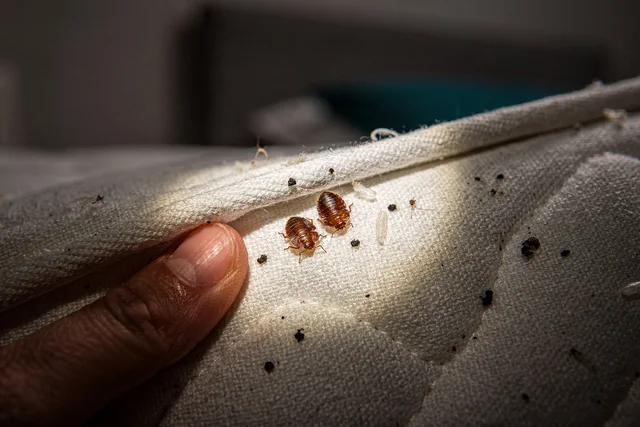
Daytime sightings are rare because bed bugs are nocturnal and thigmotactic, meaning they seek tight cracks. To find them, you need a torch and patience. Roll back the mattress piping, peel open the zip cover if it has one, and check the hollows of the bed frame, drawer joints, and the tiny gap where the carpet meets the wall. You're less likely to spot a crawling bug than you are to find their shed skins — translucent, papery husks — or the peppery black dots of dried excrement that mark a harbourage.
Bed bugs moult five times before reaching adulthood. Each moult leaves behind a near-perfect, translucent replica of the insect. These exoskeletons accumulate in the harbourage, so if you find a collection of tiny rice-like husks in a seam, you've struck gold. They don't move, so they're easier to spot than the living nymphs. A single female can produce 200 to 500 eggs over her lifetime, which is why a few weeks of invisibility can turn into a full-blown problem. The bed bug identification checklist on this site offers side-by-side photos of each life stage so you can compare what you're seeing.
Bed bug bites produce cutaneous reactions through salivary proteins that trigger inflammatory and hypersensitivity responses. Clinical manifestations range from asymptomatic lesions to pruritic papules, wheals, or bullae, often in clustered or linear distributions. Diagnosis is clinical and supported by evidence of infestation.
— StatPearls — NCBI Bookshelf, Bedbug Bites
That phrase "supported by evidence of infestation" is important. The bites alone are a suspicion. The physical finds — bugs, cast skins, or those telltale spots — turn it into a working diagnosis.
The one sign people often overreact to is a single itchy bump with no context. It's almost always a mosquito, a midge, or even just a spot. The sign to act on today is waking up with three or more fresh bites in a line on skin that was touching the mattress, and then seeing the same pattern again tomorrow. That combination rarely has another explanation.
When It's Time to Get Professional Help
Bite marks that persist, multiply, or appear in a tight sequence are your permission to stop guessing and call someone who sees this every day. A professional inspection uses a bright torch, a magnifier, and a trained eye to check all the usual harbourage points — often identifying evidence that a homeowner would walk straight past. The technician will examine the mattress seams, bed frame, headboard, skirting boards, loose wallpaper, and the inside of nearby electrical sockets and furniture. In many cases, the bugs are hiding within a metre of where you sleep, tucked into gaps no wider than a credit card.
Don't be tempted to douse the area with an insecticide before a technician arrives. You'll mask the signs and possibly drive the bugs deeper into the room or even into an adjacent flat. Instead, do three things today: photograph the marks, bag any loose bedding in sealed plastic (but don't wash it until after the inspection), and avoid moving furniture or luggage between rooms. If you share a wall with a neighbour — common in many London terraces and blocks — assume the bugs could be using the cavity too.
The CDC clinical guidance is clear: most bite cases need only symptomatic care — antiseptic cream, an oral antihistamine, and not scratching. But the bites always point to a larger issue: an infestation that won't resolve on its own. Heat treatment from a qualified company is now the method that most London technicians reach for first, precisely because it bypasses the growing insecticide-resistance problem. A specialist will raise the room's temperature to a level that kills all life stages — adults, nymphs, and eggs — in a single visit, which is why many pros now consider it the gold standard. If you're weighing your options, a plain-English comparison of heat treatment vs chemical spray can help you understand the practical differences before you book.
If you're in East London or Essex and you've spotted multiple bite signs across three or more mornings, a same-day inspection can give you a definite answer and a clear treatment plan. There's no call-out charge to have a technician check your beds, skirting, and furniture. Get started with a visit.
Need professional help? BuzzKill offers fast, reliable pest control services across London and Essex.