
Waking up with a line of angry red bumps along your arm is never how you want to start the day. You might wonder if it’s a rogue mosquito, a reaction to new washing powder, or something more persistent. If you live in a Hackney flat, terraced house, or shared building, bed bugs are a real possibility — and those bites are often the first warning sign. I’ll walk you through how to read those bites, confirm you’re dealing with bed bugs, and take the right steps to get rid of them, whether you handle it yourself or call in professional help.
Recognising Bed Bug Bites on Your Skin
Bed bug bites can look different from person to person, but there are a few patterns that show up again and again. You’ll often see small, red, slightly raised bumps — maybe flat at first, then puffier — clustered together or in a rough line of three or four. That’s sometimes called the “breakfast, lunch, and dinner” pattern because the bug may feed multiple times in one area. The bites tend to appear on skin that’s exposed while you sleep: arms, shoulders, neck, and face. Mosquito bites, by contrast, are usually random and isolated, often with a pale halo around the bump. Flea bites cluster around the ankles and show a tiny central puncture point — something you rarely see with bed bug marks. If you need a more detailed side-by-side comparison, I’ve written about bed bug bite identification to help you spot the differences.
The itching is the real giveaway. For many people, the reaction is intensely itchy, more so than a typical mosquito bite. And unlike flea bites, which usually cluster around ankles and legs, bed bug bites can show up anywhere on the upper body. Skin tone matters here: on darker skin the bites may appear as darker or purple-coloured spots that can become hard, raised hives, so the usual “red bump” description isn’t always accurate. Check for the pattern of lines or clusters rather than fixating on colour.
One important note: not everyone reacts to bed bug bites. In fact, some people carry no visible marks at all, which means two people sharing the same bed could have vastly different experiences. So if your partner is covered in bites and you have none, don’t assume it’s not bed bugs. Look for the bugs themselves instead.
The bites typically appear one to three days after you’ve been fed on, though it can take longer for someone who’s never been bitten before. They’re not dangerous in the sense of spreading disease, but scratching opens the skin and can lead to a secondary bacterial infection. If you’re worried about that, a pharmacist can advise on soothing creams or antihistamines. Just remember that treating the bites won’t stop new ones — for that, you need to find the source.
Finding the Bugs – Where to Look First
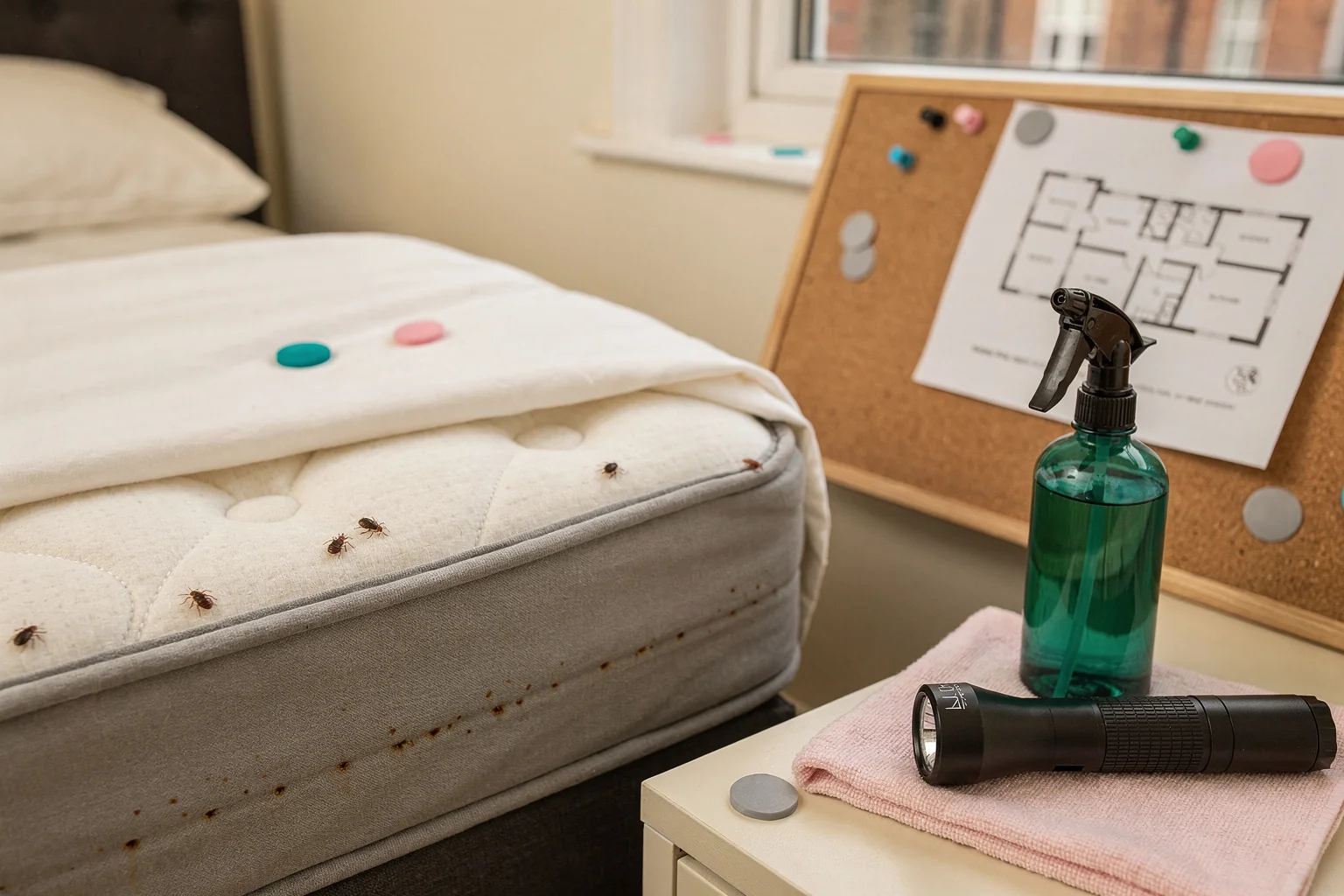
Bites alone aren’t enough to confirm bed bugs. You need physical evidence, and the best place to start is your mattress. Pull back the sheets and inspect the seams, tufts, and piping around the edges. Look for tiny dark spots — that’s bed bug excrement — about the size of a felt-tip pen dot. You might also find rust-coloured smears from crushed bugs, small pale eggshells, or the bugs themselves. Rub a damp cloth over a suspicious dark spot: bed bug excrement smears like an ink stain because it’s partially digested blood.
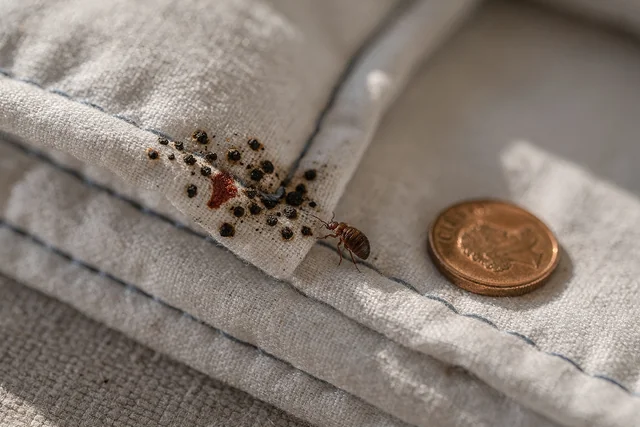
Don’t stop at the mattress. Bed bugs are called bed bugs for good reason, but they’ll happily settle into headboards, bed frames, bedside tables, and even the gap between the carpet and skirting board. Use a torch and a thin card (like a credit card) to probe cracks and joints; sliding the card along seams can dislodge eggs and nymphs. In a Hackney property — especially a Victorian conversion with exposed floorboards, original cornicing, or deep skirting board gaps — there are plenty of crevices for them to hide in. I know from inspecting many homes across East London that bed bugs often tuck themselves into the space where the carpet meets the wall, behind loose wallpaper, or inside unused electrical outlets.
If you’re checking a flat and want a systematic approach, I’ve compiled some early bed bug detection methods that apply just as well to Hackney homes. Catching them early makes removal much simpler, so take your time with this step. Here’s a quick inspection checklist for a typical Hackney bedroom:
- Mattress seams, tufts, and labels — run the card edge through each one.
- Headboard joints and the wall behind the headboard.
- Bed frame bolt holes and any wooden joinery.
- Skirting boards and carpet edges along the entire room perimeter.
- Inside drawers of bedside tables and chests of drawers — pull them out completely and inspect the slides.
- Curtain rod brackets and the top hem of curtains.
- Behind picture frames and mirrors hung on or near the bed wall.
- Inside electrical sockets (switch off the mains first if you need to unscrew the plate).
If you have a fabric bed valance, lift it up — you’ll often find evidence clinging to the underside. A handheld steamer can be useful here because the steam makes the bugs move, giving you a much clearer view of where they’re concentrated. Just move slowly: a rapid jet of steam can push bugs deeper into cracks.
At night, try setting an alarm for a couple of hours after you’d normally fall asleep. Wake up quietly, flick on a torch, and scan the headboard and pillow area. Live bed bugs are peanut-shaped, reddish-brown, and about the size of an apple seed. Seeing even one adult — or a shed translucent skin — is enough to tell you treatment is needed. Eggs are tiny, pearly white, and cemented into crevices; a magnifying glass helps.
Practical DIY Steps You Can Take Today
Once you’ve found evidence, your instinct might be to reach for a shop-bought spray. Before you do, focus on cleaning and containment. These steps won’t eliminate a deep infestation, but they reduce the number of bugs quickly and protect the rest of your home.
Strip and wash everything. Remove all sheets, duvet covers, pillowcases, and any removable covers. Wash on the hottest setting the fabric can handle (aim for 60°C or above) and tumble dry on high heat for at least 30 minutes. The combination of heat and mechanical action kills both bugs and eggs. If you have items that can’t be washed, a hot dryer alone can still do the job.
Vacuum relentlessly. Vacuum the mattress, box spring, bed frame, and surrounding floor thoroughly. Use the crevice tool to get into seams and joints. After finishing, remove the vacuum bag or empty the canister immediately, seal it in a plastic bag, knot it tight, and bin it outside your home. You don’t want any survivors crawling back out. Repeat this daily for at least a week while you monitor.
Encase the mattress and box spring. High-quality encasements have zippers with teeth so tight that bed bugs can’t squeeze through. They trap any bugs already inside and prevent new ones from getting in or out. Leave the encasements on for at least a year — bed bugs can survive months without feeding, and the encasement ensures they eventually die off. This alone can turn a chronic problem into a manageable one.
Steam what you can’t wash. A fabric steamer can treat the mattress itself, heavy sofa cushions, or curtains. Pass the steamer slowly over seams and creases; the steam temperature must be hot enough to kill on contact. Most home steamers just about reach the required range if you hold the nozzle close to the surface — move at a pace of about 30 cm per 10 seconds to let the heat sink in. Avoid holding it in one spot so long that you soak the fabric, which could encourage mould.
Isolate the bed. Pull the bed away from the wall so no bedding touches the skirting. Place bed bug interceptors — small plastic dishes — under each leg of the bed frame. They trap bugs trying to climb up and also serve as an early warning if the population persists.
Be cautious with over-the-counter insecticides. Many products sold for bed bugs aren’t strong enough to kill eggs, and misapplying them can scatter the bugs into deeper hiding spots, making a professional job harder later. Similarly, diatomaceous earth — a fine, abrasive powder — can kill bugs that crawl through it if applied as a thin dust in cracks, but it must be food-grade, used with a dust mask, and kept well away from pets and children. In my experience, the safest DIY approach is cleaning, heat, and containment while you assess whether the problem goes deeper.
When It’s Time to Call a Professional in Hackney
Some bed bug situations you can handle alone. Others call for an expert. Ask yourself these questions: Am I seeing live bugs every night, even after cleaning? Are the bites spreading to new parts of my body or to other family members? Have I found eggs or shed skins in multiple rooms beyond the bedroom? If any answer is yes, the infestation has likely moved beyond the “one hot wash can fix it” stage.
A single female bed bug can lay one to five eggs every day. After a few weeks, those eggs hatch and start feeding, so a small problem can escalate before your eyes. If you’ve been trying DIY methods for more than a fortnight and the signs aren’t reducing — the bites keep appearing, fresh dark spots show up despite cleaning — it’s time to bring in a technician. Professional treatments are designed to find and eliminate every life stage, including eggs that sprays can’t touch.
Hackney’s housing stock is full of terraced homes and flats where bed bugs travel through wall voids, pipe runs, and shared corridors. Treating one flat without checking the neighbours can lead to a cycle of reinfestation. That’s why a professional assessment that looks at the whole property makes a real difference. If you’re a tenant, under the Homes (Fitness for Human Habitation) Act 2018 you have a legal right to a home free of hazards including pest infestations, so report the problem to your landlord in writing as soon as you suspect bed bugs. The landlord should arrange treatment; if they don’t, the local council’s environmental health team can step in.
At BuzzKill Pest Control, we cover the whole Hackney area and our technicians carry RSPH Level 2 qualifications plus NPTA and BASIS PROMPT accreditation. That means we follow evidence-led treatment protocols, not guesswork. There’s no call-out charge, and we can often have someone with you the same day. If you’re weighing up whether to call, this guide on professional bed bug solutions walks through what makes a safe, effective treatment.
How Professionals Remove Bed Bugs – The Two Main Routes
When a pest controller arrives at your Hackney home, they’ll first run a thorough inspection — often more detailed than the one you did. They use torches, probes, and sometimes even bed bug-sniffing dogs to map the infestation. After that, the treatment plan usually follows one of two paths: heat or targeted insecticides.
Heat treatment raises the temperature in the infested room or whole property to a level that’s lethal to bed bugs and their eggs — typically around 56°C — and holds it there for several hours. Industrial heaters and high-velocity fans are positioned to push hot air into every crack and void, including behind skirting and inside furniture cavities. Because it’s chemical-free and penetrates deeply, many Hackney homeowners prefer it. The process is usually completed in a single day, though preparation matters: your technician will give you a list of items to remove — such as candles, aerosol cans, and electronics sensitive to prolonged heat — before treatment begins. For a closer look at why this method has gained ground, I’ve covered the details of East London bed bug removal and how heat compares to older chemical approaches.
The insecticide route uses carefully applied sprays and dusts at specific intervals. Modern products are formulated to have a residual effect, meaning they kill bugs that cross treated surfaces for weeks after the first application. A technician will target cracks, skirting boards, bed frames, and furniture joints. Because bed bug eggs are tough and insecticide may not always penetrate them, a professional usually schedules a follow-up visit about two weeks later to break the lifecycle — hatching nymphs encounter the residual deposit and die before they can reproduce.
Some cases benefit from a combination: a heat treatment for immediate knockdown, followed by a targeted insecticide barrier along skirting boards and entry points. The right choice depends on the layout of your home, the severity of the problem, and any sensitive equipment or materials present. Your technician will talk you through the options so you can make an informed choice. At BuzzKill, we often recommend heat for bedrooms where residents spend many hours, then reinforce it with a low-impact residual spray in hallways and communal areas of multi-occupancy buildings to stop bugs migrating from untreated units.
After treatment, you’ll be given clear instructions — like not vacuuming treated areas for a set period, keeping encasements on, and watching for any new signs. Most professional services, including ours, include a guarantee period: if anything reappears within that window, we come back at no extra cost. Preparation before the technician arrives is important too. You’ll typically need to bag and hot-wash all clothing and linens, move furniture slightly away from walls so all edges are accessible, and ensure pets and family members are out of the property during the treatment window.
Keeping Bed Bugs Away After Removal
Eliminating bed bugs once is stressful enough. You’ll want to make sure they don’t return. A few simple habits go a long way.
Be cautious with second-hand furniture. That chest of drawers on Gumtree that looks like a bargain could be carrying an unwanted passenger. If you do buy used furniture, inspect every joint, drawer cavity, and underside in good light before bringing it inside. A bed bug identification checklist can help you recognise all life stages — from the see-through nymphs to the sesame-seed-sized eggs. Never pick up discarded mattresses or upholstered furniture left on the street, however clean they appear.
When you travel, keep your suitcase on a luggage rack away from walls and the bed. After returning home, wash all clothes from the trip on a hot cycle and vacuum the suitcase before storing it. I know a few Hackney families who picked up bed bugs from hotels and then had to deal with bed bug travel prevention because a single fertilised female hitched a ride in their luggage. Once inside a Hackney flat, that one bug can start a colony in weeks.
At home, consider bed bug interceptors — small plastic dishes that slip under bed legs — to trap crawling bugs and provide an early warning. They’re cheap, chemical-free, and will catch any bugs attempting to reach you from the floor. If you live in a flat, maintain a good relationship with your neighbours and your landlord; mention any pest issues early so the whole building can be managed, not just one unit. When you move into a new rental, check the mattress seams and around the bed frame on moving-in day — it’s far easier to request treatment before you’ve unpacked.
Bites are unsettling, but they are also a clear signal that something needs attention — and that signal, caught early, is what prevents a small problem from growing into something that takes over whole rooms. If the steps above feel overwhelming or the bites keep appearing, that’s not a personal failing; it’s a sign to hand the job to someone who deals with bed bugs every day.
Need professional help? BuzzKill offers fast, reliable pest control services across London and Essex.