
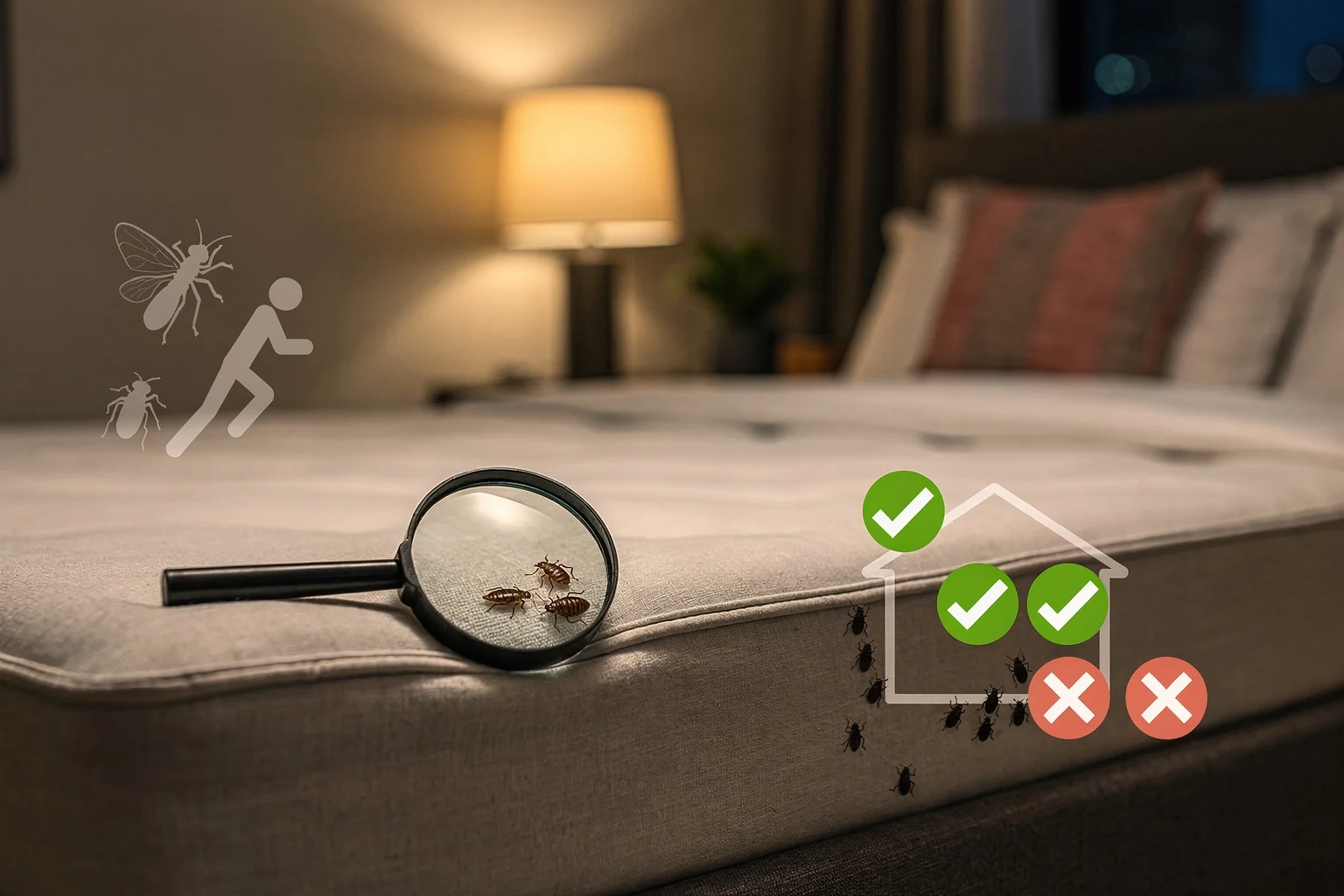
Bed bugs are back in the news across the UK, and the stories tend to follow the same pattern: someone wakes up with bites, panics, and starts searching for answers at 3am. The trouble is that most of what circulates online about these insects is wrong. Can they jump like fleas? Fly like mosquitoes? Does a spotless home protect you? The gap between what people believe and what actually happens costs London homeowners time, money, and sleep.
This article walks through the most persistent bed bug myths using a detailed field investigation as its starting point. Mark Rober's video Bed Bugs: What You've Been Told is Totally False takes viewers into actual infestations, runs experiments, and interviews entomologists who spend their careers studying these insects. The video is worth watching for the visual evidence alone — seeing how bed bugs move, where they hide, and how they respond to common treatments changes how you think about the problem.
Video: Bed Bugs- What You've Been Told is Totally False
What follows is not a transcript. It is a companion guide that verifies the video's claims against current UK pest-control practice, adds London-specific context, and fills in the practical details a five-minute watch cannot cover. If you are trying to work out whether you have bed bugs, whether your DIY plan will work, or when to call a technician, this is for you.
What Bed Bugs Actually Look Like and Why People Get It Wrong
The first myth begins with identification. Many people who call our technicians describe "tiny black dots" or "fast-moving spiders" and assume they cannot have bed bugs because the creature does not match the mental image. In reality, adult bed bugs are roughly the size and shape of an apple seed — about 5 to 7 millimetres long — with a flattened, oval body that reddens after feeding. Nymphs are smaller and paler, often almost translucent, which makes them easy to miss against light-coloured bedding.
Mark Rober's footage shows this clearly: the insects are visible to the naked eye if you know where to look. They are not microscopic. They do not burrow into skin. They do not have wings at any life stage. The bed bug identification checklist on our site breaks down the size and colour differences across life stages, which helps when you are staring at a suspicious speck on your mattress and trying to decide whether to call someone.
Misidentification matters because it leads to wrong treatment. Carpet beetles, bat bugs, and even lint balls have sent people buying insecticides they did not need. If you cannot confirm the insect, a £15 magnifying glass and a phone camera are better tools than a can of spray.
The Jumping and Flying Myths: How Bed Bugs Actually Move
This is where the myths get physical. Bed bugs cannot jump. They cannot fly. They do not have the leg structure of fleas or the wing development of mosquitoes. What they do have is a flat body that squeezes into gaps no thicker than a credit card, and they crawl surprisingly fast for their size — roughly one metre per minute on a flat surface.
Rober's video demonstrates this with slow-motion footage that looks almost lazy until you realise how quickly they cover ground when motivated by carbon dioxide and body heat. They climb. They fall. They navigate fabric weave and electrical outlets. They do not, however, launch themselves across a room.
The persistence of the jumping myth probably comes from confusion with fleas, which share the same habitat and bite pattern. If you see something spring off the mattress, you likely have a secondary pest. That distinction matters for treatment: flea protocols differ from bed bug protocols, and treating for the wrong insect wastes time while the real population grows.
For Londoners in dense housing — Victorian conversions, ex-council flats, new-build apartments with shared ducting — the crawling reality is actually worse than flying would be. Bed bugs travel through wall voids, along pipe runs, and under skirting boards. They do not need wings to reach your neighbour's bedroom.
Clean Homes, Dirty Homes, and the Real Reason Bed Bugs Arrive
Perhaps the most damaging myth is that bed bugs indicate poor hygiene. They do not. They never have. They are drawn to blood, not filth, and a five-star hotel room is as vulnerable as a cluttered bedsit. The difference is that high-turnover environments — hotels, hostels, short-term rentals — simply offer more opportunities for introduction.
Rentokil reported a 68% jump in UK bed bug treatments between 2022 and 2023, with hospitality accounting for much of the increase. The insects had been relatively rare in British hotels for two decades, but global travel patterns and pesticide resistance have reversed that trend. A single traveller can carry a fertilised female in a suitcase wheel or laptop bag, and the infestation begins before anyone notices a bite.
Paul Blackhurst, head of Technical Academy at Rentokil Pest Control, describes bed bugs as "silent assassins, emerging under cover of darkness, moving quickly, feeding at night, and hiding in the smallest cracks and crevices near where people sleep." By the time bites appear, the population may already be established.
This matters for how you respond emotionally. Shame delays action. People hide the problem, try secret remedies, and lose weeks while the insects spread. The truth is that bed bugs are a structural and travel risk, not a moral failing. Clean sheets, vacuumed carpets, and organised wardrobes do not prevent them — though clutter does make treatment harder by creating more hiding places.
DIY Traps and Home Remedies: What Actually Fails
The internet offers endless bed bug solutions: diatomaceous earth, essential oils, rubbing alcohol, hair dryers, mattress encasements as standalone fixes. Rober's video tests several of these under controlled conditions, and the results are sobering.
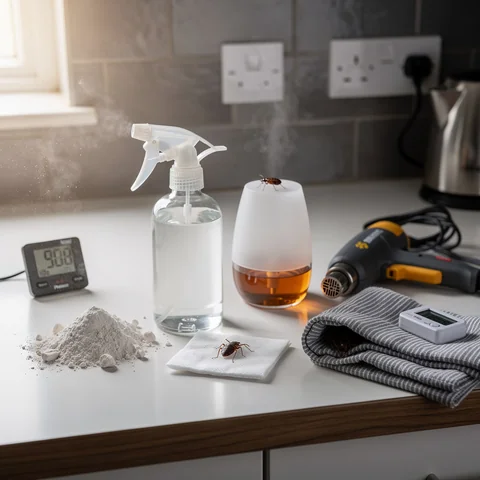
Alcohol sprays kill on contact but evaporate before reaching hidden insects. Diatomaceous earth works slowly — over weeks, not days — and becomes ineffective if damp, which is a problem in British bathrooms and kitchens. Essential oils may repel at high concentration but do not eliminate an established population. Hair dryers and heat guns raise surface temperature locally but cannot penetrate mattress seams, wall voids, or the inside of furniture where bugs aggregate.
The heat versus chemical treatment comparison explains why professional methods succeed where home attempts fail. Heat treatment raises the entire room — walls, furniture, textiles — to a temperature that denatures bed bug proteins, typically around 56°C sustained for a controlled period. Chemical treatment uses residual insecticides in combination with insect growth regulators. Both require training, equipment, and follow-up inspection.
A common pattern among callers in East London is the "almost worked" DIY attempt: someone buys a steam cleaner, treats the mattress, sees dead bugs, and assumes victory. Two weeks later, the bites return. The steam killed the adults on the surface but missed the eggs cemented into the bed frame joints. Those eggs hatch, feed, mature, and the cycle restarts. This is why our professional bed bug elimination treatments include follow-up visits as standard — not because the initial treatment failed, but because biology has a timetable that does not match human optimism.
Why Bed Bugs Are So Hard to Eliminate Without Professional Help
The biology that makes bed bugs difficult is not exotic. They reproduce quickly — a single female can lay 200 to 250 eggs in her lifetime. They feed roughly every five to ten days but can survive months without a blood meal in cooler conditions. They aggregate in harbourages, meaning the bugs you see represent a fraction of the population. And they have developed resistance to several classes of insecticide, including some pyrethroids that were standard treatment a decade ago.
Dr Richard Naylor, who has studied bed bugs for over two decades and runs a research lab near Chepstow, notes that product testing in realistic environments often reveals gaps between laboratory claims and field performance. The Bed Bug Foundation, which he co-directs, works with pest professionals to evaluate treatments in simulated bedrooms rather than petri dishes. This matters because a product that kills 100% of exposed insects in a glass vial may perform differently when those insects are deep inside a divan base.
For London properties, the structural complexity adds another layer. Period homes in Islington or Camden have original floorboards with gaps, fireplaces with voids, and plaster that crumbles behind skirting. New-builds in Stratford or Custom House have lightweight partition walls with continuous cavities. Both offer travel routes that surface-level treatment cannot reach. Our London bed bug removal methods account for these variations during the initial survey — something no over-the-counter product can do.
The Heat Treatment Question: When It Works and When It Needs Backup
Heat treatment has become the gold standard for bed bug elimination in many situations, but it is not universal. The heat treatment superiority evidence from our Greenwich coverage explains the mechanics: specialised heaters raise ambient temperature while fans circulate air to eliminate cold spots. Sensors monitor multiple points to confirm lethal temperature throughout the treatment zone.
The limitations are practical. Heat-sensitive items — wax, some electronics, certain medications — must be removed. The property needs preparation: decluttering, laundering textiles at high temperature, and sometimes removing items that insulate bugs from the heat. In multi-occupancy buildings, heat can drive insects into adjacent units if those spaces are not simultaneously treated or sealed.
This is why many professional jobs combine approaches. Heat for the rapid knockdown, residual insecticide for perimeter protection, and monitoring devices to confirm elimination. The East London bed bug treatments page details how we adapt this combination for the housing stock common in Tower Hamlets, Newham, and Waltham Forest — areas with high-density Victorian and interwar housing where infestations spread readily between units.
Signs That You Are Dealing with Bed Bugs Rather Than Another Pest
Knowing what bed bugs cannot do helps narrow the field, but positive identification still matters. The classic signs are:
- Bites in lines or clusters, often on exposed skin that touches the bed
- Small blood spots on sheets from crushed, fed bugs
- Dark faecal spots along mattress seams, bed frames, and nearby furniture
- Shed skins and egg cases in harbourage areas
- A sweet, musty odour in heavy infestations
Not everyone reacts to bites. Studies suggest 20 to 30% of people show no visible response, which means one resident can sleep undisturbed while another suffers. This creates confusion about whether the problem is real or imagined.
The bed bug bite warning signs article helps distinguish bed bug patterns from mosquito bites, which tend to be more random, and from flea bites, which cluster around ankles. For readers in specific boroughs, the early bed bug detection guide covers the particular risks of dense London housing where early signs often appear in shared areas before reaching bedrooms.
What to Do in the First 24 Hours of Suspecting Bed Bugs
Speed matters more than perfection in the early stage. The actions that help most are:
Inspect the sleeping area systematically. Strip the bed, check mattress seams with a torch and magnifier, examine the bed frame joints, and look behind the headboard. Bed bugs compress into remarkably thin spaces — the width of a credit card is the standard reference.
Launder bedding and recently worn clothing at 60°C minimum. Heat kills all life stages. Dry on high heat if the fabric allows.
Reduce clutter near the bed. Not because clutter attracts bed bugs, but because it removes harbourage and makes treatment more effective.
Avoid sleeping in a different room. This disperses the insects as they follow carbon dioxide, potentially creating new harbourages and making treatment more complex.
Document what you find. Photos of insects, bite patterns, and suspected faecal spots help technicians assess severity before arrival.
The Hackney bed bug removal steps page offers a borough-specific version of this sequence, adapted for the flat conversions and shared houses common in that area.
When Professional Treatment Becomes Necessary
There is a honest threshold here. A single bed bug, confirmed and caught early, might theoretically be eliminated with meticulous vacuuming, heat treatment of belongings, and weeks of monitoring. In practice, almost no one achieves this. The insects are too good at hiding, reproduction is too rapid, and confirmation of elimination is too difficult without professional tools.
The point at which most people call is when sleep disruption becomes unbearable, when bites multiply, or when DIY attempts have visibly failed. A better trigger is earlier: when you have confirmed the insect but before the population expands. This typically means within days of first suspicion, not weeks.
Professional assessment includes inspection with magnification, possibly canine detection for large or complex properties, and a treatment plan matched to the infestation level and property type. The Barking bed bug treatment options page shows how this works for a typical East London terrace or ex-council flat — the kind of property where bed bugs move easily between units and treatment needs to account for neighbouring risks.
For commercial properties — hotels, care homes, student housing — the threshold is lower still. A single confirmed room often triggers inspection of adjacent units, because the cost of delayed action exceeds the cost of precautionary treatment. The Housing Ombudsman has highlighted pest cases as a "significant learning opportunity" for landlords, with wider orders requiring root-cause analysis beyond individual complaints.
Reader Questions: Bed Bug Myths That Still Cause Confusion
Do bed bugs spread disease?
No. Unlike mosquitoes or ticks, bed bugs are not known to transmit pathogens to humans. The NHS confirms that while bites can itch and secondary infection can occur from scratching, bed bugs do not carry disease. The distress is real and the sleep disruption significant, but the health risk is mechanical rather than infectious.
Can bed bugs live in my hair or on my body?
No. Bed bugs are not adapted to cling to hair or skin. They feed and retreat to a harbourage. Body lice and head lice are different insects with different biology. If you feel crawling sensations without visible insects, other causes are more likely.
Will moving out for a few weeks starve them?
Adults can survive several months without feeding in cool conditions. A two-week holiday will not eliminate an established population. Worse, disturbed bugs may spread to neighbouring rooms or units seeking food.
Are mattress encasements enough on their own?
Encasements trap bugs inside and prevent new harbourage in the mattress, but they do not eliminate insects already in the bed frame, nearby furniture, or wall voids. They are a useful component of integrated treatment, not a standalone solution.
Does cold weather kill bed bugs?
British winter temperatures are not reliably cold enough to kill bed bugs in an unheated property. They survive freezing for short periods, and indoor heating often keeps them well above lethal thresholds. Controlled freezing with professional equipment works, but leaving windows open in January does not.
The Missing Detail Most Articles Skip
Here is what the video and most guides do not fully address: the psychological toll. Bed bug infestations produce anxiety that persists after elimination. People wake at imagined sensations. They inspect hotel rooms with military thoroughness. They discard belongings unnecessarily. This is normal and worth acknowledging.
The practical response is verification. After professional treatment, monitoring devices — interceptors under bed legs, periodic inspection — provide objective evidence that the insects are gone. Without this, the mind fills uncertainty with worst-case scenarios. Our technicians in Waltham Forest bed bug treatments and surrounding areas often schedule follow-up inspections specifically for this reassurance, not because they expect failure but because confirmation heals faster than assumption.
If you are currently searching at 3am, wondering whether that speck moved, whether the bite pattern matches, whether your home is clean enough to be exempt — you are not alone, and the uncertainty is the hardest part. The insects themselves are treatable. The myths are what make them feel impossible.

Need professional help? BuzzKill offers fast, reliable pest control services across London and Essex.