

This guide reveals the surprising non-bedroom locations where bed bugs hide, travel, and thrive in your home.
What if the most important step in finding bed bugs was looking everywhere except the mattress? It sounds strange, but it’s often true. While the bed is the most obvious place to start, the full story of where bed bugs live is much more complex. These pests are master hitchhikers and survivors, capable of setting up camp in almost any crack or crevice that offers darkness and easy access to a meal—you. This guide is your complete checklist for a whole-home inspection, taking you far beyond the bedroom to uncover every last potential hiding spot.
Key Takeaways
- Bed bugs aren't just mattress-dwellers; they inhabit any tight, dark space near where you sit or sleep.
- The most common hiding spots are actually in bed frames, headboards, skirting boards, and furniture joints.
- From the bedroom, they often spread to living rooms, hiding deep within sofas, chairs, and cushions.
- They can flatten themselves to hide behind loose wallpaper, picture frames, and even inside electrical sockets.
- Secondhand furniture is one of the main ways bed bugs get into a home in the first place.
- A systematic, room-by-room inspection is the only way to understand the true extent of the problem.
- Clutter gives them endless hiding places and makes it much harder for professionals to treat effectively.
- Pest control experts use a zonal approach, inspecting far beyond the obvious areas to ensure nothing is missed.
At a Glance
| Dimension | What Matters Most | Quick Read |
|---|---|---|
| Primary Zone | The bed frame, headboard, and box spring joints are the most common hideouts. | Start by checking all seams, screw holes, and corners of the bed's structure. |
| Secondary Zone | Bedroom furniture, curtains, carpets, and electrical outlets come next. | Inspect nightstands, wardrobes, and the wall space behind picture frames. |
| Spread Risk | Sofas and upholstered chairs in living areas are extremely vulnerable. | Any piece of furniture where people rest for long periods is a potential hotspot. |
| Travel Vectors | Luggage, backpacks, and secondhand items are their primary mode of transport. | Always inspect used furniture before you bring it into your home. |
| Key Evidence | Look for tiny black spots (fecal matter), shed skins, and, of course, live insects. | Use a bright torch and a credit card to probe tight crevices for these signs. |
| Professional Help | If the problem has spread beyond the bed, you'll need professional treatment for full removal. | Finding evidence in the living room means it's time to call an expert. |
What Are Bed Bug Harborage Points?
A bed bug "harborage" is simply any crack, crevice, or sheltered spot where these pests can hide out, rest, and reproduce. Despite their name, where bed bugs live is determined by opportunity, not a love for mattresses. They are looking for dark, undisturbed locations that are ideally within a few metres of where a person sleeps or rests for hours at a time.
Understanding what a harborage is—and what it looks like—is crucial. Treating only the mattress is one of the most common reasons people see a problem come right back. According to the British Pest Control Association (BPCA), bed bugs are particularly drawn to wood and fabric surfaces. Their bodies are incredibly flat, which allows them to squeeze into gaps as thin as a credit card. This is why a proper inspection has to include everything from furniture joints and floorboard cracks to the spines of hardcover books on your nightstand.
Framework Overview: The Four Zones of Inspection
To find every last hiding spot, you have to think like a professional. We use a zonal approach, starting from the primary sleeping area and working our way outwards. This systematic method ensures no stone is left unturned and accounts for the fact that bed bugs will expand their territory as their numbers grow or if they're disturbed by a failed treatment attempt.
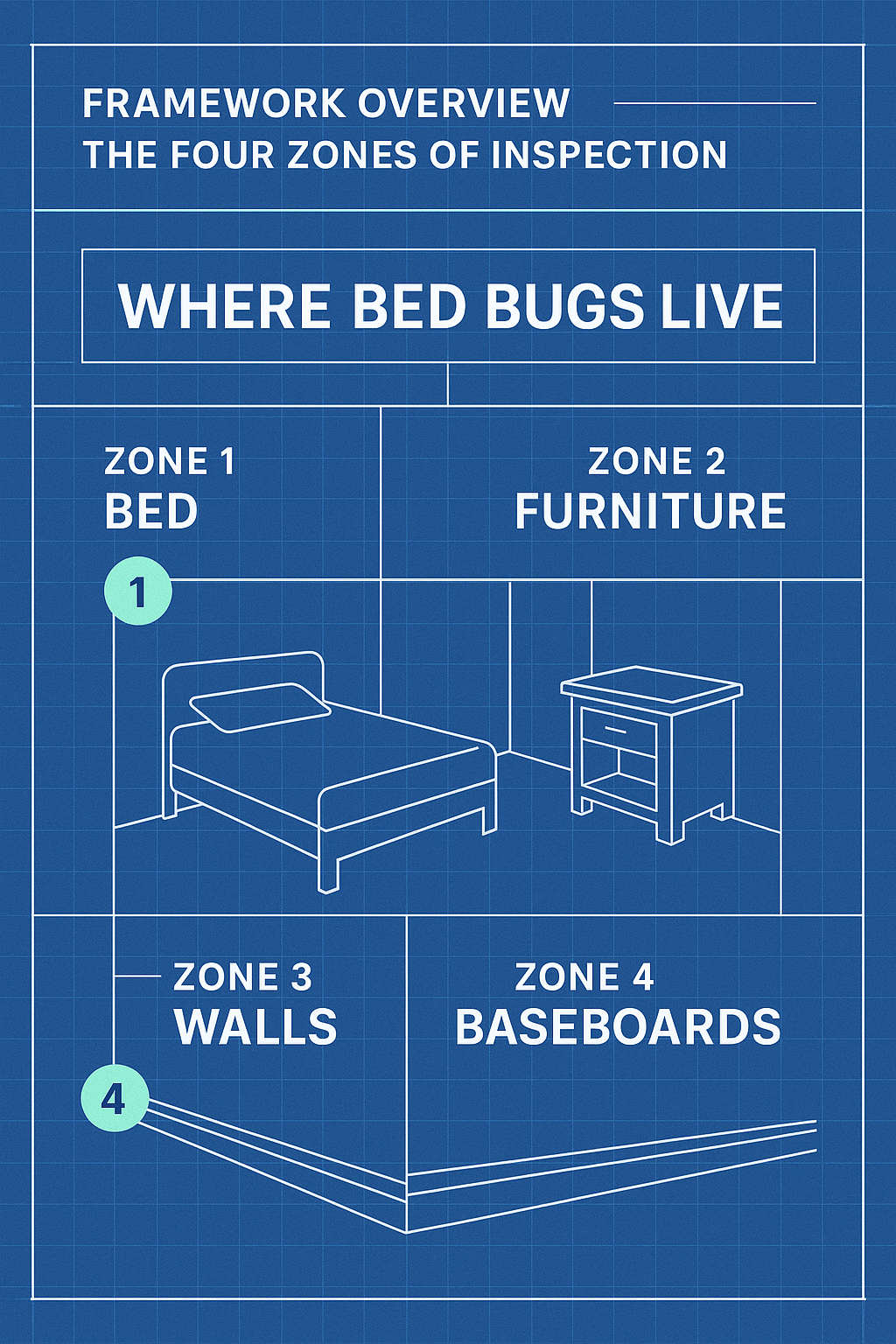
- Zone 1: The Bed and Immediate Area. This is ground zero. It includes the mattress, box spring, bed frame, and headboard. It’s the most likely place to find the first signs of a problem and is always where an inspection begins.
- Zone 2: The Rest of the Bedroom. This zone covers every other item in the room: nightstands, wardrobes, chests of drawers, curtains, carpets, skirting boards, and even electrical outlets.
- Zone 3: Adjacent Rooms and Living Areas. Bed bugs are surprisingly mobile and can easily travel to other rooms. This zone focuses on sofas, upholstered chairs, cushions, and other furniture in living rooms or studies where people relax.
- Zone 4: Entry Points and Unique Hideouts. This final zone covers the less common but critical areas. Think luggage, backpacks, secondhand items you've brought in, wall voids, and even electronics.
Key Terms
| Term | Plain-English Meaning | Why It Matters |
|---|---|---|
| Harborage | A crack or crevice where bed bugs hide. | Finding and treating every single harborage is the only way to solve the problem. |
| Aggregation | A cluster of bed bugs, including adults, nymphs, and eggs. | Finding an aggregation point usually means you have a significant, breeding population. |
| Fecal Spots | Small black or dark brown stains left by bed bugs after feeding. | These inky spots are a clear sign of bed bug activity, even if you can't find a live bug. |
| Instar | A developmental stage for a young bed bug. | A bed bug has to shed its skin five times (molt) before it becomes a breeding adult. |
| Cast Skins | The empty, see-through skins shed by growing bed bugs. | Finding these confirms that a breeding population is present and growing. |
| Thigmotaxis | An organism's instinct to seek out contact with surfaces. | Bed bugs are positively thigmotactic, which is why they cram themselves into tight spaces. |
| Nocturnal | Active mostly at night. | This is why you rarely see them during the day, unless the population is very large. |
| Vector | An item that transports pests from one place to another. | Luggage and used furniture are the most common vectors for bringing bed bugs home. |
Zone 1 & 2: Beyond the Mattress and box spring
The mattress might be the first place you look, but in a long-term problem, it's often one of the least populated areas. Bed bugs prefer solid, unmoving structures over the shifting surface where you sleep. To do this part of the inspection right, you'll need a bright torch and something thin and stiff, like a credit card or loyalty card.
H3: The Bed Frame and Headboard
This is the real epicentre of most bed bug problems. If you can, dismantle the bed frame completely. It might feel like a lot of work, but it's the only way to be sure. Pay extremely close attention to the joints, corners, and any screw holes, as these are prime real estate for bed bugs. If you have a wooden frame with slats, take each one out and inspect the plastic or wooden holders they sit in. These little nooks are perfect hiding spots.
Headboards, especially ones fixed to the wall, create a dark, undisturbed void that bed bugs love. Carefully remove the headboard and inspect both the back of it and the section of wall it was covering. You're looking for live bugs, pale cast skins, and the tell-tale black fecal spots that look like someone dotted the surface with a black marker pen.
H3: Bedroom Furniture and Storage
Every piece of furniture near the bed is a potential secondary base of operations. Start with your nightstands and chests of drawers. Empty them completely, then take the drawers all the way out. Inspect the interior corners, the joints, and the metal drawer runners. Then, turn the entire piece of furniture upside down. Check the underside, the feet, and any screw holes or cracks in the wood or laminate.
Wardrobes need a similar check, especially along the back panel and in the top and bottom corners. While less common, bed bugs can tuck themselves into the folds of clothing, so it's worth being cautious. For a more detailed look at what you're searching for, our guide on the signs of bed bugs can give you a visual reference.
H3: Skirting Boards, Sockets, and Walls
This is where so many DIY treatments go wrong. Bed bugs will happily use the tiny gap between the skirting board and the wall or floor as a hidden highway to travel around the room. Take your credit card and gently run the edge along this gap. This can dislodge hiding bugs or smear any fecal matter, making it visible.
Electrical sockets and light switches offer a warm, dark, and completely protected void. A word of caution: never poke anything metallic into a socket. As part of a professional treatment, a qualified technician from a company like BuzzKill Pest Control can safely remove the faceplate to inspect and treat the cavity behind it. Don't forget to check behind picture frames, wall-mounted clocks, and mirrors. You should also look for any areas where wallpaper might be peeling or bubbling, as they can hide underneath.
Zone 3: How Bed Bugs Spread Through Your Home
It's a common myth that bed bugs will just stay put in the bedroom. Once a population gets large enough, or if it's disturbed by ineffective "bug bomb" foggers, it will start to migrate. Their goal is simple: find another safe harborage close to a food source. Very often, that means your living room sofa.
H3: Sofas, Armchairs, and Upholstery
After the bed frame, upholstered furniture is the second most common place to find bed bugs. The way a sofa is built offers an almost endless supply of hiding spots: the seams and piping, the deep tufts in the fabric, inside cushion zippers, and within the dark, hollow frame itself.
To inspect a sofa properly, you need to be methodical. First, take off all the cushions. Check the zippers and run your fingers along every seam, feeling for anything unusual. Next, with a helper, turn the sofa or armchair completely over. You'll likely see a thin fabric dust cover stapled to the underside. Carefully peel this back or remove it entirely. This will expose the internal wooden frame, the springs, and all the joints—this is where the core of a living room infestation is often found. Skipping this step means you could miss the entire problem.
H3: Other Living Room Items
Don't just stop at the sofa. Bed bugs can and will hide in other parts of your living space. Inspect your curtains and curtain rods, paying special attention to the pleats and folds of fabric at the top. Check the seams and undersides of any rugs, as well as the perimeter of fitted carpets where they meet the skirting boards.
Bookshelves are another surprising spot. Bed bugs have been found hiding in the spines of hardcover books, especially those left undisturbed for a long time. Any clutter, like stacks of magazines, newspapers, or storage boxes, provides more harborage points and should be carefully sorted through and inspected. A tidy, clutter-free home is always much easier to inspect and treat.
Zone 4: Unlikely Hiding Spots and Travel Routes
Understanding where bed bugs live also means understanding how they got into your home in the first place. They are passive travellers, which means they rely on us to give them a lift from one place to another. That's why a complete inspection has to include the items that travel with you.

H3: Luggage, Backpacks, and Purses
Hotels are a notorious source of bed bugs, and your luggage is their first-class ticket into your home. After any trip, you should always inspect your suitcase before bringing it into the bedroom. A great tip is to place it in a dry bath or shower stall; the white surface makes any dark bugs easy to spot. Go over every seam, pocket, and zipper with your torch.
And it's not just holiday luggage. Backpacks used for commuting on public transport, work laptop bags, and even handbags can pick up stowaways in offices, cinemas, or on buses and trains. Bed bugs can survive for months without feeding, according to NHS guidance, so a single bug picked up weeks ago can easily be the start of a brand new infestation.
H3: Secondhand Furniture and Deliveries
Bringing secondhand furniture into your home is one of the riskiest things you can do when it comes to bed bugs. You should always assume that any used item—especially bed frames, mattresses, or sofas—could be carrying them. No matter how much of a bargain it was, conduct a meticulous inspection outdoors or in a garage before it crosses your threshold.
While it's less common, even brand-new furniture can provide temporary harborage for bed bugs. During transit from a warehouse or showroom, items can come into contact with an infested environment, such as a delivery vehicle that also transports old mattress disposals. When this happens, bed bugs will quickly find a place to hide on the new item. The most common places bed bugs live on new deliveries are within the folds of protective plastic wrapping, deep inside the corrugation of cardboard packaging, or tucked into the external seams and structural joints of the furniture. A thorough inspection of these specific hiding spots before bringing the item into your home is a crucial preventative step.
Lifecycle and Behaviour: Why They Hide Where They Do
A bed bug's entire life is driven by a few simple instincts: feed, hide, and reproduce. Their preference for tight spaces (a behaviour called thigmotaxis) makes them feel safe and secure from predators. They hide together in groups called aggregations, which can contain a mix of adults, younger nymphs, and eggs.
They are drawn to the carbon dioxide we exhale, which is how they know to emerge at night when we are still and breathing deeply in one place. After feeding for about 5-10 minutes, they retreat back to their harborage to digest their meal, mate, and lay eggs. A single adult female can lay 1-5 eggs every single day, which shows just how quickly a small problem can spiral out of control. This rapid lifecycle is what makes finding every last hiding spot so critical for successful bed bug removal.
Expert Tips
- The Credit Card Test: Slide a credit card or a similar thin, stiff object along furniture seams, joints, and the gap under skirting boards. This simple action can physically push out hiding bugs, eggs, or fecal deposits, making them visible. It's a low-tech but surprisingly effective trick.
- Isolate the Bed: After you've done a thorough inspection and clean, you can place bed bug interceptors under each leg of the bed. These are small, specially designed plastic dishes that trap bugs trying to climb up or down from the bed frame. They won't solve the problem, but they're a great tool for monitoring activity.
- Use a Steamer: A dry steamer that produces high-temperature steam can be a great tool for treating items you can't easily spray with insecticide, like the surface of a mattress, a sofa, or a child's soft toys. The intense heat kills bed bugs and their eggs instantly on contact.
- Reduce Clutter Permanently: Clutter is a pest's best friend. By getting rid of unnecessary clutter around your home, especially in the bedroom, you eliminate hundreds of potential hiding spots. This makes future inspections and any necessary treatments much faster and more effective.
- Don't Immediately Throw Things Out: A common reaction to finding bed bugs is to panic and drag the mattress or sofa out to the curb. This is often unnecessary, can be very expensive, and risks spreading the bugs through hallways and common areas as you move it. Most items can be successfully treated by a professional.
Real-World Scenarios
Scenario 1: The University Student Sarah, a university student, came home to her family in Essex for the holidays. A few weeks later, her parents started getting mysterious bites. A thorough inspection revealed the source wasn't anyone's bed, but the fabric backpack Sarah used for lectures. She always dropped it on the living room sofa when she came home, and the bugs had simply crawled out and moved into the sofa cushions.
Scenario 2: The Secondhand Bargain Mark was thrilled with the vintage wooden chest of drawers he bought online for his East London flat. He gave it a good wipe-down but didn't think to inspect the joints. Two months later, he had a major infestation. The bugs had been dormant deep inside the cabinet's dovetail joints and only emerged once they sensed a human sleeping nearby every night.
Scenario 3: The Office Transfer An office building had a bed bug problem that was contained to one department. An employee, completely unaware, had a few bugs cling to their coat. They didn't have an issue in their bedroom at all. The problem started in their hallway coat closet, where the bugs eventually migrated to a nearby armchair in the lounge, starting a new infestation there.
Common Mistakes to Avoid
- Focusing Only on the Mattress: This is the single biggest mistake people make. As this guide shows, the bed frame, surrounding furniture, and even the structure of the room itself are far more likely to be the real heart of the problem.
- Using "Bug Bombs" or Foggers: These over-the-counter products are almost completely useless for bed bugs. The aerosol insecticide rarely gets into the deep cracks where they hide. Worse, the irritating fog often acts as a repellent, causing them to scatter and spread deeper into your home, making the problem harder to solve.
- Moving Items Between Rooms: Taking a lamp, clock radio, or book from an affected bedroom into another room is the perfect way to start a brand new colony. Any items from a room with bed bugs should be sealed in plastic bags and inspected or treated carefully before being moved.
- Ignoring the Early Signs: It can be easy to dismiss a single bug or a few unexplained bites as a one-off. But given how quickly they reproduce, early detection and swift action are absolutely crucial to preventing a much larger, more stressful, and more expensive problem down the line.
- Trying to DIY a Large Problem: While a very minor issue caught extremely early might be handled with a lot of diligent work, an infestation that has spread beyond the bed requires professional expertise. Our technicians have the training, experience, and specialised equipment to find every harborage and apply treatments that are both safe and effective.
How to Prepare with BuzzKill Pest Control
If you've found evidence of bed bugs, we know how stressful it can be. Taking a few simple preparatory steps can make the professional treatment we provide more effective and efficient. At BuzzKill Pest Control, our entire focus is on giving you a guaranteed solution with as little disruption to your life as possible.
First, please do not move items out of the affected rooms. It’s a natural impulse, but our RSPH Level 2 qualified technicians need to see the environment as it is to conduct an accurate survey. Moving things around can spread the problem and make it much harder for us to identify all the harborage points.
Second, if you can, reduce clutter. Place loose items like books, clothes, and papers from floors and furniture surfaces into sealed plastic bags. This clears the way and exposes key treatment areas like skirting boards and furniture legs. Our team will give you clear, simple instructions on how to safely deal with the contents of these bags.
When you call us for a same-day appointment, we start with a comprehensive inspection based on the same zonal framework in this guide. We check all the high-risk areas to understand the full scope of the issue. This allows us to create a targeted treatment plan, often using a combination of professional-grade insecticides and heat treatments to make sure the problem is solved completely. We're committed to using methods that are safe for your family and pets, giving you total peace of mind.
Frequently Asked Questions
Can bed bugs live in your hair or on your body? No, thankfully. Unlike lice, bed bugs do not live on their hosts. They visit for a quick meal (5-10 minutes) and then retreat to their hiding places. Their bodies are not designed to live in hair or on skin.
Where do bed bugs live in a car? It's not common, but it can happen. In a car, bed bugs can live in the seams of the seats, under the floor mats, inside the glove compartment, or in the boot—especially if you frequently transport luggage. A car's interior offers plenty of suitable cracks and crevices.
Can bed bugs live in walls? Yes, in a heavy or long-standing infestation, bed bugs can get into wall voids. They can travel along electrical wiring and plumbing, which is often how they move between flats in an apartment building.
Do bed bugs live in clothes in a wardrobe? While they much prefer solid, unmoving hiding places, they can hide in the folds of clothes, especially in a cluttered wardrobe. Items that aren't worn very often are at greater risk. A hot wash cycle (60°C) and a hot tumble dry will kill any bugs or eggs on clothing.
How do you check a hotel room for bed bugs? The moment you arrive, place your luggage in the bathroom (on the tiles, not a mat). Then, pull back the bed sheets and use your phone's torch to inspect the mattress seams, especially around the head of the bed. After that, check the headboard, the bedside tables, and any nearby chairs before you even think about unpacking.
Can you have bed bugs in just one room? Yes, if an infestation is caught very early, it might be confined to a single room. However, because they are so prone to spreading, a professional inspection of the adjacent rooms is always a good idea to be absolutely certain.
What to Read Next
Now that you have a much clearer picture of where bed bugs hide, the next step is to understand the different ways to get rid of them. Learning about the pros and cons of chemical treatments, heat treatments, and integrated pest management will help you have a more informed conversation with a professional. You can explore these strategies in our guide on how to get rid of bed bugs effectively.
The Bottom Line
The key to winning the battle against bed bugs is knowledge. When you understand that their world is much bigger than your mattress, you can inspect your home more effectively and appreciate why professional treatment is so thorough. Remember to think in zones, check every last crack and crevice, and be mindful of the routes they use to get into and move through your home. Finding a small problem early is infinitely easier and less stressful to solve than a widespread one discovered late. If you have even the slightest doubt, getting a professional survey is the fastest way to get a clear answer and a solid plan for taking back your home.
Related Blog Posts
- The Telltale Signs of Bed Bugs You Might Be Missing
- How to Get Rid of Bed Bugs: A Complete Guide
- Professional Pest Control Services for Your Home
Need professional help? BuzzKill offers fast, reliable pest control services across London and Essex.