
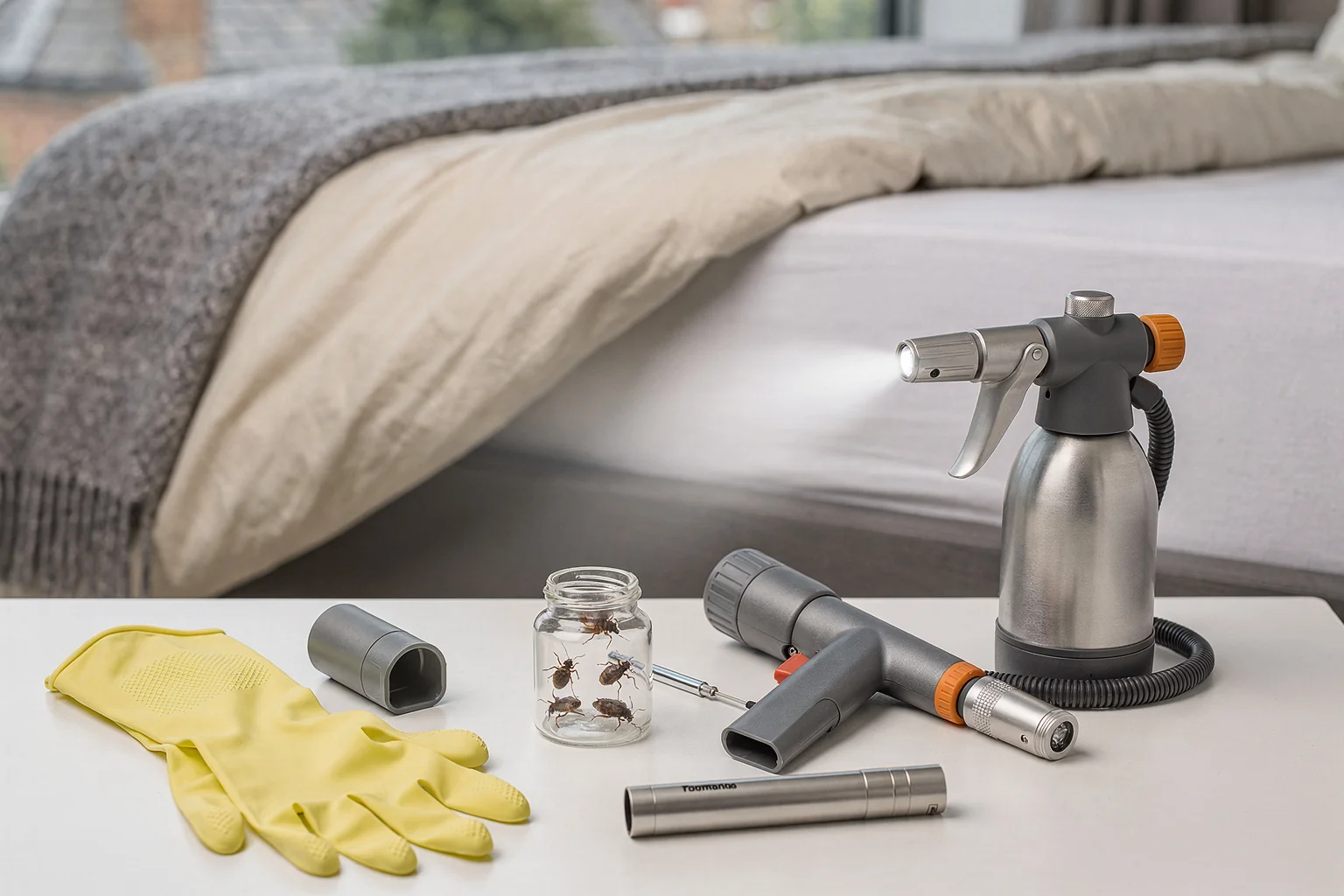
When a bed bug problem hits a home in Hornchurch, Upminster, or Romford, the first instinct is usually a dash to the nearest shop. A tin of insecticide, a plastic mattress cover — it feels like action. More often than not, it’s the fastest way to turn a small, contained issue into a whole-house challenge. The bugs don’t die; they scatter. And by the time we walk through the door, a problem that might have been solved with a single targeted visit now demands a much larger effort.
Many Havering homeowners call us after two or three rounds of shop-bought products. The same frustration comes through every time: “I’ve tried everything, and they keep coming back.” The underlying truth is simple enough. Over-the-counter sprays kill the adults they touch, but bed bug eggs are practically bulletproof. A single surviving egg cluster, tucked inside a skirting board gap or behind a loose wallpaper edge, restarts the whole cycle in under two weeks.
The good news for anyone searching for the best bed bug removal Havering can offer is that professional methods have moved on considerably over the past decade. You now have at least six distinct, evidence-backed solutions to choose from, each with a clear role, timeline, and cost bracket. None of them involve tea-tree oil. I’ve ordered the six below by how reliably they kill every life stage — egg, nymph, and adult — without requiring you to throw away half your furniture. All of them sit well above anything you can do on your own, but the differences matter when you’re deciding where to put your money.
Whole-Room Heat Treatment: The Most Reliable Option
If you ask a technician to name the method with the highest one-shot success rate, the answer is almost always heat. The principle is straightforward: raise the temperature of an entire room to a level where bed bugs cannot survive, hold it there for several hours, and you kill every egg, nymph, and adult in a single session. No chemical residue, no repeat visits to mop up stragglers, and no guessing which crack a female chose for her next batch of eggs.
In a typical Havering terraced house, a professional crew brings in industrial heaters and fans that push the air to between 50°C and 60°C. The heat penetrates soft furnishings, mattress seams, box springs, and even the hollow voids inside bed frames. If it can hide there, it cooks there. The process usually takes six to eight hours from setup to pack-down, though you’ll need to vacate the property for the day. The main hassle is the preparation: removing anything that would melt or explode — aerosols, candles, some electronics, indoor plants — and pulling furniture away from walls so the air can circulate. A decent provider gives you a clear checklist ahead of time.
The common mistake? Trying to replicate it with a domestic fan heater or a wallpaper stripper. Bed bugs can sense a local heat rise and will retreat deeper into walls and subfloors long before the temperature becomes lethal. You end up driving the infestation into the structure of the building, which is the last thing you want.
Heat works best in a home where you need to be clear of bed bugs quickly and don’t want to bin mattresses or soft furniture. It is also the top choice for landlords and letting agents in Havering who need a property re-let without delay. The main limitation is cost: expect to pay more than a chemical-only treatment, though you should weigh that against the fact that one heat session often replaces two or three spray visits. If you’re comparing options, our own team uses this method routinely across Havering because it delivers a guaranteed result in the shortest calendar time. It’s not the cheapest line on an invoice, but it’s the one that ends the problem fastest.
Residual Insecticide Spraying: The Established Workhorse
Chemical spraying remains the most widely offered bed bug treatment across the UK. Unlike the contact killers in a shop-bought can, professional-grade residual insecticides leave a dried film on surfaces that stays active for several weeks. Bed bugs crossing that film absorb a fatal dose, including newly hatched nymphs that appear days after the first application. So you’re not just killing the visible adults; you’re creating a barrier that catches the next wave before it can bite.
A proper spray treatment always starts with a thorough survey. A technician moves furniture, lifts carpet edges, unscrews electrical faceplates, and works insecticide into every crack, seam, and junction where bed bugs travel. In Havering homes with fitted wardrobes or panelled headboards, that can take a good couple of hours. One treatment is rarely enough for a full clearance. Standard practice calls for two or three visits, spaced about a fortnight apart, to intercept eggs that hatch after the first round. This is a method built on patience, not a single dramatic day.
The biggest mistake I see is people confusing a professional treatment with the aerosol from a supermarket. Professional products contain a mix of adulticides and insect growth regulators that disrupt the bed bug’s ability to mature and reproduce. Shop-bought cans don’t. If you’ve already sprayed something yourself, tell your technician before they start — some household chemicals can interfere with the residual film and make the professional product less effective.
Chemical spraying suits situations where heat is impractical: rooms with lots of delicate electronics, high-end antiques, or where the building’s power supply simply cannot handle the electrical load of industrial heaters. It also costs less upfront, which matters when you’re managing a tight budget. The trade-off is time and disruption: you’ll need to move furniture away from walls before each visit, and you’ll live with the knowledge that bed bugs may still be present between appointments. For a more detailed comparison of how these two main approaches stack up, we’ve written about East London bed bug treatments that dive into the cost and speed differences.
Canine Detection + Targeted Treatment: Stopping the Guesswork
Here’s a scenario we see at least once a month. A family in Rainham or Elm Park brings in a technician, pays for a full-room spray, and two months later the bites return — in a completely different bedroom. The original infestation wasn’t truly gone; it was simply hiding somewhere the human eye missed. That’s precisely where bed bug sniffing dogs change the game.

Detection dogs, usually Beagles or working Cocker Spaniels, are trained to pinpoint live bed bugs and viable eggs with an accuracy that outperforms visual inspection by a wide margin. A dog can sweep a three-bedroom house in under twenty minutes, sniffing out hot spots behind skirting boards, inside wardrobe corners, or along the seams of a box spring that looks clean to you and me. The dog doesn’t chase dead casings or old faecal spots — it targets the live insects.
What makes this a stand-alone solution isn’t the dog alone. It’s the pairing of canine detection with a precisely targeted treatment afterwards. Instead of spraying every square metre of floor and wall, a technician can concentrate the insecticide (or steam, or dust) into the few square metres that actually harbour bugs. The result is less chemical in your home, a shorter treatment session, and a lower chance of missing that one clutch of eggs tucked inside an electrical conduit.
The limitation is availability. Not every pest control firm in Havering has a canine unit on call. When you do find one, expect to pay a premium for the dog’s time — between £150 and £300 for the sweep is typical. But if you’ve had a failed treatment before, that investment often pays for itself by avoiding repeated whole-room applications. We often recommend canine sweeps after a bed bug incident in a multi-occupancy building, where you need to prove an infestation is gone before a flat can be reoccupied. It’s also worth remembering that a dog is a detection tool, not a removal method on its own; you still need a treatment plan to finish the job.
High-Pressure Steam: Scalpel-Like Precision for the Right Spots
Steam is the professional’s detail tool. It uses water heated past boiling point, expelled under pressure through a fine nozzle, to deliver instant, lethal heat on contact. Unlike whole-room heat, steam is local — you aim it at a mattress button, a bed frame joint, or a curtain hem. A single pass kills eggs, nymphs, and adults in seconds. No chemicals, no drying time, minimal disruption to the rest of the room.
For a parent in Havering whose child’s bedroom has a bed bug cluster but the rest of the house is clear, steam can be the perfect targeted answer. Professional-grade machines produce dry steam with low moisture content, so there’s no soaking of fabrics or risk of mould. A technician works inch by inch, following the path of greatest risk: the mattress piping, the back of the headboard, the skirtings closest to the bed. The visual reassurance is real — you can see the work happening right in front of you.
The flip side is that steam is extraordinarily labour-intensive. A full bed frame can take over an hour, and the technique demands patience and skill. Move the nozzle too fast, and you miss the kill temperature; too slow, and you risk blowing live bugs off the surface rather than destroying them. This is not a job for a handheld clothing steamer from a catalogue. The temperature drop-off between a domestic gadget and a professional unit is the difference between a bed bug that dies and one that simply jogs to the next room.
Steam excels as part of a combination treatment. After a heat treatment or chemical spray has addressed the main area, a technician may follow up with steam to hit a stubborn seam or a piece of furniture that can’t be moved. It also works well for people who want a chemical-free approach but can’t tolerate the full-room heat process. The main limitation is that steam cannot reach insects deep inside wall cavities or floor voids; it only kills what it can directly touch.
Diatomaceous Earth Dust: The Slow, Chemical-Free Assistant
Diatomaceous earth doesn’t poison bed bugs. It cuts them. The powder is made from fossilised algae, ground into a fine dust whose microscopic edges slice the waxy coating on a bed bug’s exoskeleton. Without that coating, the insect loses moisture and dies of dehydration over a few days. The effect is physical, not chemical, meaning bed bugs cannot develop resistance to it — a real advantage over some insecticides.
This method works best as a defensive, long-acting barrier rather than a frontline assault. A technician will puff a thin layer of food-grade diatomaceous earth into cracks, behind skirting boards, inside light switches, and along the inner edges of wardrobes. Bed bugs crossing these treated zones pick up the dust and carry it back to their hiding spots, gradually collapsing the colony. Because it’s inert and non-toxic to mammals, it’s a popular choice for households with pets, small children, or anyone sensitive to chemicals.
The trade-off is patience. Diatomaceous earth might take two to four weeks to fully suppress a moderate infestation, and it rarely wipes out a heavy one on its own. It’s dusty, it can irritate airways if applied too heavily, and it’s useless on vertical surfaces or smooth metals where it won’t stick. I often see it used as a follow-on maintenance step after a heat or spray treatment — a final security layer that makes it harder for any wanderers to re-establish.
Structural Fumigation: The Nuclear Option You’ll Hardly Ever Need
Structural fumigation involves sealing a building inside a gas-tight tent and releasing a penetrating gas, typically sulfuryl fluoride, that fills every void and kills every living stage of a bed bug right down to the egg. It is the only method that can legitimately claim to reach 100% of the insects in a single go, because the gas gets into wall cavities, under floorboards, and even inside electronics. No other technique matches that completeness.
The reality for a Havering residential property, though, is that fumigation is hardly ever the right call. The preparation is enormous: all food, plants, pets, and people must leave for several days. Gas monitoring lines need to be run, neighbours have to be informed, and the property must be aerated thoroughly afterwards. The cost runs into the thousands, and few pest control companies in East London own the kit or hold the licence to carry it out. I’ve only seen it used twice in a domestic context in ten years — once for a severe, long-standing infestation in a large listed building, and once after a reinfestation that kept returning despite every other method.
This is not a solution for a flat in Romford with a handful of bites. It’s the industrial backup option, the one you reach for when all else has truly failed or when a commercial site simply cannot tolerate any margin of error. For any typical Havering home, the first five methods on this list will get you to the same result with far less cost and upheaval.
Don’t Let the Smallest Sign Turn Into a Whole-House Problem
Bed bugs don’t negotiate. A single female, fertilised once, can lay 200 to 500 eggs over her lifetime, and each egg hatches into a nymph ready to bite in as little as six days at room temperature. The window between “I noticed something on the mattress” and “they’re in three rooms” is often just a few weeks. That’s why the most impactful decision isn’t which treatment you pick — it’s how quickly you get a professional inspection. A thorough survey takes under an hour, and in Havering you can ordinarily book one for the following day.
Whether you lean towards the speed of whole-room heat, the thoroughness of a dog-assisted targeted plan, or a staged chemical programme, the common thread is this: professional tools and training bridge the gap between what you can see and what is actually hiding inside your skirting boards, bed frames, and electrical sockets. The moment you move past shop-bought products and into a structured plan, you change the odds from repeated frustration to genuine, auditable control. That’s the point where a bed bug problem stops being a story you tell the neighbours and becomes an invoice you pay and forget.
Need professional help? BuzzKill offers fast, reliable pest control services across London and Essex.