
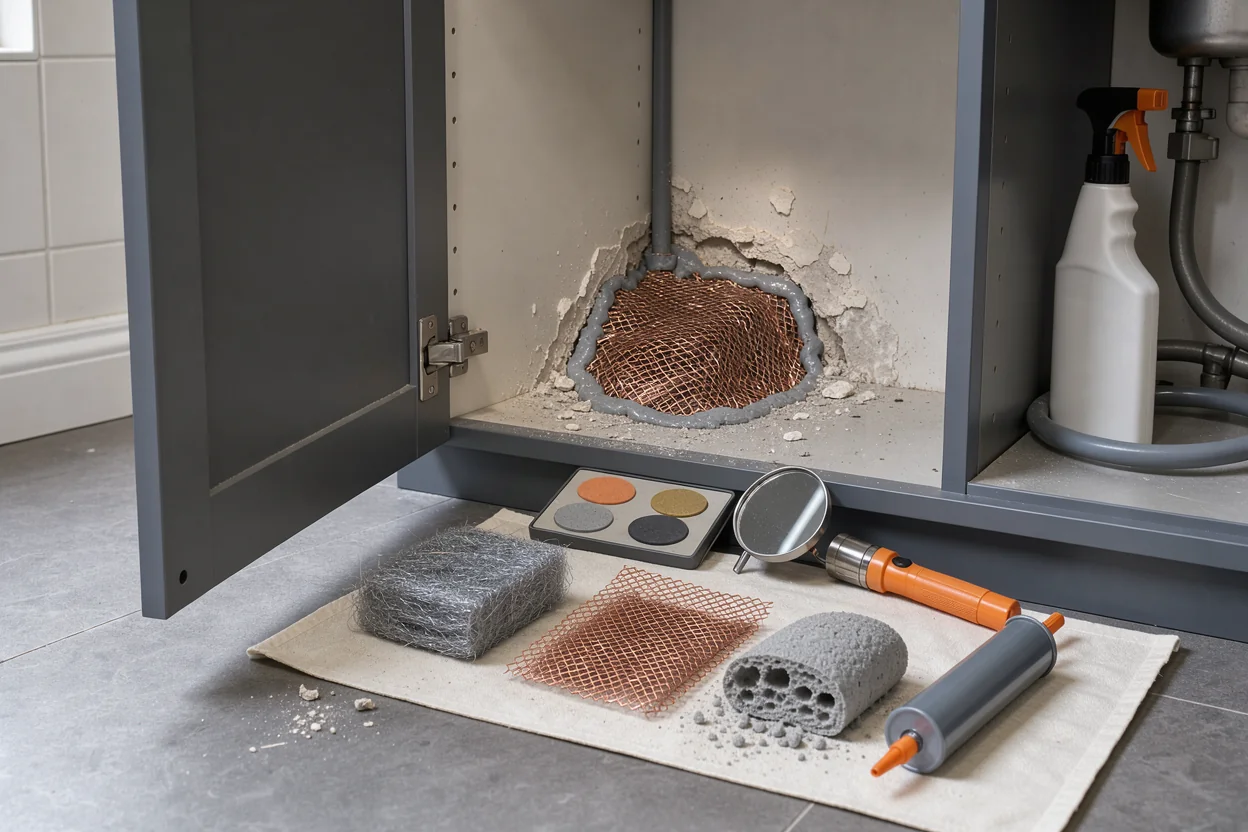
If you’re looking for mouse control kitchen cupboard gap size advice, start by matching the material to the opening. For a fixed hole, I’d prioritise a secured metal barrier, with a suitable sealant where needed to hold or finish it. The choice changes around damp pipework, removable kickboards and ventilation openings.
This roundup compares steel wool, copper mesh, silicone, expanding foam and brush strips by their practical job, their limits and how securely they can stay fitted. Fitted metal mesh also earns a place for openings that need a cover. Decorative fillers and scent deterrents are outside this comparison because the decision here is how to close a physical route.
Measure the opening behind the cupboard
Buying a kitchen gap filler is easier once you know the opening’s size, shape and purpose. A hole around a water pipe needs a different repair from a long seam beneath a removable cupboard panel.

Use roughly 6 mm as an inspection trigger
Mice can exploit openings around 6 mm, approximately a quarter inch. That measurement is the starting point in Gladewick’s entry gap sealing guide. Treat it as a reason to investigate, rather than a precise boundary below which every gap is safe.
Measure the clear opening beside the pipe or panel. The diameter of a pipe tells you little about the space around it. An uneven cut-out might fit closely at the bottom while leaving an accessible opening above.
A pencil can help you notice suspicious gaps, but a ruler gives you a clearer record. Photograph each opening with the scale visible. Avoid pushing measuring tools into holes containing cables, fittings or anything you cannot identify.
Look along the whole edge, too. A repaired centre can leave an opening at either end.
Find where the cupboard opening leads
The cupboard carcass is the fixed body of the cabinet. Its back panel may separate your food storage from a larger space behind the units. Closing a hole in that panel can protect the cupboard while leaving the underlying route open.
The plinth, often called the kickboard, is the panel along the bottom of fitted units. Check behind it where removal is straightforward and safe. Pay attention to pipe entries, floor edges and openings in the wall.
If a gap connects to another room or building void, widen the inspection. The guide to priority rooms to seal provides context beyond the kitchen.
For several different openings, an interactive gap selector could help: enter each gap’s width, surface, moisture exposure and access requirements to receive a material category and an inspection flag.
Metal fillers for fixed holes around pipes
Metal fillers belong on the shortlist for fixed cupboard openings because they provide a physical barrier. Their usefulness depends on how they fit and how the repair holds them in position.
Steel wool for small, accessible openings
Steel wool is a mass of fine steel strands that can be shaped into an irregular opening. It suits small holes where a rigid patch would be awkward, including certain gaps around pipe entries.
Its place in the roundup comes from the published recommendation discussed below from Rodent Defense Norman. That recommendation concerns small cracks and holes; it does not establish that every household steel-wool product is suitable for every kitchen location.
The practical weakness is retention. A loose wad pushed into a hole gives you little confidence about the edges or what holds it there. Choose a suitable retaining method, and check that the surrounding surface is sound enough to support the repair.
For damp cupboards, check the product’s corrosion suitability before buying. Resolve a sink leak first. Also follow restrictions around electrical equipment and neighbouring materials.
I’d choose steel wool for a small, dry, accessible opening where it can be secured and checked later. Avoid leaving loose strands where food, utensils, children or pets can reach them.
Copper mesh for awkward pipe shapes
Copper mesh is another formable metal filler to consider when a pipe cut-out has an uneven outline. Its appeal is the shape you can make around the opening, particularly where a flat cover would be difficult to position.
However, the evidence available here does not establish that copper mesh outlasts steel wool in kitchen cupboards. I would choose it by the actual product specification, its suitability for the surrounding materials and the fixing method.
For an under-sink job, check the manufacturer’s information about damp conditions and contact with pipework. Confirm that the product is intended for rodent exclusion, which means closing routes rodents use to enter.
A mesh filler still needs secure edges. Check whether it can be pulled out, pushed aside or bypassed through a neighbouring gap. Packing more material into the centre cannot correct a loose perimeter.
Copper mesh is worth considering for an irregular opening when its specification fits the location. Buy enough to form a secure barrier, and follow the product’s installation instructions.
Fitted metal mesh for openings a filler cannot support
A fitted metal cover or mesh patch deserves attention when the opening is too broad for a small plug. It changes the job from filling a hole to covering it with a barrier attached to sound surrounding material.
For cupboard proofing, check both the mesh openings and the fixing arrangement. A sheet of metal mesh is useful only if its aperture size is suitable for excluding mice and its perimeter stays closed.
The Fort Products example below illustrates another application: a stainless steel cover for an air brick. That is a ventilation job, so an appropriate cover matters more than packing the opening solid.
Around a cupboard panel, a securely fixed patch may also make future inspection easier than an opening buried beneath layers of filler. The fit still needs to suit the cabinet and any nearby services.
I’d favour a properly specified, fitted cover for a broad opening with sound edges. If the surrounding timber is damaged or the void contains unidentified services, have the opening assessed before fastening anything across it.
Silicone, foam and brush strips have supporting jobs
Soft sealants and flexible strips can help finish cupboard repairs or close particular joints. I would assess them separately from the material expected to resist chewing at an active mouse route.
Silicone for narrow joints and retained fillers
Silicone suits narrow joints where the product can bond to both sides of the opening. PURCOR Pest Solutions specifically includes silicone in its sealing advice, as discussed below.
A narrow seam between sound surfaces is a different job from a large pipe hole. Before choosing a cartridge, check the permitted joint dimensions, the surfaces it can bond to and its suitability for the cupboard location.
Where silicone retains or finishes a metal filler, check that the combination is compatible. The repair needs a secure barrier beneath the visible surface. A neat bead across the front cannot tell you whether an opening remains behind it.
Clean and prepare the surfaces according to the product instructions. Keep food and utensils away during application and curing, and follow the stated ventilation requirements.
I’d use silicone for an appropriate narrow joint or a compatible finishing job. For a mouse-accessible pipe hole, assess the underlying barrier as well as the sealant.
Expanding foam for filling space around a suitable barrier
Expanding foam can fill a space that is awkward to reach with a rigid patch. Published advice includes foam among gap-filling materials, but I would not count exposed ordinary foam as the chew-resistant part of a mouse barrier.
That distinction matters behind kitchen units, where the finished surface may be difficult to inspect. A filled-looking opening gives limited information about its resistance to renewed activity or whether the edges remain accessible.
If foam forms part of a repair, identify the material that provides the physical barrier. Check the foam’s compatibility with that material and with the surrounding cupboard, wall and services.
Foam also needs an appropriate application space. Follow its expansion and curing instructions, and keep appliance ventilation and service access clear.
My choice would be foam as a specified supporting filler where the arrangement is suitable. For a straightforward mouse entry hole, start with the secured barrier and decide whether foam adds anything useful.
Brush strips for gaps that must remain movable
A brush strip can suit a moving edge that needs to open, close or be removed. Around kitchen units, that might include a removable plinth or a cupboard edge where a solid seal would prevent access.
The limitation is the flexible brush itself. A standard draught strip should not automatically be treated as a mouse-proof barrier. Check whether the manufacturer explicitly specifies it for rodent exclusion and how it must be fitted.
Inspect the ends and corners after installation. A strip that follows the middle of a panel neatly can still leave an accessible space beside a clip, return or uneven floor.
There is also a route question. If mice enter through a hole in the wall behind the units, a strip at the front of the plinth addresses only the visible boundary.
I’d consider a suitable strip where movement is necessary. For a fixed building entry behind the cupboard, assess that opening independently.
How the published advice applies to a kitchen
The named sources below cover different proofing jobs. Their recommendations help identify material categories, but each still needs translating into the shape, surface and access requirements of your cupboard opening.
Fort Products
Fort Products describes its Roshield Fort Products as a barrier against mice and insects entering building cavities through air bricks.
That earns it a place as a fitted-cover option where the opening provides ventilation. It is a specific product example, so cupboard suitability still needs confirmation against the dimensions and fixing arrangement.
The practical recommendation is to consider an appropriately specified cover for a matching ventilation opening. Check its fit and retained airflow before purchase.
PURCOR Pest Solutions
PURCOR’s PURCOR Pest Solutions lists steel wool, silicone caulk, solid foam and weather stripping among entry-point materials. It identifies 100% silicone caulk as suitable for narrow gaps.
That supports silicone’s place in the roundup as a narrow-joint material. The recommendation alone does not establish that a silicone bead will resist chewing at every opening.
Use this guidance to distinguish sealing jobs from larger barrier repairs. Then check the chosen product’s permitted joint dimensions, surface preparation and application requirements.
Rodent Defense Norman
Rodent Defense Norman’s Rodent Defense Norman recommends steel wool for small cracks and gaps, including openings around pipes and vents. It also discusses caulk and expanding foam as gap-filling options.
The steel-wool recommendation is relevant to awkward cupboard pipe holes. Its limit is that a material recommendation cannot account for the condition of your cabinet, the size of the opening or how securely the filler will stay fitted.
Choose the repair around those details. Inspect its perimeter once installed.
British Pest Control Association
The British Pest Control Association available through the British Pest Control Association discusses mice occupying building fabric and arriving through the movement of materials that provide refuge.
Its role here is understanding routes into buildings. It does not provide a kitchen-specific ranking of the five materials in this roundup.
That wider context matters when a cupboard opening connects to a wall or floor void. Include adjoining spaces and possible routes into the building in the inspection, alongside the visible cabinet hole.
Fit the barrier without hiding another problem
A cupboard repair needs to close the opening while leaving the kitchen usable and inspectable. Check nearby services, the surrounding surface and access requirements before committing to a permanent seal.
Keep ventilation, pipework and electrical fittings accessible
Look closely around the opening before inserting metal strands, applying foam or fitting a cover. Stop if you cannot identify a cable, pipe, duct or fitting. Guessing its purpose makes material selection harder.
Do not pack metal fillers against exposed electrical parts. Around uncertain services, have the arrangement assessed by the appropriate qualified tradesperson.
Keep required ventilation openings clear. A suitable mesh cover can be considered where exclusion and airflow must coexist, but its specification and placement need checking.
Removable plinths, appliance clearances and service points also need access. Avoid gluing a removable panel permanently into place simply because that is the easiest surface to reach.
In a rented property, photograph the opening and report it before altering fixed cupboards or building services. Give the landlord or managing agent the location and measurements so the repair can address the actual hole.
Inspect the fitted edges and continuing activity
After fitting the barrier, check where it meets the pipe, wall, floor or cupboard panel. Inspect the whole perimeter with a torch. Pay particular attention to corners and uneven surfaces.
Follow the stated curing time before handling or checking a sealant. For a mechanically fixed cover, inspect the fastenings and surrounding material without disturbing services.
Keep a dated photograph of the completed repair. It gives you a reference if material later shifts or new damage appears.
Continuing cupboard activity deserves another inspection. The guide to failed DIY mouse control discusses reasons to reassess an unsuccessful approach.
For inaccessible routes in a London kitchen, BuzzKill Pest Control is one local inspection option. A useful assessment should identify suspected entry points and the repairs needed around them.
Questions about sealing kitchen mouse gaps
These questions matter when you are choosing cupboard materials because a tidy repair and a complete barrier can require different decisions.
Should I seal a gap smaller than a pencil?
Investigate it if it connects to a building void or sits beside signs of mouse activity. A pencil is a rough inspection aid, and irregular openings are difficult to judge by sight.
Check whether the surrounding edge is damaged or easily altered. Record the opening’s widest accessible part, then choose a repair that closes the full perimeter.
Can silicone alone stop mice entering a cupboard?
Silicone may suit an appropriately sized narrow joint between sound surfaces. For a pipe hole or an opening with signs of chewing, I’d assess a secured metal barrier as well.
Check the sealant’s specified use and the joint beneath it. A smooth finish across the front cannot confirm that the hidden opening has been closed.
Can I combine steel wool and expanding foam?
They may form parts of a repair if the products, location and installation method are compatible. The metal must provide a securely retained barrier, and the foam must suit the surrounding surfaces and services.
Check both manufacturers’ instructions. Keep ventilation and service access clear, and inspect the edges after the foam has cured.
How can I tell whether the repair is working?
Keep dated photographs and look for displacement, fresh damage or continuing mouse signs. An intact repair at one hole does not confirm that every route behind the kitchen units is closed.
Our comparison of home mouse monitoring solutions considers alarms alongside professional pest control. Use observations to guide inspection of the remaining openings.
Choose by cupboard location and signs of activity
The strongest material choice depends on where the hole sits and what the repair must preserve. I’d make the final selection around the following cupboard situations.
A small hole in a dry cupboard
For a small, fixed opening with sound surrounding material, consider securely retained steel wool or a specified copper-mesh filler. Choose between them using the product information and the shape of the hole.
Steel wool has a direct recommendation in the published guidance above. Copper mesh remains a product-specific alternative; the available evidence does not justify a universal durability ranking between them.
Check every edge after fitting, especially where a pipe leaves a narrow crescent-shaped opening. If the cupboard contains food or utensils, keep the barrier and any loose material away from storage surfaces. Photograph the completed opening before replacing the contents.
An uneven opening beneath the sink
Under the sink, moisture and pipe access need attention before the filler. Resolve a leak, check the surrounding panel and confirm that the selected material suits the conditions.
For a broad cut-out, consider a fitted cover or a shaped barrier secured to sound material. A narrow suitable joint may need only the appropriate sealant, while a larger opening needs a supported repair.
If the pipe or cabinet panel moves, assess why before sealing it. The repair needs a stable edge to attach to. Keep shut-off points and fittings accessible.
A route behind the plinth or into a wall void
Behind a removable plinth, find the fixed opening that gives access to the concealed space. Choose its barrier separately from any strip needed along the movable front panel.
The easily overlooked alternative is a fitted metal cover at the actual building opening. I’d recommend considering it when a broad hole has sound edges, or when an appropriate mesh cover must preserve ventilation.
For continuing activity, inspect the connected void and adjoining openings before buying more filler. Where the route is inaccessible or contains unidentified services, record the visible evidence and have the opening assessed before sealing it.

Need professional help? BuzzKill offers fast, reliable pest control services across London and Essex.