
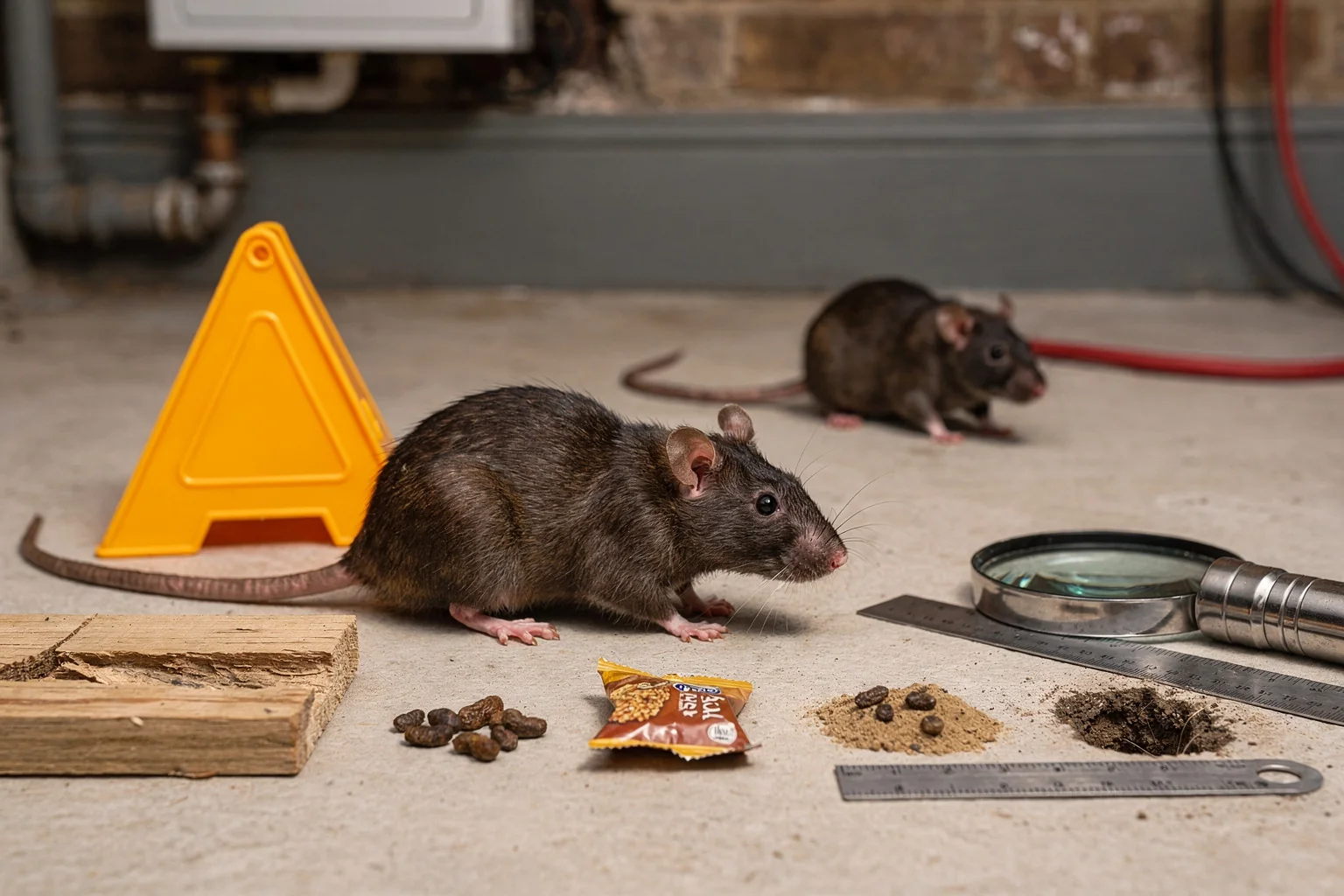
You type "brown rat" into a search engine. Then you type "Norwegian rat". The results look interchangeable. Fact is, they are. The brown rat (Rattus norvegicus) and the Norway rat are the same animal. The UK tends to call it a brown rat; North America often calls it a Norway rat. The official taxonomy recognises both as common names for the same species, according to the Integrated Taxonomic Information System. So why are you still second-guessing what you saw scuttling behind your bins in Greenwich?
Because the real mix-up isn’t about two names for one animal. It’s about mistaking that animal for a roof rat, a house mouse, or even a water vole. When you misidentify the pest, you buy the wrong bait, set traps in the wrong places, and end up waiting weeks for results that never come. With rodent sightings rising across London — data shows UK rat activity jumped by over 20% in a single year following a run of wet winters — getting the ID right matters more than ever.
This list is a practical field guide. I’m going to walk you through seven physical signs, ranked from the one you’ll spot first to the one that takes a little patience. Each sign comes with the common mistake people make and the simplest way to check it where you live, whether that’s a terraced house in Barking or a ground-floor flat in Hackney. By the end, you’ll know whether you’re really dealing with Rattus norvegicus — or something you should handle completely differently.
The Tail Is Shorter Than the Body, Not Longer
A brown rat’s tail usually reaches about 70–80% of its body length. It’s thick, almost scaly, and hairless. If you ever get a clear view — say one runs across a garden path in Islington — you’ll notice the tail looks shorter than the animal’s overall length. The Smithsonian’s National Zoo describes the tail as bald, like the ears and nose.
That’s your first filter. Roof rats, the species you’d find nesting in attics or climbing cables, carry tails longer than their bodies. A mouse’s tail might be about the same length as its body, but the animal itself is smaller and the tail is noticeably thinner.
The common mistake: a homeowner in Tower Hamlets spots a rat with a long, thin tail disappearing under the shed and assumes it’s a brown rat because the body looked brownish. In reality, that length-to-body mismatch points squarely to a roof rat. The quicker you rule that out, the sooner you avoid wasting bait boxes placed at ground level — roof rats don’t forage there reliably.
If you can’t measure the tail with your eyes, try this: next time you spot droppings, check where they’re sitting. Brown rat tails drag behind them and sometimes leave a faint smear on dusty surfaces, but the shorter tail means those smears appear closer to the wall-floor junction. Roof rats, with their longer tails, leave distinct wipe marks on rafters or along cables. If you want a deeper side-by-side on these two species, our Norway rat vs roof rat guide puts eight field marks under one roof.
Ears That Sit Low and Don’t Reach the Eyes
Brown rats have relatively small ears that sit close to the head. If you were to fold one forward, it wouldn’t cover the eye. That’s a far cry from a roof rat, whose large, prominent ears flop forward past the eye, or from a house mouse, whose oversized ears look almost comical on a tiny head.
Why does ear size matter? Because it tells you how the animal navigates. Brown rats rely heavily on smell and touch; their ears aren’t the main sensory tool. In fact, a Home Office code of practice for rodents notes that wild brown rats have poor daylight vision and depend on scent marking and hearing — but hearing that’s tuned to low frequencies and ultrasound, not the kind of directional hearing you’d expect from a big-eared animal. So if you see a rat in dim light and it appears to have small, almost inconspicuous ears, you’re looking at a classic brown rat trait.
The common mistake: someone spots a rat in a Hackney back garden at dusk, sees dark fur, and calls it a brown rat — but those big, forward-facing ears are a roof rat giveaway. It matters because roof rats are far better climbers; small-ear brown rats are ground dwellers, so your control plan shifts from sealing high entry points to reinforcing ground-level defences.
Check a simple thing: if you can get a photo or a good look, note whether the ears look like they belong on a mouse or on something stockier. Small ears usually mean brown rat.
Droppings Shaped Like Stubby Capsules, Not Pointed Grains
This is the sign most people spot first, because it’s evidence that doesn’t run away. Brown rat droppings are capsule-shaped, about 12–18 mm long, with blunt or slightly rounded ends. They’re often scattered loosely or left in small groups near feeding sites. A single brown rat can leave 40 to 50 droppings a night, so you’ll notice them quickly if you check behind the bin store in a Newham block or along the edges of a Plaistow garage.
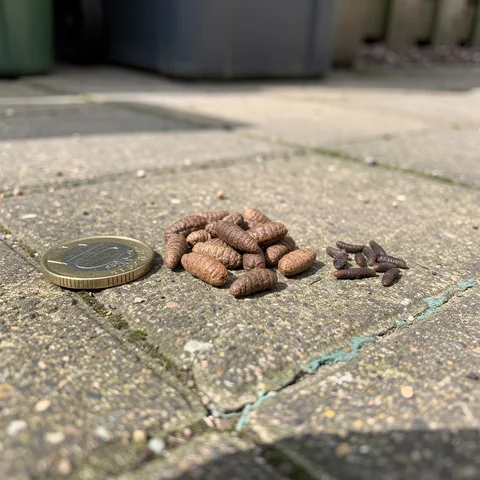
Mouse droppings, by contrast, are about the size of a grain of rice — 3 to 6 mm — and come to a point at one or both ends. They’re usually found in smaller clusters and are more likely to be along skirting boards or inside cupboards. Roof rat droppings land somewhere in between, but tend to be more spindle-shaped, with curved, tapered ends.
The common mistake: a householder in Waltham Forest finds small droppings in the kitchen drawer and assumes it’s a mouse, while a young brown rat could produce droppings that look similar. I’ve watched people lay mouse traps for what turned out to be adolescent rats — and the trap catches nothing because the bait isn’t sized right and the trap is too light to hold a rat. That’s how a small problem becomes a breeding colony.
Take a photo with a coin for scale and compare it to the description. If the droppings are 12 mm or longer and blunt, you’re dealing with a brown rat. And if you need to double-check the rat-versus-mouse puzzle across more evidence, our rat or mouse misidentification walkthrough helps you avoid the trap-size mistake that keeps London homes stuck.
Entry Holes at Ground Level, Often With Kicked-Out Soil
Brown rats are committed excavators. They build extensive burrow systems with multiple entrances, usually at the base of walls, under sheds, in compost heaps, or along overgrown fence lines. A typical main entrance is about 50–80 mm across — wide enough to fit three fingers — and you’ll often see a fan of loose soil or gravel kicked out just below the opening.
Roof rats don’t do this. They nest above ground, in lofts, dense ivy, or palm trees. Mice burrow too, but their holes are smaller (around 20 mm) and much neater, without a soil fan. Water voles create similar holes along riverbanks, but in a typical East London back garden in Bromley, you won’t find a water vole unless you back onto a watercourse.
The common mistake: someone sees a hole in the lawn and assumes it’s a rat. Squirrels also dig, but they tend to create shallow, scattered holes without a clear tunnel entrance. If the hole is clean, oval, and leads into a tunnel you can see, it’s almost certainly a brown rat.
Walk your property boundaries. Look for smooth, well-used paths leading from the hole to a food source — compost heap, bird feeder, overturned bin. Brown rats stick to edges instinctively; the Home Office code notes they avoid open spaces and use urine trails to mark territory, which reinforces those visible "rat runs" along walls. When you find a burrow and confirm brown rat activity, your next step is figuring out the right intervention. We’ve broken down rat extermination prices in Tower Hamlets vs going it alone so you can weigh the real costs.
Rough, Ragged Gnaw Marks That Look Like a Chisel Was Used
Brown rat incisors never stop growing, so they gnaw constantly — on wood, plastic pipes, electrical cables, and even soft metals. Each bite leaves a pair of parallel grooves about 2 mm wide, often rough and splintered at the edges. If you run your finger (carefully) along a gnawed timber joist in a Havering loft, you’ll feel the ridges.
Mice leave much finer marks, less than 1 mm wide, and the edges look cleaner, almost like a tiny file was used. Squirrels gnaw with a wider, more irregular pattern and often strip bark. But the brown rat’s work is distinctive: it’s deep, repeated, and tends to concentrate near food or entry points — the bottom corner of a wooden door in a Canning Town kitchen, for instance.
The common mistake: homeowners see gnawed plastic and blame rats, when in fact a mouse is the culprit. That matters because mouse entry points are smaller and easier to seal with wire wool, while rats need heavier-grade mesh and reinforcement. If you’re patching a 8 mm gap when the real entry is a 25 mm hole, you’re not solving the problem.
Collect evidence in daylight. Photograph the marks with a ruler. If the grooves are 2 mm wide and you’re also finding capsule-shaped droppings, the brown rat ID firms up fast.
Nests at Ground Level, Not in Lofts or Roof Voids
Brown rats nest in burrows, under concrete slabs, inside cavity walls at ground level, or within large piles of timber and debris. They’ll happily colonise a disused drain or a broken sewer pipe, emerging close to the foundation. This is one of the strongest differentiators: if the nest is above your head, you’re likely dealing with a roof rat. If it’s under your feet, it’s a brown rat.
In London’s dense terraced housing — say, a row of Victorian houses in Lewisham — brown rats frequently exploit broken drain collars and then burrow outward into the subfloor void. You might notice a faint, musty smell near an air brick, or hear scratching that doesn’t come from the loft but seems to travel along the base of a wall.
The common mistake: a landlord in Barking and Dagenham hears scratching in the bedroom wall at night and assumes a mouse or squirrel. Because the noise seems to move upward, they check the loft first — and find nothing. The rat is actually moving inside a cavity wall at ground level, following a pipe run. Knowing the nesting preference saves hours of wasted inspection time.
Brown rats build substantial nests from shredded paper, insulation, leaves, and fabric. If you pull back an old piece of carpet in a garden shed and find a football-sized mass of shredded material with multiple entrance tunnels beneath it, that’s a textbook brown rat nest. At that point, you’re beyond DIY traps; the colony is established.
You Spot Them at Dusk or Dawn, Rarely During the Day
Brown rats are primarily nocturnal. They’re most active shortly after sunset and just before sunrise, which is why you’ll often see one darting across the road near bins in Islington around 9 p.m. in summer, or at 5 a.m. on a winter morning. According to the Home Office code, activity increases during the hours of darkness and many strains avoid light levels over 25 lux — about the brightness of a moonlit room.
Seeing a rat in broad daylight doesn’t automatically make it a different species. But it can signal a large population where competition for food forces some individuals to forage during riskier hours. If you spot a brown rat casually strolling across your patio in Enfield at lunchtime, there’s a good chance the infestation is larger than you think.
The common mistake: people assume a daytime sighting means the rat is sick or desperate. While that can happen, more often it reflects a well‑fed colony that has simply expanded to the point where timid individuals get pushed out of the prime night‑feeding slots. So don’t use time of day alone to decide if you need to act. Look at the whole picture: if large droppings, ground burrows, and short‑tailed rats all appear, it’s a brown rat problem regardless of the clock.
Brown rats are also famously neophobic — wary of new objects. You might set a bait box and find it untouched for days, not because the rats are gone, but because they’re circling it cautiously. This behaviour is why professional rodent management often starts with a survey and a monitoring period rather than just dashing in with poison. In a Hackney restaurant, for instance, a technician might place non‑toxic monitoring blocks first just to map the runs before any treatment begins.
If you’ve checked all seven signs and the evidence still points to Rattus norvegicus, you’ve got a solid ID. The next question isn’t what it’s called — it’s how fast you can shut down the colony before it doubles in size. A same-day inspection from a local London technician who carries no call‑out charge can settle any remaining doubt in minutes. Many East London callers report that what they thought was a mouse turned out to be an adolescent brown rat, and knowing that early kept a small issue from becoming a five‑figure repair job.
Need professional help? BuzzKill offers fast, reliable pest control services across London and Essex.