
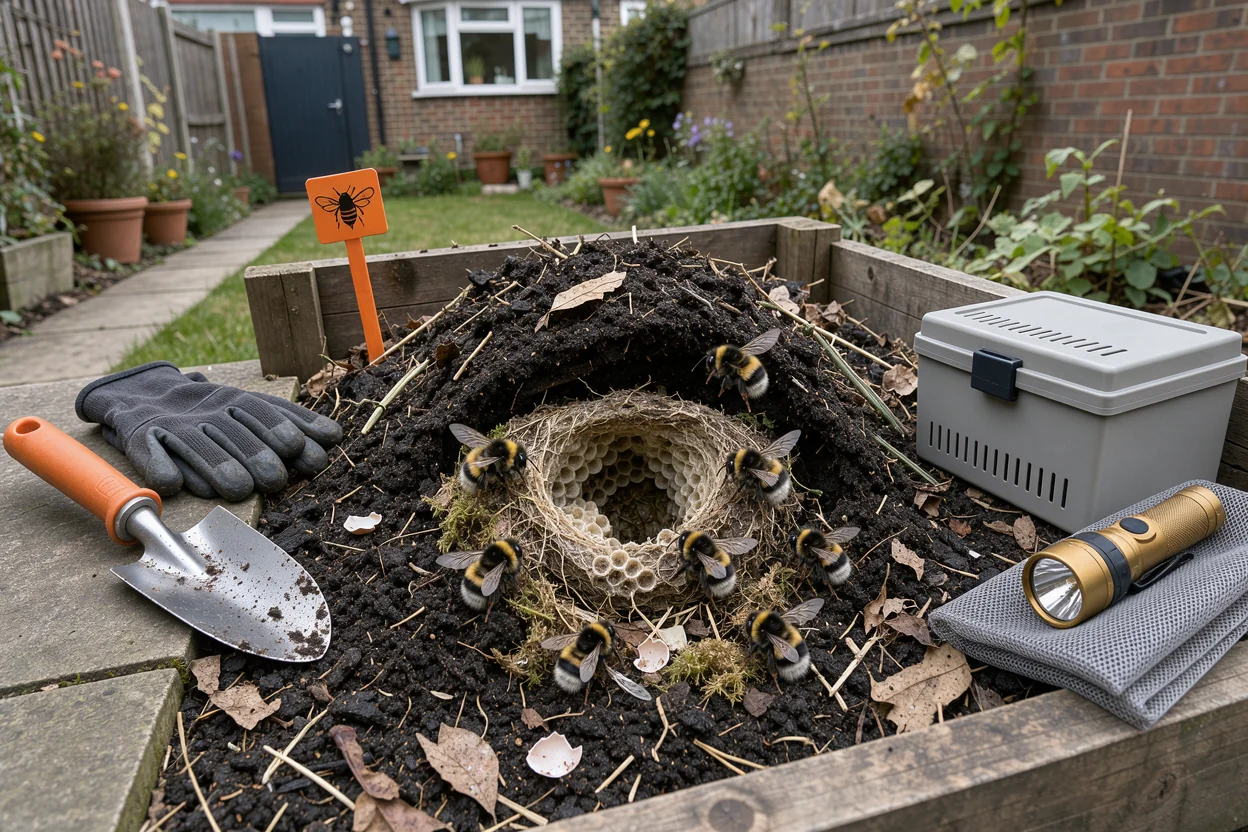
Leave an active bumblebee nest undisturbed if you can keep people and pets away from its entrance. If you're weighing up bumblebee nest in compost heap options, pause compost work first, then decide whether you can protect the area or need a specialist assessment.
Finding bees when you've gone outside with a garden fork can be unsettling. You don't have to settle the whole problem immediately. Start by working out whether the heap can stay untouched, which insects are present and who needs access nearby.
What should I do as soon as I find bees in my compost?
Stop disturbing the compost, move away from the entrance and give the bees space.
Put down the fork or shovel without making another attempt to uncover the nest. If a tool is beside the entrance, leave it there temporarily rather than reaching through active bees to retrieve it. Keep other people away while you decide what to do.
Watch from somewhere that does not interrupt their route. Repeated arrivals and departures through the same gap are more useful evidence than a single bee resting on the bin.
Make a short note of what you can see:
- Where bees enter, such as a gap beneath the lid or an opening near ground level.
- Whether the entrance faces a path, seating area or children's play space.
- Whether anyone has already turned, watered or partly emptied the heap.
- Which garden jobs can wait without affecting essential access.
A photograph taken with your phone's zoom may help with identification. There is no reason to open the bin for a better picture.
I'd leave the lid and panels as they are while checking the options. Avoid spraying, smoking, flooding or sealing the entrance. If the nest sits beside your only usable doorway or passage, arrange an assessment before trying to change anything around it.
How can I tell whether they are bumblebees?
Bumblebees usually look rounded and noticeably hairy, but identification should rely on a clear view rather than colour alone.
Wasps tend to look smoother and more sharply waisted. Honeybees generally look slimmer than bumblebees. These differences can help, although a fast-moving insect seen in poor light is easy to misidentify.
Look at the activity as well as the insect. Bees repeatedly using one opening may have an established nest inside. A bee visiting flowers beside the heap does not establish that anything is nesting there.
Several bumblebee species have different colour patterns, so a white tail or yellow band does not tell you everything. You do not need to identify the exact species before keeping the compost undisturbed.
A colony is the group of bees sharing a nest. An established bumblebee colony in compost needs a different assessment from a cluster of honeybees gathered on an exposed branch. Our guide to the UK bee swarm season discusses that separate seasonal concern; it should not be used as a countdown for a compost nest.
If you cannot get a useful view without approaching the entrance, stop there. Explain the location and behaviour to someone who can identify the insects safely, and keep any photographs you have already taken.
Can I leave the bumblebee nest where it is?
Yes, leaving the nest in place is usually the least disruptive option when the surrounding area can be managed.
The practical question is whether ordinary garden use brings people close to the entrance or requires disturbing the heap. A nest behind a border presents a different problem from one beside a narrow back-door step.
Check what happens during a normal day. Does someone need to collect tools beside the bin? Does a dog investigate that corner? Will a gardener arrive expecting to turn the compost? An arrangement works only if everyone using the space understands it.
Leaving the nest alone should include an agreement to suspend work on that heap. Ask contractors and household members to use another area for suitable garden waste.
You can review the arrangement if circumstances change. Building work, a new access requirement or repeated disturbance may make a previously manageable position unsuitable.
An interactive garden-access checklist could help compare the choices: essential routes, access by children or pets, and whether composting can pause. Any unresolved access problem should flag the need for an assessment.
For now, mark the heap as temporarily out of use and tell anyone who might empty, move or maintain it.
How can I keep children and pets away without blocking the bees?
Separate people and pets from the nest area while leaving the bees' entrance and flight route open.
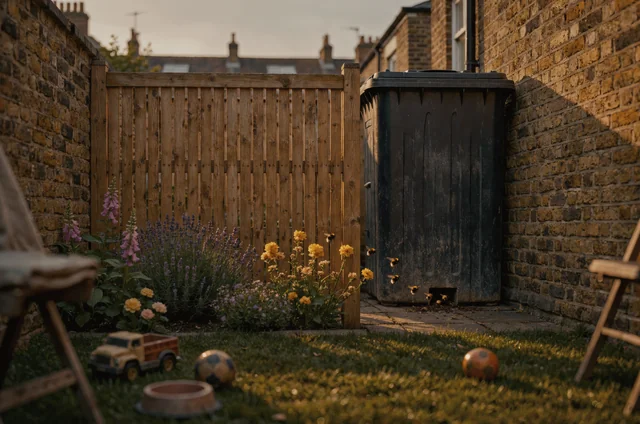
A barrier should prevent accidental approaches. It should not enclose the opening or force you to work against the bin. In a small London garden, temporarily changing the route to a shed may be more practical than placing fencing beside the nest.
Consider the whole activity area. Children might reach behind a screen to retrieve a ball, while a dog may push beneath a loose barrier. A sign or strip of tape alone may not provide the separation your household needs.
Useful changes can include:
- Moving toys, pet bowls and garden chairs away from the affected corner.
- Keeping pets in another part of the garden under supervision.
- Using a stable barrier that can be positioned without disturbing the heap.
- Telling visitors and gardeners why the area is temporarily restricted.
Avoid draping loose netting over the compost or attaching a barrier to a panel that could shift the nest. Keep the route bees use to enter and leave clear.
There is no single separation distance that makes every garden suitable. The entrance position, layout and people using the space all matter. If keeping a child or pet away depends on constant interception, the arrangement needs reassessing before normal garden use resumes.
Can I still use the compost bin and the rest of the garden?
You may be able to use other parts of the garden, but pause work on the occupied bin or heap.
Turning, digging, emptying and moving compost can disturb a nest hidden within it. Working on the opposite side is not a reliable workaround because you cannot see how far the nest extends.
Adding material also brings you close to the entrance and may cover it accidentally. I'd use a separate composting space, or another suitable disposal route, until the occupied heap is available again.
Do not assume that opening the lid is harmless because the bees enter near the bottom. The nest's position and the bin's construction may be unclear.
Other garden jobs need their own judgement. Hand-weeding a separate bed may be manageable, while mowing directly beside the entrance could create avoidable disturbance. Leave the immediate nest area out of the maintenance schedule.
Keep ordinary access under review. If bees regularly cross the space where you need to stand, sit or supervise children, move that activity elsewhere where possible.
The aim is a workable division of space. If your garden is too small to achieve that, ask for an assessment rather than repeatedly testing how much disturbance the bees will tolerate.
How long will the bumblebees stay in the compost heap?
Most bumblebee colonies are seasonal, but you cannot reliably predict when a particular compost nest will finish from its discovery date.
Finding a nest does not tell you when it began. The colony may already be well established, or activity may only recently have become noticeable. Species and weather can also affect the pattern you see.
The usual colony cycle includes a queen establishing the nest, workers helping it develop, and the production of new queens and males. The old colony eventually ends, while new queens may survive to establish colonies of their own.
That broad pattern does not justify promising that your heap will be free by a particular month. Activity can continue later than expected.
A quiet spell is not proof that the nest has finished. Rain, cooler conditions and the time of observation can affect how many bees you see outside.
Watch from a safe position on separate occasions when conditions are suitable for bee activity. Record whether insects still enter or leave the same opening. Do not dig into the compost to test whether anything remains.
If you need to empty the heap for a fixed-date project, explain that deadline during an assessment. When nest status remains uncertain, keep the compost undisturbed until it has been checked.
When does a compost nest need a professional assessment?
An assessment is appropriate when you cannot prevent close contact or the compost must be disturbed for essential work.
Examples include an entrance beside the only practical access route, a nest within a bin that needs moving, or a shared garden where restrictions cannot be maintained. A household member's known sting allergy also changes the access decision; follow their existing medical advice.
The issue is the relationship between the nest and everyday use. A busy entrance in an unused corner may be easier to manage than a quieter entrance directly beside a frequently used gate.
Explain what makes the location difficult. “We cannot reach the back door without passing the opening” gives an assessor more useful information than “there are lots of bees”.
If BuzzKill Pest Control is assessing the nest, describe the bin's construction, the entrance position and which route must remain usable. Mention any previous disturbance before anyone handles the structure.
An assessment may support leaving the nest in place with better separation. It may also identify reasons to consider relocation. Neither result should be assumed before identification and inspection.
Where access is urgent, keep people away from the affected route as far as practicable and explain the urgency when arranging the assessment. Avoid moving the bin yourself while waiting.
Can a bumblebee nest be relocated without destroying it?
Relocation may be possible, but it needs a nest-specific assessment and should not be treated as a routine bin-moving job.
The nest may be concealed among loose material, beneath the heap or within part of the bin's structure. Moving only the container may fail to move the nest intact.
An assessor needs to establish what can be accessed, what would need disturbing and whether there is a suitable destination. The plan also needs to consider bees away gathering food when work begins.
A promise to collect the visible bees does not explain how the colony will be moved. Ask what will happen to the nest itself and how the proposed method addresses the surrounding compost.
Do not improvise a move by sealing the entrance, dragging the bin across the garden or transferring handfuls of compost. Darkness does not make an unfamiliar nest safe to handle.
For background to questions about bee relocation and UK law, keep identification, the proposed method and the reasons for intervention separate. Ask the contractor to explain the position relevant to your nest.
A sensible proposal should acknowledge uncertainty. If leaving the colony in place remains practical, ask why relocation would produce a better outcome before agreeing to move it.
What if I have already turned the heap or exposed the nest?
Stop work and move away rather than trying to repair or investigate the disturbed area yourself.
It is understandable to want to put everything back immediately. Reaching into exposed nesting material, however, creates another disturbance and may bring you closer to active bees.
Keep children, pets and other garden users away. If the fork, wheelbarrow or open bin panel is near the nest, leave it temporarily unless it creates a separate immediate danger.
Tell an assessor exactly what happened. Useful details include whether you lifted compost out, shifted a panel, added water or moved the container. Mention anything already applied to the heap, even if it was intended to deter another insect.
Take photographs only from a position you can reach without approaching the nest again. A description is enough if photographs would require close access.
If someone has been stung, their immediate care takes priority over the compost problem. Anyone with a known allergy should follow their prescribed emergency plan.
Do not return simply because the visible activity has reduced. Where the nest is exposed or its structure may have been damaged, keep the area restricted and obtain advice before handling the compost again.
What should I ask before agreeing to work on the nest?
Ask for a clear explanation of the identification, proposed work and what happens if relocation proves unsuitable.
The same questions apply to BuzzKill Pest Control's bee relocation service as to any contractor's proposal. Establish what the visit covers before agreeing to additional work.
Useful questions include:
- Have the insects been identified as bumblebees?
- Can the nest remain where it is with changes to garden access?
- What parts of the bin or heap would need disturbing?
- If relocation is proposed, what would be moved and where?
- What happens if the nest cannot be accessed as expected?
- What should residents do before and after the visit?
Ask about relevant experience as well as general pest-control membership. Our guide to pest controller credentials explains checks you can use when reviewing a provider.
There is no useful fixed price to quote without knowing the location, access and proposed work. A reachable nest in a movable structure presents different practical questions from one beneath a fixed compost bay.
Request the scope and price in writing, including whether identification, relocation, changes to the bin and any follow-up are included. If a quote describes treatment without explaining what will happen to the bees and nest, ask for that explanation before work begins.
Who should manage a nest in a rented or shared garden?
Notify whoever manages the garden and agree who will arrange the assessment and communicate any temporary restrictions.
For a rented home, tell the landlord or letting agent where the entrance is and how it affects access. Send an existing photograph if useful, but do not approach the nest to obtain one.
Avoid assuming who must pay before the circumstances and relevant agreement have been checked. Identification, access needs and the proposed work should be clear before responsibility for a quote is settled.
In a shared courtyard, allotment or communal composting area, several people may use the heap without knowing it is occupied. A temporary instruction needs to reach everyone who turns, empties or adds material to it.
Put one person in charge of passing on the agreed plan. That helps prevent one resident arranging relocation while another gardener empties the bin.
For schools, nurseries and other managed sites, tell the person responsible for the grounds and keep the affected area out of use pending assessment. Include maintenance staff and visiting contractors in that message.
Record which heap is affected, which activities are paused and who will review the arrangement. Give any contractor those details before they enter the garden.
How can I restart composting and reduce the chance of another nest?
Restart only after the nest is confirmed inactive, then review the bin and surrounding storage before regular use resumes.
Do not use the calendar alone as permission to empty it. If there is uncertainty about continuing activity, have that checked before digging, dismantling or relocating the structure.
Once the heap is available again, inspect the container for damaged panels, unstable sections and gaps that need attention. Plan repairs while it is unoccupied. Avoid alterations that undermine the bin's intended ventilation or drainage.
Keep nearby tools and stored materials organised so future activity is easier to notice. Before restarting a heap left untouched for a long period, observe it from outside before inserting a fork.
Review what goes into the compost as well. Our guide to compost bins attracting rats covers a separate concern worth considering when restoring the area. Manage those risks without applying treatments indiscriminately around a bee nest.
No garden arrangement can guarantee that bumblebees will never choose the area again. The practical aim is to notice nesting before routine work creates a conflict.
If fresh bee traffic appears while you restart composting, stop and leave the entrance clear. Treat the heap as occupied until its status has been checked.

Need professional help? BuzzKill offers fast, reliable pest control services across London and Essex.