
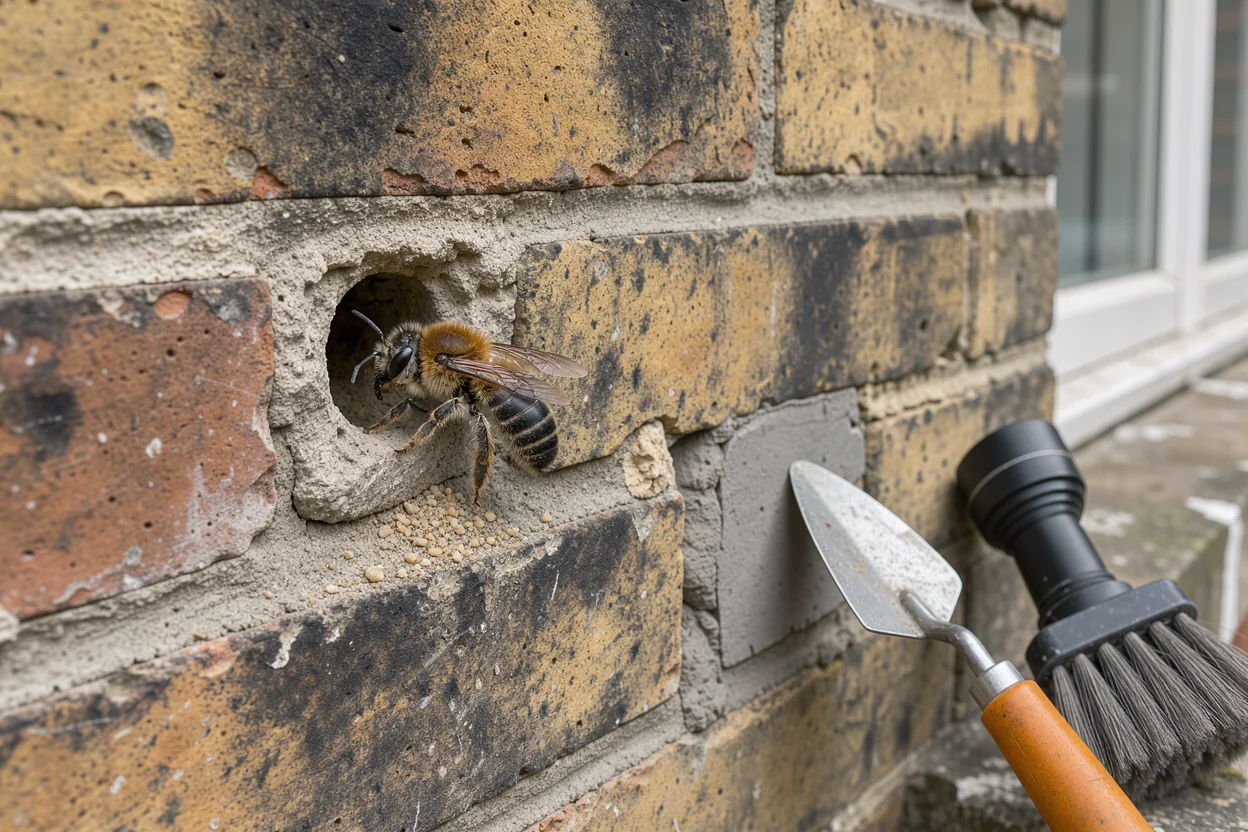
If you're weighing up masonry bee brickwork damage reality vs myth, start with photographs of the wall from ground level. Leave occupied holes open while you check the surrounding mortar, the material between the bricks. Rochdale Borough Council's masonry bee guidance explains that these bees usually use existing holes and rarely cause significant property damage. However, widespread mortar loss deserves attention, whether bees are present or absent. The inspection below helps you separate nesting activity from a building defect and decide what needs monitoring, identification or repair.
Check the wall from ground level today
Your first inspection should establish where the bees are entering and what the surrounding brickwork looks like. You can gather useful evidence within half an hour without touching a nest.
I'd begin from a comfortable distance, with a phone camera and somewhere to record observations. Keep children and pets away from the immediate inspection area. Avoid ladders, leaning out of windows or standing beneath visibly loose masonry.
If you already see bulging brickwork or falling fragments, move away and arrange a building assessment. Skip the close inspection.
Make a useful photographic record
Follow this sequence around the affected wall:
- Take a wide photograph showing the whole wall, including windows, doors and the roofline.
- Photograph the area containing the entrances. Include nearby bricks so the holes can be located again.
- Use your camera's zoom to record individual entrances and the surrounding joints.
- Note whether bees enter separate holes or repeatedly use one shared opening.
Record the date, weather and approximate time. A short video may capture activity that a still photograph misses. Take it from a distance rather than placing your phone against an entrance.
Look for missing pointing, the outer finished part of a mortar joint. Also record cracks, damaged brick faces and any material lying below the wall.
You don't need to count every insect. A useful note describes the pattern: several bees entering separate joints, for example, or repeated traffic through one opening beneath a window.
Leave drill holes, ventilation openings and gaps of uncertain purpose alone. Some openings are part of the building's design. Photograph their location rather than assuming every hole needs filling.
Confirm what is using the holes
A bee entering brickwork doesn't establish the species or the type of nest. Identification matters because insects described loosely as “masonry bees” can use walls differently.
The red mason bee, Osmia bicornis, uses existing cavities. Pest Evidence's red mason bee assessment distinguishes this behaviour from excavating sound masonry: the bee occupies a suitable space in weathered mortar rather than drilling through a healthy wall.
That distinction changes the repair question. You need to establish why the cavity exists before deciding what action is appropriate.
Several entrances can still mean solitary bees
Solitary nesting means each female provisions her own nest rather than sharing the organised colony of honeybees. Several females can nest close together where a wall contains suitable openings.
Watch where individual bees disappear. Separate entrances across several joints are consistent with this pattern, although observation alone won't confirm the species.
Avoid identifying insects solely from colour. Lighting, movement and distance can make photographs misleading. Capture the insect and its entrance if possible, then retain the original image so someone assessing it can zoom in.
An insect assessment through BuzzKill Pest Control can help distinguish wall-nesting bees from other activity. Questions about the wall's stability belong with a building surveyor or structural engineer.
A busy shared entrance needs another identification
Repeated traffic through one opening, activity inside rooms or a large cluster of bees should prompt a fresh identification. These observations don't reliably establish solitary masonry bee nesting.
Honeybee swarming is a separate behaviour. The guide to UK bee swarm season provides seasonal context if you're also seeing a cluster outside the wall.
Keep the entrance open while its occupants are identified. A blocked opening can hide the evidence needed to understand the problem, and filling it won't establish what is behind it.
Separate old mortar decay from fresh excavation
The condition of the mortar helps explain why bees have chosen the wall. An existing cavity may be suitable even where the surrounding joints remain in reasonable condition.
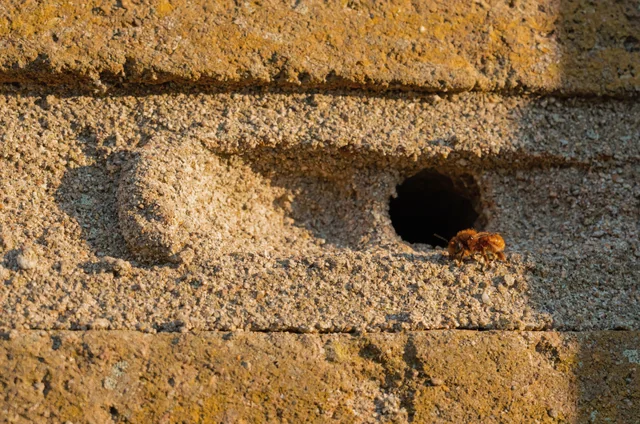
The Society for the Protection of Ancient Buildings, or SPAB, explains in its advice on masonry bees that many bees occupy existing crevices. It also notes that some can excavate or enlarge holes in soft material.
Both observations matter. A blanket claim that every nesting bee damages walls is misleading. So is an assurance that every species merely occupies an unchanged hole.
Compare nesting joints with nearby joints
Look beyond the occupied entrances. Compare them with joints nearby that have no visible bee activity.
Signs worth recording include:
- Mortar recessed or missing across several adjoining joints.
- Powder or fragments beneath areas without occupied entrances.
- Cracks and gaps continuing beyond the nesting patch.
- Damaged brick faces beside apparently intact mortar.
- A mixture of older joints and visibly different repair patches.
Widespread deterioration away from bee holes suggests the building needs attention beyond the nesting sites. It doesn't establish the precise cause.
I'd treat loose material as a reason to investigate the mortar, rather than proof that bees produced it. Fresh spoil beside an entrance may indicate excavation, but rain, previous repairs and ordinary deterioration can also leave debris.
Don't insert a screwdriver into a hole to measure its depth. You could disturb a nest or remove material from an already weakened joint.
Allow for different bee species
SPAB identifies repeated excavation, especially by Colletes daviesanus, as a possible cause of extensive galleries in soft material. Galleries are connected tunnels within that material. Over time, substantial tunnelling can affect the mortar supporting the masonry.
This is why identification and the extent of mortar loss should be assessed together.
A few visible holes can't reveal the size of any concealed tunnel system. Equally, a large number of flying bees doesn't measure how much supporting mortar has been lost.
A home inspection can record cavities and surface deterioration. It cannot reliably establish mortar hardness, hidden tunnel depth or the wall's remaining strength. Leave those assessments to someone qualified to inspect the masonry.
Check for damage that needs a building assessment
Structural damage affects how a wall supports loads or remains stable. Small surface cavities and structural defects require different assessments, even when both appear in the same patch of brickwork.
Bee activity should therefore lead you to inspect the wider wall, rather than concentrate only on the occupied holes. Look from ground level and use photographs to record anything you cannot safely approach.
Inspect the whole wall
Check the areas around windows and doors, the top of the wall and any visible junction with another wall. Also inspect the corresponding indoor area if you have safe access.
Record cracks that continue across several joints or pass through bricks. Photograph displacement, where adjacent parts no longer appear aligned, and any section that seems to bulge.
Indoors, note matching cracks, damp patches or a door that has recently become difficult to close. These observations have several possible causes. They don't prove bee damage, but they can help a building professional understand the wider condition.
An old hairline crack and a newly changing crack are different records. If you have earlier photographs, compare them rather than relying on memory.
Avoid assigning a cause from a single image. Weathering, moisture, movement and previous repairs may need investigation.
Keep urgent building defects separate from bee activity
Falling masonry, visible wall movement or a pronounced bulge should end the DIY inspection. Keep people clear of the affected area and arrange an urgent building assessment.
For a loose boundary wall beside a pavement or shared entrance, prevent access where you can do so safely. Tell the owner or managing agent promptly. Don't stand nearby to take a better photograph.
Where the defect appears stable but its extent is uncertain, arrange a survey rather than digging into the joints yourself.
A pest inspection can identify insects and nesting activity. It cannot replace an assessment of whether damaged masonry can safely remain in place. When requesting help, describe the building symptoms separately from the bees.
Choose a response for the next 48 hours
Your response should follow the evidence you recorded. The aim is to avoid unnecessary disturbance while ensuring that deteriorating masonry gets attention.
Use separate notes for insect activity and building condition. That makes it easier to explain whether you need identification, mortar repair advice or a structural assessment.
If evidence is limited to a few holes
Where the surrounding joints appear intact and there are no wider warning signs, leave the entrances alone today.
Repeat your observation during another suitable period over the next day or two. Use the same viewpoint for photographs. Record any change in the mortar separately from changes in the number of bees.
If no insects appear, retain the original record. A quiet visit doesn't establish that every cavity is empty or that the earlier identification was correct.
There is no reason to spray a wall simply because a few bees have entered it. Rochdale's guidance supports leaving most masonry bee activity undisturbed where it isn't causing a building problem.
If mortar loss is widespread or identity is uncertain
Contact the property owner, managing agent or an appropriate building professional within the next 48 hours. Send the wide photograph alongside close-ups, rather than an isolated image of one hole.
If insect identification remains uncertain, arrange that assessment alongside the building advice. For an assessment through BuzzKill Pest Control or another provider, check pest controller qualifications and ask how the findings will be recorded.
For landlords managing several reports, a digital photo checklist could record entrances, mortar loss and changing cracks, then flag observations needing a building surveyor.
Don't wait through this monitoring period if masonry is falling or moving. Keep the area clear and seek urgent building advice.
Repair the mortar without creating another problem
Where the mortar has deteriorated, repairs should address its condition and compatibility with the wall. Removing bee activity alone won't restore missing joints.
Repointing means removing unsuitable or deteriorated outer mortar and replacing it with an appropriate material. Its scope depends on the wall, the depth of deterioration and any other defects.
Match the repair to the existing masonry
Rochdale Borough Council advises that replacement mortar should be sufficiently firm to discourage nesting without being too strong for the surrounding bricks or stone.
That balance matters in older London properties. Choosing the hardest available mix doesn't establish that it suits the building. Where the original construction uses lime mortar, the repair specification needs to account for it.
Ask the repairer to explain:
- Which joints need repair and why.
- How the replacement mortar suits the existing bricks and joints.
- Whether damaged bricks or moisture problems also need attention.
- How occupied nesting sites will be handled.
A small surface patch may leave deteriorated material behind it. Conversely, sound joints shouldn't be removed simply because they sit near a bee entrance.
Listed buildings and older walls with uncertain repair histories may need specialist conservation advice. Establish the repair approach before agreeing to broad removal of existing pointing.
Avoid copying a mortar recipe without knowing the wall's materials. The useful specification is one suited to the actual masonry.
Agree timing before disturbing nests
Rochdale recommends summer or autumn for masonry repairs intended to discourage reuse of nesting sites. Treat that as planning guidance rather than proof that every hole is empty at that time.
Adult activity and nest occupancy are different observations. A quiet entrance can still contain developing bees.
Before work starts, ask the insect assessor and repairer to agree how they will identify occupied cavities and manage disturbance. Where the building is stable, there may be time to plan the work around the identified species.
Urgent structural defects need a building-led response. Tell the professional about the nesting activity so both issues can be considered.
Don't fill occupied entrances with expanding foam, sealant or a quick smear of mortar. Avoid adding insecticide to a repair mix as a household experiment. Agree a suitable masonry repair and any justified insect treatment separately.
Reduce repeat nesting through wall maintenance
Preventing repeat nesting starts with maintaining suitable joints and addressing defects that leave cavities. It doesn't require treating every bee seen near the property.
After repairs, keep the original photographs and take a new set from the same positions. These provide a record of which areas were repaired and how they looked when the work was completed.
Include the affected wall in ordinary property checks. Look for renewed gaps, loose material and signs of water running across the masonry.
Leaking gutters and failed fittings deserve attention in their own right. Ask the repairer whether moisture has contributed to the deterioration, rather than assuming the bees explain every defect.
Keep purpose-made ventilation and drainage openings clear. Don't seal them as part of general bee prevention unless a building professional has specified an appropriate alteration.
Bee hotels also need a clear purpose. An alternative nesting feature cannot guarantee that insects will leave existing wall cavities, and it cannot repair deteriorated pointing. Address the building condition first.
If bees return, compare the location with your earlier records. Entry through a different existing cavity doesn't automatically mean a repaired joint has failed. Photograph the entrance and surrounding mortar before arranging further work.
For a rented property, retain the repair specification with the inspection photographs. Give the next contractor the record so they can assess the wall without repeating the original assumptions.
Questions about bee holes and wall repairs
Some decisions remain difficult even after you've photographed the wall. These answers help separate insect management from the work needed to maintain the masonry.
Can a few holes make the house collapse?
A few visible nesting holes alone aren't evidence that a house is about to collapse. SPAB states that a small number of holes won't cause significant decay to building fabric.
Extensive deterioration, connected tunnels in soft mortar or wider signs of movement need a separate assessment. Judge those conditions through a building inspection rather than the number of bees outside.
Does crumbling mortar prove the bees caused it?
No. Red mason bees use existing cavities, so their presence can follow earlier deterioration.
Some other wall-nesting bees can enlarge soft material. Identifying the species helps distinguish those possibilities, but photographs alone may still leave the original cause uncertain. Record mortar condition in occupied and unoccupied parts of the wall.
Can I seal an entrance once the bees stop flying?
A pause in visible activity doesn't prove the nest is empty. It also doesn't establish that the opening is suitable for filling.
Have occupied sites identified before repair work. For an opening of uncertain purpose, check whether it belongs to the building's ventilation or drainage arrangements.
Will treatment solve the mortar problem?
Insect treatment cannot restore missing mortar or stabilise damaged masonry. Any treatment decision needs a reason based on the identified insects and circumstances.
The guide to bee relocation and treatment provides context for questions about those approaches. Don't assume honeybee swarm collection is appropriate for solitary nests spread through mortar joints.
Where deterioration is the concern, ask for a building repair assessment alongside any insect advice.
What should a landlord give the inspecting professional?
Send dated photographs, the entrance locations and a description of any changes. Include previous pointing work, known damp problems and reports of falling material.
Separate what the tenant observed from what has been confirmed. “Bees enter three joints beside the kitchen window” is a useful observation. “Bees have weakened the house” requires evidence.
Retain the identification, building findings and agreed repair specification in the property maintenance record.

Need professional help? BuzzKill offers fast, reliable pest control services across London and Essex.