
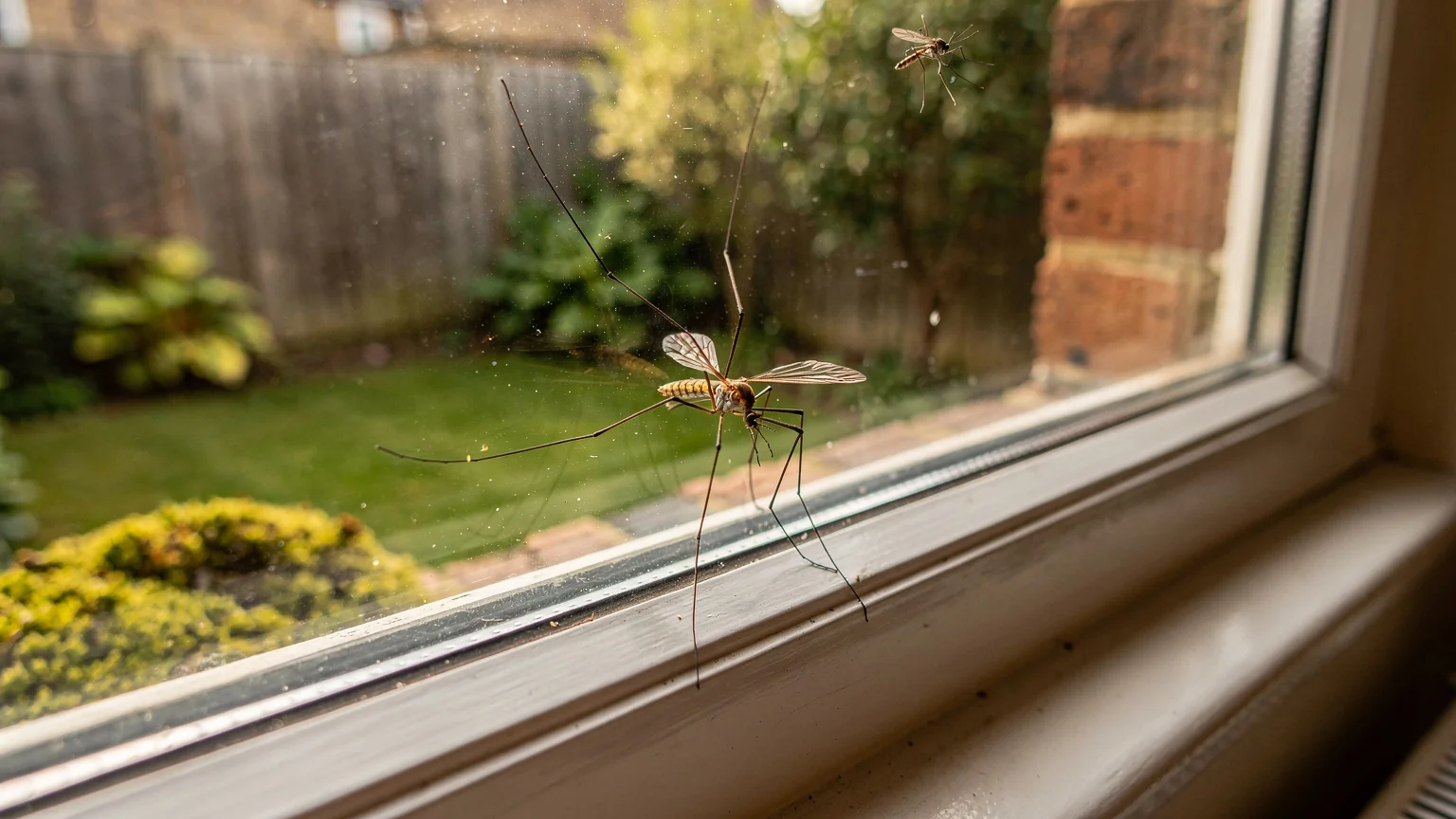
Crane Fly or Mosquito? How to Tell Before You Call Pest Control
A calm, practical guide to distinguishing these common insects and knowing when professional pest control is actually needed.
When a long-legged insect drifts through your living room at dusk, most people react the same way: swat first, identify later. The problem is that crane flies and mosquitoes share enough visual DNA to trigger identical alarm bells, yet their risks, behaviour, and the response they demand are entirely different. Misidentification leads to unnecessary anxiety, wasted money on the wrong treatments, or worse, a genuine mosquito problem left to breed unchecked. This guide will help you tell them apart in under 30 seconds, understand what each insect is actually doing in your home, and decide with confidence whether you need professional pest control or simply patience and an open window.
Why Correct Identification Matters
The stakes of getting this wrong are higher than most homeowners realise. Treating a harmless crane fly invasion with insecticides wastes product, exposes your household to unnecessary chemicals, and does nothing to address the actual source if mosquitoes are breeding nearby. Conversely, dismissing mosquitoes as "just daddy long-legs" allows females to complete their blood-feeding cycles and lay hundreds of eggs in standing water around your property.
From a pest control perspective, the two insects fall into completely different service categories. Crane flies require no treatment at all in most cases; they are transient visitors that die naturally within days. Mosquitoes, however, may indicate breeding sites that need professional assessment and targeted intervention, particularly in London and Essex where urban water features, blocked gutters, and garden containers create ideal conditions.
The financial distinction matters too. A call-out for crane flies that have wandered through an open window is unnecessary expenditure. A delayed response to mosquitoes can lead to repeated bites, potential disease transmission concerns, and escalating treatment costs as breeding sites multiply. Learning the visual and behavioural cues that separate these insects empowers you to make the right decision first time.
Visual Identification: Four Field Marks to Check
Body shape, leg proportions, wing posture at rest, and antennae structure provide reliable separation between these insects. You do not need magnification or specialist equipment; normal indoor lighting is sufficient.
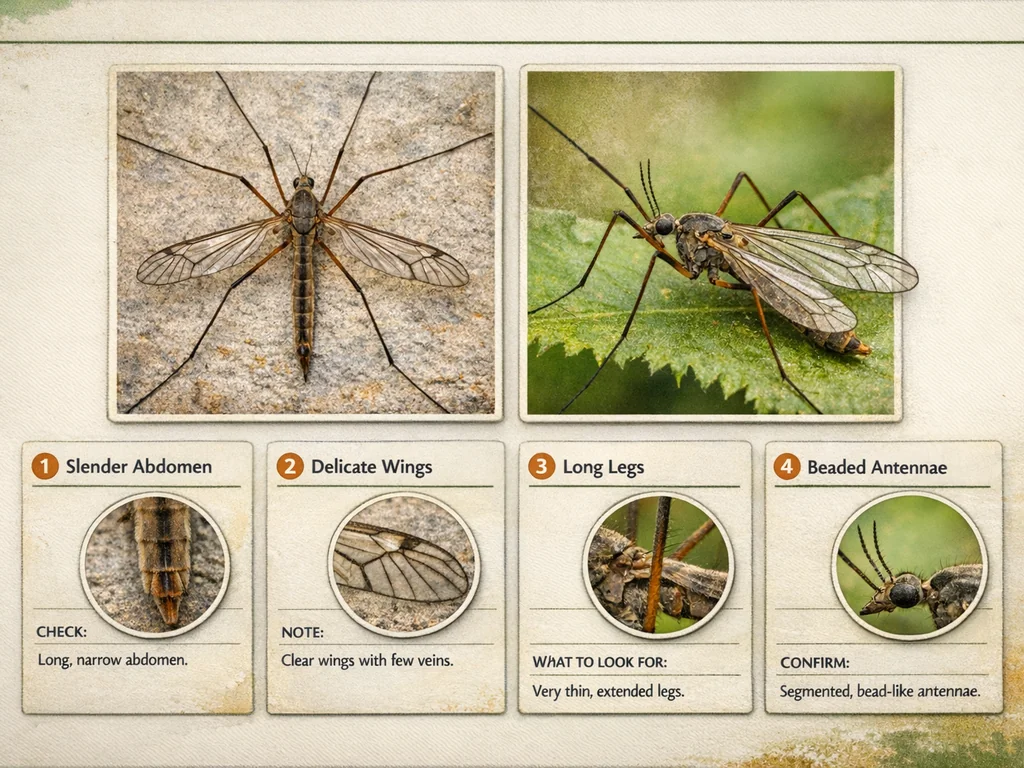
Body proportions offer the clearest immediate cue. Crane flies possess extremely elongated, cylindrical bodies that appear almost fragile, with a narrow thorax and abdomen creating a straight, stick-like silhouette. Mosquitoes have a more compact, humped thorax that gives them a distinctive "head-down" posture when at rest. The mosquito's abdomen is shorter relative to its body and often visibly swollen after blood-feeding.
Leg length is the feature that causes most confusion. Crane fly legs are dramatically long, frequently exceeding twice the body length, and they dangle loosely in flight or when perched. These legs detach easily if handled, a defence mechanism that can leave you holding a single limb while the insect escapes. Mosquito legs are long but proportionate to the body, typically 1.5 times body length at most, and they are held more tightly beneath the body in a characteristic angled stance.
Wing position at rest provides another reliable check. Crane flies rest with wings held outstretched horizontally, like a small aircraft, or sometimes slightly folded back but never tightly against the body. Mosquitoes fold their wings flat over the abdomen in a steep, roof-like angle that conceals much of the body from above. This difference is visible even in peripheral vision and becomes automatic with practice.
Antennae structure requires slightly closer observation but confirms the identification. Male mosquitoes have conspicuously plumose, feathery antennae that are immediately obvious. Crane fly antennae are short, simple, and bristle-like, projecting forward from the head without branching. Female mosquitoes have simpler antennae than males, but still more prominent than the crane fly's minimal pair.
Behavioural Clues: What Each Insect Is Actually Doing
Beyond appearance, how the insect moves and where you encounter it provides decisive context for identification.
Crane flies are weak, erratic fliers that bounce off walls and ceilings with seemingly no navigational control. They are attracted to light and will congregate around lamps or windows at dusk, often entering through the slightest gap in glazing or around poorly sealed frames. Once inside, they are largely inactive during daylight hours, becoming noticeable again in the evening. They do not bite, they do not feed as adults, and their mouthparts are reduced to non-functional stubs. The adult stage exists solely for reproduction, and their lifespan is typically 10 to 15 days.
Mosquitoes fly with purpose and precision. Females track carbon dioxide and body heat to locate hosts, flying in deliberate, hovering patterns before landing. They are crepuscular, most active at dawn and dusk, and will seek shaded resting sites during bright daylight. Indoor encounters usually mean they followed a host inside or are emerging from indoor breeding sites such as plant saucers, blocked drains, or water tanks. The distinctive high-pitched whine of their wingbeat, caused by frequencies around 400 to 600 Hertz, is often audible before the insect is visible.
The ecological roles diverge sharply. Crane fly larvae, called leatherjackets, live in soil and feed on decaying organic matter and plant roots. They are significant food sources for birds and small mammals. Mosquito larvae are aquatic filter-feeders that occupy standing water, and while they too serve as prey for fish and aquatic insects, their adult females pose direct human health concerns through blood-feeding and potential pathogen transmission.
Seasonal Timing and Geographic Patterns
Understanding when each insect appears helps set appropriate expectations and reduces unnecessary concern.
Crane flies have a concentrated adult emergence in late summer and autumn, typically August through October in the United Kingdom, with peak numbers often coinciding with the first damp spells after dry periods. The Dipterists Forum, Cranefly Recording Scheme documents this phenology across Britain and Ireland, noting that local abundance varies considerably with soil moisture and temperature. In the warmer microclimates of urban London and the Thames corridor, some species may appear slightly earlier or persist later into November.
Mosquitoes present a more complex seasonal picture. Native Culex species breed from April through October, with multiple generations producing overlapping peaks. The invasive Asian tiger mosquito, Aedes albopictus, has established in parts of southern England and can remain active into November in sheltered locations. Warm, wet summers extend the season; drought years may suppress numbers but concentrate breeding in remaining water sources.
Geographic factors within London and Essex create local variation. Areas near the Thames, Lea Valley, and the Essex coastal marshes have higher baseline mosquito pressure due to extensive wetland habitat. New housing developments with sustainable drainage systems, rain gardens, and attenuation ponds have inadvertently created new breeding opportunities. Crane flies are more uniformly distributed, reflecting their soil-dwelling larval stage, though they favour damper soils and are more abundant in areas with established lawns and gardens.
Lifecycle and Breeding: Where Problems Actually Start
The adult insects you see represent the final, visible stage of very different lifecycle strategies.
Crane flies undergo complete metamorphosis with a single generation per year in most UK species. Eggs are laid in soil or damp turf during autumn. The larvae, leatherjackets, feed through winter and spring, growing to 30 millimetres or more in larger species. Pupation occurs in late summer, with adults emerging to mate and disperse. The Provisional atlas of the long-palped craneflies documents the distribution and habitat associations of the most common British species. Leatherjackets can damage lawns and young plants in high densities, but this is a horticultural issue rather than a pest control emergency.
Mosquitoes have multiple generations annually, with the speed of development determined by temperature. Eggs are laid on or near water, either singly or in rafts depending on species. Larvae pass through four instars, pupate, and emerge as adults in as little as seven days under optimal conditions. The critical management point is standing water: gutters, bird baths, water butts, discarded containers, blocked drains, and even saucers under pot plants. A single female can lay 100 to 300 eggs per blood meal, and populations can escalate rapidly when breeding sites are numerous and temperatures favourable.
The distinction has direct practical implications. Crane fly problems, if they exist at all, are addressed through lawn care and soil management. Mosquito problems require systematic inspection and elimination of aquatic breeding habitat, supplemented by adult control where necessary.
When You Actually Need Pest Control
This is the decision point that saves money and anxiety. Most crane fly encounters require no professional intervention whatsoever.
Crane flies: typically no treatment needed. If you are seeing occasional adults indoors during autumn evenings, the appropriate response is exclusion: check window screens, seal gaps around frames, and reduce outdoor lighting near entry points. If leatherjacket damage to turf is severe, a lawn care specialist or horticultural advice is more appropriate than pest control. The insects are harmless, transient, and will disappear naturally.
Mosquitoes: assessment often warranted. Persistent indoor biting, multiple specimens encountered during daytime, or visible larvae in water features indicate established breeding that professional inspection can identify and address. This is particularly relevant for businesses with outdoor seating, residential properties near water, and locations with complex drainage. Our emergency pest control service provides rapid response when biting pressure is severe or when breeding sites are not readily accessible for homeowner treatment.
The threshold for calling a professional varies with context. A single mosquito in a bedroom in July is normal and requires no action beyond removal. Nightly biting, visible larvae, or specimens in basement or utility areas suggest structural issues with drainage or water ingress that benefit from expert assessment. For properties across London and Essex, local knowledge of drainage patterns, seasonal species composition, and regulatory constraints ensures effective, compliant treatment.
Prevention and Practical Management
Effective prevention targets the actual source, not the symptoms.
For crane flies, the priority is physical exclusion. Inspect window and door seals annually, particularly in older properties common across East London boroughs. Fit fine mesh screens to windows that are opened regularly. Reduce attraction by minimising unnecessary outdoor lighting during peak emergence periods, or switch to yellow-toned bulbs that are less attractive to nocturnal insects.
For mosquitoes, the approach is habitat modification. Conduct a systematic survey of standing water within 50 metres of your property. Empty and refresh bird baths weekly. Ensure water butts have tight-fitting lids. Clear gutters and downpipes of leaves and debris. Check air conditioning condensate trays, plant saucers, and any container that holds water after rain. For properties with ponds, consider biological control using Bacillus thuringiensis israelensis formulations, available from garden centres, which target mosquito larvae without affecting other aquatic life.
Personal protection measures complement source reduction. Fine mesh insect screens on bedroom windows, particularly in ground-floor and basement rooms, prevent night-time entry. Fans create air movement that disrupts mosquito flight and landing behaviour. Long-sleeved clothing and appropriate repellents provide additional protection during peak activity periods.
Treatment Options If Intervention Is Necessary
When professional pest control is justified, the approach depends on confirmed identification and the specific circumstances.
For mosquito issues, BuzzKill Pest Control provides integrated management that begins with breeding site identification. Our technicians conduct thorough property surveys, identifying water sources that may be overlooked by homeowners. Larval source reduction is prioritised, with targeted application of biological or conventional larvicides where water cannot be eliminated. Adult control uses residual or space treatments appropriate to the setting, with careful attention to safety around children, pets, and food preparation areas. The cluster fly pest control service addresses related fly species that do require management, using methods distinct from those appropriate for mosquitoes.
Crane flies do not feature in professional pest control treatment protocols because they are not pests. Any service proposing chemical treatment for adult crane flies should be questioned; this represents unnecessary application and potential environmental harm without corresponding benefit.
Frequently Asked Questions
Do crane flies bite humans?
No. Adult crane flies lack functional mouthparts and cannot bite, sting, or feed. They are entirely harmless to humans and pets. The "mosquito hawk" and "skeeter-eater" names are folk myths with no biological basis.
Why do crane flies come into my house?
They are attracted to light and enter through gaps around windows and doors, particularly on warm autumn evenings. They are not seeking food, water, or shelter for breeding; they are simply disoriented by artificial lighting.
Can crane fly larvae damage my lawn?
Leatherjackets can feed on grass roots and cause yellowing or dead patches in severe infestations. This is a horticultural issue managed through lawn care practices, not pest control. Localised damage often resolves naturally as predatory birds and soil organisms reduce populations.
How long do crane flies live indoors?
Adult crane flies typically survive 10 to 15 days under favourable conditions. Indoors, without access to mates and with lower humidity, they often die within a few days. They do not establish breeding populations inside buildings.
Are mosquitoes in the UK dangerous?
Native species are primarily nuisance pests, though they can transmit rare pathogens under specific circumstances. The risk is low but not zero. The invasive Asian tiger mosquito has greater disease transmission potential and is subject to active surveillance and control programmes.
What is the fastest way to tell crane flies and mosquitoes apart?
Check wing position at rest: outstretched horizontally for crane flies, folded roof-like over the body for mosquitoes. Confirm with leg proportions: dramatically elongated and fragile in crane flies, proportionate in mosquitoes.
Call Buzz Kill Pest Control Now!
If you are uncertain whether you are dealing with mosquitoes, crane flies, or another insect entirely, professional identification removes the guesswork. BuzzKill Pest Control offers same-day inspection across East London and Essex, with NPTA-accredited technicians who can confirm identification, assess any breeding risk, and recommend proportionate, effective action. Call 0203 468 1999 or request a callback to book a same-day inspection.
Need professional help? BuzzKill offers fast, reliable pest control services across London and Essex.