
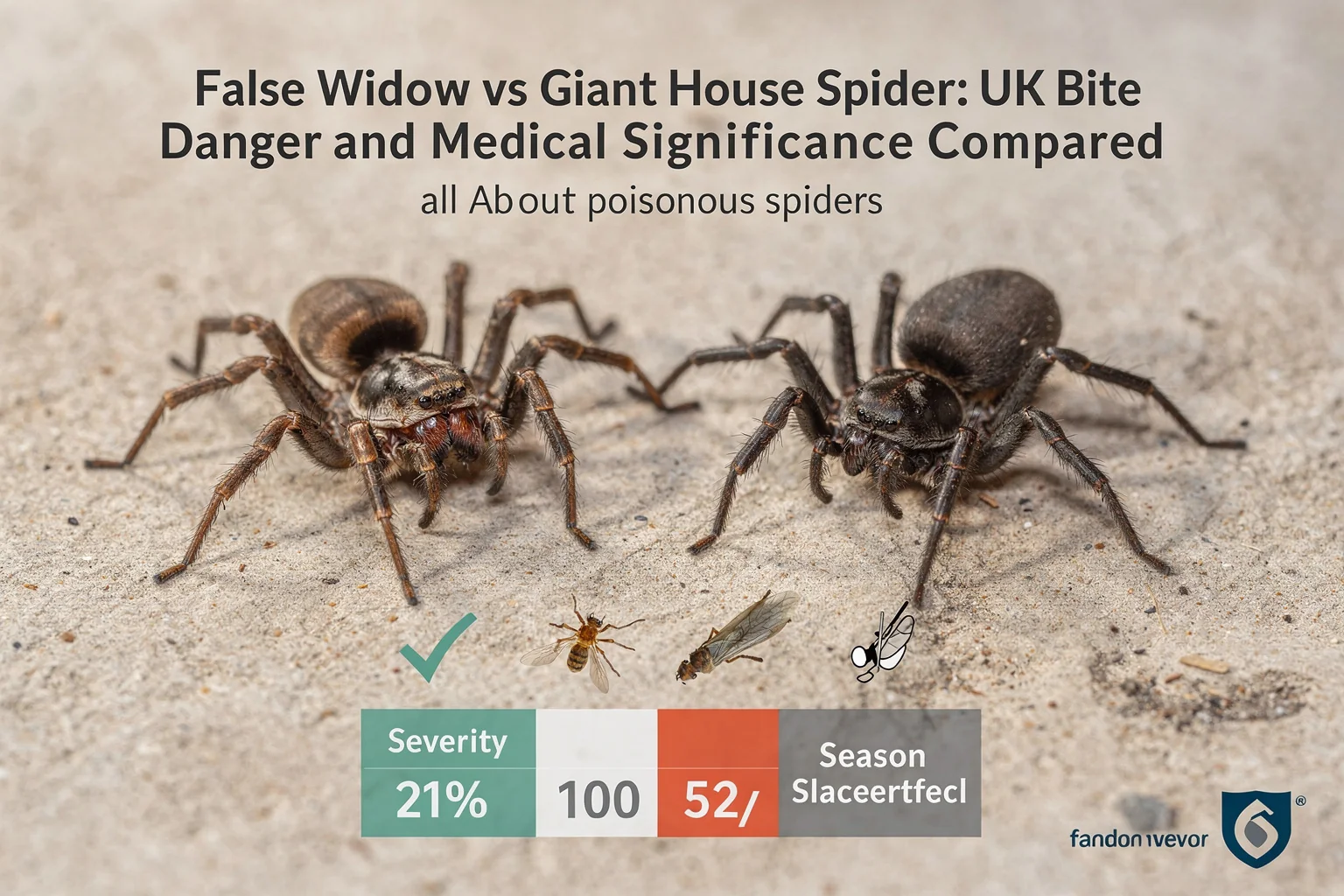
The spider you just spotted in the bath probably isn't what you think it is. Most UK households will encounter either a false widow or a giant house spider at some point, yet the two species trigger wildly different reactions. One sends people to A&E in growing numbers. The other simply scares them into standing on a chair. Getting the identification right matters because your next move — from calm observation to calling NHS 111 or booking a pest inspection — depends on it.
This comparison breaks down what each spider actually does, where it lives, how its bite feels, and what the medical evidence says about real danger. If you want the facts on poisonous spiders in the UK, this is where to start.
Why These Two Spiders Dominate the Conversation
Walk into any East London kitchen after dark in autumn and you will likely meet one of these arachnids. The false widow (Steatoda nobilis) and the giant house spider (Eratigena atrica group) have become the most discussed spiders in British homes for opposite reasons. The false widow carries a toxic reputation backed by rising hospital statistics. The giant house spider carries a visual threat — all legs and sudden movement — with almost no medical record to support the panic.
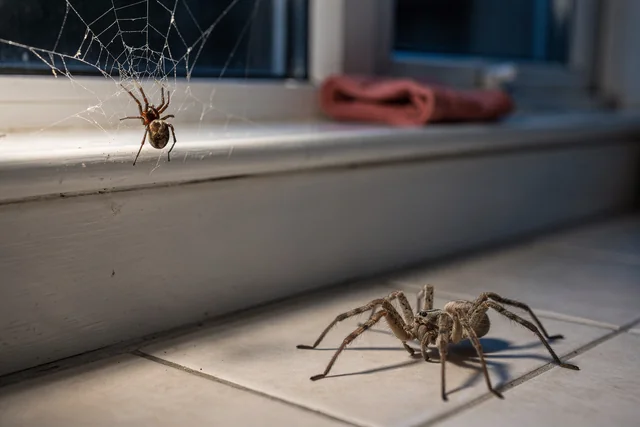
The confusion starts with size and shadow. A large brown spider scuttling across the carpet at night gets labelled dangerous by default. Most people cannot distinguish between a harmless house spider and a false widow at a glance, so every eight-legged visitor becomes a potential emergency. This misidentification costs the NHS in unnecessary anxiety and sometimes delays treatment for genuine bites.
Both species have expanded their UK range significantly in the past two decades. Warmer summers and milder winters help them survive and breed in greater numbers. The false widow arrived from the Canary Islands and Madeira, likely in fruit shipments, and has now established itself across southern England and into the Midlands. The giant house spider has always been native but thrives in the warm, dry corners of modern centrally heated homes.
Understanding the difference between these two common visitors lets you respond proportionately. Not every spider needs a glass and a piece of card. Not every bite needs A&E.
How to Tell Them Apart Without a Magnifying Glass
Identification starts with behaviour and location, not scientific equipment. These two spiders live differently, move differently, and leave different evidence behind.
The False Widow: Shape, Web, and Posture
False widows belong to the genus Steatoda, with Steatoda nobilis — the noble false widow — being the species behind most UK concern. The British Arachnological Society notes that false widows have globular, almost spherical abdomens and a distinctive dark, shiny appearance. The body shape resembles a small, dull grape. Legs are relatively short and thick compared to body size. Colouration ranges from dark brown to black, sometimes with cream or reddish markings on the abdomen that can form a vague skull-like pattern.
The web gives away a false widow immediately. It builds a three-dimensional tangle — messy, irregular, with strands running in all directions. You will find these webs at window frames, behind cupboards, in conservatories, and anywhere that offers warmth and shelter from drafts. The spider sits inverted in the web, often tucked into a corner or a tubular retreat formed from silk.
False widows are slow movers. They do not run across open floors. If you disturb one, it tends to curl into a defensive ball rather than flee. This sluggishness actually increases bite risk: a spider that cannot escape when pressed against skin is more likely to defend itself.
The Giant House Spider: Size, Speed, and Habitat
The giant house spider group — Eratigena atrica, Eratigena duellica, and closely related species — earns its name honestly. The British Arachnological Society records body sizes up to 18mm for mature females, with leg span pushing 75mm. That is a substantial spider by any measure. The body is elongated rather than round, with a mottled brown colouration and long, banded legs that look hairy but are actually covered in fine bristles.
These spiders build sheet webs with a distinct tubular retreat, often in a corner or behind furniture. Strands of silk extend from the main platform in a tangle that acts as a tripwire system. Unlike the false widow's chaotic web, the giant house spider's construction has clear structure: a flat sheet leading to a tunnel.
Behaviour differs dramatically too. Giant house spiders are fast — famously fast. They can cover ground at speeds that startle even confident spider-watchers. This speed is defensive, not aggressive. When disturbed, they run. They do not stand their ground. Most bath encounters happen because the spider fell in and cannot climb the smooth surface, not because it chose to lurk there.
The seasonal pattern also helps with identification. Giant house spiders become visible in August and September as males roam in search of mates. This "spider season" brings a predictable surge of sightings that coincides with cooling weather and mating behaviour, not with any increase in danger.
What Each Bite Actually Feels Like
Bite descriptions vary because spider bites are rare, often unwitnessed, and frequently misattributed. Skin reactions have many causes. Still, the medical literature and NHS data give us enough to compare.
False Widow Bite Symptoms and Timeline
The false widow bite is the one that generates genuine medical concern. The Natural History Museum explains that while these spiders are often confused with black widows, they are far less dangerous. Most bites produce only local effects. The typical sequence runs: immediate sharp pain, similar to a bee sting, followed by redness and swelling at the site. Within hours, the area may become tender and slightly raised.
Some bites develop into more significant reactions. The venom contains compounds that can cause local tissue effects, including blistering or, in rare cases, a small area of skin death (necrosis). A 2026 case reported in the Daily Mail described a Kent woman developing a "crater" in her leg from a false widow bite sustained from a spider hiding on a clothes peg. Such severe outcomes are unusual but documented.
Systemic symptoms — those affecting the whole body — are uncommon but possible. These can include fever, nausea, and general malaise. The NHS records these as "toxic effect of spider" admissions, and the numbers have risen sharply.
NHS Hospital Admission Data: The Rising Trend
The statistics deserve attention. NHS figures obtained through freedom of information requests show 100 hospital admissions in England for spider bites in 2025, up from 47 in 2015. BBC News, The Independent, and ITV News all reported this doubling in April 2026, linking it to the spread of the noble false widow spider. Oxford University ecologist Clive Hambler described Steatoda nobilis as "the most dangerous spider breeding in Britain" in a 2020 paper, a label that has stuck in media coverage.
"Hospital admissions from spider bites have doubled in England in the last decade, with experts blaming the rise on the 'explosion' in the population of false widows."
This increase reflects both more spiders and more awareness. People who might have ignored a mysterious skin lesion ten years ago now suspect spider bites and seek treatment. The actual danger per encounter remains low, but the population-level impact has grown.
Importantly, no deaths from false widow bites have been recorded in the UK. The charity Buglife emphasises that these spiders are not aggressive and that serious illness or death has not been documented. The risk is real but bounded: painful, occasionally medically significant, rarely life-threatening.
Giant House Spider Bite: The Non-Event
The giant house spider presents a stark contrast. Despite their intimidating size, verified bites from Eratigena atrica group spiders are extraordinarily rare. These spiders lack the defensive behaviour that leads to biting. Their first response is flight. Their second response is faster flight. They do not coil, they do not posture, and they do not hold their ground against a perceived threat.
When bites do occur — typically through accidental trapping against skin — the effects are minimal. Local redness and mild pain, if anything. No significant envenomation syndrome exists in the medical literature for this group. Anaphylactic reactions are theoretically possible in severely allergic individuals, as with any arthropod encounter, but this is not a spider-specific risk.
The giant house spider's venom is adapted for subduing small insects, not large mammals. The mechanical bite from the fangs might cause a brief pinch, but the venom delivery does not produce the tissue effects seen with false widows.
Medical Significance: When to Worry and When to Wait
The practical question for any household is: does this need professional medical attention? The answer depends on the spider, the symptoms, and the person bitten.
Red Flags After Any Spider Encounter
Seek NHS advice promptly if you experience any of the following after a suspected bite: spreading redness or red streaks from the site, increasing pain after 24 hours, fever or chills, nausea or vomiting, muscle cramps or spasms, or any difficulty breathing. These symptoms suggest either a significant envenomation or a secondary infection, both of which need assessment.
People with compromised immune systems, diabetes, or poor circulation should have a lower threshold for seeking help. Children and elderly individuals also warrant closer observation.
For false widow bites specifically, watch for blistering at the bite site or any area of skin that turns pale, dusky, or black. These signs suggest local tissue involvement that may need wound care.
When Observation Is Enough
Most spider encounters need no medical intervention at all. A giant house spider in the bath warrants a glass, a piece of card, and release outdoors — or simply leaving it be if it is not causing distress. These spiders are predators of flies and other household insects. Their presence indicates a food source, not a hygiene problem.
Even with false widows, the majority of bites resolve without treatment. Clean the site with soap and water, apply a cold compress for swelling, and monitor. If symptoms remain local and stable, routine NHS services can handle any follow-up.
The key is accurate identification. If you did not see the spider, do not assume a spider bite. Many skin infections, allergic reactions, and insect stings present similarly. The NHS 111 service can help triage if you are uncertain.
Seasonal Patterns and Where to Find Each Spider
Timing and location help predict which spider you are dealing with. Both species have preferred habitats within the home, and their activity peaks at different times.
False Widow Distribution Year-Round
False widows do not follow a single seasonal spike. The Natural History Museum confirms they can be seen indoors throughout the year, though autumn brings more visible movement as temperatures drop. Some move inside from outdoor locations; others have been present in undisturbed corners for months.
Preferred locations include window frames (especially south-facing), conservatories, loft spaces, and areas near external doors. They favour height — webs are often at or above eye level — and warmth. A centrally heated home with poor draft proofing offers ideal conditions.
In London and the southeast, false widows are now well-established. Sightings have reached Buckingham Palace gardens, according to 2026 reports, demonstrating how thoroughly they have penetrated urban environments. Their spread continues northward and westward, though they remain most common in the warmer southern counties.
Giant House Spider Autumn Surge
The giant house spider follows a more predictable calendar. August and September mark "spider season," when male spiders become active wanderers. Recent hot weather and heatwaves have produced bumper populations, as warm summers improve survival rates for spiderlings.
These spiders favour ground-level locations: under sofas, behind kitchen units, in garages and sheds. They need space for their substantial webs and retreat tubes. A cluttered spare room or little-used cupboard is ideal. The bath encounter is usually accidental — a male exploring territory falls in and cannot escape.
Unlike false widows, giant house spiders often signal their presence through visible web structure before the spider itself appears. The sheet-and-tunnel construction is distinctive once you know to look for it.
Practical Response: Observe, Contain, or Call For Help
Your response should match the actual risk, not the initial adrenaline spike. Here is how to handle each spider proportionately.
For Giant House Spiders
Catch and release works fine. These spiders are harmless, beneficial predators, and easily relocated. Place a glass over the spider, slide a stiff card underneath, and release it in a shed or garden area. If you prefer not to handle them, most local pest control services will treat spider removal as a minor call-out.
Prevention focuses on reducing entry points. Check door seals, window frames, and pipe penetrations. Reduce outdoor lighting near entrances, as lights attract the insects that spiders hunt. Peppermint oil spray along skirting boards has some deterrent effect, though evidence is anecdotal rather than clinical.
For False Widows
The approach depends on location and density. A single false widow in an unused conservatory is not an emergency. Multiple spiders in bedrooms or living areas, or any in homes with young children, warrant more decisive action.
DIY removal carries bite risk because of the spider's defensive curling behaviour. Wear gloves and use a vacuum with a long attachment for webs. Sticky traps placed near known web locations can reduce numbers, though they do not address how spiders are entering.
Professional pest control becomes sensible when: you have confirmed multiple false widows, bites have occurred, the household includes vulnerable individuals, or you cannot locate the source of entry. Treatments typically involve targeted insecticide application to harbourage areas, followed by monitoring. The pest control services across London that specialise in insect management can assess whether a one-off treatment or ongoing management is appropriate.
When to Call NHS 111 vs Pest Control
Medical services and pest control serve different purposes. Call NHS 111 or visit A&E for bite symptoms that are spreading, worsening, or systemic. Call pest control for spider presence that you cannot manage yourself, or when identification is uncertain and you need professional assessment.
The two services sometimes overlap. A pest technician can identify the species and advise on whether medical follow-up is warranted. An NHS clinician can treat symptoms but cannot tell you what spider was responsible unless you bring a specimen.
Common Misidentifications and Mistakes
The most frequent error is assuming size equals danger. The giant house spider looks threatening and triggers more panic calls than the smaller, more hazardous false widow. Reversing this assumption — learning that the modest dark spider in the window is the one to watch — is the core lesson for UK households.
Another mistake is killing every spider on sight. Indiscriminate spraying with household insecticides creates unnecessary chemical exposure and rarely solves the underlying issue. Spiders are predators; persistent spider presence indicates prey availability. Addressing flies, moths, or other insects often reduces spider numbers more effectively than targeting spiders directly.
The "spider season" media coverage also distorts perception. August and September bring more giant house spider sightings, which generates news coverage and social media posts. This visibility does not correlate with increased danger, but it does create a background anxiety that makes every subsequent spider encounter feel more threatening.
Finally, do not rely on internet images for identification. Lighting, angle, and spider condition dramatically alter appearance. The British Arachnological Society and Natural History Museum resources provide reliable visual references, but when in doubt, a local pest professional or natural history museum identification service can confirm what you have.
What the Research Says About Long-Term Risk
The scientific picture continues to evolve. The noble false widow's expansion across the UK is well-documented, and climate modelling suggests further northward spread. Warmer winters improve overwinter survival; longer summers extend the breeding season. This is not an invasion in the dramatic sense but a gradual range expansion that has been underway for two decades.
The medical research is less certain. Hospital admissions have doubled, but the baseline was low. One hundred admissions annually across England's population of 56 million is not a public health crisis. It is, however, a trend worth monitoring. Better recording practices, increased public awareness, and genuine population growth all contribute to the rise.
For the giant house spider, no comparable research agenda exists. These spiders are medically unremarkable, and scientific attention focuses on their ecological role and population dynamics rather than any health impact.
Reader Questions: False Widow and Giant House Spider Concerns
Can a false widow kill you?
No deaths from false widow bites have been recorded in the UK. The venom can cause significant local pain and, in rare cases, tissue damage, but life-threatening systemic effects have not been documented.
Are giant house spiders dangerous to pets?
Not specifically. A very small pet might experience local irritation from a bite, but giant house spiders avoid confrontation. The greater risk is a pet disturbing a false widow web and receiving a defensive bite.
Why do I only see these spiders in autumn?
You are probably seeing male giant house spiders roaming for mates. False widows are present year-round but may become more visible as they move indoors for warmth. The autumn concentration is behavioural, not a population spike.
Should I move house if I find false widows?
Almost certainly not. Professional treatment can reduce or eliminate a local population. The spiders are widespread across southern England; moving offers no guarantee of avoiding them.
Can I treat a false widow bite at home?
Most bites need only basic first aid: clean the wound, apply a cold compress, and monitor. Seek medical advice if symptoms spread or worsen. Do not attempt to extract venom or cut the wound.
Where to Get Reliable Identification Help
If you have photographed a spider and need confirmation, several services can help. The Natural History Museum's identification forums and the British Arachnological Society both accept queries, though response times vary. Local natural history societies often have knowledgeable members who can assist.
For immediate concerns, especially with children or vulnerable adults in the household, a same-day pest inspection removes uncertainty. Technicians can identify the species, assess the scale of any issue, and advise on whether treatment or simple monitoring is appropriate. In East London and Essex, pest control specialists familiar with both species can typically confirm identification and recommend next steps within a single visit.
Need professional help? BuzzKill offers fast, reliable pest control services across London and Essex.