
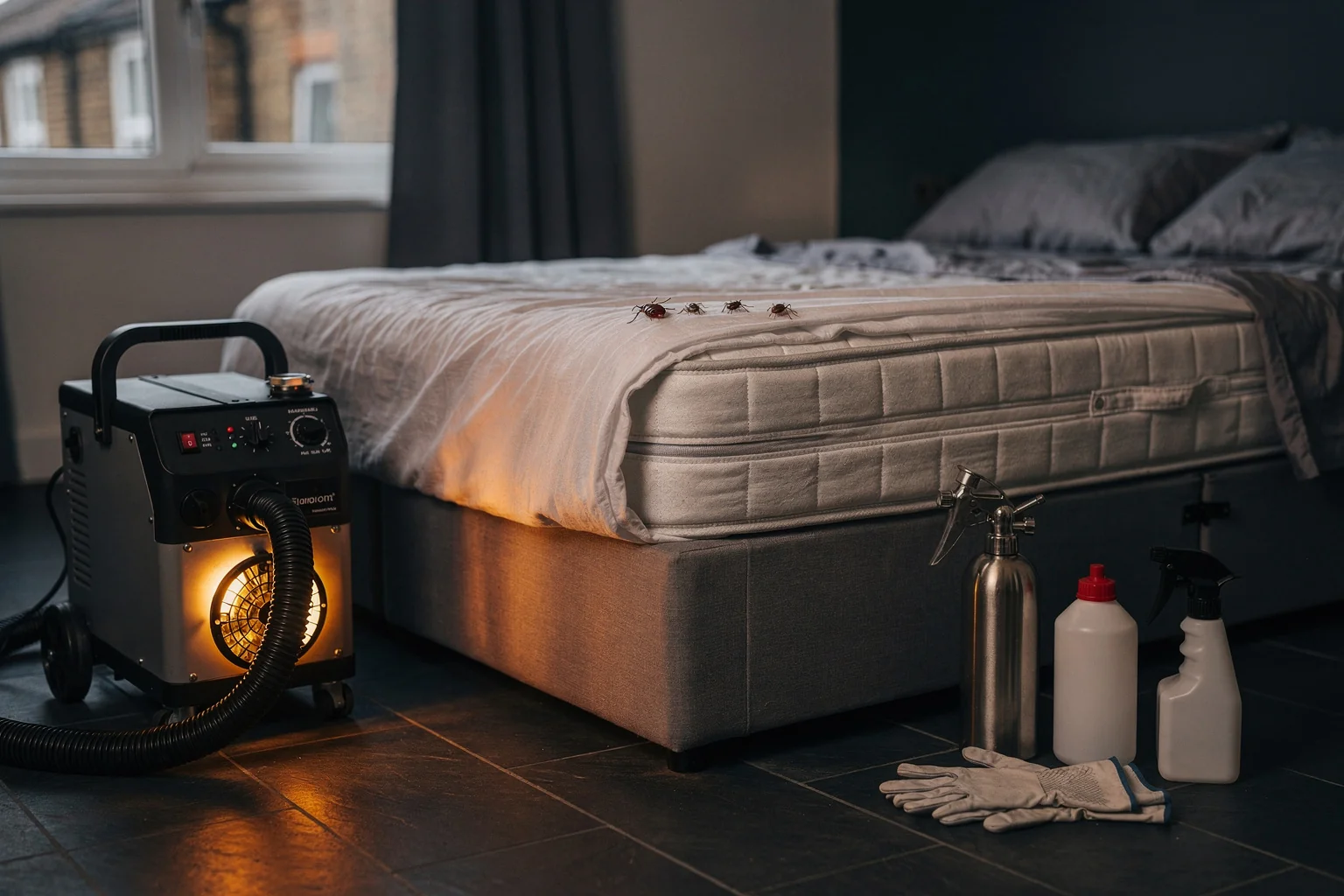
Mark woke up with three angry bites across his forearm on a Tuesday morning in late May. He’d noticed a faint rusty speck on his pillowcase the night before but brushed it aside. By Thursday, his wife had three more bites along her shoulder blade, and their four-year-old was scratching a small cluster on her legs. Mark lives in a two-up-two-down Victorian terrace off Ripple Road in Barking — the kind of solid 1890s build where party walls run right through the bedroom and sound travels, along with a lot else. His first call wasn’t to a pest controller. It was to a mate who’d “got rid of them with a shop spray” two years ago. It didn’t work. By the time he’d tried a second over-the-counter product and thrown away a mattress, the infestation had pushed into the skirting boards and was starting to show in the next bedroom. That’s when he asked the question most Barking homeowners end up asking: do I need a heat treatment or a chemical insecticide?
We hear some version of that question every week across East London. And it’s the right one to ask — because the wrong choice at the wrong property wastes time, costs more than it should, and drags out a problem that rarely fixes itself. In this article, we’ll walk through the two proper professional routes for getting bed bugs out of a Barking home: whole-room heat treatment and targeted insecticide. You’ll find out how each one works, what the prep involves, what it costs in real terms, where it works well, and — perhaps most importantly — where it doesn’t. By the end, you’ll be able to match the method to your property and your household’s tolerance for disruption.
Understanding What’s Actually in the Room
Before you compare treatments, it’s worth being clear about what you’re treating. Bed bugs (Cimex lectularius) are small, flat, reddish-brown insects that feed on blood. An adult is about the size of an apple seed. They don’t fly or jump — they crawl, which means they spread by hitching a ride on clothes, bags, or furniture, and then by moving through voids in walls and floors once indoors.
In Barking, the housing stock hands bed bugs a particular advantage. Those Victorian and Edwardian terraces that fill streets around the Abbey and Upney often share roof voids, joist pockets, and party walls that aren’t fully sealed. Converted flats — and there are plenty of them in the area — can share service risers and pipework that give bed bugs a corridor between units. Even a well-kept home can pick up an infestation from next door, and the first you’ll know about it is usually bites.
The sign to look for is a small, flat, rust-coloured stain on bedding or mattress seams — that’s bed bug faecal matter. You might also see pale shed skins or, if the population is further along, the insects themselves hiding in bed frame joints, behind headboards, or in the curl of a mattress piping. Bites tend to appear in lines or clusters on exposed skin and can take a day or two to show up. If any of that sounds familiar, you’re not dealing with a one-off spider or a rogue mosquito — and it’s time to think about a proper treatment plan.
The Two Routes Out of an Infestation
When you strip away the marketing, there are really two evidence-backed ways to clear bed bugs from a property: heat that kills all stages of the insect in one sustained treatment, and a multi-visit insecticide programme that relies on contact and residual chemicals to break the breeding cycle. Both can work. Both have trade-offs. The one that fits your household will depend on the layout of the rooms, who lives there, how much prep you can do yourself, and you’ll want to weigh the cost-per-certainty question.
We’ll look at each method in turn, then put them side by side for a Barking-specific decision — because a semi-detached in Goodmayes with cavity walls faces different challenges from a top-floor flat in Barking town centre.
Whole-Room Heat Treatment
Heat treatment works by raising the core temperature of a room — and everything in it — to a level that is lethal to all bed bug life stages. In a professional setup, large electric or diesel-powered heaters are brought in, temperatures are monitored with wireless sensors placed in the deepest hiding spots, and the air is moved with high-flow fans to avoid cool pockets. The target is typically 49 °C to 56 °C maintained long enough to kill adults, nymphs, and eggs. Most UK operators aim for a minimum of 135 °F (roughly 57 °C) throughout the treatment zone and hold it for at least 90 minutes to two hours.
The obvious advantage is completeness. Heat doesn’t care whether the bug is buried inside a mattress seam, tucked behind a skirting board, or hiding in a plug socket — if the temperature reaches target and holds, the insect dies. There’s no resistance issue, no egg survival, and no need to guess whether you’ve treated every crevice with the right amount of chemical.
For a Barking terrace with solid brick walls, heat has another advantage: it penetrates into the nooks and crannies that chemical sprays struggle to reach if you can’t get the nozzle deep enough. In a converted flat with adjacent units, heat can be aimed at the affected rooms only, which means you’re not relying on a chemical barrier that might be breached from next door.
The drawback is preparation. Anything that can’t tolerate prolonged high temperatures — candles, certain plastics, pressurised cans, delicate antiques, some electronics — has to be removed or protected. The treatment takes four to eight hours on the day, and you can’t occupy the rooms during that time. Afterward, there’s no long-lasting residual protection, so if a neighbour’s flat is the source and that source isn’t treated, you could get re-infested. Heat treatment tends to cost more per visit, but it is usually a single session.
Last year, a young family in a mid-terrace on the Barking side of Longbridge Road went with heat after finding bed bugs in two bedrooms. The technician sealed the room doors with temporary barriers, placed sensors inside the mattress seams and behind the headboard, and ran the heaters for the full cycle. The whole family went out for the day, and by that evening the rooms were cooling down and free of live activity. They had to bag and launder bedding first, but they didn’t need to discard furniture or vacate the house overnight. In that specific layout — two stacked bedrooms with solid dividing walls — heat worked well because the target zone was self-contained and the neighbour on the other side of the party wall wasn’t reporting issues.
Chemical Insecticide Treatment
A professional chemical programme isn’t the same as the aerosol you buy in a supermarket. It typically mixes fast-acting pyrethroid sprays with longer-lasting residual dusts applied to cracks, crevices, skirting boards, bed frames, and other harbourages. Sometimes a technician will also use an insect growth regulator that stops immature bed bugs from reaching breeding age. Unlike heat, this method doesn’t aim to kill everything in a single session. Instead, the first visit knocks down the active population, and follow-up visits — usually two or three, spaced a fortnight apart — catch newly hatched nymphs before they can mature and lay eggs.
The main advantage for a Barking resident is that insecticide can be easier to schedule around a working household. The rooms can usually be used soon after the product dries, which might be an hour or two, and the preparation tends to be less disruptive: clear the floors, pull furniture a few inches from the walls, wash and tumble-dry bedding on a hot cycle, but you don’t need to empty every heat-sensitive item. Residual products left in wall voids and behind skirting provide a protective window for several weeks, which is useful if the infestation originated in a neighbouring flat that hasn’t yet been treated or if the source is a shared laundry room.
The trade-off is that insecticide must physically contact the insect. Bed bugs hiding deep inside a wall cavity, inside a hollow bedpost, or under a carpet gripper may survive the first application. There’s also the question of resistance. Some UK bed bug populations have developed reduced susceptibility to common pyrethroids, though professional operators in London are aware of this and can rotate product classes or add silica-based dusts that desiccate the insect mechanically. In practical terms, a multi-visit plan usually works, but it requires patience and a strict follow-up schedule.
A landlord we worked with in a Barking conversion flat off Longbridge Road chose a chemical programme after bed bugs appeared in a tenanted one-bedroom. The resident couldn’t easily leave the property for a full day and wasn’t comfortable with the upheaval of a whole-room heat prep. The first visit applied a residual spray to the bed frame, skirting, and any gaps in the floorboards; the second visit two weeks later picked off the last nymphs that had hatched after the initial treatment. It took three visits total to get to zero activity, but it cost less than a heat session and the tenant could live normally in between. The risk — and the landlord accepted it — was that if the infestation had spread into the adjacent flat, the chemical barrier alone wouldn’t stop a fresh incursion.
How They Compare in a Barking Home
At this point, you’re probably trying to picture what each option means for your specific situation. Let’s line them up across the things that matter most when you’re choosing a treatment path.
Speed and certainty. Heat treatment kills all stages in a single session, provided the operator reaches the correct temperature in every hiding spot. If the survey misses a cold pocket — a thick wall void that the fans didn’t penetrate — a few eggs can survive, but a competent crew uses enough sensors to catch that. Chemical programmes need multiple visits, so you’re living with the problem for three to six weeks. For most households, the psychological relief of a one-and-done treatment is significant.
Prevention of recurrence. A heat treatment leaves no residual barrier, so its lasting value depends on the source being inside the treated rooms and not being reintroduced. If your infestation came from a neighbour and that neighbour’s flat remains infested, heat won’t help you three weeks later. Insecticide’s residual layer offers ongoing protection for a month or so, which buys time if you’re still negotiating with a landlord or a housing association about treating the adjacent property. That’s a real consideration in Barking’s older blocks, where party walls and shared pipework can act as pest corridors.
Preparation effort. Heat treatment asks more of you upfront: clothes and bedding need to be bagged and washed, delicate items removed, rooms cleared enough for fans and ducting. If you’re already exhausted from weeks of interrupted sleep, that can feel overwhelming. Chemical prep is lighter — mostly floor clearance and a thorough hoover — but you’ll need to repeat the hoovering before each follow-up visit to lift eggs and debris.
Safety around people and pets. Heat treatment poses no chemical risk. You re-enter a clean room. The fire risk is managed by the operator, who monitors temperatures and moves furniture away from heater outlets. Chemical treatment uses products that are authorised for indoor use in the UK, but you do need to keep children and pets away from treated surfaces until the product dries, and you should not re-enter until the technician says it’s safe. If you have a crawling baby, a pet that licks the skirting, or a family member with respiratory sensitivity, that’s a conversation to have with the operator before anyone opens a spray bottle.
Cost. In Barking, you can expect to pay somewhere between £350 and £650 for a single-room heat treatment, depending on room size and access. A two-bedroom terrace might run closer to £800 to £1,200 once you factor in all affected rooms. A chemical programme typically comes in at £150 to £250 per visit, with two or three visits needed, putting the total between £300 and £750. The headline difference isn’t always massive, but heat costs more upfront while chemical spreads the bill over several weeks.
There’s no universal winner. The right call shifts depending on whether the flat above you has an unaddressed problem, whether you can empty the bedroom for a day, and how quickly you need the biting to stop.
Matching the Method to Your Barking Property
Let’s put this into a few real-looking scenarios — not because your home will be exactly the same, but because seeing how the factors interact often makes the decision clearer than any checklist.
Victorian terrace, owner-occupied, infestation confined to two bedrooms, no issues reported in neighbouring houses. Heat treatment is the strongest candidate. The solid brick walls give good thermal mass, and if the bug source is inside your own home, a single well-monitored session can close the chapter. You’ll need to strip beds and move some belongings, but you can be back in your own bed the same night.
Ground-floor conversion flat in a four-storey building, infestation started after new neighbours moved in upstairs, managing agent is slow to act. A chemical programme may be the more practical route. The residual protection gives you a buffer while you push the freeholder to inspect the adjacent flats. A heat treatment here could be undercut within a fortnight if the source above isn’t treated. You’ll need to schedule follow-ups, but you’re not betting everything on a single day.
Family with a baby under one year old and a dog, infestation in one bedroom. Safety concerns around crawling hands and pet curiosity might push you towards heat, simply to avoid the question of chemical exposure — even though the products are safe when dry, the worry often isn’t worth it. Heat treatment also avoids the need for repeat entries, which means less disruption to nap schedules and a single day of upheaval rather than three separate mornings.
Rental property in Barking and Dagenham, where the tenant has limited ability to vacate the flat for a full day. Insecticide, with a considered prep plan, is often the realistic choice. The tenant can stay in the property, the landlord can spread the cost over multiple visits, and the follow-ups catch the inevitable stragglers. If you’re the landlord, make sure your chosen contractor knows the layout of any adjacent flats and is prepared to treat them if needed.
If you’re still unsure, the most useful thing you can do is book a professional survey before committing to a treatment path. A technician who spends thirty minutes on site will spot things no phone call can: the actual extent of the infestation, the construction details that matter for heat distribution, the harbourage points that a chemical programme needs to hit, and any sign that the problem crosses a party wall. In Barking, that kind of walk-through survey often takes less than an hour and gives you a clear plan.
When You Need a Professional Look
Bed bugs are one of the few pests where waiting almost always increases the cost. A light infestation caught in one room might be cleared with two chemical visits or a single heat session. A heavy infestation that has spread through the floorboards and into the landing wardrobe might need full-house treatment and cost several times as much.
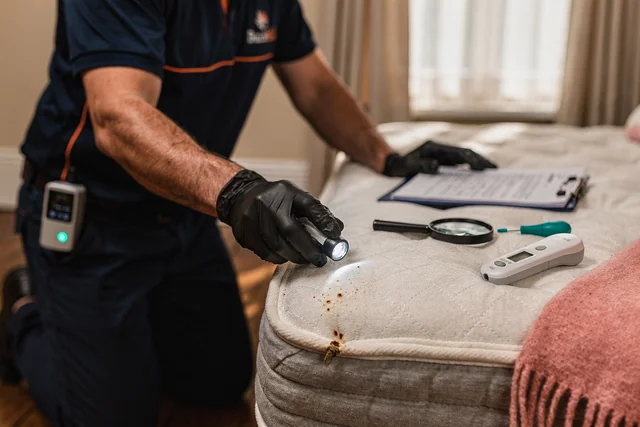
If you’ve found bites, if you’ve seen the telltale rust spots on a mattress, or if you’ve already tried a shop-bought spray and it didn’t stop the problem, the next step is to bring in an experienced pair of eyes. That’s where bed bug removal in Barking can make a real difference — you get a same-day inspection with no call-out charge, and the technician will talk you through which method fits your property rather than pushing a single option. The team covers the whole Barking and Dagenham pest control area and is used to working in the converted flats and terraced streets that define the borough, so they’ve seen how bed bugs move between rooms and between addresses in this specific building stock.
Not every bed bug job needs heavy equipment — sometimes a targeted chemical treatment around the bed frame is all it takes. But you won’t know until someone looks. Our technicians carry the right gear for both heat and insecticide, and they’ll explain the prep, the cost, and the likely outcome before anything starts. If you decide to go ahead, the whole thing can often be scheduled within 24 hours, which matters when you’re being bitten.
Every bed bug infestation ends the same way: either the bugs go, or they don’t. The only question is how many sleepless nights happen in between. Getting the method right for your Barking home is the single biggest thing you can control.
Need professional help? BuzzKill offers fast, reliable pest control services across London and Essex.