
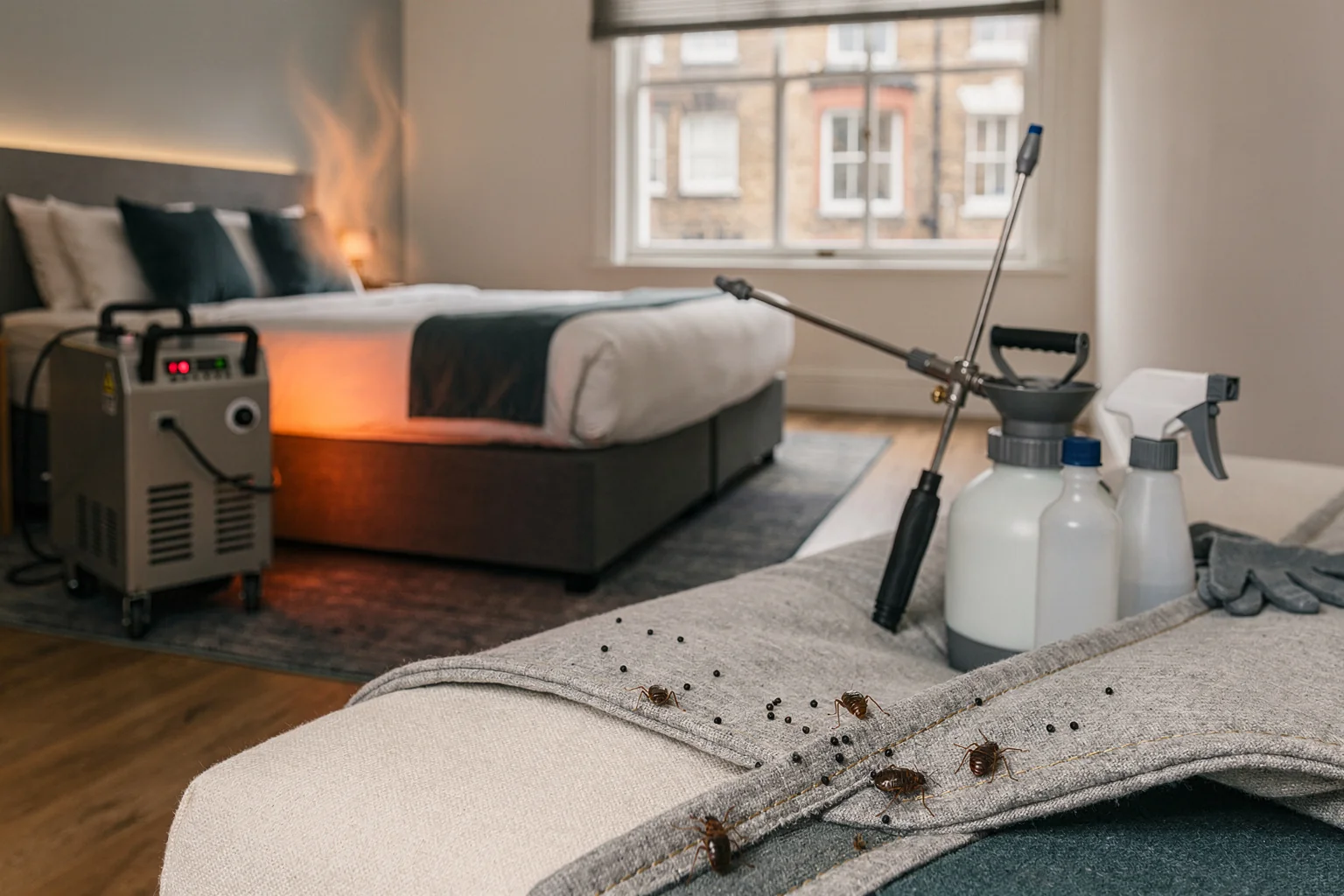
You have a business to run. Discovering bed bugs in a hotel guest room, an office, or a care home sends a shiver down any manager’s spine. You need them gone, fast, but you also need a plan that fits around your operations, your guests, and your reputation. Two professional treatment routes dominate the UK market today: whole-room heat treatment and targeted chemical spraying. Both can work, but their impact on a business is not the same. You do not have the luxury of treating a single bedroom and waiting a week to check — you have bookings, shifts, and regulations. The right choice often comes down to the building, the nature of the pest problem, and how much downtime you can absorb.
We will walk through what each method actually does inside a commercial property, what drives their effectiveness, what they cost in time and money, and how to decide which one gets your business back to normal fastest. Along the way we will look at what bed bug biology and recent UK field data tell us, and how your specific type of business flips the priority list.
Why Business Settings Make Bed Bug Control Different
A residential bed bug job usually involves two or three bedrooms and a sofa. A commercial job might involve a 40-room hotel, a restaurant booth area, a theatre auditorium, or an entire wing of a care home. The stakes shift.
First, reputation risk. One verified guest review mentioning bed bugs can cost far more than the treatment itself. Speed matters, but so does silence — you want a method that resolves the problem without broadcasting it.
Second, operational downtime. Every hour a room is out of use directly hits revenue. Hotels lose nightly rates; offices lose productive space; cafes lose covers. You need to know exactly how long the treated area stays closed and how long it takes until it is safe again.
Third, compliance. Commercial kitchens, food service areas, and registered care premises fall under strict health and safety regulations. Any insecticide application must follow the Control of Pesticides Regulations (COPR) 1986 and the product label exactly, because pest controllers are legally bound by them. The British Pest Control Association’s Code of Best Practice for Bed Bug Management requires members to document every step, risk-assess vulnerable residents, and treat bed bug infestations to a published minimum standard. A DIY job or an uncertified contractor cannot offer that paper trail.
Fourth, scale and re-infestation risk. In a block of offices, a bed bug problem may be contained to one desk pod, yet you cannot treat one desk without thinking about the adjacent cluster. Chemical sprays leave eggs in cracks that hatch two weeks later. Heat can treat an entire floor in a single session. The difference in follow-up disruption changes your budget calculations.
How Heat Treatment Works in a Commercial Environment
Heat treatment lifts the air temperature of a sealed room or zone to a level lethal for bed bugs at every life stage — eggs, nymphs, adults — typically held between 50°C and 60°C. Large electric or propane-powered heaters push hot air through flexible ducting while high-velocity fans circulate it into every corner. Technicians monitor wireless sensors placed in the hardest-to-heat spots: under heavy furniture, inside wall voids, inside electrical sockets. The target temperature must reach those spots and hold for a defined period (often 90–120 minutes once the coolest sensor hits threshold).
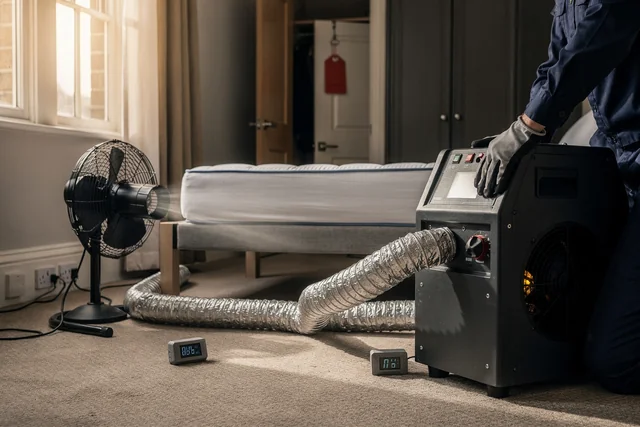
From a business perspective, the clock usually looks like this:
- Room prep: 1–2 hours (removing heat-sensitive items like candles, vinyl records, pressurised canisters; computers can usually stay if powered down).
- Active heating: 4–8 hours, depending on room volume and clutter.
- Cool-down: 1–2 hours before staff or guests can re-enter.
- Total downtime per area: roughly one working day.
Because heat can treat an entire room — and, when planned well, adjacent rooms simultaneously — a 20-room guesthouse can often be cleared in a single long day, with rooms coming back online in the evening.
The effectiveness is biological, not chemical. Heat denatures proteins and desiccates the insect. There is no resistance to 56°C. Egg stages, which many sprays cannot touch, are killed in the same session. Virginia Tech researchers outline the real-world variables that decide success: the size of the structure, the amount of time held at lethal temperature, the air movement created by fans, and — critically — the placement of the heater relative to the target rooms. They note that “rooms that are located at a distance from the heat generating equipment may take much longer to reach bed bug lethal temperature (if they reach it at all).” (Bed Bug Heat Treatments) So a qualified technician must design the heat layout for the specific floorplan, not just show up and turn on a machine.
For businesses, that means heat works best when the property can be sectioned into manageable, sealable zones. Open-plan offices with few doors need screening and segmentation. Kitchenettes with large extraction vents may bleed heat and must be checked. Records storage areas with archives at risk of humidity damage need extra care. Most good commercial pest controllers bring industrial dehumidifiers to prevent condensation after the treatment and use temperature-tolerant contact insecticides in the few cold spots that might escape the heating envelope.
How Chemical Spray Treatments Work for Businesses
Chemical treatments use liquid insecticides applied as a targeted residual spray along bed bug harbourages: mattress seams, bed frames, skirting boards, behind headboards, inside furniture joints, along carpet edges. The spray leaves a dry film that remains active for weeks, killing bugs that crawl over it. Some formulations also include an insect growth regulator (IGR) that stops young bed bugs from reaching adulthood and reproducing.
The operational timetable is shorter per visit but frequently multiplies:
- Prep: 1–2 hours (removing bedding, clearing floor edges, vacuuming).
- Application: 1–3 hours — the technician works through the affected rooms methodically, often using crack-and-crevice injection tips for electrical sockets and drill holes.
- Re-entry delay: 2–4 hours while the spray dries (faster with modern water-based microencapsulated products).
- Repeat visits: typically 2–3 visits spaced 10–14 days apart to catch hatching eggs that survived the first application. Because most insecticides are not ovicidal, larvae emerging after the initial spray pose a fresh wave.
For a business, that means multiple blocks of downtime spread over a month. A small hotel can find itself repeatedly cordoning off the same room at short notice, which often annoys guests more than a single deep-clean day.
The bigger variable now is insecticide resistance. Across the UK, bed bug populations have developed widespread genetic resistance to pyrethroid and, increasingly, neonicotinoid insecticides. Field reports from pest professionals in London describe treatment failures where previously reliable products no longer depress bug numbers. When a technician faces a resistant strain, the chemical route can turn into a protracted, expensive cycle of trying different active ingredients — each with its own label limitations, especially in food preparation areas. The BPCA code stresses that all insecticides must gain approval under COPR, and the label becomes a legal instruction. So the technician cannot improvise; they must use the permitted rate, in the permitted locations, or risk breaking the law. For a restaurant manager, that often means many surfaces cannot be sprayed, narrowing what a chemical treatment can achieve on its own.
Chemical spraying still has real strengths. It is often less expensive per visit than heat equipment hire. It can target a single piece of furniture without emptying an entire floor. It leaves a protective residue that may intercept bed bugs wandering in from untreated neighbouring units. In low-level infestations caught early — say, a few bugs spotted on one chair in a community centre — a fast chemical hit combined with thorough steam cleaning can stop the problem without business disruption.
Key Differences for Business Owners
When you weigh these two options, the balance tips on four operational factors: downtime, certainty, cost per day of closure, and how the treatment fits your furniture and layout.
Downtime comparison. Heat requires roughly one full day per treatment zone. Chemical takes two or three shorter closures spread across a month. If your business is a hotel where you can take a wing offline on a Tuesday, the heat approach may cost a day’s revenue but leave you finished. If your business is a call centre with fixed shift patterns, multiple partial closures might be easier to absorb.
Effectiveness against eggs. Heat kills eggs outright, provided the temperature at the egg location reaches the lethal threshold. Chemicals rarely do. That single fact often makes heat the preferred route for premises where a single surviving egg can restart the infestation, such as a care home with residents who cannot easily be moved for follow-up treatments.
Resistance. As noted, chemical resistance is no longer a scare story. While you can still find potent non-pyrethroid insecticides prescribed by a professional, it requires experience to select and rotate them. Heat bypasses resistance biology entirely.
Residual protection. Chemical sprays leave a lasting film that may catch returning bugs for weeks. Heat leaves nothing. After a heat treatment, there is zero residual effect. That is an advantage for rooms used by chemically sensitive people; it is a disadvantage if neighbouring units remain infested and bugs can walk back in. In multi-occupancy buildings like flats above a business, the best strategy is often to combine heat in the worst-affected unit with targeted chemical barriers at entry points.
Cost. There is no single price. A whole-floor chemical treatment package with three visits might cost £300–£700 for a small footprint; a whole-building heat treatment for a large B&B might run £1,500–£3,000. But the financial loss from a closed room for a week can dwarf that difference. A single hotel room in London grossing £120 per night loses £840 in seven days. If heat fixes it in one day and chemicals take three return visits over three weeks, the faster method can actually work out cheaper.
Documentation. Both methods, when delivered by a BPCA member or BASIS PROMPT-registered firm, produce a full risk assessment and a report you can file for your environmental health officer or insurance provider. A well-documented chemical treatment is usually compliant; a well-documented heat treatment is equally defensible. The difference is the surrounding risk: heat treatment avoids the residual pesticide presence that some insurers ask extra questions about, especially in food service environments.
In a side-by-side look at a typical East London guesthouse, the choice often mirrors the logic we cover in our heat treatment vs chemical sprays East London guide, where the call depends as much on building design and guest booking profile as on the pest itself. In Barking, premises with older, compartmentalised layouts sometimes need a split strategy, which our heat treatment or insecticide for Barking bed bugs piece walks through. Those examples show why no single answer fits every postcode.
Choosing the Right Treatment for Your Type of Business
Different premises live by different rhythms. Here is how the decision often shakes out by sector.
Hotels, Guesthouses, and Short-Stay Accommodation
Turnaround speed is everything. A room out of service for three weeks of sporadic treatments means three weeks of lost revenue and, potentially, a reputation note on Booking.com or Trustpilot. Heat’s ability to deliver same-day reoccupation makes it the default for many East London hoteliers. If you manage a 12-room guesthouse in Greenwich and discover bed bugs in two adjacent rooms, the most efficient plan is usually to treat the cluster with heat and have the rooms back online by evening with a follow-up inspection a week later. For carpets and upholstery, it helps that the dry heat does not leave the damp residue that invites mould — a real concern in small, poorly ventilated rooms.
If your property sits in an area where bed bug callouts are rising sharply — one London borough recently logged a 50% increase in cases — having a standing relationship with a professional who can respond on the day you call is worth more than haggling over the treatment type.
Restaurants, Cafés, and Commercial Kitchens
Heat can work, but it demands caution around refrigerated units, fire suppression systems, sprinkler heads, and delicate electronics. It also cannot be applied in a busy kitchen mid-service. Many restaurant managers prefer a carefully targeted chemical programme because the technician can treat only bench legs, booth frames, and skirting boards after closing, leaving the food preparation surfaces untouched. The key is product choice: only insecticides approved for use in food areas with the correct post-treatment ventilation period. The BPCA best-practice document reminds every technician to consult the product label for the required clearance interval, and that label has the force of law. When those intervals are respected, the risk to diners is minimal. Resistance management matters, though: a restaurant with a stubborn infestation may still need to switch to heat if chemicals fail to knock back the population.
Offices
Offices are often the easiest premises to treat because desks and partitions can be rearranged to give a technician clear access. If the issue is confined to one floor, heat treatment over a weekend when the office is empty can return the space ready for Monday morning. Nobody wants to explain a lingering pesticide smell to staff arriving for the week, so heat’s lack of residue and odour is a selling point. If the building slab has a history of bed bugs floating between tenant suites, a combined approach — heat in the source suite and chemical barriers along the shared wall — often prevents the problem bouncing back.
Care Homes and Sheltered Accommodation
Vulnerable residents, mobility aids, hoists, and sensitive skin all make chemical residues a serious concern. A resident cannot be temporarily relocated for two weeks while the room “airs off” between spray cycles. Heat’s one-and-done nature and residue-free outcome give it a strong advantage in these settings, though careful prep is still required to remove personal items that could melt, and a qualified technician will always coordinate with the care manager to ensure resident safety during the treatment window.
Whatever your sector, the best plan starts with an on-site survey. A technician will map the infestation, measure rooms, check the presence of heat sinks (stone walls, large metal fixtures), and advise whether a single method or a blend will give the fastest, most reliable result.
Preparing Your Business for Bed Bug Treatment
Whether you pick heat or chemicals, preparation determines how smoothly the job goes and whether you avoid recalls. Here is what you can do the day before the crew arrives.
For heat treatments:
- Remove or open heat-sensitive items: candles, chocolates, vinyl wallpaper (if facing the source), flammable aerosols, pressurised canisters.
- Power down computers and unplug non-essential electronics. Laptops can usually be left in the room if they are lid-open for airflow, but check with your technician.
- Empty wardrobes of clothing that covers drawers and blocks air circulation; launder all bed linen at 60°C anyway — independent of the treatment, that reduces the bug load.
- Notify any neighbouring units about the noise of heaters, which can run for several hours. In multi-let offices, a short email avoids alarm.
- Confirm with your pest controller whether they will supply backup dehumidifiers to prevent condensation dripping through light fittings — particularly in older London buildings with suspended ceilings.
For chemical treatments:
- Strip beds and launder linen at hot wash. Do not return it to the room until after the application has dried.
- Vacuum all floors, especially edges and under furniture, and seal the vacuum bag for disposal.
- Move furniture 30–60 cm away from walls to expose skirting boards.
- Remove all food, cutlery, and utensils from the treatment zone, even in an office kitchenette.
- Inform cleaning staff of the re-entry interval; nobody should enter with wet shoes or mop the treated surfaces before the label-stipulated drying time expires.
A good commercial pest controller will give you a written prep sheet specific to your building. Follow it. Insurance claims after a bed bug incident often hinge on whether the business can show reasonable cooperation with the treatment plan.
When to Call a Professional Pest Controller
If you have spotted a handful of bed bugs in one room and your business has never had them before, it is tempting to buy a shop-bought spray. But that instinct can make things worse. Incomplete spraying can scatter bed bugs into deeper hiding places — they move away from the vapour into wall voids and adjacent rooms. The Metro investigation earlier this year highlighted how “the cost-of-living crisis has meant that more people are turning to ineffective DIY treatments that cause infestations to spread out of control.” In a commercial building, scattering a population across multiple units turns a one-room problem into a multi-floor disaster.
As soon as a staff member or guest reports a suspected bed bug, take three immediate steps:
- Isolate the area. Close internal doors, place a plastic sheet under the door, and stop service in that room.
- Do not remove furniture, luggage, or linen from the room — you risk carrying eggs or live bugs through the corridors.
- Contact a professional pest controller who is NPTA-registered and BASIS PROMPT-certified. Ask explicitly about their experience with commercial treatment protocols and request a written treatment plan before work begins.
Many businesses in London rely on a rapid on-site assessment to select the optimal treatment. When downtime is measured in hours, an appointment tomorrow is not fast enough. At BuzzKill Pest Control, we operate same-day inspections across East London and Essex, with no call-out charge, and our commercial bed bug removal in London service lets you speak to a BAS PROMPT-certified technician who can walk the property and recommend a heat-based, chemical, or blended approach within the hour.
The European Code of Practice for bed bug management frames every treatment around understanding bed bug biology and selecting tools that match the specific infestation — knowledge that comes from experience, not a one-size script. In a commercial setting, that level of scrutiny is not optional; it is the difference between a quiet resolution and a costly ongoing cycle.
Call 0203 468 1999 or request a callback through our website to get a technician on site the day you spot the first signs.
Need professional help? BuzzKill offers fast, reliable pest control services across London and Essex.