
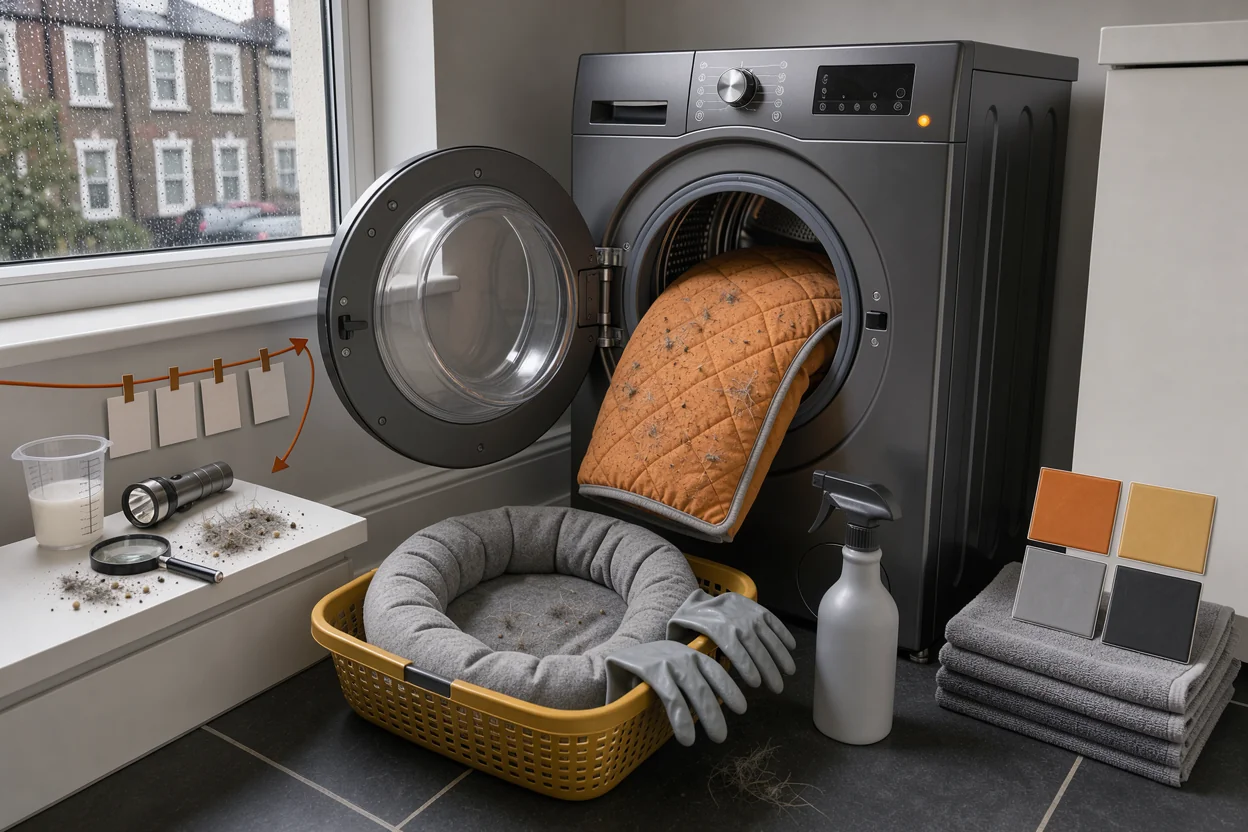
If you've found fleas on the dog or the cat, the single most useful thing you can do in the next hour is strip every bit of bedding they touch and get it into a properly hot wash. The question everyone asks at that point is the one this checklist answers: what temperature actually kills flea eggs, and what temperature just rinses them around the drum. The short answer is 60°C, held for the full cycle. A 40°C wash lifts adult fleas off the fabric and drowns some of them, but the eggs — tiny, smooth, and surprisingly tough — can come through it intact. This guide walks you through the whole job in order: the science of the kill threshold, a 30 to 60 minute bedding checklist you can run today, what to do with things that can't take 60 degrees, and the signs that the problem is in the room rather than the laundry basket.
I'm writing this the way our technicians talk it through on site visits across East London, because getting the flea treatment pet bedding hot wash temperature right is the difference between one bad week and a problem that keeps hatching back for months.
Why 60°C is the number that matters
Fleas don't die at a single magic temperature. They die when heat is sustained long enough to denature the proteins in their bodies, and the same goes for their eggs and larvae. The threshold that pest specialists quote again and again is roughly 50°C held over time — heat kills fleas at every life stage, including eggs, once temperatures climb past that point and stay there. Your washing machine's 60°C programme gives you that sustained heat with a margin of safety, because water temperature drops as the load absorbs it, and thick dog-bed filling insulates whatever is hiding in the middle.
Here's what happens at the temperatures people actually use:
- 30°C or cold wash. A rinse, effectively. Adult fleas can survive immersion in water for up to 24 hours, and eggs are waterproof. You've cleaned the bedding and kept every flea alive.
- 40°C wash. This dislodges adults and larvae and drowns some of them, especially with detergent and a long cycle. But it sits well below the kill threshold, so eggs tucked into seams and folds can survive and hatch within days of the bedding going back down.
- 60°C wash, full cycle. Sustained heat above 50°C reaches into the fabric long enough to kill adults, larvae, and eggs. This is the standard UK veterinary charities and pest professionals recommend for exactly this reason.
- 60°C wash plus a hot tumble dry. The belt-and-braces option. Thirty minutes in a hot dryer after a hot wash finishes off anything that made it through, and it's the routine US shelter guidance swears by for flea-heavy households.
So when someone tells you "wash everything hot", what they mean is 60, not the eco setting you normally run. That one dial change is the entire point of this article.
One more thing worth knowing: detergent helps, but it's not doing the killing here. Detergent breaks the water's surface tension so fleas sink and drown faster, and it strips the waxy coating off eggs, which makes them more vulnerable to the heat. Flea Science's breakdown of flea eggs in water makes the point clearly — water alone, even soapy water, is a weak weapon. The heat is the weapon.
The 30 to 60 minute bedding strip-down checklist
Work through this in order. You need bin bags, your usual detergent, and access to the washing machine and, ideally, a tumble dryer. The route runs from the pet's sleeping spots outwards to everything else fabric in the house, because flea eggs roll off animals and land wherever they rest.
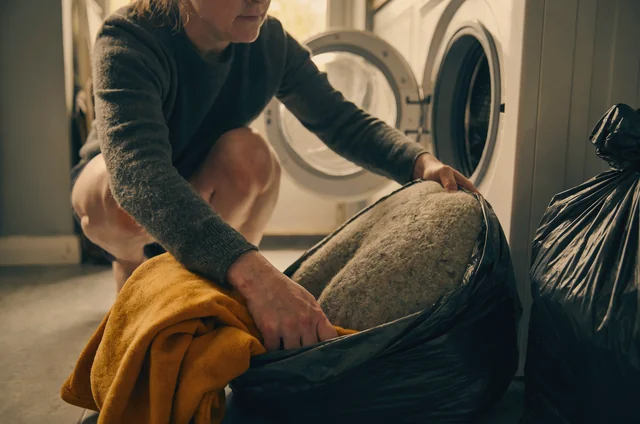
1. Bag the bedding at the source, not at the machine. Pick up the pet bed, blankets, and any throws the animal sleeps on, and put them straight into a bin bag where they lie. Don't carry them loose through the house — eggs shake off like dandruff and you'll seed the hallway carpet on the way. A "yes" here looks like everything fabric from the pet's zone sealed in bags before it moves an inch. If yes, carry the bag straight to the machine and empty it directly into the drum, then tie the empty bag and bin it outside.
2. Check the wash label before you commit to 60°C. Most cotton covers, fleece blankets, and duvet-style pet bed covers take 60 degrees fine. Memory foam inserts, waterproof-backed beds, and anything with glued seams often can't. A "yes" — the label permits 60°C — means it goes in now on the longest 60-degree programme your machine offers. A "no" isn't a dead end; skip ahead to the section below on delicate items, because the tumble dryer or steam can do the job the washer can't.
3. Strip your own bed if the pet ever gets on it. This is the step people skip and regret. If the dog sleeps on your duvet even occasionally, your bedding is part of the problem. Sheets, duvet covers, pillowcases, and the throw at the foot of the bed all go in at 60. What "yes" looks like: you've seen the animal on your bed in the last month. What it means: your bedding joins load one or two, no exceptions.
4. Run full cycles, not quick washes. A 15-minute rapid cycle at 60°C doesn't hold the load at temperature long enough to penetrate a dense dog bed. Choose the full cotton or synthetics programme. Yes means the cycle runs an hour or more. That extra time is the kill mechanism, not wasted electricity.
5. Don't overload the drum. Hot water has to circulate through the fabric. A drum packed tight leaves a cool core in the middle of the load, and that's where eggs survive. If you're washing a thick pet bed, wash it alone. Yes looks like the drum no more than two-thirds full.
6. Dry hot, or dry long. Tumble dry on high heat for at least 30 minutes after the wash. If you're line-drying because the item can't take the dryer, get it into direct sun and let it dry completely — UV and the dry-out itself work against eggs, just more slowly and less reliably. Damp bedding left in a heap is a nursery.
7. Hoover the empty sleeping area while the wash runs. Eggs that fell off the bedding before you bagged it are in the carpet, the sofa gaps, and the skirting boards around the pet's spot. Vacuum slowly, go over the area twice, and empty the cylinder or bag into an outside bin straight away. WebMD's flea prevention and treatment guidance is blunt about this: vacuuming and hot washing together are what clear a home, because each one catches what the other misses.
8. Treat the animal on the same day. All of this is pointless if the walking egg-layer is still carrying fleas. A vet-approved spot-on, tablet, or collar needs to go on the same day as the big wash. Yes means the pet is treated and dosed to date. If it isn't, you're laundering around a moving source and the cycle restarts.
That's the full run. Most households get through it in under an hour of active effort plus machine time.
What to do with bedding that can't take 60 degrees
This is where good intentions stall, because the posh orthopaedic dog bed with the foam core says 30°C and nothing hotter. You have four workable routes, and each has a "yes" test.
Hot tumble dry without the wash. Heat kills fleas in the dryer just as it does in the washer — heat treatment works on fleas and eggs whether the heat arrives wet or dry. Thirty minutes on high in the dryer kills adults, larvae, and eggs on dry fabric. Yes looks like: the label bans hot washing but allows tumble drying, or the item is dry-clean-only but dryer-tolerant. Run it hot and long.
Steam. A handheld garment steamer or a steam cleaner with a fabric head delivers contact heat well above 60°C. Work it slowly over seams, piping, and folds, because that's where eggs lodge. This is also the right tool for the mattress itself, the sofa, and carpet edges — the stuff that physically cannot go in a machine. Our technicians lean on steam constantly; it's one of the reasons steam bed bug removal works so well on fabric seams, and flea eggs are no tougher than bed bug eggs.
The freezer. Cold is slower than heat but it works. Seal the item in a bag and freeze it for at least 48 hours — longer for thick items, because the core takes time to get cold. Adult fleas die within days below freezing, though this is the least practical option for anything bigger than a cushion cover.
Replace it. If a cheap pet bed has been ground zero for weeks and won't survive any of the above, bin it. Seal it in a bag first. A fifteen-pound bed is cheaper than a second round of flea treatment for the whole house.
One item deserves a special warning: the mattress protector. Eggs collect in its seams and zip channel, and a loose fit means the centre barely heats up in the wash. If the protector allows it, 60°C with an unhurried cycle. If it doesn't, steam every seam twice. Do not assume a wipe-down or a spray of fabric freshener does anything at all.
Why the wash alone won't finish the job
Here's the uncomfortable maths. The fleas on your pet are the tip of it — roughly five per cent of the total problem. The other 95 per cent is eggs, larvae, and pupae scattered through your home: carpet pile, sofa cushions, floorboard gaps, the car boot if the dog travels with you. Veterinary guidance puts it plainly: fifty fleas on the animal can mean a thousand eggs and juveniles in the environment, and pupae can sit dormant for months waiting for warmth and vibration.
That dormancy is why fleas seem to "come back" two or three weeks after you've washed everything. They didn't come back. A new cohort hatched out of the carpet, jumped on the newly treated pet or the clean bedding, and the cycle rolled on. The hot wash handles the fabric reservoir. It does nothing about the floor.
So the wash sits inside a bigger routine:
- Vacuum daily for at least a fortnight, concentrating on the pet's routes and resting spots. Vibration from the hoover actually triggers dormant pupae to hatch, which sounds like a downside but isn't — newly hatched adults are exposed and killable, either by the treated pet's spot-on or by the next vacuum pass.
- Keep the pet's preventative current year-round. UK vets increasingly argue for twelve-month coverage because centrally heated homes keep fleas active through winter. The old "flea season" idea doesn't hold indoors.
- Wash the bedding weekly while you're clearing an outbreak, then monthly as maintenance. Fleas survive washing at lower temperatures, so keep the dial at 60 every time, not just the first time.
- Consider a household spray with an insect growth regulator if the outbreak is established. Growth regulators stop eggs and larvae from developing, which breaks the cycle in the places you can't wash. Follow the label carefully, keep pets and children out until it dries, and never spray bedding directly.
If you want a habit that keeps all of this straight, a simple wash-day tracker helps: date, what was washed, at what temperature, when the pet was last treated. BuzzKill is planning a printable flea-clearance checklist along exactly those lines, because the households that beat fleas are the ones that keep the rhythm going past the first week.
Signs the fleas are in the room, not the laundry
There comes a point where the washing machine has done all it can. Run these checks after your first full cycle of washing, treating, and vacuuming.
You're still seeing fleas a week later. A few new hatchlings in week one is normal. Fresh fleas every day in week two means the environmental reservoir is bigger than fabric, and the lifecycle in the carpet is self-sustaining.
Bites keep appearing on ankles and lower legs. Flea bites on humans cluster around the feet and ankles because that's jumping height from floor level. New bites after the big clean point to an active population in flooring or furniture.
The pet is treated, washed, and still scratching. If the animal is on a current, vet-approved preventative and still showing flea dirt (the black grit that turns red-brown on damp tissue), the reinfestation pressure from the home is overwhelming the treatment.
Fleas in rooms the pet never enters. That means the population has spread through the property on clothing and foot traffic, and spot-treating fabric won't reach it.
You can see them in the carpet. Part the pile in a sunny spot near the pet's bed and watch for movement, or shuffle across the carpet in white socks and check them after ten minutes. Fleas on the socks means fleas in the floor.
Any two of these together and it's time for professional treatment. A proper flea job treats the whole environment — insecticide plus growth regulator, applied into carpet edges, under furniture, and along skirting — and it's the same principle as the hot wash, scaled up: sustained action at every life stage. It's why heat treatment beats chemical spray logic applies across fabric pests generally, and why a one-off spray can from the supermarket so often disappoints. When we treat a flea job at BuzzKill Pest Control, the visit always comes with a preparation sheet that starts with exactly the checklist above — bedding bagged and hot-washed, floors vacuumed, pets treated — because the chemistry works twice as well when the laundry work is already done.
Keeping the cycle broken once it's broken
The last wash of an outbreak feels like the end. It isn't; it's the start of the quiet maintenance phase, and the households that stay clear are the ones that keep two habits. First, the pet's bedding gets a 60°C wash every month as routine, and weekly the moment anyone spots scratching or flea dirt. Second, the vacuum keeps hitting the sleeping areas a few times a week even when everything looks fine, because pupae can wait out months of calm before hatching.
Season matters less than it used to. Fleas breed fastest between roughly 18 and 26°C with decent humidity, which UK homes supply from June to October outdoors and all year round indoors with the heating on. Autumn is the classic trap: the central heating clicks on, dormant pupae in the carpet sense the warmth and vibration, and a home that seemed clear all summer suddenly has fleas in November. If you cleared an outbreak this year, put a note in your phone for the first cold snap — bedding wash at 60, pet treatment checked, sleeping areas hoovered. The same pest prevention tips that keep other pests out apply here too: seal the gaps, manage the soft furnishings, and stay ahead of the seasons.
Questions readers ask about washing fleas out of bedding
Does hot water kill flea eggs outright? Yes, at 60°C sustained through a full wash cycle. Eggs are tougher than adults — heat does kill both fleas and their eggs, but only once the temperature crosses roughly 50°C and holds there. A hot tap rinse or a quick warm cycle won't do it.
Will a 40°C wash do anything at all? It removes adult fleas from the fabric and drowns some of them, so it's better than nothing for lightly affected items. But it won't reliably kill eggs, which means the bedding can re-seed the room within days. Use 40 only for items that genuinely can't take more, and pair it with a hot tumble dry or steam.
Can fleas drown in the washing machine? Adults can, eventually — they survive up to about 24 hours in plain water, less with detergent breaking the surface tension. Eggs are effectively waterproof. Drowning is the side benefit; heat is the kill.
Do I need special detergent or an additive? No. Standard detergent helps by stripping the eggs' waxy coating, but the temperature does the work. Don't add bleach or disinfectant hoping it'll compensate for a cool wash — it won't, and it can damage waterproof bed linings.
How often should I wash pet bedding during an outbreak? Weekly at 60°C for at least three to four weeks, alongside daily vacuuming and a treated pet. After that, monthly hot washes as standing maintenance. If you're following the full routine and still seeing fresh fleas after two weeks, the source is the room itself — that's when our technicians at BuzzKill Pest Control suggest a proper inspection, because no wash temperature fixes fleas living in the floorboards.

Need professional help? BuzzKill offers fast, reliable pest control services across London and Essex.