
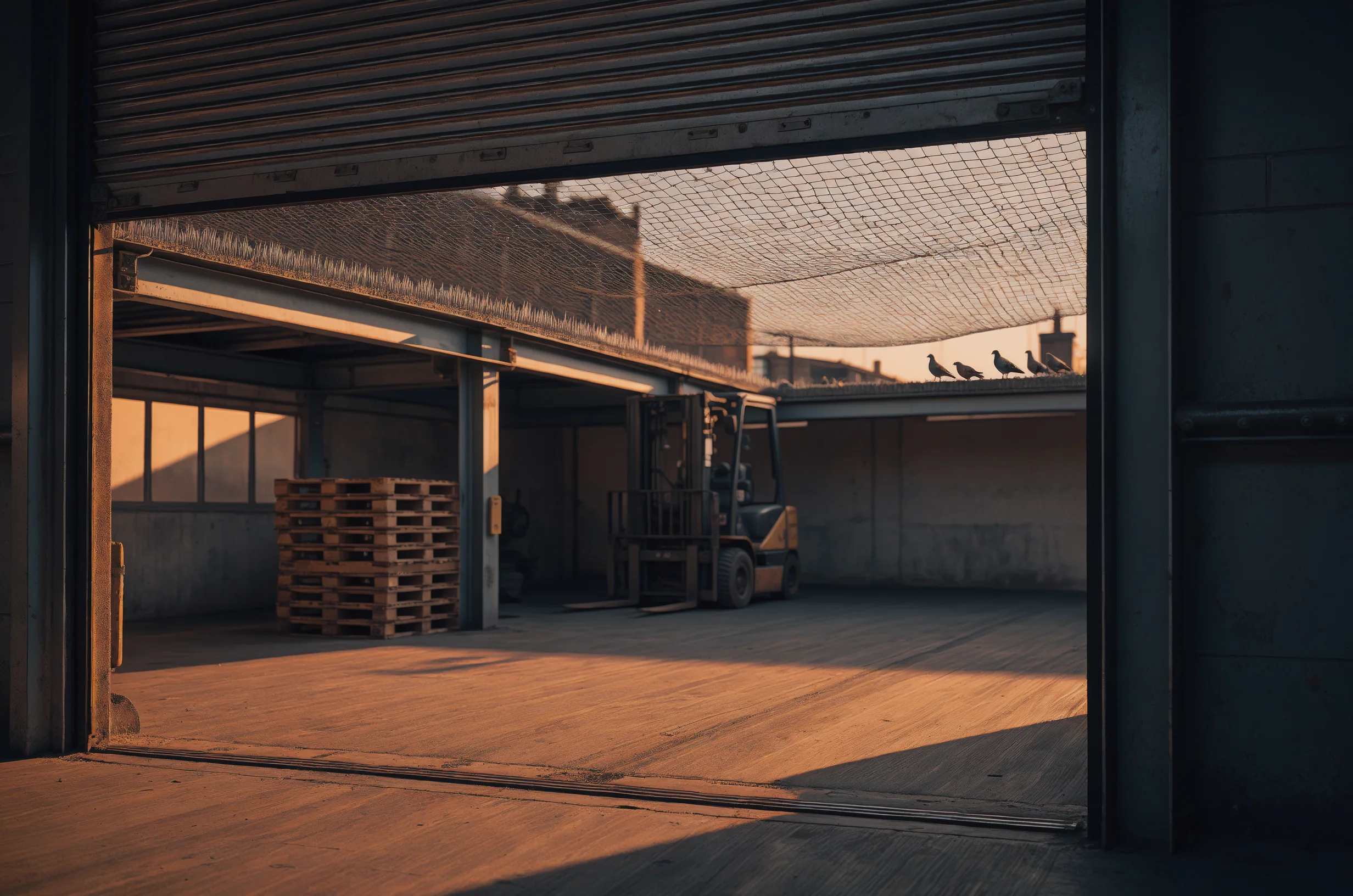
Keep pigeons out by controlling the entrance where operations allow, protecting overhead resting places and removing accessible food. The useful commercial loading bay pigeon deterrent options depend on where birds enter, where they settle and how vehicles move through the space.
An open bay creates a practical problem: deliveries must continue while birds have access to the building. I’d start with a drawing of the doorway, canopy and internal beams before choosing equipment. A deterrent fitted to a ledge addresses a different problem from a barrier across an entrance. The installation needs to match the route pigeons actually use.
Why are pigeons entering a busy loading bay?
Start by checking whether pigeons are entering to feed, rest or reach a nesting place.
Watch from a safe position outside vehicle routes. Record whether birds walk across the threshold, fly directly towards a beam or wait on the canopy between deliveries. Those details help identify where a measure needs to act.
Inspect the surroundings as well as the doorway. Useful evidence includes split food sacks, open waste containers, droppings beneath steelwork and repeated flights towards a concealed space. Photograph the location without moving nesting material.
Timing matters. Compare observations during unloading, meal breaks and quieter periods. A bay that appears clear during the morning rush may need checking when vehicle movements stop.
Avoid assuming that every bird enters through the main opening. Check adjacent doors, damaged cladding and gaps around the canopy from an accessible position.
If pigeons repeatedly disappear into a roof space, arrange a closer inspection before covering the opening. The survey needs to establish what is behind it and whether birds remain inside.
Which pigeon deterrent suits each part of the bay?
Choose each measure according to the area it must protect and the access that area needs.
There may be several separate jobs within one loading bay. The doorway handles traffic, the canopy provides shelter and the roof contains equipment that maintenance staff must reach.
| Option | Area to assess | Operational question |
|---|---|---|
| Fixed bird netting | Canopy underside or overhead steelwork | Can maintenance access remain available? |
| Rigid mesh | Static openings and recesses | Will ventilation and servicing still work? |
| Strip curtains | Doorway between movements | Can staff see and travel through safely? |
| Fast doors | Entrance with usable closing intervals | Can the door close during actual operations? |
| Spikes or bird wire | Individual ledges and landing points | Is the whole usable surface covered? |
| Optical bird gel | Selected landing points | Is the specific product suitable for that location? |
| Air curtains or visual deterrents | Areas needing additional assessment | What evidence supports their use against pigeons here? |
Separate essential work from optional additions in the specification. That makes quotes easier to compare.
For example, if birds fly straight to roof beams, a proposal limited to entrance signage leaves that route available. Ask the contractor to mark the protected area and any remaining access points on the drawing.
Can bird netting protect the roof without blocking lorries?
Yes, netting can separate pigeons from overhead spaces while leaving a planned vehicle route beneath it.
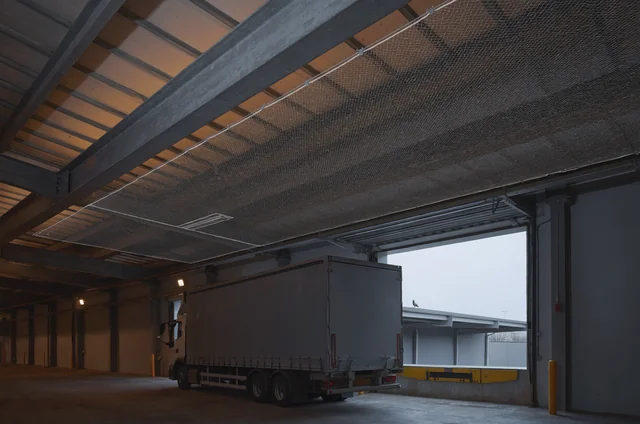
The design must define that separation clearly. Netting beneath a canopy protects a different space from netting across the front of a building. Drawings should show the height, edges, supporting fixings and position relative to the tallest expected load.
Correct installation and maintenance matter for both exclusion and bird welfare. Natural England’s bird management advice stresses the need to prevent accidental trapping and maintain netting properly.
Include lights, detectors, shutters and other equipment in the access plan. Staff should have a documented way to reach them without cutting a hole in the net.
Ask how corners, pipes and changes in roof shape will be finished. These details belong in the proposed design before installation begins.
Our guide to warehouse bird netting maintenance can help organise later checks around the building.
Before handover, inspect the completed perimeter with the installer. Identify access panels, agree who checks them after maintenance and record how damaged sections will be repaired. A loose edge or bird behind the net needs prompt attention.
Are strip curtains or fast doors practical during constant deliveries?
They can be practical where they fit the traffic pattern and close properly between movements.
Start with a delivery observation. Note how long the entrance stays clear, whether lorries remain docked and whether staff need frequent pedestrian access. A door that is routinely held open needs a different operating plan.
Strip curtains are overlapping flexible strips across an opening. For a loading bay, assess visibility, pedestrian access and the way pallet loads pass through them. Check whether the strips return to their intended position after traffic.
Fast doors open and close mechanically. Their suitability depends on the opening size, controls, maintenance arrangements and opportunities to close during work.
Ask the supplier to demonstrate the proposed arrangement with representative traffic. Include a tall pallet, a turning forklift and the pedestrian route in the assessment.
Do not improvise hanging cords or loose mesh across a working entrance. Keep the design within the site’s vehicle and fire safety arrangements.
If a curtain would be tied aside throughout the shift, record that limitation before buying it. Where neither system can operate as intended, assess protection further inside the bay, including the overhead spaces pigeons are trying to reach.
Will spikes or optical gel stop pigeons entering the doorway?
Perch treatments address particular landing surfaces; they leave the doorway itself open.
Spikes and tensioned bird wire are measures to assess for ledges, signs and other resting points. The survey should establish the surface width, the birds’ landing positions and the condition of the material receiving the fixings.
A narrow strip of treatment needs scrutiny if a wider shelf remains accessible behind it. Ask the installer to show the full area the arrangement is intended to protect.
Optical bird gel also needs a product-specific assessment. Before accepting it for a landing point, request the manufacturer’s installation instructions, safety information and evidence relevant to pigeons in comparable conditions.
Ask how the product will be inspected, cleaned, renewed or removed. Include the location of any goods or workstations beneath it in the discussion. Avoid accepting broad claims about performance without those details.
I’d also ask what happens if birds move to the next untreated beam. The plan should cover nearby landing places and a review after installation.
If the main problem is pigeons flying into the warehouse, keep that entry route visible in the specification. A quote for ledge treatment should explain exactly which part of the problem it addresses.
Can an air curtain keep pigeons out of an open bay?
An air curtain needs evidence from the proposed installation before you count it as pigeon exclusion.
An air curtain produces moving air across an opening. It leaves the physical opening available, so its role needs careful definition in a bird-control proposal.
Ask whether the supplier’s evidence concerns pigeons, the intended doorway dimensions and the conditions at your site. Claims about temperature control or insects do not establish performance against pigeons.
Include crosswinds, nearby extraction equipment and the position of a docked lorry in the assessment. Ask how the proposed system would be checked during normal deliveries.
Request a clear distinction between the system’s existing purpose and any claimed bird-control benefit. That helps prevent assumptions from becoming purchasing decisions.
If an air curtain is already fitted, record bird entries while it operates normally. Keep other conditions as consistent as practical and note when the doorway is obstructed.
Where pigeons continue to cross the threshold, retain the observation record and review another means of protecting the affected space. Avoid increasing fan settings without checking the equipment instructions and site requirements.
Do lasers, sound devices or model birds work in loading bays?
Treat scaring devices as measures to assess and monitor, with a clear review point if pigeons continue entering.
A model bird, flashing device or sound unit leaves access to the building available. Its usefulness therefore needs judging against actual bird activity at the bay.
Ask for evidence relevant to the species and setting. A claim about an outdoor agricultural site may have limited relevance to a covered entrance containing people, vehicles and reflective surfaces.
For any proposed laser system, request a specialist assessment of beam paths, reflections and nearby sight lines. Include drivers, pedestrians and anyone who can approach from outside the site. Avoid using a handheld pointer as an improvised treatment.
Sound devices also need assessment within the workplace. Ask whether the proposed operation fits communication needs and neighbouring premises.
Keep a written record of the device’s location, settings and operating times. Compare that with entries, resting places and new droppings.
If activity continues, use those records to revise the plan. Agree the review criteria before installation so that a poorly performing device does not remain the sole response.
What if pigeons or nests are already inside?
Establish where the birds are and whether nests are in use before closing access or fitting proofing.
Keep the affected area under observation and tell the facilities manager. Avoid moving nesting material, reaching into concealed spaces or encouraging birds further into the warehouse.
For London premises, Natural England’s guidance for businesses explains that wild birds in England are legally protected and that licences govern certain actions involving birds, eggs and nests. A commercial setting does not remove the need to check the position.
Describe what you have seen to the bird-control contractor. Useful details include repeated visits to one recess, birds carrying material and any sounds from behind cladding. Photographs taken from a safe distance can help.
The proposed work sequence should account for birds already present. Ask who confirms that an area is clear before an opening is closed, and how any nesting concern will be resolved.
Keep affected work areas separate where practical while the assessment takes place. Follow site procedures for goods beneath the resting or nesting location.
A bird trapped behind existing netting needs prompt attention from someone equipped to release it safely and repair the access point.
How should staff handle droppings near pallets or food?
Restrict access to the affected area and arrange cleaning according to the extent of the deposits and the work required.
Guano means accumulated bird droppings. Before cleaning, identify what is affected: floor surfaces, packaging, equipment or overhead structures. Keep vehicle wheels and pedestrian routes away from deposits where practical.
HSE’s bird droppings guidance explains the risks from airborne dust and droplets during relevant work. It advises controlling dust and avoiding high-pressure washing. Do not dry-sweep deposits into the working bay or blow them away with compressed air.
Cleaning above goods or machinery needs planning. The work method should address access, protection of nearby areas and the protective equipment required for the task.
The overview of pigeon droppings health risks provides further context for staff responsible for arranging that work.
For food distribution, involve the food safety lead before releasing affected goods. Apply the business’s inspection and stock-handling procedures to the specific incident. Our guide to food premises pest rules covers the wider setting.
Record which surfaces and goods were affected, who assessed them and when the area returned to use.
What can we change today without disrupting deliveries?
Begin with food access, reporting and unnecessary opening time while the permanent measures are assessed.
Check waste containers, staff eating areas and damaged food packaging around the bay. Assign responsibility for reporting and clearing spills through the site’s normal cleaning procedures. Include the yard immediately outside the entrance.
Review door habits with the loading team. Identify periods when an entrance could close without interrupting work. Changes should fit the agreed traffic plan and remain within the operating instructions for the door.
Give staff one reporting route. A useful sighting report identifies the bay, time, entry route and landing place. Encourage photographs only where taking them is safe.
If BuzzKill Pest Control already handles your commercial pest control, add the loading bay observations to the existing site action log. This gives the bird problem a location, an owner and a record of completed work.
Keep staff away from overhead inspection tasks unless suitable access and training are arranged. Ground-level photographs and observations are enough to start defining the problem.
During the next delivery period, check whether the same entry route remains active. Pass that detail to the person preparing the proofing specification.
How can we tell whether the deterrents are working?
Compare bird activity and new droppings before and after installation under similar operating conditions.
Create a baseline, meaning a record of conditions before the change. Use fixed observation points and note whether the bay is loading, quiet or closed. Record the length of each observation so comparisons have context.
Choose measures that match the original problem. These might include birds crossing the threshold, birds settling above pallets or fresh droppings in a protected area.
Also inspect nearby spaces. If pigeons stop using one beam but begin resting above another goods lane, the record should show that movement.
Keep installation photographs, inspection findings and repair dates together. The guide to pest monitoring records can help organise the paperwork.
A useful digital checklist would record each bay’s opening status, sightings, barrier condition and overdue repairs, with photographs attached to the relevant location.
Agree inspection responsibilities at handover and after maintenance work. Include a way to report vehicle contact, loose fixings or altered access panels.
Escalate immediately if a bird becomes trapped. For continued entry or new fouling, send the installer the location, observation record and photograph so the review addresses the remaining route.
What should a loading bay bird-control survey and quote include?
The quote should connect each proposed measure to a documented bird route, protected area and maintenance task.
For a BuzzKill Pest Control bird-control survey, a marked bay drawing and delivery schedule help explain the operating constraints. Include photographs of the entrance, canopy, roof structure and affected goods lanes.
Ask for the following details in writing:
- The openings, landing surfaces and overhead areas included in the work.
- The access equipment and delivery interruptions required for installation.
- The sequence for checking birds, addressing nesting concerns and completing proofing.
- The inspection arrangements, repair access and responsibilities after handover.
Separate cleaning from installation in the scope. The discussion of commercial guano cleanup requirements can help frame questions about the cleaning work.
Compare proposals against the same drawing and operating requirements. A smaller protected area or different maintenance provision changes what the quoted price covers.
Costs need a site-specific assessment of access, fixing surfaces, installation area and work scheduling. Request those assumptions alongside the price.
Before approving the work, check that the drawing preserves the vehicle route and identifies every pigeon access point the installation is intended to address.
Need professional help? BuzzKill offers fast, reliable pest control services across London and Essex.