

How to Choose Mosquito Repellent That Actually Lasts Outdoors
The right active ingredient matters more than brand or price when you need protection that holds up through an evening in the garden or a weekend camping trip.
Mosquitoes are becoming a year-round concern across London and Essex. Warmer, wetter weather patterns have extended the biting season from early spring through late autumn, with species previously uncommon in the UK now established in southern counties. Choosing an effective repellent is no longer just a holiday packing decision; it is a practical household task for anyone who spends time outdoors. This guide walks you through the four main active ingredients, how to match them to your situation, and where repellent protection ends and professional pest control begins.
What to Do in the First 10 Minutes
Do not spray anything on your skin until you have checked the product label for the active ingredient and concentration. The concentration determines how long protection lasts, and the wrong choice for your situation means either unnecessary chemical exposure or bites within the hour.
If you already have a product in the cupboard, turn the bottle over and locate the active ingredient panel. Look for one of these four: DEET (N,N-diethyl-meta-toluamide), picaridin (also listed as icaridin or KBR 3023), PMD (p-menthane-3,8-diol, the refined form of oil of lemon eucalyptus), or citronella oil. Permethrin appears on clothing and gear treatments only, never on skin-applied products. Note the percentage. Below 20 percent, expect roughly one to three hours of protection. Above 20 percent, you gain four to eight hours depending on the ingredient and your activity level.
Do not apply repellent over cuts, sunburn, or irritated skin. Do not use combination sunscreen-repellent products for extended outdoor work; sunscreen requires frequent reapplication, which leads to overexposure to the repellent active ingredient.
Confirm What You Are Actually Dealing With
Not every flying insect that bites is a mosquito, and not every itchy welt comes from a flying insect at all. Midges, blackflies, and horse flies respond differently to repellents, and some require entirely different management.
Mosquito bites typically appear as raised, puffy welts with a single puncture point at the centre, often clustering on ankles, wrists, and other exposed areas. They itch intensely within minutes. Midge bites are smaller, more numerous, and often line up where clothing meets skin. Horse fly bites are larger, more painful than itchy, and may bruise. Flea bites cluster around the ankles and lower legs in people with pets.
Check your garden and immediate property for standing water. Mosquitoes need as little as a bottle cap of water to breed. Look in guttering, plant saucers, wheelbarrows, blocked drains, and tarpaulin folds. If you find wriggling larvae or dark comma-shaped pupae, you have an active breeding site. Photograph the location and note the time of day you observed the most biting activity. Mosquitoes in the UK are most active from dusk to dawn, though some species bite during daylight hours in shaded areas.
Inspect Your Property Like a Technician
A systematic inspection reveals whether repellent alone will solve your problem or whether you need to address breeding habitat and entry points.
Start at the boundary. Walk the perimeter of your garden during daylight. Look for standing water in containers, depressions in lawn or patio areas, and poorly draining corners. Lift any tarpaulins or covers. Check water butts for tight-fitting lids; open butts are major breeding sites.
Check the house exterior. Examine guttering and downpipes for blockages that create pooled water. Look at air brick vents, gaps around pipe entries, and damaged window screens. Mosquitoes do not need large openings; a gap of 5 millimetres is sufficient for entry.
Inspect the garden interior. Turn over plant pots and saucers. Check compost bins for excess moisture. Look at pond edges for stagnant margins; healthy ponds with fish and movement rarely support mosquito breeding, but neglected ponds do. Note any dense, shaded vegetation where adult mosquitoes rest during the day.
Review the immediate indoors. Check window screens for tears. Look at bathroom and kitchen extractor vents for proper backdraft shutters. Examine bedrooms, particularly those above ground level where heat accumulation draws mosquitoes. Note any musty or stagnant odours that might indicate hidden moisture.
Document the pattern. Record where and when bites occur. Bites concentrated around ankles in ground-floor rooms suggest entry at foundation level. Bites at upper-floor windows indicate entry through damaged screens or open vents. Bites only outdoors point to garden breeding rather than indoor entry.
Decision Fork: What the Evidence Tells You
If you found standing water with larvae or pupae, repellent protects you temporarily but does not reduce the population. Empty the water, scrub the container to remove eggs, and refill with fresh water if needed for plants. For permanent features like ponds, consider introducing mosquito fish or installing a small fountain to create surface movement. If the water source belongs to a neighbour or is on council property, contact your local authority; in London, this falls under environmental health regulations that your council can enforce.
If you found no standing water but mosquitoes are entering the house, focus on physical exclusion. Repair window screens, fit brush strips to doors, and check that air bricks have proper mesh. A single overlooked entry point can render skin repellent irrelevant because you are exposed while sleeping.
If bites occur only during garden use in the evening, a personal repellent is the correct primary intervention. Choose based on the duration you need and the activities you have planned. If you need protection for a two-hour barbecue, a lower-concentration product suffices. If you are working outdoors all day or camping overnight, you need a longer-duration formulation.
If you have infants under six months, do not use any skin-applied repellent. Use physical barriers: long sleeves, long trousers, and mosquito netting over prams and cots. For children aged six months to two years, use only products with 10 percent DEET or less, applied sparingly to exposed skin but not to hands or face. For children over two years, picaridin at 20 percent or DEET at 10-30 percent is appropriate. Always follow the specific product age guidance, as formulations vary.
Matching the Active Ingredient to Your Situation
DEET remains the benchmark for long-duration protection. Developed in the 1940s and extensively tested since, it confuses the mosquito's olfactory receptors so they cannot locate human skin. Concentrations of 20-30 percent provide six to eight hours of protection under normal conditions. Higher concentrations do not significantly extend duration but do increase skin absorption and the risk of irritation. DEET can damage plastics and synthetic fabrics, so wash hands before handling phones, cameras, or sunglasses. Per EPA guidance on repellent products, always follow label directions and safety precautions when applying DEET-based formulations.
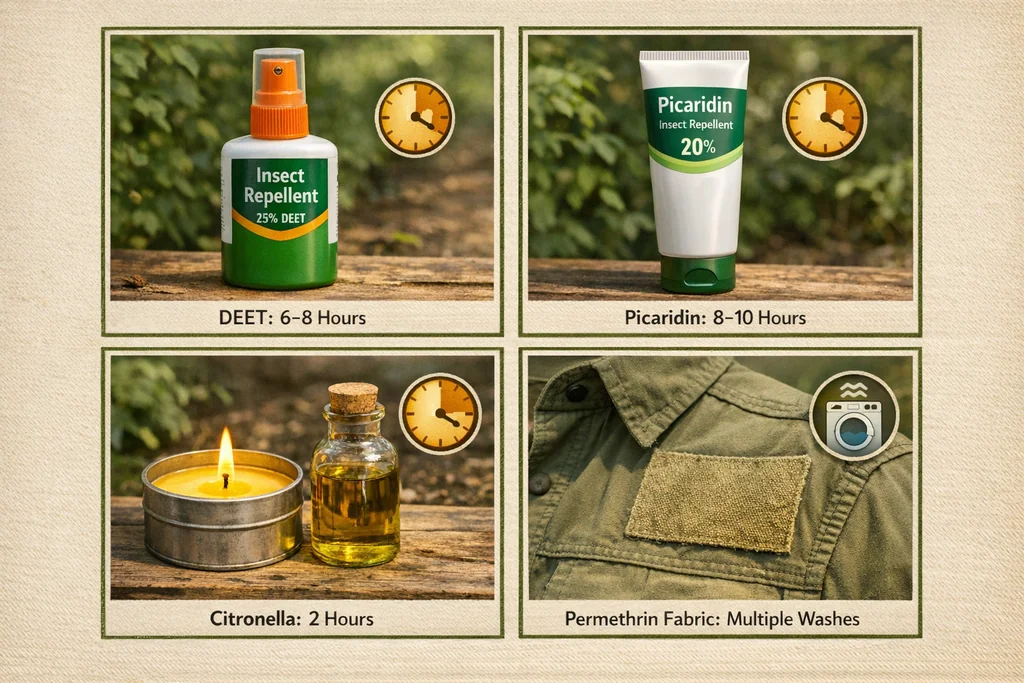
Picaridin at 20 percent matches DEET's duration without the plastic-damage risk and with a less greasy feel on skin. It is odourless, does not stain clothing, and has a better cosmetic profile for daily use. The UK Health Security Agency has noted picaridin as an effective alternative in mosquito repellent research for malaria prevention, though the primary UK concern remains nuisance biting rather than disease transmission. Picaridin is the better choice for office workers who need evening garden protection and do not want to change clothes or wash off residue before indoor activities.
PMD, the refined version of oil of lemon eucalyptus, offers protection comparable to low-concentration DEET, roughly two hours at the concentrations typically available in UK retail. It has a pleasant citrus scent and is derived from a natural source, which appeals to consumers avoiding synthetic chemicals. However, it is not recommended for children under three years, and the shorter duration means more frequent reapplication, which increases total skin exposure over a long day.
Citronella oil provides the shortest protection, typically 30 minutes to two hours depending on formulation and environmental conditions. Candles, incense sticks, and diffusers create a localised deterrent zone but do not protect individuals beyond the immediate radius. A 2026 trend saw consumers reporting success with citronella incense sticks for garden seating areas, but this is spatial protection, not personal protection. If you move beyond the scent plume, you are unprotected. Citronella is best viewed as a supplementary measure for static outdoor dining, not as primary protection for active gardening or walking.
Permethrin is an insecticide, not a repellent, and it is applied to clothing, tents, and gear rather than skin. It kills mosquitoes on contact and retains effectiveness through multiple washes when applied correctly. Treated clothing provides passive protection without the need for skin application, which is valuable for people with sensitive skin, those working in high-bite environments, or parents dressing children for outdoor play. Do not apply permethrin to skin. Treat clothing in a well-ventilated area, allow full drying before wearing, and re-treat after the specified number of washes.
Time Windows: Tonight, Tomorrow, and the Next 48 Hours
Tonight, if you have an immediate outdoor commitment and no suitable product, a pharmacy or supermarket open late will stock basic DEET or picaridin formulations. Choose the lowest concentration that matches your expected exposure time. Apply to exposed skin 15 minutes before going outside, not while you are already being bitten. Reapply if you swim, sweat heavily, or towel off.
Tomorrow, purchase the correct product for your regular pattern of exposure. If you garden two evenings a week, a 20 percent picaridin spray is practical and comfortable. If you work outdoors professionally or camp frequently, a 30 percent DEET lotion or a permethrin clothing treatment programme is more appropriate. Check expiry dates; repellent efficacy degrades over time, particularly in clear bottles exposed to light.
Within 48 hours, address any breeding sites you identified during inspection. This is the step most homeowners postpone, and it is the reason repellent use becomes a daily necessity rather than an occasional precaution. Empty standing water, clear guttering, and consider whether permanent features like water butts need modification. If you live near marshland, canal edges, or other unmanaged water bodies, breeding control may be beyond your individual capacity, and you should consider whether professional pest control services can assess the wider environment.
When Repellent Is Not Enough
Repellent protects the individual. It does not reduce the mosquito population, and it does not address breeding sites on or near your property. If you are applying repellent daily, if family members are being bitten despite correct use, or if you have eliminated all visible standing water and mosquitoes persist, the source is likely hidden or off-property.
The escalation signal is simple: repeated bites after correct, consistent repellent use and thorough breeding-site elimination. This indicates either a cryptic breeding source you cannot access, such as a blocked drain or sub-floor void, or a population level that requires professional intervention. At this point, further product experimentation wastes money and prolongs exposure. A technician can identify species, locate hidden breeding sites, and apply targeted treatments that reduce the population rather than merely repelling individuals from it. Book a same-day inspection if bites are disrupting sleep or if you have vulnerable individuals in the household.
Learn more: Call 0203 468 1999 or request a callback to book a same-day inspection
Need professional help? BuzzKill offers fast, reliable pest control services across London and Essex.