
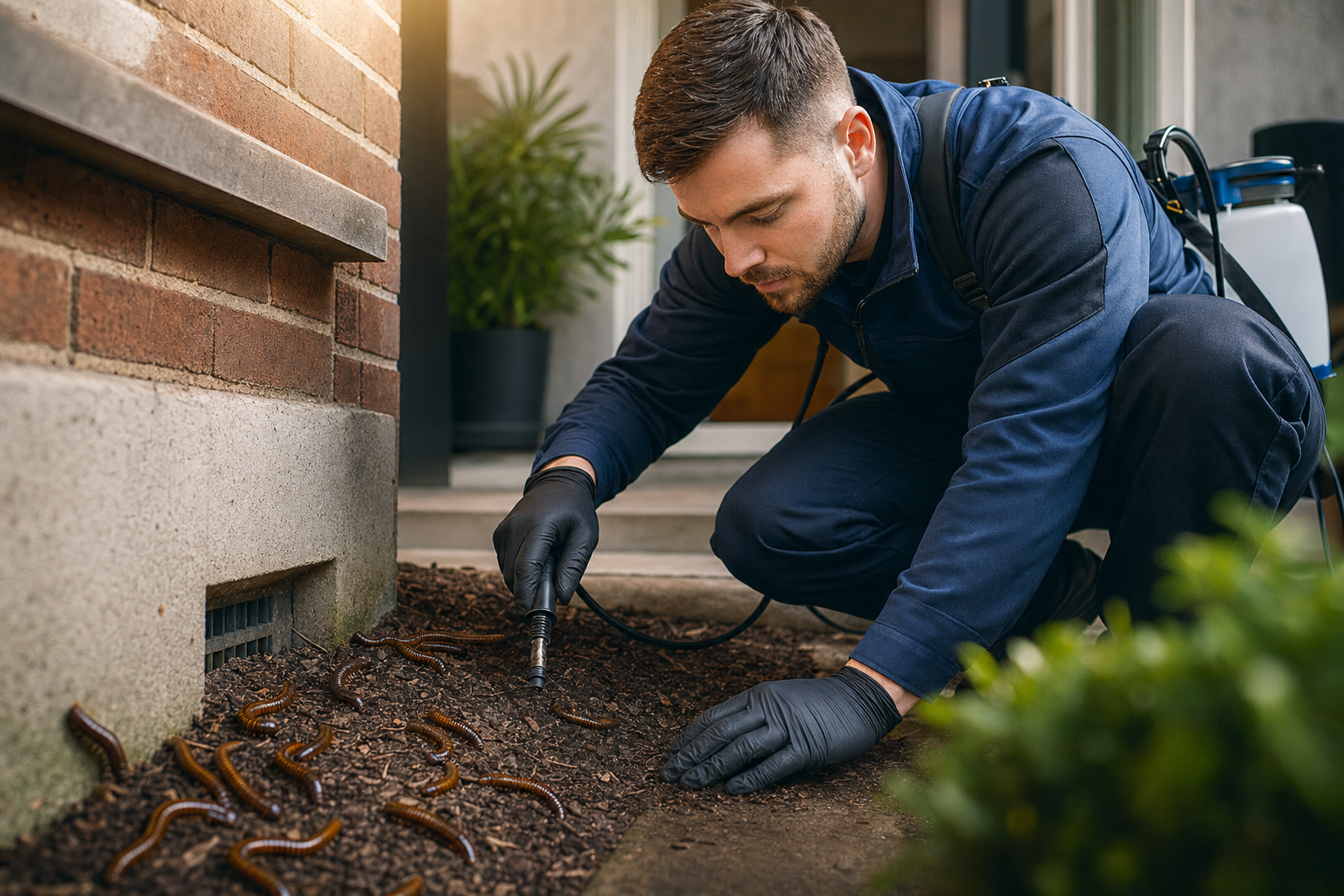
Millipede removal relies on drying out their habitat and blocking entry points rather than chemical warfare — here's the complete safe approach for UK homes.
Here's the thing about millipede removal: it doesn't start with a spray bottle. These slow, many-legged creatures aren't even insects — they're detritivores, meaning they break down decaying plant matter, and they only wander indoors when outside conditions get too wet or too dry for their taste. In East London and Essex, where Victorian houses with chronic condensation sit next to clay-heavy gardens that hold water like a sponge, millipedes find perfect conditions right up against your walls. This guide walks through why they're showing up, how to get them out, and how to keep them out — all without harsh chemicals that put your kids, pets, and the hedgehogs in your garden at risk.
Quick Summary
| Focus | Details |
|---|---|
| Best for | Readers trying to solve millipede removal |
| What you'll learn | A practical explanation of the highest-value next steps |
| What this covers | What Is Millipede Removal? • Framework Overview • Key Terms |
| Reader outcome | A scannable answer path plus deeper sections on What Is Millipede Removal? |
Key Takeaways
- Millipedes are harmless decomposers — they don't bite, sting, damage your house, or spread disease, so you don't need to panic
- Moisture control beats chemical sprays every time for millipede removal, because you're removing the reason they're there instead of just killing the ones you see
- Diatomaceous earth, boric acid, and essential oil barriers work well when you use them correctly around entry points
- Sealing gaps below 6mm blocks millipede entry, since even the largest UK species (the banded millipede) can't squeeze through anything smaller
- Persistent indoor millipedes usually mean hidden damp in subfloors, wall cavities, or failed damp-proof courses — worth checking before things get worse
- Most "millipede" sightings in UK homes are actually centipedes — getting the ID right matters because the control strategies are completely different
- Professional pest control makes sense when DIY hasn't worked after 4-6 weeks or when they suddenly appear in large numbers
At a Glance
| Dimension | What Matters Most | Quick Read |
|---|---|---|
| Primary cause | Excess moisture near foundations, plus leaf litter or decaying wood | 2 min |
| Speed of results | Habitat drying takes 2-4 weeks; barriers work immediately | 1 min |
| Best non-toxic treatment | Food-grade diatomaceous earth around entry points | 2 min |
| Prevention priority | Gutter maintenance, ventilation, and ground clearance | 3 min |
| When to call pros | Sudden mass appearance, or persistence after 4-6 weeks of DIY | 1 min |
| Cost range (DIY) | £15-£50 for materials; professional treatment £120-£280 | 1 min |
What Is Millipede Removal?
Millipede removal is the process of reducing or eliminating millipede populations from buildings through environmental modification, physical exclusion, and — when needed — targeted low-toxicity treatments. Unlike dealing with cockroaches, rodents, or bed bugs, millipede management rarely needs insecticides because these creatures simply aren't built to survive indoors. They're accidental visitors, not permanent residents.
The approach has changed a lot over the past fifty years. Back in the mid-20th century, pest controllers relied heavily on persistent organochlorine pesticides like dieldrin and chlordane, slathered liberally around foundations. The UK banned these chemicals under the 1985 Food and Environment Protection Act and subsequent EU regulations, which pushed the industry toward integrated pest management (IPM) principles. Modern millipede control — whether you do it yourself or hire someone — starts with understanding why these arthropods enter buildings and changing those conditions.
This matters right now because UK homeowners are facing a perfect storm: aging housing stock with failing damp-proofing, increasingly erratic rainfall, and more families reluctant to use synthetic pesticides around children and pets. The British Pest Control Association reports that enquiries about "nuisance" arthropods including millipedes have risen roughly 15% since 2020, partly driven by climate shifts pushing these creatures into new areas. Meanwhile, the same gardens that host millipedes often support hedgehogs, solitary bees, and other wildlife that broad-spectrum sprays would harm.
The crucial point is that millipede removal sits somewhere between pest control and building maintenance. Treat the symptom (millipedes indoors) without fixing the cause (moisture, access) and they'll be back. This guide covers the whole system — identification, environment, exclusion, and safe intervention — because half-measures waste your time and money.
Framework Overview
Effective millipede removal follows four connected stages that build on each other. Skip one and you'll likely be starting over in a few months.
Stage 1: Correct Identification — Make sure you're actually dealing with millipedes, not centipedes, woodlice, or something else entirely. Get this wrong and you'll use the wrong treatments: centipedes need a completely different approach, and some "millipede" problems turn out to be springtails or even carpet beetle larvae.
Stage 2: Environmental Modification — Cut moisture and remove habitat near your foundation. This is the bedrock of non-toxic control. Millipedes breathe through moist skin and dry out quickly in arid conditions. Make your property's perimeter unpleasant for them, and indoor sightings drop off dramatically.
Stage 3: Physical Exclusion — Seal up entry routes with the right materials. Millipedes can't chew through barriers — they're soft-bodied and depend on gaps that already exist. A thorough sealing job gives you permanent protection against reinvasion.
Stage 4: Targeted Treatment — Apply non-toxic or low-toxicity products only where needed, when environmental modification alone hasn't solved things within a reasonable timeframe. This preserves beneficial insects and avoids unnecessary chemical exposure.
These stages work in sequence but also reinforce each other. Drying out the environment reduces pressure on your entry points; good exclusion often makes treatment unnecessary; targeted treatment buys you time while your environmental measures take effect. In my experience — both as a technician and advising DIYers — the homeowners who work through all four stages methodically get the best results, while those rushing straight to sprays keep calling back with the same problem.
Key Terms
| Term | Plain-English Meaning | Why It Matters |
|---|---|---|
| Detritivore | An organism that feeds on dead and decaying organic matter | Millipedes aren't after your food or blood — they want rotting leaves and wood, which tells you exactly where to focus your efforts |
| Damp-proof course (DPC) | A horizontal barrier in walls (usually slate, bitumen, or plastic) that stops ground moisture rising by capillary action | Failed DPCs create the persistently damp conditions that support millipede populations near foundations |
| Diatomaceous earth (DE) | Powder made from fossilised microscopic algae with sharp silica edges that scrape away the waxy coating on arthropod exoskeletons, causing dehydration | Food-grade DE is safe around humans and pets but kills millipedes that crawl through it — an ideal targeted treatment |
| Exoskeleton | The hard external skeleton that supports and protects arthropods | Millipedes need to keep their exoskeleton moist; anything that damages this moisture barrier (like DE) kills them |
| Integrated Pest Management (IPM) | An approach combining biological knowledge, environmental modification, and minimal chemical use for sustainable pest control | IPM principles underpin effective non-toxic millipede removal and are endorsed by UK pest control accreditation bodies |
| Millipede | A slow-moving arthropod with two pairs of legs per body segment (not actually 1,000 legs — UK species typically have 80-400) | Proper identification matters because millipedes coil when disturbed, while similar-looking centipedes run fast and can bite |
| Subfloor void | The space beneath ground-floor timber floors, often with limited ventilation and soil contact | Common hidden moisture source in Victorian and Edwardian properties throughout East London and Essex |
| Ventilation rate | The volume of air moving through a space per hour, measured in air changes per hour (ACH) | Poor ventilation in crawl spaces, cellars, and subfloors creates the stagnant, humid conditions millipedes exploit |
Understanding Millipede Biology and Behaviour — Deep Exploration
Why Millipedes Enter Buildings
Millipedes don't actually want to be in your house. That's not me being reassuring — it's biological fact that should change how you react when you spot one. These animals are thigmotactic, meaning they like touching surfaces on all sides, and negatively phototactic, preferring darkness. Your dry, lit, open rooms offer none of this. When millipedes appear indoors, something has gone wrong outside or they've been accidentally funnelled in.
The typical sequence in UK properties goes like this: prolonged wet weather soaks garden soil and leaf litter, the millipede's preferred home. Heavy rain or overenthusiastic watering drives them to higher ground. If your foundation has accumulated organic debris — leaves against walls, rotting fence posts, compost bins too close — millipedes gather there. Then they seek even drier conditions, or simply explore cracks while active, and emerge through gaps in mortar, around pipes, or under doors.
Temperature plays a part too. UK-native millipedes slow down below 5°C and may seek residual warmth from building foundations in autumn. The banded millipede (Ommatoiulus sabulosus), our most common large species, shows particularly strong autumn movement. On the flip side, extreme summer dryness can also trigger migration as they search for moisture — I've found live millipedes in bathroom traps during August droughts, presumably following drain moisture.
Understanding this motivation is practical, not academic. It tells you that killing visible millipedes solves nothing while the environmental trigger persists. It also tells you that indoor sprays are especially pointless — you're treating animals that will die from desiccation anyway, while completely missing the source.
UK Species You're Likely to Encounter
Three species dominate UK millipede complaints. The banded millipede (Ommatoiulus sabulosus) is the large one (up to 60mm), dark with pale rings, that most homeowners notice. It's widespread in southern England, strongly associated with sandy or chalky soils, and the most likely to enter buildings in numbers. The spotted snake millipede (Blaniulus guttulatus) is smaller (20-30mm), paler, with distinctive red spots along each side — more common in agricultural areas and sometimes a crop pest, but occasionally found in gardens with heavy manure or compost use. The white-legged snake millipede (Tachypodoiulus niger) is glossy black with contrasting white legs, often found under bark and logs, and more likely in properties with wooded gardens.
All three share the same weaknesses: they dry out easily, can't climb well (though banded millipedes manage rough vertical surfaces), and struggle to survive in sustained dry conditions. None are protected species, none pose health risks, and none damage building materials — though large aggregations can leave minor staining from defensive secretions on light surfaces.
Those defensive secretions deserve a mention because they explain why some homeowners react so strongly. Millipedes in several families, including the common Julidae, can release benzoquinones and other compounds when handled or crushed. These may cause minor skin irritation or stain fabrics. It's not dangerous, but it's unpleasant — another reason to avoid crushing millipedes and focus on exclusion instead.
The Moisture Connection: Reading Your Building
Millipede presence is diagnostic. Where you find them points to where you should investigate moisture. Here's the pattern I've seen across hundreds of East London and Essex properties:
Ground-floor rooms, especially kitchens and bathrooms: Check for failed DPC, leaking appliances, or inadequate subfloor ventilation. The combination of soil contact and plumbing leaks creates ideal conditions.
Basements and cellars: Almost always ventilation failure. Original coal-hole vents blocked, no modern mechanical extraction, and persistent condensation on cool walls.
Near external doors, especially rear doors: Usually indicates a gap in the threshold seal, plus accumulated organic debris immediately outside. Common where patios have sunk or door frames have rotted.
Upstairs rooms: Surprising but not rare — usually indicates chimney stack leakage, roof gutter failure, or (in Victorian terraces) shared wall cavities with damp penetration from next door.
This diagnostic approach saves time. Instead of treating the whole house, you target the specific moisture source. In one Ilford property I assessed, millipedes in an upstairs bedroom led us to a failed gutter pouring water into the cavity wall — fixed with roofing work, not pest control.
Non-Toxic Control Methods — Deep Exploration
Environmental Modification: The Foundation
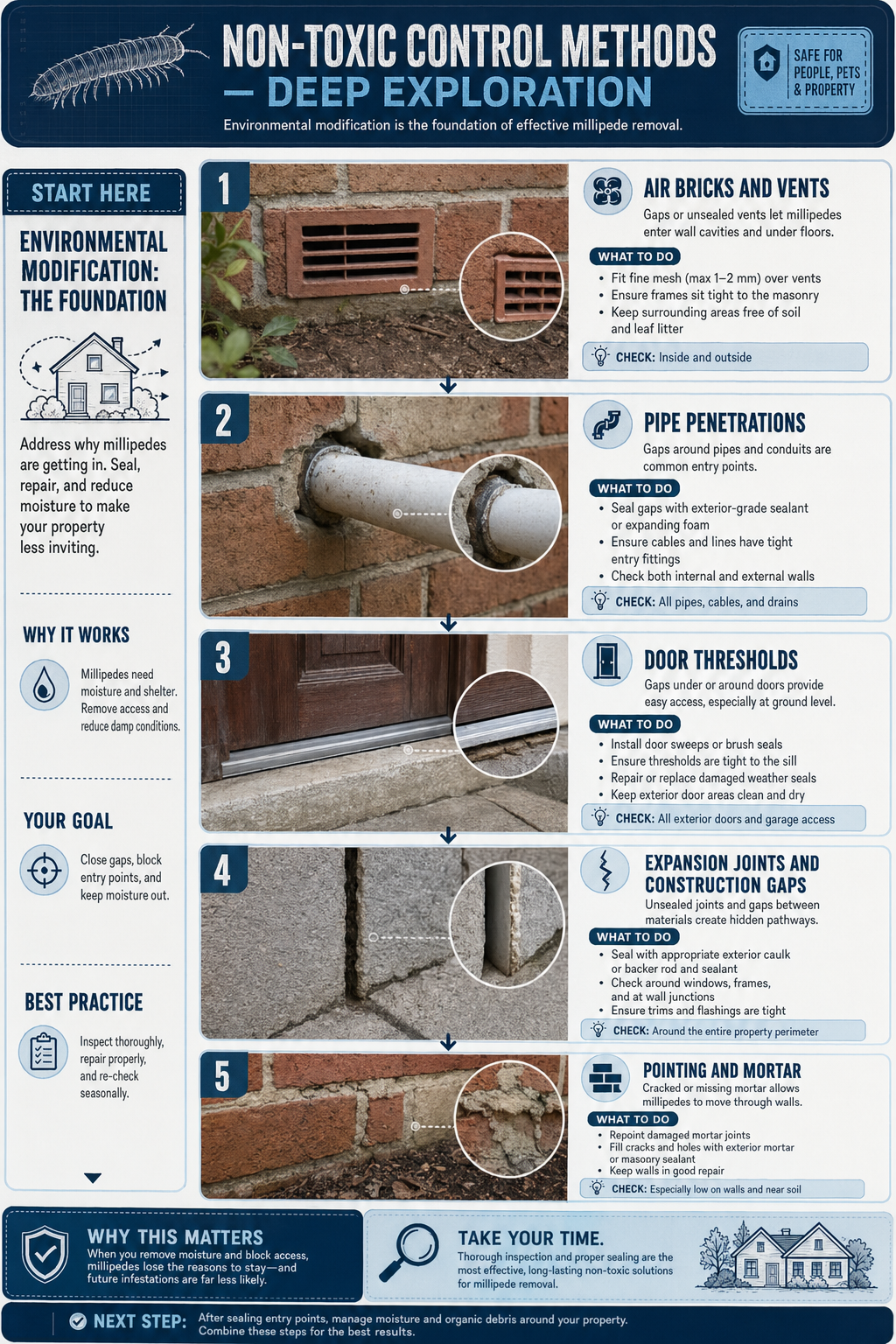
Start here, spend real time here, and don't rush this stage. Environmental modification addresses why millipedes are present, not just where they're currently crawling.
Perimeter clearance: Remove all organic material from within 30cm of your foundation. This isn't a random number — it's the zone where soil moisture fluctuates most dramatically and where foundation warmth creates microclimates. Leaf litter, mulch, compost, grass clippings, and decaying wood all need moving. In my experience, this single measure reduces millipede pressure by 60-80% within two weeks where it was the main attractant.
Pay particular attention to north and east-facing walls, which get least sun and dry slowest. These are predictable millipede hotspots. If you have planted borders against walls, consider replacing moisture-retentive bark mulch with gravel, or creating a narrow gap between planting and wall.
Drainage improvement: Make sure downpipes discharge well away from walls — at least 1.5 metres — and that soil slopes away from foundations. French drains or simple land drains may be needed in clay-heavy soils with poor drainage, common across Essex. Where groundwater is high, sump pumps in subfloor voids can transform conditions.
Subfloor and void management: For properties with accessible subfloors, increase ventilation to achieve at least 5 air changes per hour. This may need additional air bricks, mechanical extraction, or simply unblocking existing vents. Check that air bricks have intact insect mesh — without it, millipedes enter through the vents themselves, turning your ventilation into a highway.
Dehumidification: In occupied spaces with persistent humidity, keep relative humidity below 60% using refrigerant dehumidifiers. This is the threshold below which millipede survival becomes marginal. For unheated spaces, desiccant dehumidifiers work at lower temperatures.
Physical Exclusion: Sealing for Permanent Protection
Millipedes can't chew, dig, or force their way in. Every access point is a gap that already existed. This makes exclusion highly effective once done properly.
Critical sealing points:
- Air bricks and vents: Fit stainless steel mesh (0.6mm aperture) behind existing grilles. This blocks millipedes while maintaining airflow. Avoid plastic mesh — UV degradation makes it a temporary fix at best.
- Pipe penetrations: Use intumescent sealant or mortar repair around soil pipes, waste pipes, and any service entries. Pay attention where modern plastic pipes pass through old brickwork — the gap around them is often substantial.
- Door thresholds: Replace worn brush strips and make sure threshold plates make full contact. Millipedes exploit gaps as small as 3-4mm.
- Expansion joints and construction gaps: Common in extensions and where different building periods meet. Fill with appropriate flexible sealant that accommodates movement.
- Pointing and mortar: Repoint eroded mortar, especially at ground level. Victorian soft lime mortar degrades faster than modern equivalents.
The banded millipede's body diameter reaches approximately 4mm, so gaps below this are effectively sealed against adults. Juveniles are smaller, but less mobile and less likely to explore far from established populations.
Targeted Non-Toxic Treatments
When environmental modification needs backup, or when you need faster results while longer-term measures take effect, several options work well with minimal risk.
Food-grade diatomaceous earth: Apply a thin, visible dust layer around entry points, in subfloor voids, and along known millipede routes. The silica fragments scrape away the lipid layer on millipede exoskeletons, causing lethal dehydration within 24-48 hours. Food-grade DE is safe around humans and pets — it's used as an anti-caking agent in food processing — but the dust is a respiratory irritant, so apply with a duster rather than creating clouds, and avoid use where children play on the floor. Reapply after rain or cleaning.
Boric acid powder: Similar application to DE, with additional stomach toxicity if ingested during grooming. Effective at lower concentrations but more toxic to mammals — use with greater caution around pets and children, and never in food preparation areas. In the UK, boric acid products are regulated and should carry HSE approval numbers.
Essential oil barriers: Peppermint, tea tree, and eucalyptus oils show repellent effects in research, though less consistently lethal than DE. They're best used as perimeter barriers — diluted and applied to external foundation walls — where their volatility matters less. Reapplication every 7-14 days is necessary. I consider these supplementary, not primary, controls.
Desiccant dusts (silica gel): More aggressive than DE and potentially effective in enclosed voids where rapid knockdown is needed. Not food-grade and more hazardous if inhaled — reserve for professional application in inaccessible spaces.
The key principle is targeted application at entry points and harborage, not broadcast treatment. This preserves ground beetles, spiders, and other beneficial predators that actually help keep millipede populations in check naturally.
Expert Tips
Tip 1: Time your interventions with weather patterns. The most effective millipede exclusion happens in late summer, before autumn migration begins. Seal in August, and you'll block the seasonal influx. Try the same work in October, and you'll be constantly treating symptoms while new arrivals find any gaps you missed.
Tip 2: Use millipede presence to find hidden building defects. I've identified failed damp-proof courses, leaking drains, and roof failures that homeowners hadn't noticed, all because millipedes led me to persistently damp zones. Treat this as free building diagnostics, not just a nuisance to eliminate.
Tip 3: The "flushing" technique for subfloor voids. Where millipedes persist in inaccessible subfloors despite ventilation improvements, temporary desiccant dust application combined with temporary sealing of internal gaps can flush survivors outward. Apply dust, seal internal cracks for 48 hours, then inspect external emergence points. This concentrates the population for removal without repeated indoor disturbance.
Tip 4: Distinguish millipede "trails" from slug trails. Both leave silvery deposits, but millipede trails are finer, more regular, and often show the impression of numerous legs. Finding fresh trails indicates active, recent entry — focus your exclusion efforts there.
Tip 5: Don't overwater against foundations. Automated irrigation systems are increasingly common in UK gardens, and poorly positioned sprinklers that soak walls create ideal millipede conditions. Adjust heads to maintain 30cm clearance, and water in morning so surfaces dry by evening when millipedes become active.
Real-World Scenarios
Scenario 1: The Victorian Terrace Subfloor Sarah and Mark in Leytonstone noticed millipedes in their ground-floor kitchen every autumn, increasing over three years. Initial DIY attempts involved spraying insecticide around skirting boards — ineffective and worrying with a toddler in the house. Investigation revealed a completely blocked subfloor, original 1890s air bricks bricked up by a previous owner, and soil saturated from a leaking external soil pipe. The solution required no pesticides: soil pipe repair, four new air bricks installed, and six weeks of dehumidifier use in the subfloor void. Millipede appearances stopped entirely by week four, and the previously musty kitchen smell disappeared too. Total cost: £340 for drainage and building work, versus repeated £40 spray cans that never addressed the cause.
Scenario 2: The New-Build Garden Conversion A family in Chelmsford moved into a 2018 new-build and were surprised by millipedes in the utility room within six months. The property had been constructed with garden soil built up against the air brick level — a known issue with some rapid developments where finished ground levels exceed design specifications. The builder had also installed decorative bark mulch right to the walls. Removing the mulch, installing a gravel perimeter, and fitting vent guards solved the problem in ten days. The millipedes weren't a pest control failure — they were a construction and landscaping issue.
Scenario 3: The Persistent "Return" A restaurant in Walthamstow called after millipedes appeared in the customer toilet during August — unusual timing suggesting moisture, not autumn migration. Investigation found a failed condensate pipe from a new air conditioning unit, dripping continuously into a wall void and creating saturated plaster. The millipedes were following the moisture gradient from exterior bark mulch, through the cavity, and emerging at the internal vent. Fixing the condensate drainage and drying the wall eliminated the issue. The restaurant's concern about customer perception was valid — but the solution was building maintenance, not pest treatment.
Common Mistakes to Avoid
Mistake 1: Reaching for pyrethroid sprays immediately The most common error, and the most counterproductive. Pyrethroids kill millipedes on contact but provide no residual protection against new arrivals. Meanwhile, they contaminate surfaces, risk resistance in any co-occurring pests, and harm non-target insects. Worse, the visible dead millipedes create a false sense of resolution while the underlying moisture persists. I've seen homeowners spray monthly for years rather than fix a gutter.
Mistake 2: Confusing millipedes with centipedes Centipedes are predators with venomous forcipules (modified front legs) that can deliver painful bites. They indicate different conditions — usually other prey arthropods present — and respond to different controls. Millipede treatments focused on moisture may worsen centipede problems by preserving the prey base. The quick test: disturbed millipedes coil tightly; centipedes run rapidly and don't coil.
Mistake 3: Ignoring the subfloor void Particularly in pre-1919 properties across East London and Essex, subfloor voids are the hidden reservoir. Homeowners treat visible millipedes in living spaces while hundreds remain active below, constantly replenishing the population. Access hatches, borescope inspection, or at minimum humidity monitoring in voids is essential for persistent problems.
Mistake 4: Using salt or vinegar as "natural" killers Social media frequently promotes these as non-toxic options. Salt can damage plants and building materials without reliably killing millipedes; vinegar's acidity is too weak and brief to be lethal. Both create mess and corrosion risk without efficacy. DE and proper environmental control are genuinely effective alternatives — don't substitute folk remedies that waste time.
Mistake 5: Sealing without ventilation improvement Sealing entry points while moisture sources remain active can drive millipedes to find new routes or, worse, trap moisture that promotes wood-decay fungi and other structural problems. Always pair exclusion with environmental modification, never alone.
How to Prepare with BuzzKill Pest Control
While most millipede issues respond well to patient DIY work, certain situations warrant professional assessment. At BuzzKill Pest Control, we offer same-day pest control inspections across East London and Essex for persistent or unusual millipede problems.
Our technicians hold RSPH Level 2 qualifications and BASIS PROMPT registration, with full NPTA membership ensuring adherence to current best practice. We carry £5 million public liability insurance and offer guaranteed results with no call-out charge. For millipede concerns, we'll identify whether you're dealing with millipedes or similar-looking species, trace moisture sources using thermal imaging and moisture meters, and provide a treatment plan that prioritises non-chemical methods where appropriate.
Multi-stage treatments aren't typically needed for millipedes — unlike bed bug control or rat infestations — but we do schedule follow-up calls to confirm environmental modifications have resolved the issue. Our bird control services and cockroach treatments use similarly targeted, minimum-chemical approaches where these concerns overlap with millipede habitat.
Learn more: Call 0203 468 1999 or request a callback to book a same-day inspection.
Frequently Asked Questions
Are millipedes dangerous to humans or pets? No. UK millipede species are harmless decomposers without venom or biting mouthparts. Some larger species release defensive secretions when handled that may cause minor skin irritation or stain fabrics — wash hands after contact and avoid crushing them. They're not known to transmit disease or damage building materials.
Why am I seeing millipedes in my house all of a sudden? Sudden appearances usually follow heavy rainfall, significant temperature change, or disturbance of their outdoor habitat (garden work, landscaping changes). Autumn is peak season for banded millipede movement. If appearance is truly sudden and in large numbers, check for broken drains, overflowing gutters, or neighbours' recent garden work that may have displaced a population.
What's the difference between millipedes and centipedes? Millipedes have two pairs of legs per body segment, rounded bodies, and move slowly — they coil when disturbed. Centipedes have one pair of legs per segment, flattened bodies, run rapidly, and don't coil. Centipedes are predatory and can bite; millipedes are harmless detritivores. Control strategies differ, so correct identification matters.
How long does non-toxic millipede removal take? Environmental modification typically shows results in 2-4 weeks as the perimeter dries and existing millipedes indoors desiccate or leave. Barriers like diatomaceous earth work within 24-48 hours for individuals crossing them. Persistent problems beyond 6 weeks suggest an unresolved moisture source or hidden entry point needing professional identification.
Can I use diatomaceous earth indoors safely? Food-grade diatomaceous earth is safe around humans and pets when used as directed — apply thin layers where millipedes travel, not broadcast across floors. Avoid creating airborne dust during application (use a duster, not shaking from container). Keep away from food preparation surfaces and children's play areas. Vacuum residue after the problem resolves.
Do millipedes cause damage to my home? Direct damage is minimal — they don't eat wood, fabric, or stored food. Large aggregations may leave minor staining from defensive secretions. However, their presence indicates moisture conditions that do cause damage: wood rot, plaster degradation, and potential structural issues from persistent damp. Treat millipedes as an early warning system.
What to Read Next
If you've identified moisture as the root cause of your millipede problem, consider having a professional damp survey to check for failed damp-proof courses or hidden leaks. For properties with persistent arthropod issues, understanding the full range of signs of rats and signs of mice helps distinguish serious pest problems from nuisance invaders like millipedes.
Homeowners dealing with multiple pest issues simultaneously may find our guides on how to get rid of ants and how to get rid of wasps useful for building a comprehensive, low-toxicity approach to household pest management.
The Bottom Line
Millipede removal without toxic sprays isn't just possible — it's usually the most effective approach. These animals tell you something important about your building's relationship with moisture, and killing them with chemicals while ignoring that message guarantees repeated problems. The four-stage framework of identification, environmental modification, physical exclusion, and targeted non-toxic treatment addresses the actual cause, protects beneficial wildlife, and creates lasting results.
For most UK homeowners, patient attention to drainage, ventilation, and sealing resolves millipede issues within a month. Where problems persist, professional assessment can identify hidden building defects that DIY investigation misses — and the earlier these are caught, the less expensive the repair. Either way, the goal is the same: a dry, well-maintained property that millipedes have no reason to enter.
Related Blog Posts
Need professional help? BuzzKill offers fast, reliable pest control services across London and Essex.