
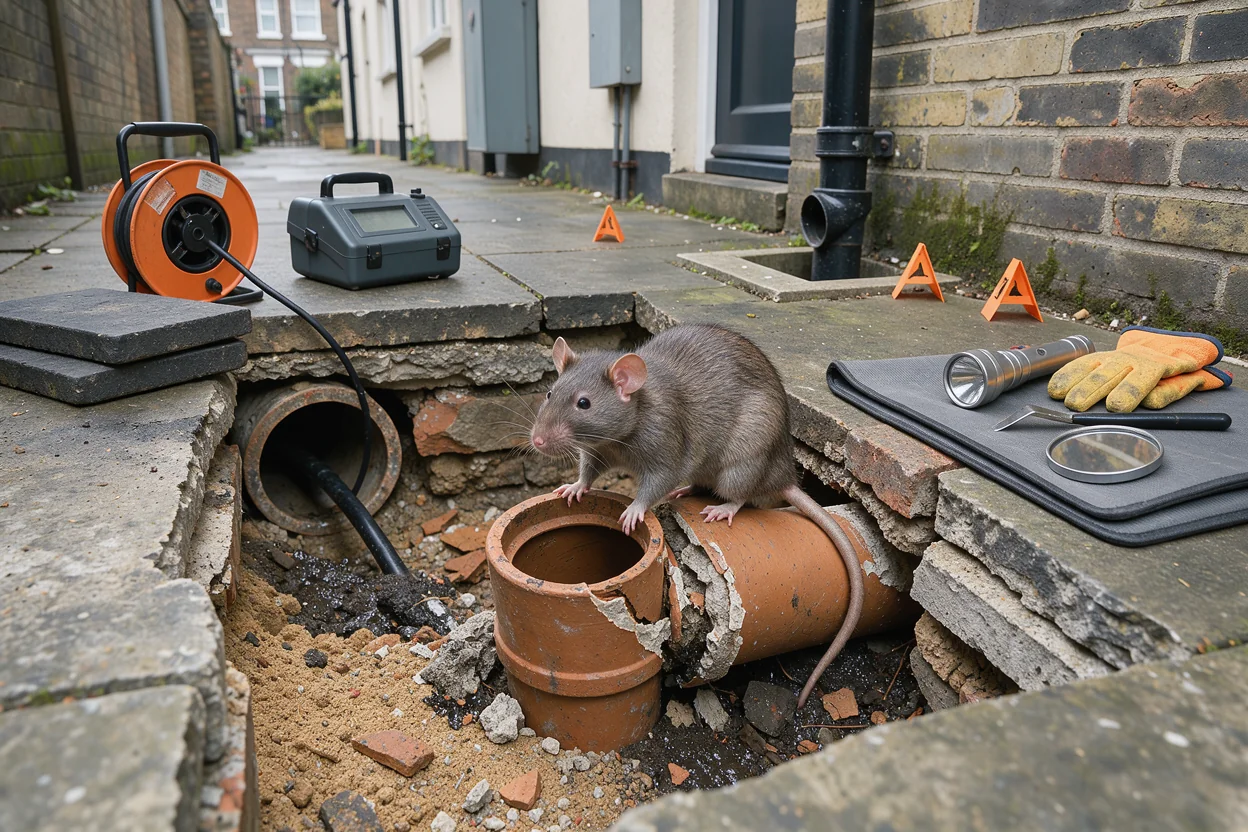
If you've treated rats more than once and they keep coming back, stop buying bait for a moment and look down. The majority of repeat rat problems in London homes don't start in the loft or the kitchen. They start underground, in a cracked pipe or a broken gully you can't see from the surface. Industry guidance from the British Pest Control Association estimates that around 80% of rat infestations inside homes originate from the drainage system, which is why a proper rat control drain defect entry survey matters more than another round of poison.
The good news: you can do the first part of this yourself, this afternoon, with a torch and a pair of gloves. This guide walks you through the same inspection sequence our technicians use at BuzzKill Pest Control before we recommend any treatment, so you can find the likely entry point, gather useful evidence, and know exactly when it's time to bring in a camera.
Why drains are the rat motorway under your home
Rats live in sewers. That's their normal habitat, and your drains connect directly to it. Every waste pipe leaving your house is, in theory, a road they could travel. The system only keeps them out because it's sealed: intact pipes, water-filled traps, and closed joints all block the route.
The problem is age and ground movement. Much of East London's housing stock still runs on original clay drainage laid decades ago. Clay pipes are jointed every metre or so, and each joint is a weak point. Tree roots push them apart, the ground shifts, and a gap of less than 2cm is enough for a rat to squeeze through. Modern PVC is smoother but not immune: rats can gnaw through plastic, and poorly sealed connections fail just as easily.
Once a rat is inside your private drain run, it follows the pipe towards warmth and food smells. From there it can exit through a broken gully, a displaced joint under your extension, or a cracked soil pipe behind a wall. Some readers find this hard to believe until they hear that rats are capable swimmers and can hold their breath long enough to pass through a water trap. National Geographic has documented rats swimming up through toilet bends, which is rare but real. The far more common route is simpler: a defect below ground that lets them out of the pipe and into the void under your floor.
This is also why surface treatment so often fails. You can clear every rat in the house, but if the pipe defect is still open, the next one arrives within weeks. A 2026 survey of UK pest professionals by the NPTA found that nearly two-thirds named either poor building proofing or drainage and sewer defects as the primary cause of internal rat problems. Fix the hole, fix the problem.
Signs the rats are coming up through the drains
Before you inspect anything, confirm the drains are actually the suspect. Drain-origin rat problems have a particular fingerprint, and it looks different from rats wandering in through a gap under the door.
Watch for these patterns:
- Recurring activity after successful treatment. You cleared them, it went quiet for a month or two, then the scratching came back. That cycle almost always means an open entry route, and drains are the first place to check.
- No entry holes above ground. You've walked the walls, checked the airbricks, and found nothing. If rats are inside but there's no external gap, they're arriving from below.
- Rats seen near gullies or manhole covers. Neighbours reporting the same, especially after heavy rain, is a strong hint. Flooding disturbs sewer rats and pushes them up private drain runs.
- Smell from a gully or a slow-draining fixture. A partial collapse or root blockage can coincide with rat activity, because the same defect admits both.
- Droppings in the subfloor void or under kitchen units near the soil stack, rather than along external walls.
- A rat in the toilet bowl. Uncommon, but it settles the question immediately.
If several of these match, you're very likely dealing with rats in drains rather than a surface entry point, and the inspection below is worth your time. If you're not sure what rat evidence looks like, our guide to the signs of rats covers droppings, gnaw marks and smear marks in detail before you start.
The inspection sequence: work from the outside in
This is the same order a technician follows, because it moves from easy above-ground checks to the defects you can't see. Set aside an hour. You'll need a torch, gloves, a screwdriver or crowbar for lifting covers, and your phone camera to record anything you find.
Start at the gullies
Every kitchen sink, bath and downpipe discharges into a gully: the open grated trap at ground level. This is the single most common above-ground drain defect we find on surveys.
Lift the grid and look at three things. First, the water seal: the gully should hold standing water. If it's dry or the trap is cracked, rats can pass straight through. Second, the grating itself: gaps around a loose or broken grid wider than about 15mm are an open door. Third, the surround: if the gully sits in broken concrete or there's a visible void between the gully and the wall, rats can exit the drain there without ever passing the trap.
Square plastic gully covers that have been chewed at the corners are a classic tell. Photograph anything damaged before you touch it.
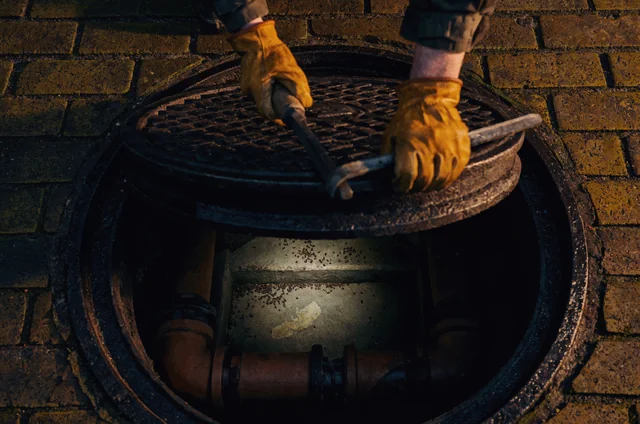
Lift the manhole or inspection chamber
Most properties have at least one inspection chamber where the house drains meet before heading to the sewer. Prise the cover up and shine your torch down.
You're looking for:
- Rat droppings on the benching (the sloped concrete channels inside the chamber). Fresh droppings here confirm rats are travelling your private run, not just the public sewer.
- Smear marks and tracks in the silt along the channel.
- Displaced or open joints where pipes enter the chamber. Look for gaps, cracks around pipe connections, or sections where the pipe has dropped.
- Broken or missing chamber walls, especially in older brick chambers where mortar has perished.
- Redundant connections: old pipes that once served a demolished outbuilding or outside WC and were never capped. An uncapped branch is an open tunnel.
Run a tap inside the house while you watch the flow through the chamber. Water should move cleanly through the channel. If it pools, backs up, or disappears into a crack in the benching, you've found a structural defect and possibly the exit route.
Check the soil stack and where pipes enter the building
The soil stack is the vertical pipe carrying waste from your bathroom down to the drain. Follow it from roof to ground. Check the collar where it meets the wall, the base where it enters the ground or a gully, and any joints along its length. Cast-iron stacks on older London terraces corrode at the base, leaving ragged holes at exactly rat height.
Do the same wherever any pipe passes through a wall: waste pipes from sinks, condensate pipes, old overflow pipes. The hole bored for a 40mm pipe is often 60mm, and the gap is rarely sealed. Rats gnaw the edge of the opening and use it as a doorway between the drain and the cavity wall.
Walk the drain run and look for ground clues
You won't see the pipe, but the ground above it talks. Walk the line from your house to the property boundary (the drain usually runs towards the street or a rear alley). Watch for:
- Rat burrows near the drain line, especially beside extensions, under decking, or next to manhole covers. Burrows here often sit directly over a cracked pipe, because the rats are exiting the pipe and digging up.
- Subsidence or soft spots: a collapsing drain leaks water, washes away soil, and leaves a dip in the ground above it.
- Persistent damp patches or lush grass strips in dry weather, marking a leaking joint.
- Cracked or uneven paving along the run, particularly where an extension was built over the original drain. Building work is a common cause of displaced joints.
Note every location on a rough sketch of the property. If you end up booking a CCTV survey, that sketch saves the engineer time and you money.
Inside the house: trace where they appear
Finish indoors. The spots where you see or hear rats tell you which branch of the system they're using. Scratching behind the kitchen units near the waste pipe points to the kitchen branch. Activity under the bath points to the bathroom run. A rat seen near the downstairs loo suggests the soil stack or its underground connection.
Pull out the kickboards under kitchen units and shine the torch along the pipe runs. Look for droppings concentrated around pipe entries through the floor, gnaw marks on plastic pipes, and greasy rub marks on the pipe itself. A pipe that rats climb regularly develops a dark polished band from the oils in their fur.
What the defects mean and what fixes them
Once you've found something, the repair depends on the defect. This is where a drain defect entry survey turns into a plan rather than a worry.
Cracked or fractured pipe. If the crack is localised, the pipe can often be lined: a resin sleeve is pulled through and cured inside the old pipe, sealing it without digging. Widespread fractures mean excavation and replacement of that section.
Displaced or open joints. Similar story. Lining bridges displaced joints well if the misalignment is small. A joint that's dropped badly needs to be dug out and re-laid.
Broken gully. Cheap and quick. The gully is cut out and replaced, and the surround re-bedded in concrete. Often a half-day job.
Uncapped redundant branch. The pipe is capped or the section removed. Simple, but only once someone has found it.
Chamber damage. Brick chambers can be re-benched and re-rendered; badly collapsed ones get replaced with a modern plastic chamber.
Rats arriving from the public sewer. If your private run is sound but rats are travelling up it from the main sewer, the standard fix is a rat blocker (sometimes called a rat gate or non-return valve): a one-way flap fitted in your drain that lets waste out but nothing back in. Drainage industry reporting in 2026 notes growing demand for WRc-approved blockers as a long-term alternative to repeated baiting. Drainage firms such as Drain247 describe how these one-way valves stop rodents without affecting normal flow.
Whatever the defect, treat the rats and repair the drain together. Sealing the entry without clearing the rats risks trapping them in the house; clearing the rats without sealing the route invites the next one. When BuzzKill handles a case like this, we run the rodent treatment alongside the drainage referral so neither half is wasted.
When you need a CCTV drain survey
Everything above is what you can see with a torch. The most common entry points are the ones you can't: defects in the buried section of pipe between your house and the sewer. That's what a CCTV drain survey is for.
A camera survey feeds a small camera head through the drain from the inspection chamber. It records the full length of the pipe and pinpoints, to the metre, any cracked sections, open joints, root ingress, redundant connections, and holes around connections. Specialists describing CCTV drain surveys for rat entry points note that the survey's real value is identifying the pathway, so the repair is based on evidence rather than guesswork. The BPCA published a code of best practice for rodent drain surveys for exactly this reason: too many homes were being baited repeatedly while the actual defect went unseen.
Book a survey when:
- You've treated rats twice or more and they return within a few months.
- Your above-ground inspection found nothing, but the evidence pattern still points to drains.
- Droppings or smear marks in the inspection chamber confirm rats in the private run.
- You're buying a period property in London with original clay drainage. A pre-purchase survey is far cheaper than discovering the defect after the rats do.
One practical point on responsibility: you own the drains on your property up to the point they connect with the shared or public sewer. Defects in your private run are yours to fix. If the survey shows the problem sits in the public sewer, that's the water company's responsibility, and the survey footage is your evidence when you report it. Uncertainty over who pays for repairs is a real cause of delay, and drainage experts quoted in Wales Online in 2026 called out this confusion as a factor worsening rat problems in British homes. Get the footage first; argue about liability second.
Keeping them out once the route is sealed
After repair, a few habits keep the system closed:
- Fit or replace gully grids so no gap exceeds about 15mm, and keep the water seal topped up in little-used gullies.
- Seal every pipe entry through walls and floors with cement or steel wool packed behind a proper filler. Expanding foam alone is not a barrier; rats chew straight through it.
- Keep manhole covers seated and replace cracked ones promptly.
- Clear leaves and silt from gullies each autumn so you can actually see the trap condition.
- Don't pour cooking fat down the sink. Blockages attract rats and mask defects.
- After heavy rain or local flooding, check the inspection chamber for fresh droppings. Flood events push sewer rats into private runs, and that's when new activity usually starts.
For the wider property, our pest prevention tips cover which rooms and gaps to seal first once the drains are dealt with. And if the inspection has confirmed an active problem, read up on getting rid of rats so the treatment side runs in parallel with the repair, not months after it.
If you want a quick self-check before calling anyone, a simple printable drain inspection checklist (gully condition, chamber evidence, pipe entries, ground clues) would suit this job well, and it's the sort of thing worth keeping with your home documents.
Questions readers ask about rats and drains
Can rats really come up through the toilet? Yes, though it's rare. Rats are strong swimmers and can pass through a water-filled trap. It's far more common for them to exit through a below-ground defect into the subfloor void. If it happens once, treat it as a confirmed drain problem and get the system surveyed.
How much does a CCTV drain survey cost in London? Prices vary by property and drain length, so get a quote based on your layout. What matters is that the survey produces recorded footage with defect locations marked in metres, because that footage is what the repair quote and any water-company claim will rely on.
Will rat poison alone solve a drain problem? No. Baiting kills the rats present today. If the entry defect stays open, new rats follow the same route, which is why recurring problems are the strongest single sign of a drainage cause.
Who is responsible for rats in the drains: me or the water company? You, for the private drains on your property up to the connection with the public sewer. The water company, beyond that point. A camera survey settles where the defect sits.
How long does a drain defect survey take? The DIY inspection above takes about an hour. A professional CCTV survey of a typical London terrace usually takes one to two hours on site, with the footage report following shortly after.
If your inspection turns up fresh droppings in the chamber, a cracked gully, or burrows along the drain line, that's the point to stop and get a technician in. A same-day visit can confirm the route, start treatment, and arrange the camera survey before the next rat finds the same door.

Need professional help? BuzzKill offers fast, reliable pest control services across London and Essex.