
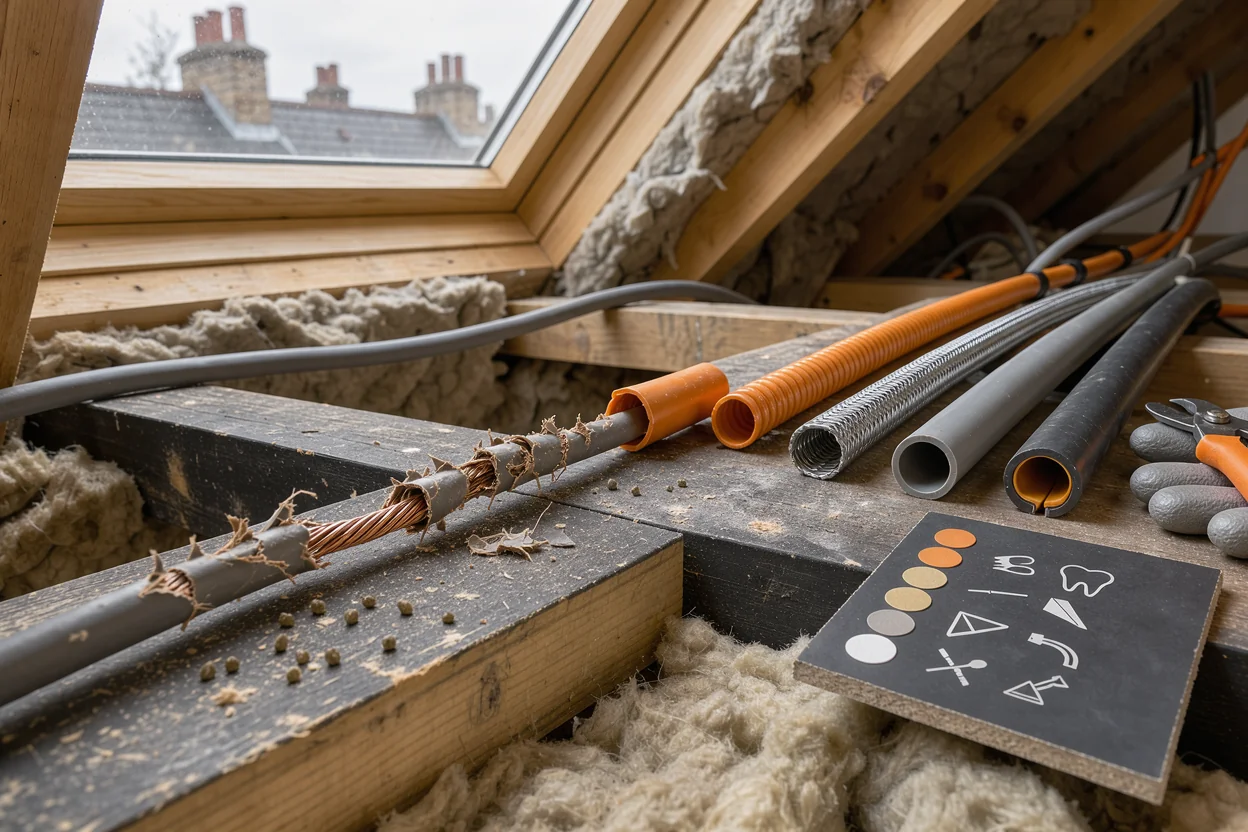
An electrical short circuit caused by rodent gnawing can happen when mice damage insulation, the protective material that keeps electrical wires separated. Finding tooth marks beside a cable is worrying, especially when that cable disappears beneath floorboards or into a loft. Start with the cable’s condition. A guard may help protect sound wiring, but putting a cover over damage cannot make it electrically safe.
For this roundup, I would shortlist guards by their construction, coverage, fitting requirements and documented performance. The useful options include galvanised flexible steel conduit, rigid steel conduit, fixed metal shields and slit sleeving. There are no product-specific test reports available for this comparison, so none is presented as a proven mouse-proof winner. Treat tested as a claim a supplier must substantiate. Sprays and improvised tape wraps are excluded because they do not provide the same enclosing physical barrier.
Deal with damaged wiring before choosing a guard
Suspected mouse damage changes the job from buying protection to arranging an electrical inspection. A protective covering belongs after the cable has been assessed and any necessary repairs completed.
Smoke, sparks and repeated tripping need action
If there is smoke, fire or ongoing sparking, leave the property and call 999 from outside. Don’t approach damaged equipment or try to reach a switch through smoke.
For suspected damage without an active fire, stop using the affected equipment or circuit. If you can safely reach an undamaged consumer unit, the box containing your home’s electrical switches, switch off the affected circuit. If you’re unsure which circuit is involved or cannot approach safely, keep away and get electrical help.
A circuit breaker is an automatic protective switch. Repeatedly resetting one that trips can restore power to an unresolved fault. Leave the affected circuit off until a qualified electrician has assessed it.
Keep children and pets away from the area. Don’t touch exposed wiring, move cables to inspect their undersides or fit a sleeve around suspected damage.
Record the location without disturbing the cable
A photograph from a safe position can help explain what you found. Note whether the marks are behind an appliance, beside a pipe opening, along a loft route or near droppings.
Give the electrician the electrical symptoms as well as the pest evidence. Mention any flickering, loss of power, unusual smell or repeated tripping. These observations help describe the problem; they don’t establish its cause.
For a rented London flat, report both concerns to the landlord or managing agent promptly. Describe the cable location and symptoms separately from the mouse sightings. Ask for electrical assessment and pest investigation to be coordinated, with access arranged for each.
Match the guard to the cable route
The most useful guard comparison starts with where the cable runs and how a covering could be fitted. A straight exposed section, a bend behind a cupboard and a crowded loft corner present different jobs.
The table compares construction and access requirements. It does not assign gnaw-resistance scores or fire ratings to unnamed products.
| Guard type | Where it may fit | Fitting consideration | Limitation to check |
|---|---|---|---|
| Galvanised flexible steel conduit | Routes with bends | An enclosed tube generally needs access to a cable end | Coverage at fittings, joints and ends |
| Rigid steel conduit | Straight, accessible runs | Needs planned supports, bends and connections | Whether the whole vulnerable route can be enclosed |
| Fixed metal shield | A short exposed section beside a surface | A designed cover may fit over an existing route | Access around the sides and ends |
| Heavy-duty slit sleeving | Existing cables whose ends are difficult to access | Opens along its length | Material, seam closure and evidence of gnaw resistance |
Measure only accessible spaces where you can do so without approaching damaged wiring. Cable dimensions, available clearance and the position of connections belong in the specification.
A useful online guard selector would ask about suspected damage, accessible cable ends and bends. Any report of damage should direct the reader to electrical inspection before suggesting a covering.
Metal protection for exposed loft and cupboard runs
Metal guards belong on the shortlist because they can place a physical barrier around vulnerable wiring. Their usefulness depends on the complete installation, including the places where cables enter and leave.
Galvanised flexible steel conduit for bends
Conduit is tubing used to contain and protect electrical wiring. Galvanised means the steel has a protective zinc coating. Flexible steel conduit can follow bends, which makes it worth considering where a cable route changes direction.
This may suit a planned installation around an accessible loft corner or a route between fixed points. Its place in the roundup comes from its enclosing metal construction and flexibility. Those characteristics do not establish the performance of every product sold under the name.
The fitting problem matters. An ordinary enclosed tube cannot simply open around a cable that is already connected at both ends. Any necessary disconnection and reconnection should be handled by an electrician.
Check whether the proposed system includes suitable connectors and protected cable entries. A covered middle section still leaves a problem if mice can reach exposed wiring immediately beyond it. Metal edges must also be prevented from damaging the cable.
I would consider this option for sound wiring on a route with bends, provided an electrician can specify and fit the complete system. Ask to see how each end will be finished.
Rigid steel conduit for straight runs
Rigid steel conduit is worth considering where a straight, accessible cable route can be enclosed as a planned installation. Its fixed shape makes the proposed coverage easier to discuss before fitting.
This may fit a refurbishment where wiring is already being replaced or rerouted. The electrician can consider the tubing, supports and connections together, rather than adding a cover around whatever space remains.
Its limitation is access. A tight corner behind fitted cupboards may leave little room for the necessary fittings. A long straight section may also end at an awkward junction, where the protection needs further planning.
Do not choose rigid conduit simply because the material looks substantial. Ask whether the specification covers the actual cable route, its connections and the conditions around it.
I would put rigid conduit ahead of a flexible covering for assessment when the route is straight and access is good. Confirm the treatment of bends and terminations before any installation begins.
Fixed metal shields for short exposed sections
A fixed shield is a cover designed to protect a particular exposed section. Depending on its construction, it may enclose a cable against a wall or another surface.
This option deserves attention when the vulnerable area is localised: for example, a short accessible run behind a removable cupboard panel. A purpose-made opening cover may avoid the threading problem associated with a closed tube.
The honest limit is its boundary. A shield can cover the visible section while leaving its sides, ends or neighbouring cable accessible. Check the proposed coverage from every direction mice could approach.
Avoid improvised sheet metal, sharp offcuts or loosely attached covers beside wiring. The cover and its fixings must be suitable for the electrical installation.
I would consider a designed shield when an electrician identifies a short, clearly defined exposure. Ask for the protected section to be shown on the proposed installation, including both ends.
Slit sleeving for cables that cannot be threaded
Slit sleeving opens along its length so it can be placed around an existing cable. That makes access easier, but the opening and the sleeve material need separate scrutiny.
An opening sleeve can solve an access problem
This category may fit a sound cable whose connected ends are difficult to reach. It can also be relevant where maintenance access matters and a permanent enclosed tube would be awkward.
The reason to include it is its fitting method. An opening sleeve addresses a real retrofit problem: adding a covering without threading the whole cable through a tube.
However, a seam is part of the protective boundary. Ask whether it stays closed in the proposed position, especially around bends. Check how the covering is secured and how its ends are treated.
A qualified electrician should assess any proposed covering for mains wiring. Ease of fitting does not establish electrical suitability.
Heavy-duty plastic needs evidence beyond its thickness
Heavy-duty does not tell you whether mice can chew through a sleeve. Thickness, colour and a tough appearance are insufficient evidence for that claim.
The same caution applies to a fire-related description. A sleeve’s behaviour around heat or flame answers a different question from whether it resists gnawing.
Without product-specific evidence, treat plastic slit sleeving as an unverified option for mouse protection. It should not become the reason to leave an active infestation unresolved.
I would keep it on the shortlist only when its exact material, intended use and relevant performance are documented. If a supplier cannot substantiate its rodent-resistance claim, choose on that basis rather than on the convenience of the slit.
Check the evidence behind a tested cable guard
A tested guard should come with information that connects the claimed result to the product you are buying. A description of steel, plastic or a general product family cannot establish every finished guard’s performance.
Ask what the gnaw test actually covered
Start with the exact product reference. Ask whether the evidence concerns the finished guard, its material alone or a different version.
Then look at the boundaries of the claim. Did the assessment include seams, bends, connectors and cable exits? Was it relevant to mice, rats or another source of damage? A result for one configuration should not be assumed to cover another.
You don’t need to interpret a laboratory report yourself. Ask the supplier to identify the relevant result and explain its limits in plain English.
Useful questions include:
- Which exact product and material were assessed?
- What test conditions and duration were used?
- What counted as a pass or failure?
- Were joints, openings and fittings included?
- Which installation instructions must be followed?
Keep the documentation with the product details. If the claim remains unclear, describe its resistance as unknown rather than upgrading it to mouse-proof.
Separate fire behaviour from electrical protection
A guard’s fire performance, its resistance to teeth and its suitability around a cable are separate matters. Evidence for one does not automatically answer the others.
Ask for the exact fire-related classification or test result, together with its scope. Avoid relying on a broad description such as fire-safe without supporting details.
Metal also needs proper installation. It conducts electricity, so an electrician must decide what protective arrangements the system requires. Earthing is a protective electrical connection that helps fault current reach the intended protective system; whether and how it is required needs professional assessment.
Cable coverings can also affect how an installation releases heat. Ask the electrician to assess the proposed enclosure alongside the cable arrangement and surrounding loft insulation.
Before buying, obtain confirmation that the chosen guard and fittings suit the actual cable and location.
Close the routes mice use to reach wiring
Cable guards address vulnerable wiring, while mouse control addresses the animals reaching it. Plan both jobs together so that a protected section does not become the only improvement.
Proof gaps without damaging cables
Inspect accessible areas around cupboards, pipe routes and service openings for signs of mouse activity. Keep clear of suspected electrical damage.
A gap beside a cable needs more care than an ordinary hole in a cupboard. Loose conductive material, pressure on the cable or an unsuitable seal can introduce another problem. Don’t push metal wool against wiring or pack material into electrical fittings.
Use the guide to mouse-proofing materials to understand the wider material choices. Where a gap contains wiring, have its treatment agreed with the electrician.
Plan openings across the property rather than concentrating on the nearest visible hole. The guide to rooms to seal first can help organise that inspection.
In a flat or terraced house, record whether a route disappears into a shared wall or service space. Arrange access before assuming the visible opening is the full route.
Coordinate repairs, treatment and follow-up access
If there are fresh droppings or continuing sightings, arrange a pest assessment alongside the electrical work. Discuss the sequence of treatment and proofing before closing suspected occupied routes.
The electrician should handle cable assessment, repair and testing. The pest controller should investigate mouse activity, access routes and the control plan. Make sure both understand where the other needs access.
For readers weighing monitoring against intervention, the comparison of mouse detection and treatment explains the different roles. BuzzKill Pest Control is one option for the pest investigation; electrical inspection and repairs need a qualified electrician.
Agree how the area will be checked afterwards. Record the repair and proofing locations, retain photographs where safe, and keep necessary inspection points accessible. Report renewed gnawing or fresh electrical symptoms promptly.
Questions when mice have reached the wiring
Visible tooth marks often leave uncertainty about the hidden cable and the work needed. These distinctions help you describe the problem accurately.
Can I cover a cable if only the outside looks chewed?
Have it assessed first. A visible mark does not establish how deeply the damage extends or whether the cable is safe.
Do not tape over the area and treat the matter as resolved. Leave the cable undisturbed and let the electrician decide whether repair, replacement or further inspection is needed.
Does a tripped breaker prove mice caused the fault?
No. A tripped breaker can have several causes, and nearby mouse activity does not establish the electrical diagnosis.
Tell the electrician about both observations. Avoid describing the fault as confirmed rodent damage until it has been investigated. Leave a repeatedly tripping circuit off rather than testing your theory by resetting it.
Can peppermint oil or tape replace a guard?
Neither supplies evidence that a cable is protected against chewing. Tape also cannot establish that previously damaged wiring is safe.
Avoid applying oils, sprays or other liquids to electrical equipment or cables. Choose protection through the cable assessment, product documentation and fitting plan, while dealing with the mouse activity separately.
What should I report in a rented flat?
Report the exact location, visible damage and any electrical symptoms to the landlord or managing agent. Include safe photographs if available.
Ask who is arranging the electrical inspection and pest assessment, and how access will work. If smoke, fire or ongoing sparking develops, leave and call 999 rather than waiting for a maintenance reply.
Specify protection around your loft or kitchen
The practical choice depends on cable condition, the shape of the route and whether the vulnerable section can be enclosed properly. Bring those details to the fitting discussion.
When a cable route is already accessible
For a sound, straight run exposed during refurbishment, ask the electrician to assess rigid steel conduit. Where the route bends, discuss a complete flexible steel conduit system.
If only a short section needs protection, a designed fixed shield may deserve closer attention. Request a proposal showing the cable entries, ends and neighbouring exposed sections.
For cables with inaccessible ends, ask whether a purpose-made opening guard is suitable. Keep ordinary plastic slit sleeving separate from any product with documented rodent-resistance performance. Buy against the exact specification agreed for the installation.
When the cable disappears into a void
The overlooked alternative is often changing access to the cable or rerouting it during necessary electrical work. More sleeving on the visible section may leave the hidden problem untouched.
In a crowded kitchen or shared loft, discuss access before buying materials. An electrician may need to assess wiring beyond the visible marks, while a pest controller investigates the route mice are using.
For suspected damage, begin with electrical assessment. For sound wiring exposed to active mice, coordinate physical protection with the control plan. Ask both professionals to identify which areas will remain accessible for inspection after the work.

Need professional help? BuzzKill offers fast, reliable pest control services across London and Essex.