
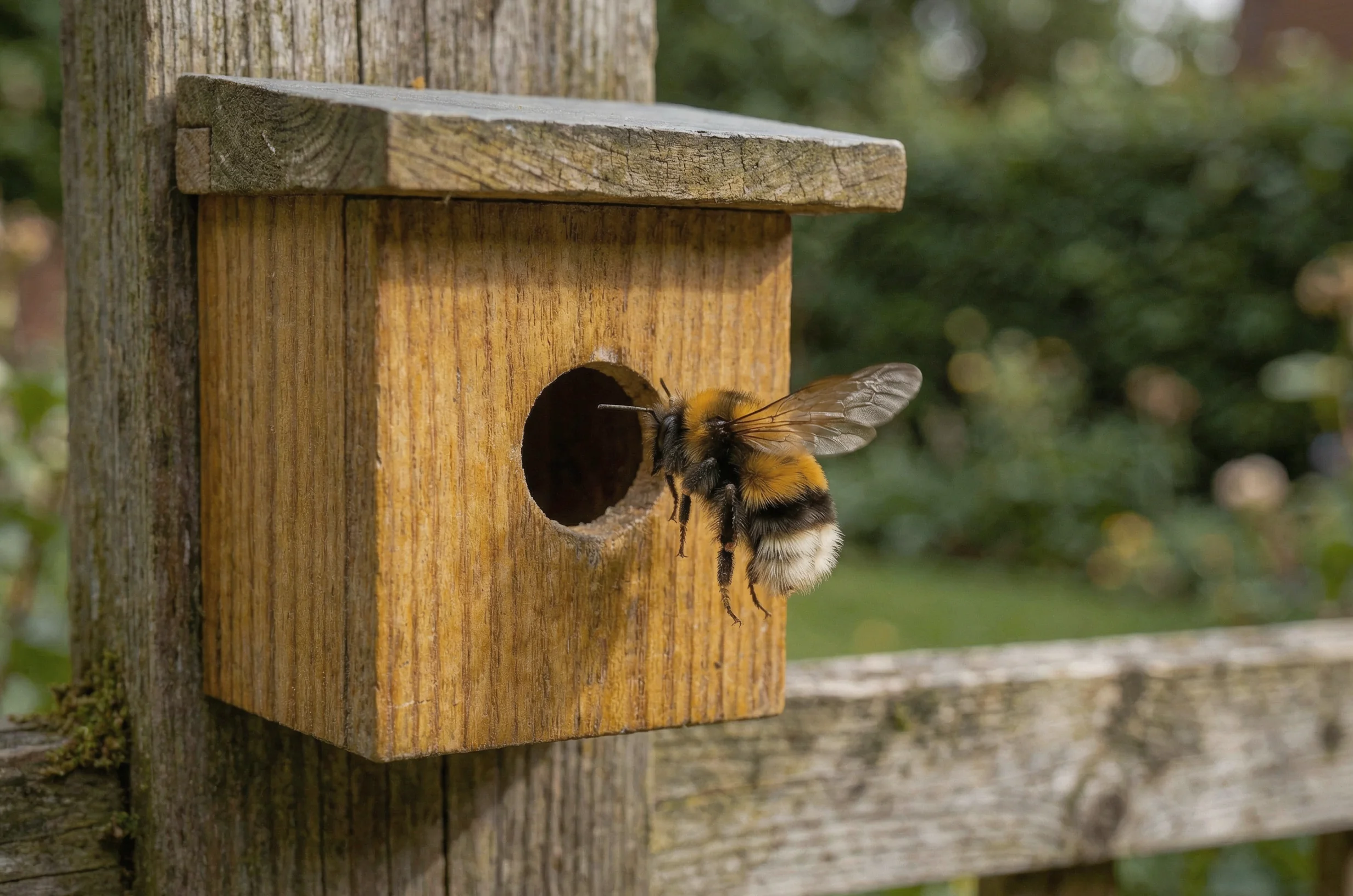
If you’re weighing tree bumblebee nesting in bird box options, start by leaving the box undisturbed and keeping people away from its entrance. You can then check what’s flying around it, whether the flight path crosses somewhere busy, and whether a temporary change to garden access would help. Moving the box straight away can create problems for both the colony and anyone handling it.
A busy entrance can look alarming, especially above a patio or beside the back door. It doesn’t automatically mean the nest needs removing. I’d begin with the checks below, working from a window or another position that lets you observe without approaching the box.
Give the occupied bird box space today
For the next half-hour, concentrate on reducing contact with the occupied box. Leave its lid, entrance and fixings alone.
Bring children and pets away from the immediate area. If garden furniture sits underneath, use another seating spot for now. Take an alternative route to the shed or washing line where possible.
Avoid standing directly in front of the entrance to count bees or take photographs. A phone’s zoom can help you record their appearance without moving closer. You don’t need a close-up badly enough to disturb the nest.
These are the useful first actions:
- Pause mowing, drilling, pruning or other work beside the box.
- Check whether you can use another door or garden route.
- Tell everyone using the garden where the activity is.
- Observe from somewhere that leaves the entrance unobstructed.
Don’t stuff the entrance with paper, cover it with tape, spray it or pour water inside. Blocking the opening is not a way to make an occupied box safe.
Where someone has a known serious sting allergy, keep them away from the nest area while suitable precautions are arranged. Breathing difficulty, swelling of the mouth or throat, or collapse after a sting needs an immediate 999 call. Our guide to sting emergency warning signs gives further context, but reading it must never delay emergency help.
Check the markings and entrance activity from a distance
A bird box location alone cannot confirm tree bumblebees. Check the insects’ appearance and what they are doing before deciding how to manage them.
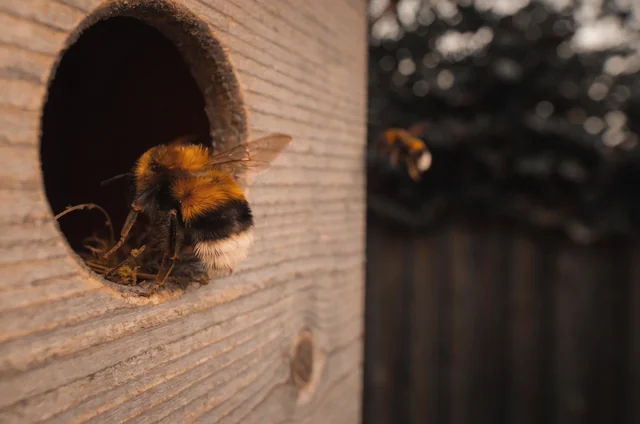
Look for the ginger, black and white pattern
Tree bumblebees typically have ginger-brown hair behind the head, a black rear body section and a white tail. Look for that combination across several insects if you can see them clearly.
Common social wasps generally look smoother, with yellow-and-black markings and a more obvious narrow waist. Honeybees are usually slimmer than bumblebees, but colour and size vary. A blurred photograph may be insufficient for identification.
You don’t need to catch an insect. Take a photograph or short video from your existing observation point. Note whether insects repeatedly enter the bird box hole or merely fly past it.
If the markings remain unclear, record the identification as uncertain. Don’t open the lid to settle the question.
Separate hovering from a honeybee swarm
Tree bumblebee males may hover around a nest entrance while looking for emerging queens. This loose gathering can resemble swarming to a worried homeowner.
Male bumblebees cannot sting, but females can. You cannot assume that every insect around an active nest is male, so hovering is not an invitation to approach.
A cluster of bees hanging from a branch is a different observation from repeated traffic into a bird box. Our guide to UK bee swarm timing discusses seasonal swarm activity; the insects and their behaviour still need identifying.
If you see birds carrying food into the box, hear chicks or suspect birds are also using it, leave everything in place. Describe both the bird activity and the insects when seeking advice.
Map where bees and people cross paths
The position of a tree bumblebee nest matters because it determines how often people pass its entrance. In a small London garden, a box above the only back door presents a different problem from one on an unused boundary fence.
Follow the route from a window
Watch where arriving and departing bees travel. Do they cross the doorway, skim a seating area or head towards a quiet part of the garden?
Trace your own ordinary journeys too:
- From the back door to the bins.
- Between the house and a shed or home office.
- Along the route children use to reach outdoor toys.
- Past a pet door, kennel or regular resting place.
- Through a shared passage used by neighbours.
Avoid choosing a universal safe distance. The height of the box, direction of travel and available space all affect whether a route is practical.
A simple interactive garden map could help here: mark the bird box, doors and seating, then save a temporary route around the entrance.
Check what could disturb the box
Look at its support without touching it. A box fixed to a shed may receive vibration when someone slams the door. Fence repairs, hedge cutting or climbing plants being pulled away can also disturb the nest.
Tree bumblebees can respond defensively when their nest is disturbed. Move the work rather than testing how much disturbance they tolerate.
Check where activity actually begins. If bees enter a compost heap instead, that is a separate nest location with different disturbance risks. Our compost heap nest guidance is more relevant to that situation.
If the entrance cannot be watched safely, make a note of the access problem and stop the inspection there.
Choose whether the colony can stay where it is
For an occupied bird box, the practical options are usually leaving the colony undisturbed, changing how the nearby space is used, or obtaining a specialist assessment of relocation.
Leave an accessible, undisturbed colony in place
Keeping the nest where it is may be workable when people can avoid its entrance and nearby activities won’t shake the box.
A sheltered bird box can suit a nesting bumblebee colony, particularly when old nesting material is present. Its occupation does not by itself mean there is a wider problem inside your home.
Bumblebee colonies are seasonal. The original colony eventually dies out, while new queens continue the next generation. That provides a reason to consider temporary accommodation rather than permanent removal.
There is no dependable departure date you can calculate from the day you notice bees. Avoid planning work around a promised number of weeks.
Change garden use before changing the nest
Move a chair, postpone a nearby task or use a different route if that resolves the conflict. Keep any temporary ground marker away from the entrance and clear of the bees’ route.
A narrow shared passage may leave little room for adjustment. Likewise, asking children to remember an invisible flight path is less dependable than keeping that part of the garden out of use.
If there’s uncertainty, write down the proposed arrangement and check whether everyone can follow it.
Discuss relocation when the conflict remains
Relocation involves more than lifting a wooden box. The colony, box condition, access and destination all need assessment.
BuzzKill Pest Control lists bee relocation among its services. Whether a particular bird box colony can be moved successfully requires an assessment of the actual situation.
Do not loosen the fixings, turn the entrance towards another direction or move the box a short distance as an experiment.
Keep garden work away from the active nest
Once you’ve chosen to leave the bird box occupied, make the temporary arrangement clear enough to last beyond today.
Tell anyone who might work nearby, including a gardener, cleaner, neighbour or visiting relative. Identify the exact box. “There are bees somewhere near the shed” leaves too much room for confusion.
Postpone work that touches the box or its support. This includes painting the surrounding fence, repairing loose timber, adjusting brackets and pulling away climbing plants. Avoid using nearby powered equipment if its vibration reaches the box.
Keep sprays and household cleaning products away from the entrance. Don’t attempt to smoke the bees out or place strong-smelling substances around the hole.
If the insects turn out to be wasps, blocking their access still needs avoiding. The risks of sealing nests are particularly relevant when someone is tempted to close an entrance before identification or assessment.
Over the next 48 hours, check whether the changed route works during ordinary garden use. Observe from the same safe position where possible. Record practical changes, such as bees crossing the doorway or visitors repeatedly approaching the box.
An active entrance alone is not evidence that the arrangement has failed. Repeated unavoidable contact with people is the issue that should prompt another assessment.
Get specialist help when access cannot be made safe
An occupied bird box needs closer professional consideration when its position prevents you from using essential access safely or avoiding repeated disturbance.
Describe the property problem clearly
Explain what makes the location difficult. “Bees above the only entrance to a shared garden” is more useful than “lots of bees outside”.
Other reasons to stop handling the situation yourself include a damaged box, loose support, repeated defensive behaviour during unavoidable access, or uncertainty about whether the insects are bees or wasps.
For an assessment by BuzzKill Pest Control or another suitable specialist, prepare:
- A photograph taken without approaching the entrance.
- The box’s position relative to doors, paths and windows.
- Details of children, pets or people with a serious sting allergy.
- Any essential repairs affecting the box or its support.
- Changes already made to routes or garden use.
Mention whether birds have been using the box. Don’t climb a ladder to obtain measurements or photographs.
Establish what relocation would involve
Ask whether the nest can remain in place with a workable access arrangement. If relocation is proposed, the assessment should address the receiving location, the condition of the box and the disruption involved.
Even a short move can leave returning bees searching around the original position. That is one reason to avoid trying different locations yourself.
Also establish whether the person assessing the nest undertakes bumblebee relocation. A service described as bee removal may involve different methods for different species and locations.
Our bee relocation and law guide gives background to the terminology. Avoid broad assumptions that every bee nest must be destroyed or that relocation is always possible.
Before any work begins, make sure the proposed action, access arrangements and treatment of the occupied box are clear.
Wait for confirmed vacancy before cleaning the box
Cleaning should wait until the bumblebee colony has finished and the box is no longer occupied. A quiet entrance during one observation does not establish that.
Check activity over time
Weather and time of day affect what you can see. A cold, wet spell may produce little visible traffic even when a nest remains active.
Watch from a distance on separate suitable occasions. Note whether insects enter or leave, whether hovering continues and whether birds show interest in the box. Don’t tap the wood or lift the lid to provoke a response.
A diary can stay simple: date, conditions and what you observed. Its purpose is to prevent a single quiet afternoon becoming the basis for disturbing an occupied nest.
If repairs are urgent and vacancy remains uncertain, arrange an assessment rather than opening the box yourself.
Clean and reposition only after occupation has ended
Once you are confident the box is unused, check again for birds before undertaking maintenance. Eggs, chicks, nest building or repeated bird visits are reasons to leave it alone and obtain appropriate advice.
Follow the nest-box maker’s cleaning instructions. Avoid leaving pesticide or cleaning-product residues inside, and let the box dry before it is returned to use.
Check the timber, lid and mounting points. Replace damaged parts while the box is empty.
Consider its position before putting it back. A location away from busy doors, seating and frequently disturbed structures may reduce future conflicts, provided it remains suitable for the birds you hope to attract.
Don’t fit entrance plugs, improvised mesh or deterrents to an occupied box. Make any changes only after confirming it is empty.
Bird box questions that affect your decision
Some bird box situations need a direct answer before you decide whether to keep observing or seek further help.
Can I still use the garden?
Often, yes, if you can avoid the entrance and leave the nest undisturbed. Start with the parts of the garden that don’t require crossing the bees’ route.
The answer changes when the box sits beside unavoidable access or someone cannot reliably keep away. Reassess the arrangement if ordinary use repeatedly brings people close to the entrance.
Does hovering mean the bees are about to attack?
Hovering around a tree bumblebee nest may be male patrol activity. It does not, by itself, establish aggressive behaviour.
Keep your distance because an occupied nest also contains females capable of stinging. If bees repeatedly approach people during unavoidable use of the area, step away and have the access problem assessed.
Can I move the box after dark?
Darkness does not make moving an occupied colony a suitable household task. Handling the box can disturb the nest, and the receiving location still needs consideration.
Leave the fixings and entrance untouched while you obtain advice. Don’t detach the box in preparation for someone else to collect it.
Will the same colony return next year?
Bumblebee colonies do not persist in the same way as a perennial honeybee colony. However, a suitable box can attract another nesting queen in a later season.
Future occupation is therefore possible. Review the location when the box is empty instead of relying on the current colony’s departure to prevent another access conflict.
What if bees are entering the roof as well?
Treat activity at the eaves, roof or wall as a separate observation. Bees near a bird box are not proof that all nearby flight traffic belongs to that nest.
Record each entrance from ground level and leave it open. If insects are also entering an occupied room, keep people away from that area and include the indoor activity in a professional assessment.
Need professional help? BuzzKill offers fast, reliable pest control services across London and Essex.