
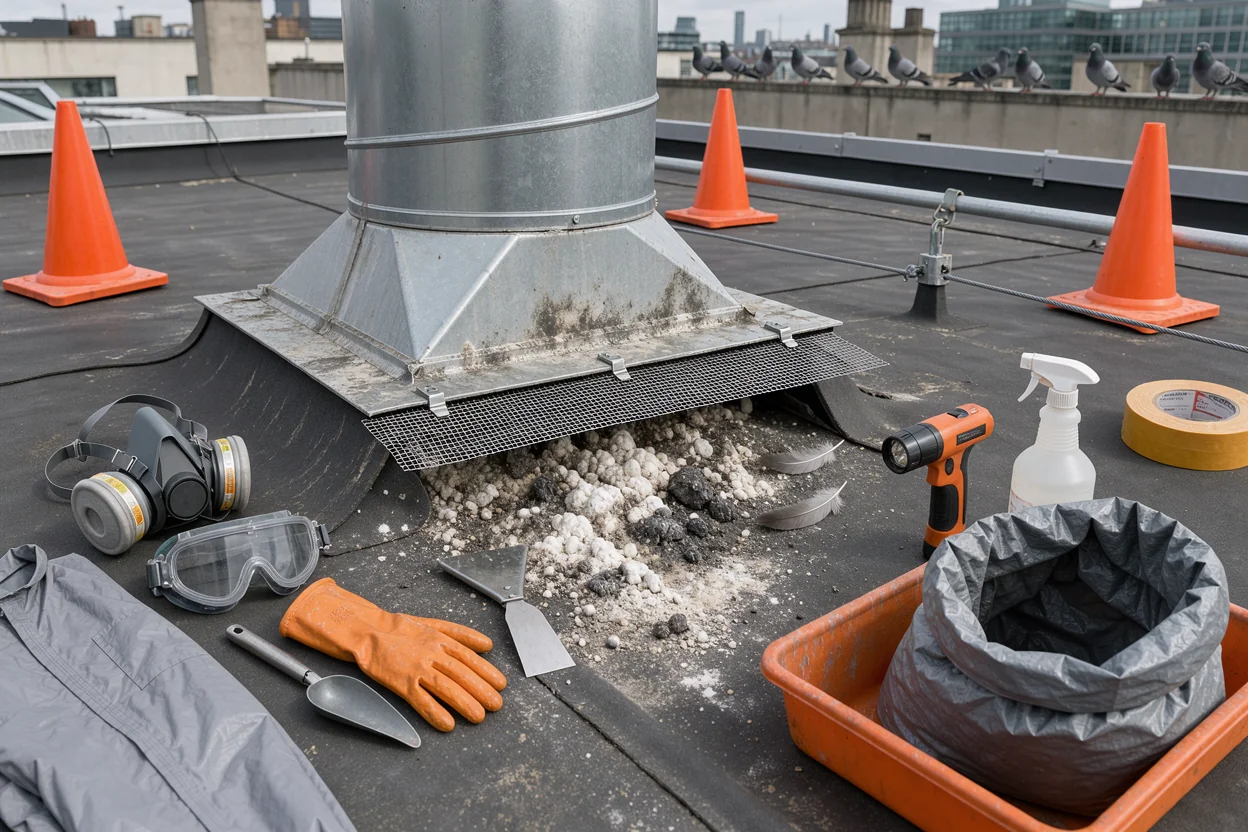
Meeting commercial roof pigeon guano safety regulations starts with controlling access. In the next 30 minutes, restrict entry to the affected roof, tell the person responsible for building maintenance, and record what you can see from a safe position. Leave deposits undisturbed until the access arrangements and cleaning method have been assessed.
For a London facilities manager or commercial property owner, the job involves several connected responsibilities: worker safety, protection of people below, safe roof access, wildlife checks and waste handling. I’d organise these before agreeing a cleaning date. The walkthrough below explains what to establish, what to document and what should stop the work.
Restrict roof access while you record the problem
Pigeon deposits on a commercial roof can affect people who have no part in the cleanup. Maintenance staff, window cleaners and ventilation contractors may all use the same access route.
Tell those teams about the affected area today. Where you control access, use the building’s normal arrangements to restrict entry without obstructing an emergency escape route. If material could fall onto an entrance, loading bay or pavement, assess the area below as well.
Record the location, approximate spread and nearby equipment. Photographs taken safely through an existing window or from another protected position can help a contractor prepare. Nobody should climb onto an uncertain roof just to improve the pictures.
Useful details include:
- Deposits beside roof hatches, walkways, gutters or plant.
- Fresh droppings beneath ledges, pipes or solar panels.
- Birds entering gaps, carrying nesting material or sitting in sheltered corners.
- Rooflights, unprotected edges or surfaces whose strength is unknown.
- Air intakes, open windows and occupied spaces near the proposed work.
Describe uncertainty honestly. A deposit’s appearance cannot establish which organisms are present or whether the roof can support a worker.
If you cannot see the affected area safely, arrange a competent survey. Keep the access restriction in place until someone responsible has reviewed the findings and authorised the next activity.
Put the roof job under the right legal duties
Commercial roof clearance needs a site-specific assessment under the relevant health, safety and environmental framework. A cleaning quotation alone does not establish that the work has been planned adequately.
Establish who controls each part of the work
The Health and Safety at Work etc. Act 1974 sets the broad framework for protecting employees and other people affected by work. The Management of Health and Safety at Work Regulations 1999 support the assessment and management of workplace risks.
For this job, identify the employer, building manager, contractor and anyone controlling roof access. Agree who will provide roof information, authorise entry, protect occupiers and accept the completed work.
Appointing a contractor leaves coordination responsibilities with the organisations involved. Give them information about fragile surfaces, existing safety systems, nearby activities and restrictions affecting the building.
Separate exposure controls from fall prevention
The Control of Substances Hazardous to Health Regulations 2002, usually called COSHH, cover exposure to substances that can harm health, including relevant biological agents. Biological agents are microorganisms that can cause harm.
The Work at Height Regulations 2005 address work where a fall could cause personal injury. A thorough COSHH assessment cannot compensate for an unsafe access route.
Where clearance forms part of roof repairs or other construction work, establish whether the Construction (Design and Management) Regulations 2015 also apply. Resolve this when defining the work package.
Check competence for the actual roof
Ask who will supervise, what relevant training workers have and how they will manage the proposed equipment. Our guide to checking pest controller credentials can support that conversation.
Memberships and certificates provide useful background. Also ask for evidence of competence in the access method and cleaning tasks proposed for your property.
Survey the roosts, roof surfaces and occupied areas
A useful guano survey connects the deposits with bird activity and the building’s layout. The result should explain where work is needed and what could affect its safe completion.
Follow the evidence across the roof
Arrange an inspection route through the roof hatch, established walkways, plant areas, drainage points and sheltered roosting spaces. The route itself needs safe access arrangements.
Map the affected areas rather than describing the whole roof as equally affected. Note whether deposits sit on a durable surface, a fragile covering, electrical equipment or material whose condition is uncertain.
If deposits are present, record their extent and the activities likely to disturb them. If no deposits are found, document the inspected areas and any inaccessible spaces. Avoid authorising broad treatment solely because pigeons have been seen nearby.
For a bird-control brief to BuzzKill Pest Control, include this roof plan, access restrictions and the occupiers who could be affected.
Check nesting activity before scheduling proofing
Cleaning and bird exclusion need to account for wildlife protection. The Wildlife and Countryside Act 1981 protects wild birds and their nests in relevant circumstances, including nests being built or in use.
An apparent pigeon problem does not establish permission to remove nests or block entrances. Licensing provisions have specific purposes and conditions.
Where nesting activity is suspected, pause the affected part of the job while a competent person establishes the lawful options. Check again close to the work date. A calendar entry or an old survey cannot establish whether a nest is active today.
Turn the survey into a task-specific COSHH assessment
The COSHH assessment should explain how workers and others could be exposed during this particular clearance. A generic document headed “bird treatment” may miss the activities that create exposure.
Describe the material and the work
Consider lifting deposits, handling debris, cleaning tools, removing protective clothing and moving waste through the building. Disturbing dry material can release dust; the cleaning method should address that route of exposure.
Our explanation of pigeon droppings health risks gives background to the biological concerns. For the job assessment, connect each concern to an activity, a person and a proposed control.
Include cleaning products too. Product safety information, intended use, dilution instructions and roof compatibility belong in the assessment. Adding a disinfectant introduces another substance to manage.
Use biological hazard groups accurately
COSHH biological hazard groups describe named organisms according to the disease risks they present. Group 2 and Group 3 classifications involve different levels of concern.
A hazard group belongs to an organism. It does not classify an entire roof or every bag of pigeon droppings.
Avoid statements such as “all guano is Hazard Group 3”. Ask the assessor to explain which organisms are relevant, how exposure could occur and which controls follow from that assessment. A classification should support decisions about the work.
Select controls before selecting protective equipment
First consider whether disturbance can be avoided or reduced. Then assess separation, dust suppression, suitable collection equipment and the cleaning sequence.
Personal protective equipment, or PPE, provides a further layer of protection. Specify gloves, clothing and eye protection according to the tasks.
Where respiratory protective equipment, or RPE, is needed, record the required protection and the reason for selecting it. Tight-fitting equipment needs appropriate face-fit testing and a reliable seal during use.
Confirm where workers will wash, change and remove used protective clothing before work begins.
Agree safe roof access and a workable rescue plan
Guano clearance should proceed only when the whole route is safe, from reaching the roof to bringing waste down. The duration of the job does not settle the access decision.
Choose access around the work
The work-at-height approach starts by considering whether work at height can be avoided. Where it cannot, plan measures to prevent falls, then address any remaining fall risk.
Consider suitable guarded work areas and access equipment before relying on personal fall protection. An existing parapet, ladder or roof anchor needs assessment for its intended use.
Check fragile rooflights, gaps, changes in level and the strength of the working surface. Keep workers, equipment and accumulated waste within the roof’s assessed capacity.
Ask how tools and filled containers will move. Carrying loads along a narrow route can change the risk even when the cleaning area itself is protected.
Make rescue arrangements specific
Where the access method requires rescue planning, identify who will respond, what equipment they need and how they will reach the worker.
A plan that only names the emergency services leaves practical questions unanswered. The people on site need arrangements suited to the roof and equipment.
Set stopping conditions for wind, rain, ice, poor visibility and changes in roof conditions. Check these against the equipment instructions and assessment rather than inventing a universal weather threshold.
If roof strength, anchor suitability or rescue arrangements remain uncertain, keep the work on hold. A permit to work can record authorisation, but it cannot resolve those uncertainties by itself.
Approve the cleaning sequence before deposits move
A written cleaning method should make the work predictable for the operatives and the building manager. Agree the sequence before people, chemicals and waste containers arrive.
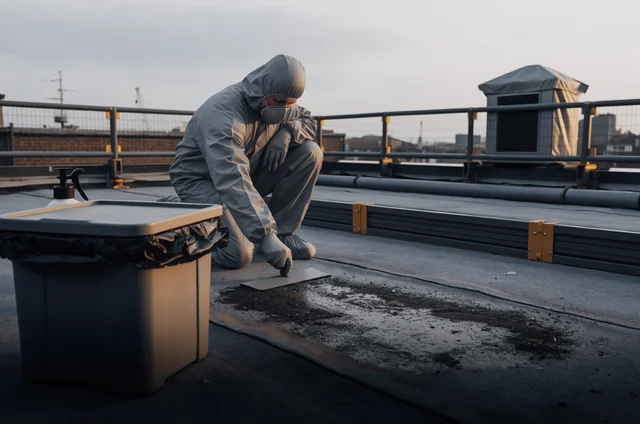
Define a controlled removal method
The exact method depends on the survey, but the sequence should address these stages:
- Establish the work area and protect people on the roof and below.
- Confirm wildlife checks, weather conditions and access authorisation.
- Apply the assessed measures to limit dust and spread.
- Collect deposits using suitable tools and containers.
- Clean the exposed surface using a compatible method.
- Collect residues and remove equipment through the agreed route.
Avoid dry sweeping, compressed air or uncontrolled pressure washing as default methods. Each can spread material beyond the immediate cleaning area.
Controlled dampening may form part of the method, but water use needs its own checks. Consider slip risk, electrical equipment, roof condition and where the liquid will go.
If vacuum collection is proposed, ask how the equipment, filtration and emptying procedure suit the assessed material.
Agree when treatment is appropriate
Disinfection needs a defined purpose. Applying a product does not establish that deposits have been removed or that a surface is ready for another trade.
Specify the product, application conditions, required contact time and any restrictions on access afterwards. Follow its instructions and check compatibility with the roof covering.
Do not improvise chemical mixtures or attempt to neutralise deposits with an acid or alkali. Where surface damage is suspected, the guide to guano masonry damage provides background for discussing the affected material.
If cleaning exposes loose masonry, damaged coverings or uncertain fixings, stop work in that area and arrange the appropriate building inspection.
Arrange the waste route before clearance begins
Roof waste needs an agreed route from the collection point to its final destination. Leaving this decision until bags are filled can create avoidable handling and storage problems.
Ask the contractor to establish the waste classification and explain the basis for it. Pigeon droppings should not automatically be labelled clinical waste or hazardous waste simply because a biological concern exists.
Where treatment chemicals, absorbents or other materials enter the waste stream, include them in that assessment. Packaging and destination must suit the resulting waste.
Before authorising removal, establish:
- Who produces, holds and transports the waste.
- Whether the carrier has the required registration.
- Which facility will receive it and whether it can accept that waste.
- Which transfer or consignment documents are appropriate.
- Where containers can wait safely before collection.
Agree how washwater and product residues will be collected or otherwise managed lawfully. A nearby roof drain is not an agreed disposal route. Establish the drainage arrangements and any required permissions before water is used.
Keep containers closed and within their handling limits. Plan the route through stairs, lifts or service areas so it does not expose other building users.
Retain the relevant waste documents with the job record and record any change of carrier or destination.
Inspect the roof and reduce the chance of another build-up
A roof handover should confirm what was completed and identify anything that still needs attention. Clear photographs help, but they need to be tied to locations and agreed acceptance criteria.
Record what the clearance achieved
Inspect the areas covered by the method, access routes, nearby equipment and any surfaces affected by the work. Check that waste, temporary barriers and cleaning equipment have been accounted for.
Record inaccessible areas, remaining deposits and repairs needed. Avoid accepting a broad statement such as “roof treated” when part of the agreed area was left untouched.
Keep the survey, assessments, work method, relevant equipment records, waste paperwork and completion notes together. Our guide to pest monitoring records can help structure ongoing records.
A useful digital checklist could flag missing access approval, COSHH controls, nest checks and waste details for human review before authorisation.
Match prevention to the roosting space
Inspect the ledges, openings and sheltered spaces associated with the deposits. Cleaning leaves those physical conditions available unless the building management plan addresses them.
Where BuzzKill Pest Control is assessing bird prevention, share the roof condition report and maintenance access requirements. Proposed proofing needs to suit both.
Solar arrays need particular coordination around equipment access and warranties. The guide to pigeon proofing solar panels explains considerations to raise before installation.
Before closing an opening or fitting exclusion measures, confirm that birds cannot become trapped and that nesting checks remain valid. Assign someone to inspect the finished system and record future defects.
Questions that delay commercial roof clearance
These practical decisions often arise between the first report of pigeon deposits and permission to begin work.
Can our maintenance team clear a small patch?
The patch’s size is only part of the assessment. Roof access, worker competence, dust generation, nearby equipment and waste handling also matter.
An appropriately trained team may be able to undertake suitable work under an assessed method. Where the task involves uncertain roof strength, substantial deposits, active nests or specialist access, arrange competent advice before assigning it.
Does the building need to close?
That depends on whether the work can be separated safely from normal activities. Consider entrances, shared access routes, air intakes and the spaces below.
Agree affected areas and timing with occupiers. If the proposed controls cannot protect people using those areas, revise the arrangements before work starts.
Is laboratory testing always necessary?
Testing should answer a defined question that affects the assessment or method. Discuss its purpose with the competent assessor before commissioning samples.
Do not treat a limited sample result as proof that every deposit on the roof has the same characteristics. Keep controls tied to the work and the conditions found.
How soon should we inspect again?
Set the inspection timing according to bird activity, the proofing installed, roof use and any limitations recorded at handover. There is no useful universal interval for every commercial roof.
Review photographs and reports promptly if fresh deposits appear. If they sit beneath a proofed area, check for damage, gaps or another roosting position. Record the location and assign the follow-up inspection to a named person.
Need professional help? BuzzKill offers fast, reliable pest control services across London and Essex.