
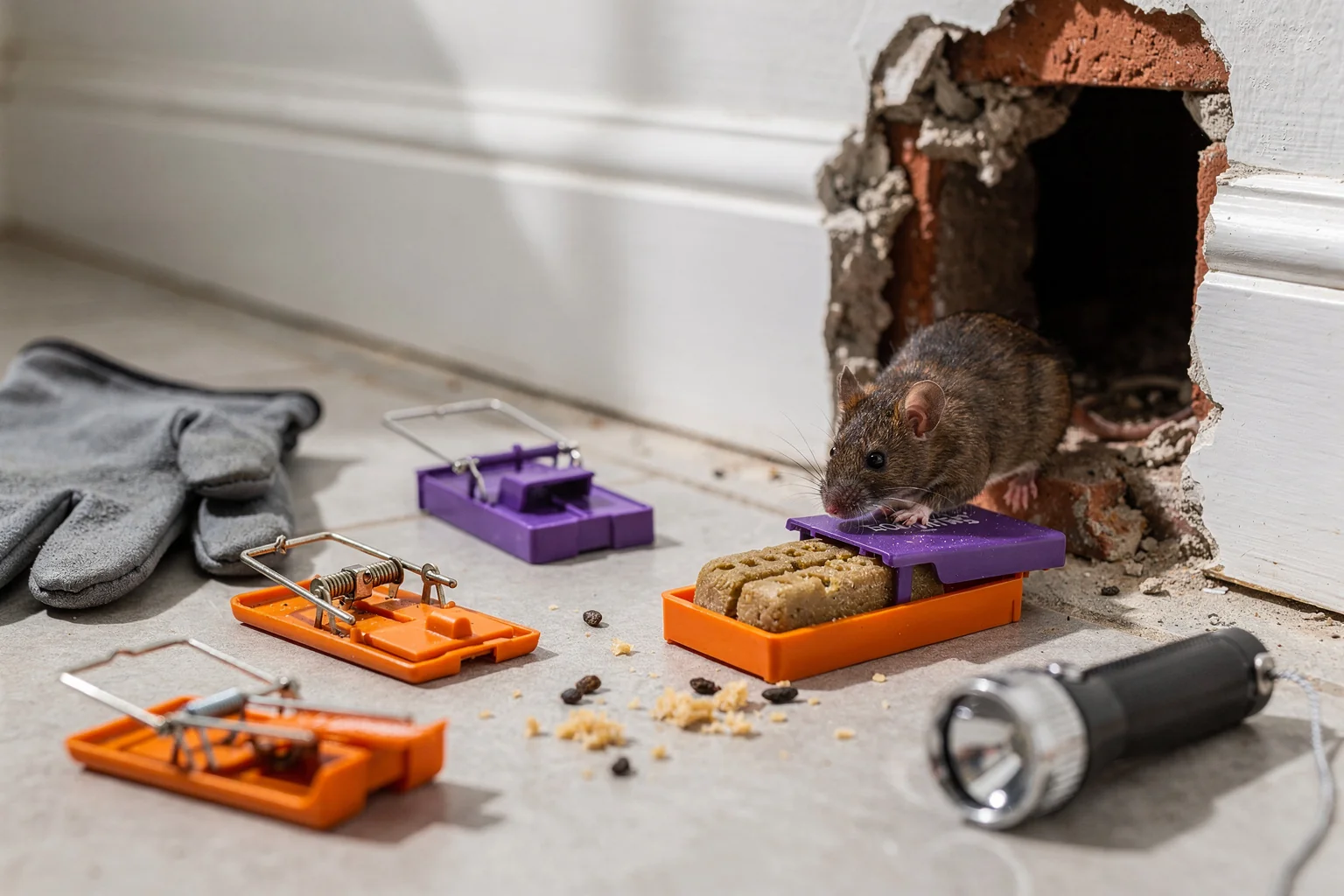
Most Redbridge homeowners try the shop-bought route first. A few traps, some bait blocks, maybe that ultrasonic plug from the hardware store on Cranbrook Road. Sometimes it works for a week. Then the scratching starts again, or you spot something dart behind the fridge at midnight. The question isn't whether you've tried — it's whether your effort is actually solving the problem, or just pausing it.
Here's how to tell when your DIY approach has reached its limit, ranked by how reliably each signal predicts a deeper issue lurking in your walls, loft, or underfloor voids.
1. Fresh Droppings Keep Appearing Near Food Sources
A single mouse produces 50–80 droppings per day. If you're still finding those small, spindle-shaped pellets under the kitchen sink, inside cupboards, or along skirting boards after two weeks of trapping, your population hasn't stalled — it's stable or growing.
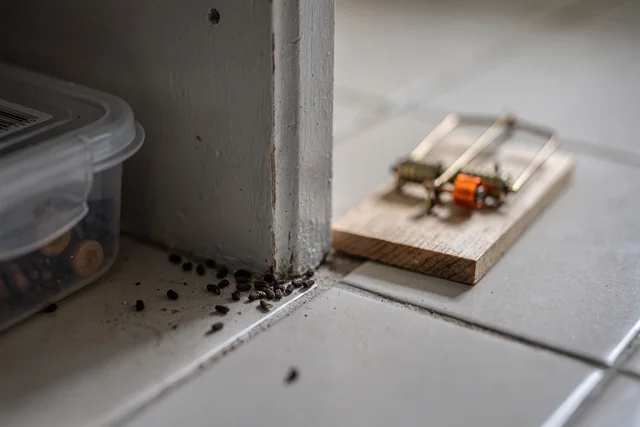
The common mistake: assuming one dead mouse equals success. Mice travel in loose family groups, and juveniles often avoid trap zones until older individuals are removed. You may have caught the curious ones while the rest stay put behind your boiler or in the cavity wall.
What this signals for Redbridge properties specifically: the 1930s semis and post-war terraces common in Ilford, Seven Kings, and Woodford Green have continuous underfloor voids and cavity walls that mice navigate easily. Your trap line covers one room; their network covers half the terrace. These properties were built with clay air bricks, suspended timber floors, and minimal insulation barriers — all of which create ideal mouse highways between neighbouring homes. A mouse entering through a broken vent in your neighbour's gable end can establish a nest in your loft without ever crossing your ground floor.
Professional difference: a technician maps the full activity pattern with UV tracing and bait stations placed at structural pinch points, not just where you've seen evidence. They'll also check for smear marks — the dark grease trails mice leave along regular routes — which reveal the true scale of movement far better than droppings alone.
2. Gnaw Marks Spread to New Rooms
Mice gnaw to keep their incisors from overgrowing, but they also gnaw to open new routes. Fresh chew marks on door frames, floorboards, or plastic piping in a room where you previously saw no activity means the colony is expanding its territory.
Look for:
- Rough, parallel tooth marks about 1–2mm wide
- Shavings or fine sawdust below the damage
- Damage to soft materials (cables, rubber seals, plastic food containers)
The mistake here is treating each room as a separate problem. Homeowners often add more traps to the new room while missing the entry point that feeds the whole system. You might catch one or two individuals in the new territory, but the source population remains untouched, continuously producing new explorers.
What changes with professional mouse or rat control: surveyors identify the structural breach — often a broken air brick, gap around waste pipes, or missing mortar — and seal it with rodent-proof materials rather than expanding foam, which mice simply chew through. They also understand that gnaw marks on electrical cabling present a fire risk that goes beyond pest nuisance, and will flag this for immediate attention.
In Redbridge's older housing stock, particularly the Victorian and Edwardian properties near Wanstead Flats, mice frequently exploit the gap between original brickwork and later extensions. A gap of just 6mm — the width of a pencil — is sufficient for entry. Professionals carry fibre-optic scopes to inspect these junctions without destructive investigation.
3. You Hear Scratching in Walls or Ceilings at Dusk and Dawn
Mice are crepuscular: most active at twilight. Scratching, scurrying, or light thumping from wall cavities, loft spaces, or between floors during these hours indicates established nesting, not just passing traffic.
The DIY trapper's error is placing snap traps on the floor where they think mice run. Wall cavity activity means the animals are travelling vertically through insulation voids, pipe ducts, or behind plasterboard — routes no floor trap intercepts. You might hear them in the bedroom ceiling at 5am, but their actual travel path could be through the airing cupboard wall, down the soil pipe boxing, and into the kitchen — a route that never touches your carefully placed kitchen trap.
Redbridge building stock makes this worse. Many properties in Wanstead and South Woodford have original lath-and-plaster ceilings with generous gaps, and lofts packed with fibreglass insulation that mice tunnel through unseen. The insulation doesn't just hide them — it provides nesting material and maintains temperature year-round, removing the seasonal pressure that might otherwise limit breeding.
Professional approach: technicians use flush-mounted bait stations in loft spaces and void access points, combined with tracking dust to confirm travel direction before any treatment starts. They'll also listen for the pattern of noise: rapid, light scratching suggests foraging activity, while slower, rhythmic scratching often indicates nest-building. This distinction affects where they place monitoring equipment and how they sequence treatment.
4. Bait Keeps Disappearing Without Bodies
This is perhaps the most frustrating sign. You check the bait tray — it's empty, or the bait block has been gnawed to nothing. But no dead mouse, no sprung trap, just… gone.
Several things could be happening:
- Mice are carrying bait back to a nest you can't access
- The bait is being consumed by multiple individuals faster than the active ingredient works
- You're using an anticoagulant formulation that requires multiple feeds over several days, and mice are dying in inaccessible voids
- Rats, not mice, are taking the bait (they're larger, bolder, and require different treatment strength)
The DIY assumption is that eaten bait equals dying mice. In practice, sub-lethal doses can make rodents bait-shy, and carcasses decaying in wall cavities create secondary problems — odour, flies, and carpet beetle attraction. A mouse that receives too little active ingredient may survive but develop resistance, making future treatment more difficult. This is particularly relevant given that UK rodent populations have shown increasing resistance to some first-generation anticoagulants over the past decade.
"You may stop seeing pests for a while, only for them to return days or weeks later… guessing can lead to wasted time and effort."
Professional protocols use weight-calibrated baiting with follow-up checks at days 3, 7, and 14, plus carcass recovery procedures. This is particularly important in food premises, where Redbridge Council's pest control guidance notes that owners have a legal duty under the Prevention of Damage by Pests Act 1949 to keep land free of mice.
The professional also considers bait rotation: if one active ingredient shows poor take or suspected resistance, they switch to a different chemical class rather than simply adding more of the same. This requires knowledge of rodenticide modes of action and current resistance patterns — expertise beyond most DIY resources.
5. There's a Musty, Ammonia-Like Smell You Can't Locate
Mouse urine contains proteins that produce a persistent, sharp odour as colony size grows. If you're noticing this in cupboards, under stairs, or near the boiler cupboard — and air fresheners only mask it temporarily — the nest is likely close by.
DIY limitation: you can clean visible areas, but you can't reach the void behind the kitchen units, the soil pipe boxing, or the gap between floor joists where mice have established a latrine site. These areas often require partial access or endoscopic inspection. The smell may also indicate a dead mouse in a cavity, which presents different challenges — decomposition attracts secondary pests and can persist for weeks without physical removal.
Health note: the same Redbridge Council guidance on pest control for mice warns that mice carry Salmonella and Toxoplasmosis, both transmissible to humans. Urine and droppings in food storage areas or near food preparation surfaces present genuine risk, especially for pregnant women, young children, or immunocompromised individuals. Toxoplasmosis, while often asymptomatic in healthy adults, can cause serious complications during pregnancy — a consideration that raises the stakes beyond simple nuisance.
Professional treatment includes not just population reduction but contamination mapping and advice on safe cleaning protocols for affected areas. Technicians can also distinguish between active nest odour and decay odour, which affects both treatment strategy and the urgency of access works. In commercial kitchens — common along Ilford Lane and the High Road — this documentation supports environmental health compliance and due diligence records.
6. Your Pet Is Fixated on a Specific Wall, Cupboard, or Floor Area
Cats and dogs often detect mouse presence before humans do. A pet staring, pawing, or refusing to settle near a particular spot — especially if that spot has no visible entry — suggests activity inside the structure.
The DIY trapper typically responds by placing traps near the pet's focus point, which may be several feet from the actual nest or travel route. Mice use vertical surfaces as guides, running along the bottom of skirting boards or the top of foundations, not across open floor where pets point. Your cat may be staring at the gap beneath the dishwasher because it hears movement in the adjacent wall cavity — a location where no floor trap will intercept.
Professional surveyors read pet behaviour as one data point among several, then confirm with physical evidence: smear marks, footprints in tracking dust, or thermal imaging for larger voids. They also understand that pet food and water bowls often attract mice in the first place, creating a feedback loop that DIY approaches rarely address comprehensively.
In Redbridge's dense residential areas, particularly the ground-floor flats and maisonettes common in council conversions, pets may detect mice in communal areas or neighbouring units that the homeowner cannot access. This requires coordination with building management or adjacent owners — a layer of complexity that individual DIY treatment cannot resolve.
What Professional Mouse Control in Redbridge Actually Changes
If two or more of these signs sound familiar, the issue has moved beyond what over-the-counter products can reliably solve. Here's what changes when you bring in a BPCA-member or NPTA-registered technician:
Structural survey, not guesswork. Rather than adding more traps to rooms where you've seen mice, professionals identify how they're entering, travelling, and nesting. In Redbridge's dense housing, this often means checking party wall junctions, shared loft spaces in converted terraces, and the gap between ground-floor slabs and timber frames. They'll also assess environmental factors: drainage condition, refuse storage, and neighbouring activity that might sustain reinvasion.
Proofing as primary defence. Killing existing mice without sealing entry points invites reinvasion. Technicians use concrete, wire mesh, and metal flashing for permanent exclusion — materials that withstand weather and gnawing, unlike DIY foam or steel wool. The choice of material matters: galvanised steel mesh resists corrosion in damp subfloor voids, while concrete repair works for larger structural gaps but requires drying time that must be factored into treatment scheduling.
Targeted, accountable baiting. Professional-grade rodenticides (where legally appropriate) are placed in tamper-resistant stations, mapped, and monitored. Since January 2026, UK regulations under CRRU require proof of competence for all professional-use rodenticide purchase — a standard DIY products don't meet. This regulatory change, covered in detail by PGM Pest Control's CRRU guide, means professional technicians now carry mandatory certification with five-year recertification cycles, replacing the previous system where farm assurance schemes were accepted as proof of competence.
Follow-up verification. A proper treatment plan includes return visits to check bait take, remove carcasses, and confirm activity has ceased. This is especially important for landlords and commercial kitchens, where documentation may be required for insurance or environmental health purposes. The verification stage often reveals secondary issues: drainage defects, stored materials providing harbourage, or neighbouring infestations that require coordinated treatment.
For context on how professional rat control versus traps differs in approach — and why the gap widens with property age and complexity — our Hackney comparison covers similar ground for rodent issues more broadly.
When DIY Still Makes Sense
To be fair, not every mouse sighting needs a technician. A single mouse in autumn, caught within 48 hours with no further evidence, often represents a transient individual seeking shelter. In that scenario, snap traps, hygiene improvements, and sealing obvious gaps around pipes may resolve the issue. The key differentiator is duration and repetition: one event versus a pattern.
The six signs above indicate when that window has closed: repeated evidence, expanding territory, inaccessible nesting, bait resistance, contamination, or persistent odour. Each suggests the colony has established beyond what surface-level control can reach. At this stage, continued DIY spending — more traps, different bait, another ultrasonic device — typically costs more than professional intervention while delivering diminishing returns.
If cost is the hesitation, our breakdown of East London pest control costs explains why pricing varies and what factors actually drive value — useful context before deciding whether to persist with DIY or book that inspection. Consider that professional treatment includes guarantee periods, meaning you're not paying repeatedly for the same unresolved problem.
Reader Questions: Mouse Control in Redbridge
How quickly can a mouse problem get worse if I wait?
A female mouse can produce 5–10 litters per year, with 4–8 young per litter. Under favourable conditions — which Redbridge's heated, food-rich homes provide year-round — a small presence can become a significant issue within two to three months. Early professional intervention is almost always cheaper than delayed response. By the time you're noticing multiple signs from this list, the population has likely already reached the point where reproduction outpaces DIY removal efforts.
Will mice leave on their own if I remove food sources?
Unlikely in established cases. Mice can survive on remarkably little food — as little as 3 grams per day — and will broaden their search radius rather than abandon a warm nesting site. Removing obvious food helps, but it's rarely sufficient alone. They'll also chew into packaging you consider sealed, and can derive moisture from condensation on pipes even without obvious water sources.
Are ultrasonic repellents worth trying?
Evidence for long-term effectiveness is mixed. Mice may initially avoid an area, then habituate. They're not a standalone solution for established infestations. Some studies suggest ultrasound can even cause stress responses that increase gnawing behaviour or drive mice deeper into structure. If used at all, they should be combined with physical proofing and trapping, not relied upon as primary control.
Do I need to leave my house during professional treatment?
Generally no. Most residential mouse treatments use locked bait stations placed in inaccessible areas, with no requirement to vacate. Technicians will advise if any specific precautions apply to your situation — for example, if you have free-roaming pets that might investigate monitoring equipment, or if access works require temporary disruption to specific rooms.
What's the legal position if I'm a landlord?
Under the Prevention of Damage by Pests Act 1949, landlords and occupiers have a duty to keep premises free of mice. Local authorities can require specific measures, including professional treatment and structural works. For tenanted properties in Redbridge, prompt action protects both tenant health and your compliance record. The Council's environmental health team can serve notices requiring works, and failure to comply can result in penalties plus the Council undertaking works at your expense.
How do I choose between local council pest control and a private technician?
Redbridge Council offers pest control services for mice, with charges that may be reduced for those receiving Council Tax benefit. However, council services often have longer waiting times and may not include the same level of proofing or follow-up as private providers. Private technicians typically offer same-day response, detailed surveys, and guarantee-backed treatments — factors worth weighing against the cost difference, particularly for time-sensitive situations or commercial premises.

Need professional help? BuzzKill offers fast, reliable pest control services across London and Essex.