
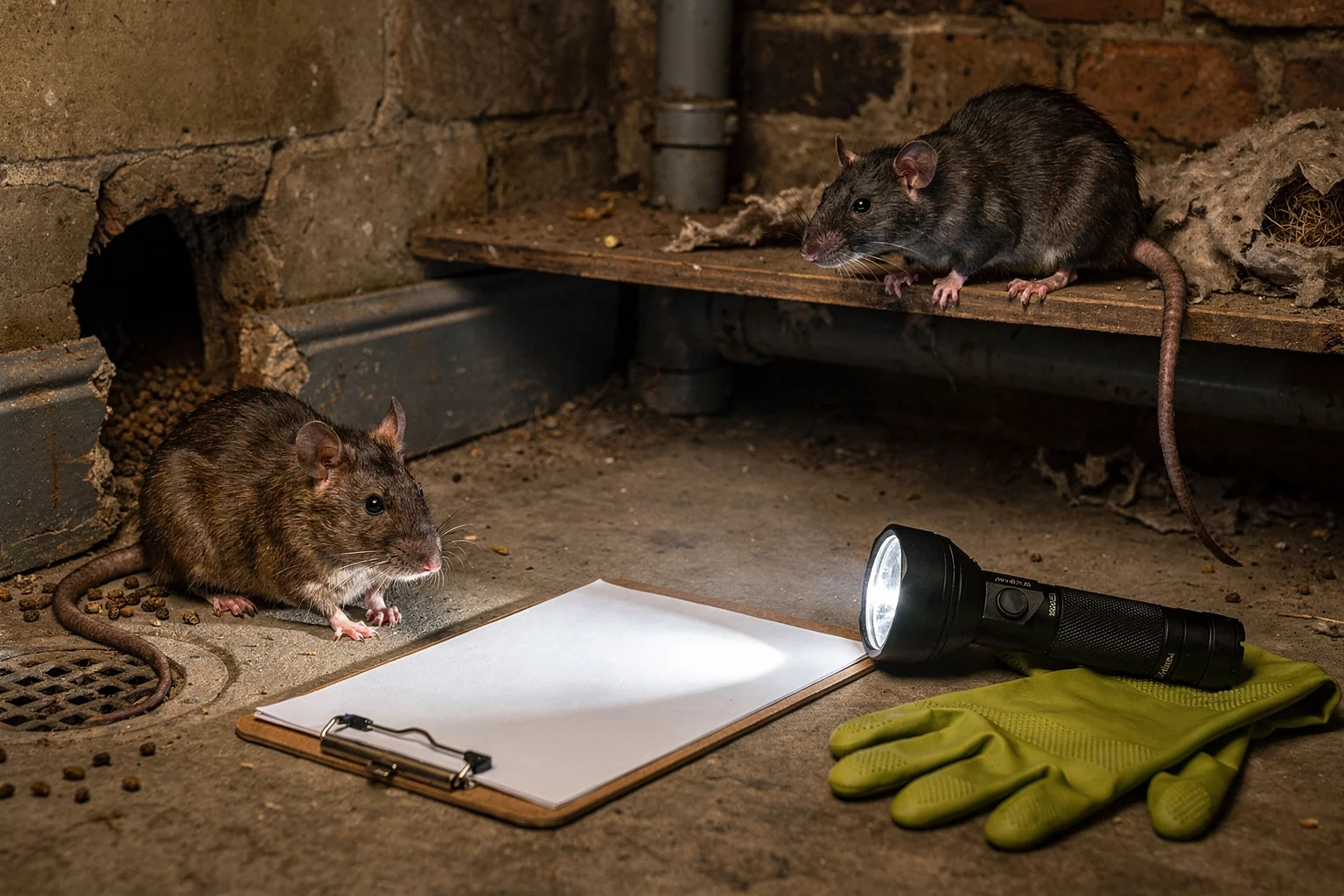
You hear scratching above the ceiling at night. Or you find droppings in the kitchen cupboard. Before you can do anything useful about it, you need to answer a simple question: is this a Norway rat or a roof rat? The answer changes everything — where you search for the nest, what traps to use, and how you seal your home afterward.
This checklist walks you through eight physical and behavioural signs that separate these two pests. You’ll need about 30 minutes, a torch, and a tape measure. By the end, you should be able to name your invader with confidence — and know exactly what to do next.
Most London homeowners never actually see the rat itself, but they do spot the evidence. That’s why this guide focuses on what you can observe without trapping the animal: body shape from a silhouette, droppings, nesting location, and the sounds and times of day you notice activity. Take each check in order. A single sign can be misleading, but two or three together usually point to one species.
Tail length: the quickest giveaway
If you catch even a fleeting glimpse of the rat, the tail is the easiest feature to judge. Roof rats have a tail that is clearly longer than their head and body combined. Norway rats have a tail that is shorter than their head and body.
Shine a torch along a beam or behind a cupboard where you last saw movement. If the tail trails behind the body and seems to stretch out like an extra limb, you’re likely looking at a roof rat. A chunkier rat with a tail that looks stubby by comparison is almost certainly a Norway rat.
The difference matters because the two species move through a property differently. A roof rat uses that long tail for balance when running along cables, fence tops, and roof beams. A Norway rat’s shorter tail reflects a life spent more on the ground.
When you can’t see the animal but spot a tail mark in dust (for example, along a dusty joist in the loft), measure the visible drag line. If it exceeds the width of the body impression, it’s consistent with a roof rat.
"The roof rat … is smaller and sleeker than the Norway rat, with a tail that is longer than the head and body combined." — UC IPM Pest Notes, Publication 74106
Body size and build
A Norway rat is the larger, heavier-bodied animal. Adults typically reach 18–25 cm in body length, not including the tail, and can weigh over 500 g. A roof rat is noticeably slimmer, with a body length of 16–20 cm and a weight that rarely exceeds 300 g.
If you’ve seen the rat from a distance, ask yourself whether it looked like a stocky, muscular rodent or a lean, almost elegant one. The silhouette is telling. Norway rats have a thick-set appearance with a rounded rump and a wide head. Roof rats look more streamlined, with a narrow body and a head that appears elongated.
This difference shows up in the holes they use. A Norway rat needs an opening roughly 2.5 cm high to squeeze through. A roof rat can slip through a gap just 2 cm high. If you’re finding gnawed entry points that barely fit a thumb, it’s more likely a roof rat.
Snout shape and ear size
Norway rats have blunt, rounded noses. Roof rats have pointed, almost triangular snouts.
Look at any photographs you’ve managed to grab or any dead specimen you find. If the nose looks like it was pinched at the end — sharper than you’d expect on a typical “rat face” — it’s a roof rat. A Norway rat’s nose appears broader and flatter from the side.
Ears reinforce the picture. Roof rats have larger, more prominent ears that sit high on the head. Norway rats have smaller ears that are partly buried in fur and sit lower.
This combination — pointed nose plus big, visible ears — makes a roof rat’s head look more alert and mouse-like, whereas a Norway rat’s head seems blunt and heavy.
Fur colour
Colour alone isn’t reliable because both species vary, but it can add weight to your other observations.
Norway rats are usually brownish-grey with a lighter belly, often described as “agouti” — each hair has bands of colour. Roof rats tend to be darker, sometimes black or charcoal grey, with a paler underside that can be cream or white. In London, roof rats are almost always black or very dark brown.
Because fur colour can shift with age and environment, treat it as a supporting clue. A rat you see in a Hackney attic that is jet black with a long tail is almost certainly a roof rat. A chunky brown rat near a drain in Tower Hamlets is almost certainly a Norway rat.
Droppings: shape, size, and location
Droppings are often the first undeniable sign of a rat problem. Both species produce capsule-shaped pellets, but the size and grouping differ.
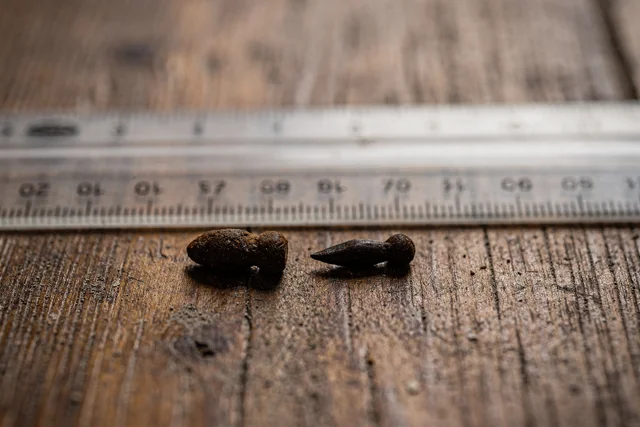
Norway rat droppings are about 15–20 mm long with blunt, rounded ends. They tend to be scattered individually or in small clusters along well-worn travel paths — behind kitchen units, along skirting boards, near burrow openings. They often appear in the same place day after day because Norway rats are creatures of habit.
Roof rat droppings are smaller, rarely exceeding 12 mm, and often have more pointed ends. They are typically found in elevated spots: along loft beams, inside insulated soffits, behind fascia boards, or on top of wall cabinets. Because roof rats move above floor level, you may find droppings on surfaces you wouldn’t normally check — the top of a wardrobe, the ledge above a window, inside a suspended ceiling.
Grab a ruler. If the pellets are over 14 mm long and blunt, you’re likely dealing with a Norway rat. If they’re under 13 mm and slightly curved with pointed tips, suspect a roof rat. Wash your hands after handling, and wear gloves.
Nesting location: where you find the evidence
This is often the deciding factor. Norway rats nest at or below ground level. Roof rats nest above ground.
Walk the outside of your property first. Look for burrows — neat, 5–10 cm holes in soil near foundations, under decking, beside compost bins, or along fence lines. These are classic Norway rat entry points. If you see freshly excavated soil and a smooth, well-used tunnel opening, you’ve almost certainly got Norway rats.
Now check high spaces: lofts, roof voids, attics, the upper corners of a shed, even dense climbing plants like ivy against an outside wall. Roof rats will nest inside the insulation layer of a loft or in the hollow of a chimney stack. They’ll also nest in trees, particularly palms or dense evergreens, and use overhanging branches as bridges to reach the roofline.
In London terraced houses with party walls, a roof rat problem on one side can become a problem on both sides within a week because they travel laterally through roof spaces. Norway rats, by contrast, move through drains and sewer pipes, often emerging through a broken inspection chamber or a toilet U-bend.
The UC IPM Pest Notes notes that roof rats “are agile climbers and usually live and nest aboveground in shrubs, trees, or dense vegetation such as ivy.” Norway rats prefer “ground burrows and sewer systems.”
Activity patterns: time of day and sounds
Both species are mostly nocturnal, but the timbre and location of the noise can help.
Norway rats are heavier, so their movement inside a cavity wall or under floorboards produces a lower, thumping sound — more of a scuffle. They also vocalise more, with audible squeaks and chattering when competing over food. You might hear Norway rats under a suspended kitchen floor at dusk, as they wake up and begin foraging.
Roof rats are lighter and faster. Their scratching in the loft sounds higher-pitched, like rapid scrabbling. They may travel at dawn and dusk, but if you startle one at night, you’ll hear a distinct scurry across the ceiling — faster and higher than a Norway rat’s heavy footsteps.
If you listen carefully, the direction of the sound tells you a lot. Noise beneath your feet points to Norway rats. Noise above your head points to roof rats.
Climbing versus burrowing behaviour
A direct observation of behaviour can clinch the identification.
Roof rats are expert climbers. In a London garden, you might see one running along a telephone wire, hopping from a tree branch onto a garage roof, or scaling a drainpipe. They often never touch the ground during an entire night’s foraging. If the rats you’re seeing around your property are using overhead cables, climbing frames, or gaps in the soffit, they are roof rats.
Norway rats are poor climbers. They are strong swimmers instead, and they navigate by moving through drains, soil tunnels, and the ground floor. You’ll see them bolting along the base of a wall, never more than a metre away from cover. If you spot a rat disappearing into a ground-level hole, that’s a Norway rat. If it scurries up a vertical surface without hesitation, it’s a roof rat.
This behavioural split explains why many DIY attempts fail. Roof rats rarely visit the floor, so ground-level traps set along a skirting board catch nothing. That’s a classic rat control mistake London homeowners make after misidentifying the species.
What to do once you know which rat you’re dealing with
Once you have a clear answer from the checklist, your next steps depend on the species and the scale of the problem.
Norway rat. If you’ve found a single ground-level burrow and only a few droppings, you might start by removing outdoor food sources (bird feeders, unsecured bin bags, pet food left out) and blocking the burrow with wire mesh after confirming the rats are out. Set heavy-duty snap traps along the wall-floor junction inside the house, where Norway rats travel. But if you have multiple burrows, smell a strong ammonia scent, or hear activity inside the cavity wall, the nest is likely well established. At that point, calling a professional is safer than experimenting with shop-bought bait.
Roof rat. The challenge is height. You’ll need to inspect the loft, soffits, and roof edges for gnawed holes, and then seal them with metal mesh or plates. Traps must be placed high — on beams, in the loft, or even on flat roof sections. Roof rats are suspicious of new objects, so baits may sit untouched for days before they investigate. This is a species where an experienced eye saves time. If you’re weighing rat extermination options for an elevated nest, the tools and access equipment can quickly make a professional visit the cheaper route.
When in doubt, get a second pair of eyes. If the checklist points to both a ground burrow and loft droppings, you may have a mixed infestation — uncommon but possible in large, older properties. A technician can do a full survey in under an hour and confirm the species, then recommend a treatment plan.
BuzzKill Pest Control covers all of East London and Essex with same-day response and no call-out charge. Their technicians are NPTA-registered and RSPH Level 2 qualified, and they walk you through the identification so you understand exactly what you’re looking at. If you’re not certain after running the checklist, a 15-minute inspection call can settle the matter without obligation.
Questions London homeowners often ask about rat identification
Is it true that Norway rats killed off the black rat in the UK? Partly. The brown rat (Norway rat) arrived later and outcompeted the black rat (roof rat) in most environments because it is larger and more aggressive. Roof rats still survive in a few UK port cities and in isolated loft populations in London, but Norway rats are now the dominant species in 99% of domestic infestations.
Can I use the same bait for both species? Technically yes, but placement is everything. A poison bait station on the ground will be ignored by roof rats living in the loft. The species determines the location and the type of trap or bait station you need. If you’re unsure, comparing professional rat extermination costs often reveals that getting the species right first is the only way to avoid wasted expense.
What if I find droppings in both the loft and the kitchen? It’s more likely you have Norway rats in the kitchen and roof rats in the loft, but a heavy Norway rat infestation can spread into wall cavities and even the loft. Check the droppings’ size and shape carefully; if they differ, you’re dealing with two separate populations. If the loft droppings are large and blunt, Norway rats have climbed up through the cavity wall, which suggests a serious, long-established infestation that needs immediate professional attention.
Are roof rats more dangerous than Norway rats? Both can carry diseases and both contaminate food and surfaces. Roof rats are associated with fleas that historically spread plague, but in a modern London home the practical risks are similar: chewed wiring, structural gnawing, and food contamination. The urgency comes from the location of the nest. A loft nest may damage wiring and insulation for months before anyone notices.
How quickly do they breed? Females of both species can produce 5–6 litters per year, averaging 8–10 pups per litter, and the young reach sexual maturity at 3–4 months. That means a single pair can multiply into a colony of 200 within a year if conditions are right. The species doesn’t change the maths, but the nest’s location does: a roof rat colony in a loft can grow unnoticed for longer because you rarely go up there.
If the checklist pointed you to a clear answer, your next move is straightforward: block entry points, set the right traps in the right place, and keep monitoring. If the signs are mixed or the nest feels beyond your reach, trust that instinct. Getting a professional ID early often saves hundreds of pounds in damage later. A same-day inspection from a local pest controller can turn a worry into a plan.
Need professional help? BuzzKill offers fast, reliable pest control services across London and Essex.