
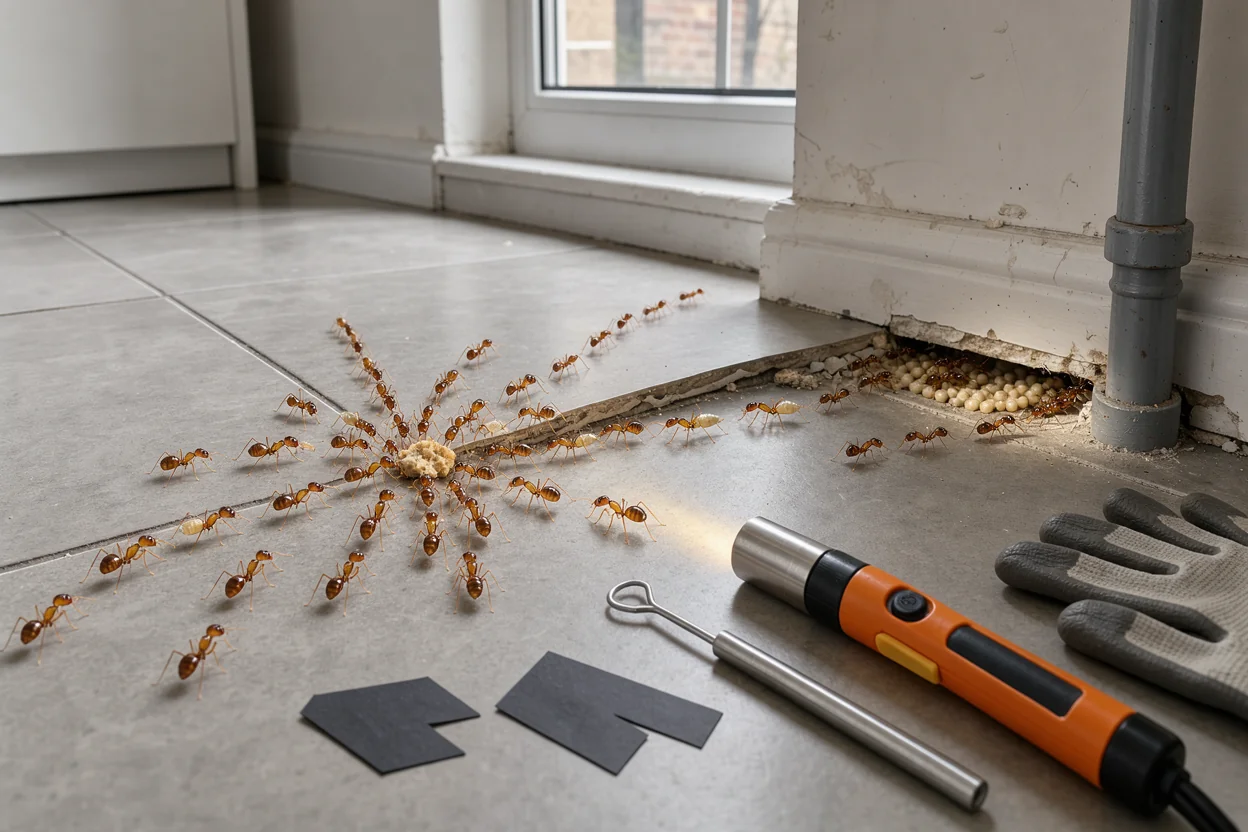
The busiest ant trail can be a poor guide to where the nests are. If you’re searching for “ant control pharaoh ant multi nest colonies”, these five signs help you assess suspected spread through a London home. Several trails can come from one nest, while several hidden nests may produce only a few visible workers.
First, check which ants you’re dealing with. Pharaoh ant workers are tiny, roughly 1.5–2 mm long, and usually yellowish to light brown, with a darker abdomen. The University of Florida’s pharaoh ant species account describes their appearance and colonies with multiple queens. Colour alone won’t confirm the species; a clear close-up photograph or identification by a pest professional is more useful.
These ants can establish new nests through budding: queens and workers leave an existing nest and settle elsewhere. The British Pest Control Association’s pharaoh ant guidance explains why control needs care, including the risk of colonies splitting after unsuitable treatment.
I’d give repeated sightings across separate rooms more weight than a single busy trail. The list below follows that practical order. Each sign helps describe the extent of activity, but none lets you count hidden nests from the surface.
Keep up ordinary food hygiene while you observe. Avoid spraying trails, adding powders or opening suspected hiding places. You can gather useful evidence without disturbing the building.
1. Ants keep appearing in separate rooms
Repeated pharaoh ant sightings in separate rooms are the first sign worth recording because they show how far visible activity extends. Ants beside a kitchen sink, around bathroom pipework and along a bedroom skirting board deserve a wider inspection than one isolated sighting.
The useful detail is repetition. One worker on a shopping bag gives you little information about the building. Workers returning to the same room edge on different occasions establish a pattern you can show someone.
Pharaoh ants can use small, concealed nesting spaces within buildings. Utah State University’s pharaoh ant identification guide describes their nesting and colony behaviour. That biology makes scattered indoor activity relevant, especially where rooms share walls or service routes.
However, three affected rooms do not prove three nests. Workers from one hidden nest may forage widely, and several nests may use connected routes. Treat room sightings as evidence of the inspection area, rather than a nest total.
Put each recurring sighting on a room map
Sketch a simple floor plan and mark where ants actually appear. “Bathroom” is less useful than “left-hand pipe opening below the basin”. Add the date, approximate time and whether you saw one worker or an established trail.
A photograph of the surrounding area helps someone find the spot again. Take a closer image too, if your phone can focus clearly. Keep enough distance that you don’t move furniture or disturb a trail just to improve the picture.
In a rented flat, send the record to the landlord or managing agent. Explain which rooms are affected and whether sightings recur beside a shared wall. This gives them a concrete access question to resolve.
The common mistake is treating the busiest room as the whole problem. A kitchen may attract more workers because food is available there, while quieter activity elsewhere receives little attention.
Ask how the inspection will cover those other rooms. Guidance on professional ant treatment visits can help you prepare access and questions without choosing a treatment yourself.
Repeated sightings in separate rooms earn first place because you can record them immediately. Make a dated room map and keep every recurring location on the inspection list.
2. Several monitored bait points attract workers
Pharaoh ants feeding at several existing bait points show that workers can reach more than one treatment location. This becomes useful evidence when the points sit in separate rooms or beside different concealed routes.
The observation belongs second because it requires context. You need to know where bait was placed, when it was checked and whether workers were actually feeding. A partly empty station, viewed once, cannot tell you how the colony is organised.
Syngenta’s multiple bait placement guidance describes using multiple placements against pharaoh ant infestations. It supports treatment across the affected area rather than concentrating solely on the largest visible trail.
Still, bait taken from several points does not establish several nests. One group of foraging workers may visit more than one placement. The useful conclusion is that each feeding location belongs in the monitoring record.
Compare feeding locations without changing the treatment
If a technician has already placed bait, use the location names or numbers in their treatment record. Note where you see feeding and when. Leave the bait in its assigned position unless they tell you otherwise.
Record what you can actually see. Workers gathered beside bait may be passing through; workers feeding provide a more specific observation. If you’re uncertain, describe the behaviour or take a photograph instead of estimating how much bait they consumed.
A short-lived increase in visible ants around an attractive bait does not, by itself, prove that the infestation has spread. Compare it with activity elsewhere and the technician’s explanation of what to expect.
Avoid adding a spray around a busy bait point or moving it closer to another trail. Those changes can interfere with the treatment plan and make later observations harder to interpret. Keep children and pets away from treatment placements, following the product and technician’s instructions.
If feeding stops, report that change too. An untouched point cannot tell you whether ants have disappeared, changed route or stopped accepting that placement. The guide to ant baiting problems discusses that separate troubleshooting question.
This sign is especially useful during follow-up visits, when the same locations can be compared over time. Record both active and quiet points.
Several feeding locations justify reviewing treatment coverage. Give the technician the placement details and observations; leave decisions about adding, replacing or relocating bait with them.
3. Workers repeatedly emerge beside electrical sockets
Pharaoh ant workers repeatedly appearing beside a socket faceplate can indicate a route through a concealed building space. The observation matters because activity at a fixed opening may continue even when nearby food surfaces are clear.
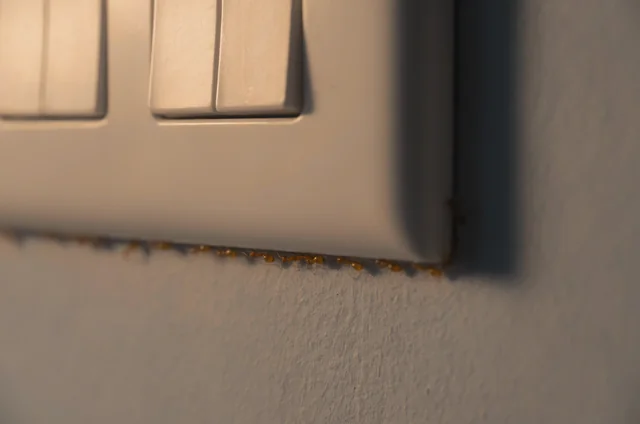
This sign ranks below sightings across rooms and monitored feeding. A socket edge gives you a specific place to inspect, but it tells you little about the distance to a nest.
Ohio State University’s guidance on hidden nests describes pharaoh ant nesting sites within buildings, including concealed spaces around structural services. Ants appearing at a wall opening fit that broader pattern, although the opening itself does not confirm a nest.
Watch the direction of travel. Ants repeatedly coming through the same edge provide different information from ants crossing the outside of a faceplate on their way along the wall.
Observe the faceplate from outside
Leave the socket closed and undisturbed. Don’t remove its cover, insert anything into the opening or put insecticide into electrical fittings. A nest search is not a reason to access wiring.
From a safe position, note which edge the workers use. A photograph showing the entire fitting and surrounding wall helps locate it later. You don’t need to get close enough to interfere with the ants.
Check other accessible wall edges visually. Record a second active fitting separately, even if it is in the same room. Two openings may connect with one void, so avoid labelling each as a separate nest.
The common mistake is assuming that ants beside a socket mean the nest sits directly behind it. They may be using a much longer concealed route. Chasing that route by dismantling fittings adds risk without resolving the nest count.
For landlords and managing agents, the location record can help coordinate any access needed for a survey. State the room, wall and fitting position clearly. Mention previous treatments around that opening too.
Treat electrical concerns separately from ant identification. If a fitting has signs of damage or another electrical problem, it needs assessment by an appropriate electrician rather than exploratory pest treatment.
Repeated emergence from a socket edge is worth including in the survey. Keep the fitting intact and record the route from outside.
4. Trails follow warm pipework and duct openings
Pharaoh ant activity beside warm pipework or accessible duct edges can help identify routes between concealed spaces. In a heated London building, those locations deserve attention alongside the kitchen worktop.
Warmth is relevant to this tropical species, which can persist inside heated buildings. Concealed spaces around pipes, walls and heating systems can provide suitable conditions. The earlier species guidance explains why indoor building conditions matter.
This sign sits fourth because a warm location can be suitable without containing a nest. Ants near a radiator pipe might be travelling towards water or food, or using a gap through the floor.
The stronger observation is a recurring route at a particular opening. “Ants near the boiler” is broad. “Workers repeatedly enter the gap beside the hot-water pipe below the cupboard” gives a technician somewhere specific to assess.
Follow visible routes without opening building services
Start with areas you can see safely: pipe penetrations below sinks, exposed radiator pipes and accessible edges of service cupboards. Leave boiler casings, fixed duct covers and other enclosed equipment alone.
Record whether workers cross the surface, enter a gap or emerge from it. Note activity at a corresponding position in another room if you can observe it without moving equipment.
An upstairs bathroom and a downstairs kitchen may share a service route, but that connection remains a possibility until assessed. Mark it as a suspected connection on your sketch rather than drawing a confirmed trail through the building.
The common mistake is treating warmth as proof. A cupboard can be warm and completely inactive. Equally, a few workers at its edge do not reveal the size of the population inside a wall.
Don’t change heating settings or introduce heat to test whether ants move. Such an experiment would alter the conditions you’re trying to describe. Likewise, avoid dismantling pipe boxing or sealing active openings before discussing the treatment plan.
If you manage several flats, collect location descriptions from residents using the same terms. Sightings beside corresponding pipe routes can help a survey cover the relevant areas.
Recurring activity beside warm services earns a place on the inspection map. Record the exact opening and direction of travel, then leave equipment and enclosed spaces undisturbed.
5. Trails switch between locations at different times
Pharaoh ant trails that appear in different places at different times can make an infestation feel unpredictable. A kitchen edge may be busy in the morning, while a bathroom route draws attention later.
This ranks fifth because changing trails are easy to overinterpret. Timing alone is weak evidence of multiple nests. Workers can change their visible routes as the conditions and available food around them change.
The observation becomes more useful when combined with location evidence. Repeated activity beside two fixed openings, seen at different times, gives you a pattern to monitor. A single trail that disappears after breakfast tells you much less.
A sudden change following a household spray is also worth reporting. Pharaoh ant colonies can split when disturbed by unsuitable treatment. The timing raises a question for the survey; it does not prove that a new nest formed that day.
Compare observations without disturbing the routes
Check accessible areas during your normal routine. You don’t need to stay awake following ants or interrupt work to watch continuously. The aim is a record you can maintain without adding stress.
Use consistent location descriptions and include the approximate time. Note nearby changes, such as cleared food, a cleaned spill or work in an adjoining cupboard. These details help explain why two sightings may differ.
Avoid using an exact worker count as your main measure. Tiny ants are difficult to count, and a changing trail gives an unreliable total. “Occasional workers” and “a steady trail” can be useful descriptions if you apply them consistently.
The common mistake is calling every newly visible route a newly established nest. It may be an existing route you hadn’t noticed. Keep observations and interpretations separate in your notes.
A useful interactive checklist would let you select affected rooms, add sighting times and export the record for a technician. Its output should describe activity without calculating a supposed nest count.
If you have already used a household product, retain its packaging or a clear photograph of the label. Record where and when you applied it. That information is more helpful than guessing whether the ants moved because of it.
Changing trail times deserve documentation, especially alongside repeated sightings elsewhere. Treat the timing as supporting evidence and give fixed, recurring locations greater weight.
What scattered pharaoh ant activity means for your home
Scattered pharaoh ant sightings leave several practical questions unanswered. The answers below help you use your observations during an assessment and judge what needs attention.
Can these signs confirm how many nests there are?
No. Visible workers, separate trails and feeding at multiple points cannot reliably count concealed nests. They show where ants are active and help define the area that needs inspection.
Species confirmation comes first. A survey can then assess routes, possible nesting spaces and the extent of activity. Ask the technician to distinguish observed facts from suspected connections. Keep that distinction in your own notes too.
Does a quiet room mean the ants have gone?
A quiet room at one check cannot confirm that its hidden activity has ended. Workers may be elsewhere, using another route or appearing at another time.
During treatment, compare the same observation points across the agreed follow-up period. Tell the technician about quiet locations as well as active ones. They can interpret the change alongside bait records and sightings elsewhere. Keep previously affected rooms in the record until the monitoring plan is complete.
Should neighbours in a block of flats be involved?
They may need to be, particularly where activity appears beside shared service routes or adjoining walls. Ants inside one flat do not prove that every neighbouring property is affected.
Notify the landlord or managing agent with your dated sightings. They can arrange appropriate access and ask whether other residents have observed similar ants. A coordinated assessment helps establish the scope before separate households apply conflicting treatments. Share location information without asking neighbours to open fittings or inspect enclosed services.
How do I choose someone to assess suspected pharaoh ants?
Ask how they will confirm the species, inspect activity beyond the busiest room and monitor the result. Explain any previous sprays, powders or bait placements before treatment begins.
Checking pest controller credentials is useful alongside asking about experience with pharaoh ants. BuzzKill Pest Control is one local option for assessment in London. Whichever provider you choose, ask for a written plan covering affected locations, household precautions and follow-up checks.
What should I do around food, children and pets?
Keep food in closed containers, clear spills and manage waste as part of ordinary hygiene. These steps are useful even while the species and extent of activity remain uncertain.
Avoid improvised treatment placements where children or pets can reach them. If treatment is already underway, follow the written precautions and ask which surfaces can be cleaned without interfering with bait. In a food business, document affected areas and discuss suitable working arrangements with the pest professional rather than applying an unplanned product.
Which sign deserves attention today?
Act first on repeated sightings in separate rooms. Make a dated map of the recurring locations, and include any activity beside sockets, pipe openings or existing bait points.
People can overreact to trails appearing at different times. That observation deserves a note, but it cannot establish new nests on its own. Give the person assessing the property your location record, photographs and details of any products already used.

Need professional help? BuzzKill offers fast, reliable pest control services across London and Essex.