
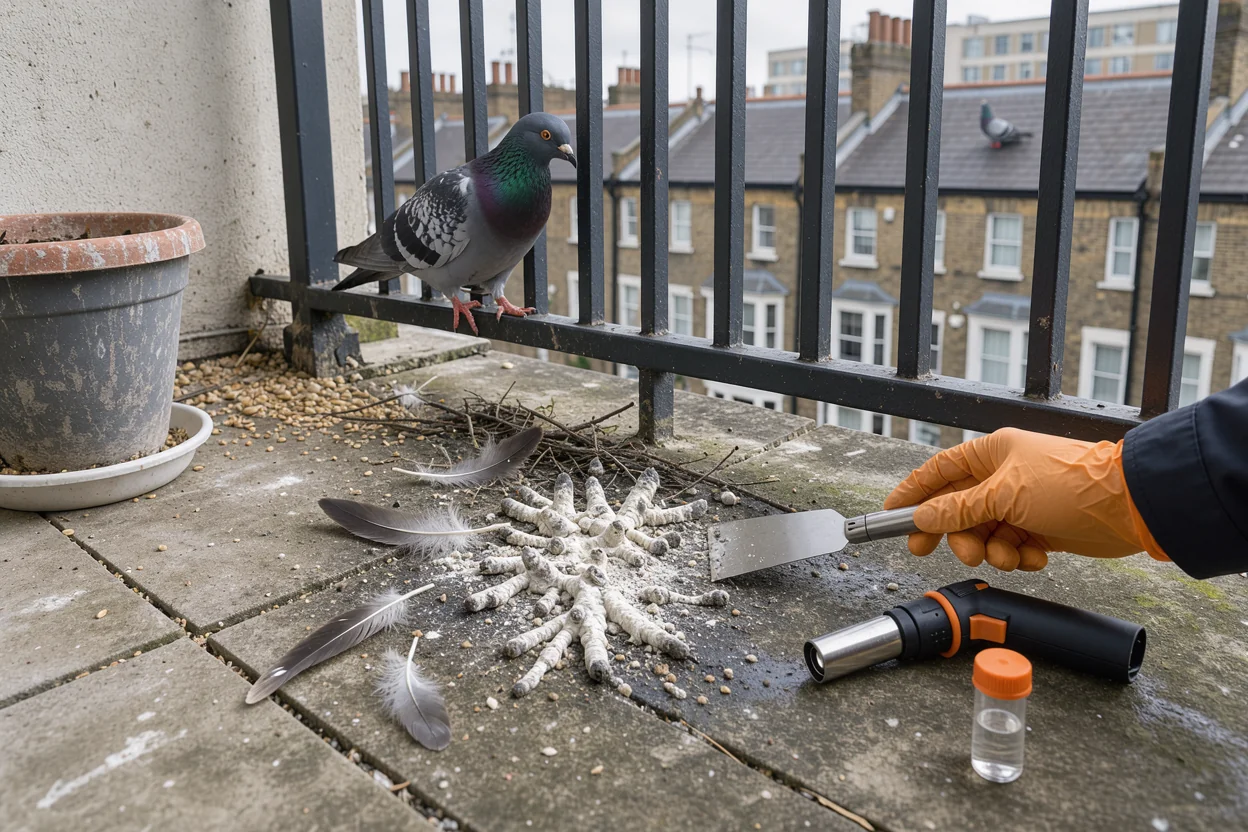
If you've searched for “pigeon control balcony cleaning disease risk”, you probably want to know whether those droppings are dangerous and how to remove them safely. The Pest Experts Ayrshire's video, The Risks of Bird Droppings and How to Clean Them Safely, introduces the health and property concerns. I'll build on its useful points, explain psittacosis and salmonella, and put its fungal warnings in context for a London balcony. The cleaning decision depends on the amount of waste, how it might become airborne and who will handle it.
Video: The Risks of Bird Droppings and How to Clean Them Safely The Pest Experts Ayrshire
What the video tells you about dried balcony droppings
The video's most useful warning concerns droppings that have accumulated, especially in enclosed or poorly ventilated spaces. It names salmonella and two fungal infections, histoplasmosis and cryptococcosis. These are different illnesses with different exposure patterns.
A list of diseases cannot tell you whether a particular dropping contains an organism capable of causing illness. Colour, smell and the age of a stain cannot identify an infection. Avoid treating every mark as proof that someone will become ill.
Dust changes the cleaning decision
Guano is accumulated bird droppings. When dried material is disturbed, particles can enter the air. Sweeping a balcony or brushing a sheltered corner may therefore create exposure that was avoidable while the material remained undisturbed.
The relevant question is what your cleaning method will release. A small patch that can be gently dampened and collected is a different task from breaking up layers beneath a long-established roost.
Inspect from somewhere you can stand securely. Leave the broom, household vacuum and pressure washer out of the initial assessment.
Check whether deposits sit below one railing, beneath the balcony above or around stored furniture. Their distribution can help an assessor locate the source. Photograph the pattern before cleaning so the original deposits remain visible in your record.
Slippery surfaces deserve attention too
The video also highlights slipping and damage to materials. Wet droppings on a walking surface can make access awkward, even before you consider infection.
Check the route from the balcony door to the affected patch. Keep children and pets away while you assess it. If you cannot reach the area without stepping on slippery waste or leaning over the rail, leave removal to someone with suitable access equipment.
Psittacosis and salmonella affect people differently
Pigeon droppings can be associated with respiratory illness and gut infections. Understanding the difference helps you control exposure and describe relevant symptoms to a clinician.
Psittacosis concerns inhaled particles
Psittacosis is an infection caused by the bacterium Chlamydia psittaci. Although often associated with parrots and other pet birds, it can involve other bird species.
The UK Health Security Agency explains that people mainly acquire it by inhaling infected particles or dust containing bird waste or secretions. An infected bird may show no obvious signs of illness. Human symptoms can include fever, headache, muscle aches and cough; some cases progress to pneumonia, an infection of the lungs. Its psittacosis guidance gives an incubation period of one to four weeks, meaning the time between infection and symptoms.
For balcony cleaning, the practical response is to avoid creating airborne dust. Seeing apparently healthy pigeons does not establish whether their droppings are safe to disturb.
If you develop a fever and cough after substantial bird-waste exposure, tell your GP what happened and when. That history can help the clinician decide what to investigate.
Salmonella makes hand hygiene matter
Salmonella is a group of bacteria that can cause a gut infection. The source video includes it among the organisms associated with bird droppings.
Swallowing bacteria through unwashed hands or affected food is a relevant exposure route. Think about the transition from cleaning to eating: handling waste, touching your phone, then preparing a sandwich can transfer material between surfaces.
The NHS includes salmonella among the causes of food poisoning. Symptoms can include diarrhoea, stomach pain, vomiting and fever. Its food poisoning advice explains when to seek help, including concerns about dehydration.
Keep food, drinks and cigarettes away from the work area. Remove gloves carefully and wash your hands with soap and water before touching food. Gloves reduce direct contact, but you still need handwashing after taking them off.
A balcony photograph cannot diagnose either infection
A photograph can show the extent of a clean-up and possible nesting activity. It cannot identify the bacteria present or explain a person's symptoms.
Send property photographs to the person assessing the balcony. Give symptoms and exposure details to a healthcare professional. Keep the date of any substantial dusty clean-up in your notes so you can describe it accurately.
Why the video's fungal warnings need context in London
The video names histoplasmosis and cryptococcosis, but those names alone do not establish the likelihood of infection on your balcony. Geography, environmental conditions and a person's health all matter.
Histoplasmosis involves an environmental fungus
Histoplasmosis is an infection caused by inhaling spores from the fungus Histoplasma. Spores are tiny particles that fungi produce and that can become airborne.
The US Centers for Disease Control and Prevention explains that the fungus grows especially well in soil or other material enriched with substantial bird or bat droppings. Droppings can support a fungus already present in the environment; they do not automatically create it.
Its environmental histoplasmosis guidance says fresh bird droppings on surfaces such as windowsills are unlikely to pose a histoplasmosis risk. The guidance also describes the fungus as most common in North and Central America.
That makes a blanket claim about histoplasmosis from every London balcony stain misleading. The video's warning provides a reason to avoid disturbing old accumulations. It does not provide a local infection rate or establish that your balcony contains Histoplasma.
Cryptococcosis matters especially with weakened immunity
Cryptococcosis is a fungal infection acquired by breathing in environmental spores. Some fungi associated with this illness can occur in bird-dropping environments.
The CDC's cryptococcosis overview explains that most exposed people do not become ill. Infections are most common in people with weakened immune systems, particularly those with advanced HIV. The illness can affect the lungs or brain.
This is a reason to take individual vulnerability seriously. It is not evidence that sharing an outdoor space with pigeons usually causes infection.
If your immune system is weakened, arrange for someone else to deal with droppings and ask your healthcare team about any significant exposure.
When balcony cleaning should be someone else's job
The amount of pigeon waste matters, but the person cleaning and the available access can change the decision even for a modest patch.
New York City's health department describes routine cleaning of small amounts, such as windowsill droppings, as low risk for most people. Its pigeon-related disease advice recommends disposable gloves and washable clothing. It also advises people with compromised immune systems against cleaning droppings themselves.
This is general health guidance from another city, rather than a measurement of risk on London balconies. It supports a proportionate response to isolated droppings while recognising that some people need extra protection.
Heavy layers and difficult access change the task
Arrange a professional assessment where waste forms thick layers, covers several surfaces or lies in an enclosed recess. The same applies when removal would require working at height or disturbing a roost.
There is no useful universal cut-off in square metres. A narrow inaccessible ledge may be harder to handle safely than a larger, open floor patch. Look at depth, access and the likely cleaning method together.
A glazed balcony also needs attention to ventilation and enclosure. Opening one panel does not automatically make an accumulated roost safe to clear. Describe the space when requesting an assessment, including its openings and the depth of deposits.
Our guide to bird control warning signs gives further property clues. For a landlord arranging BuzzKill Pest Control's bird-control service, photographs of affected surfaces and suspected roosts can make the scope clearer.
Employees need a planned method
A caretaker or contractor clearing an established roost needs an assessment of the actual work. Ask how dust and spray will be controlled, what protective equipment is needed and how waste will leave the building.
An interactive balcony-cleaning checklist could flag heavy build-up, difficult access, active nests and weakened immunity before displaying any cleaning steps.
For a shared block, record who can authorise access to the balcony, external ledges and roof areas before arranging the work.
How to wet-clean a small, accessible patch
Small amounts on an open balcony may be manageable if you can work securely, avoid airborne particles and have no health reason to leave the job to someone else. Stop if the task proves larger or more difficult than it first looked.
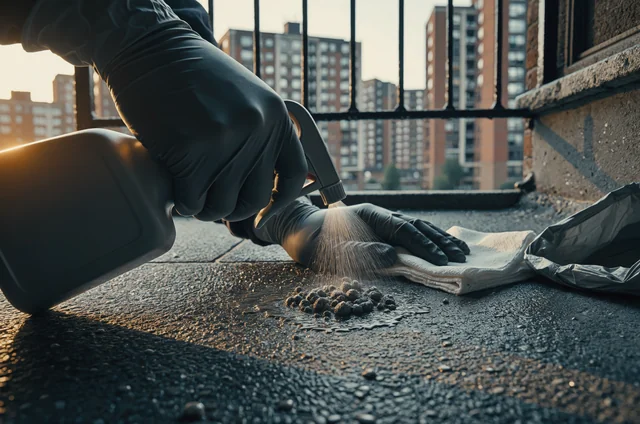
The Health and Safety Executive, or HSE, advises wetting bird-waste work areas to prevent dust. It warns against high-pressure washing because this creates airborne droplets. Its bird-droppings work guidance also addresses protective clothing and respiratory protection for work that could produce dust or spray.
Ideal Response's small-area cleaning advice supports gentle dampening and disposable cleaning materials. Keep the following approach limited to isolated, reachable patches.
Prepare the space and materials
Move people and pets away from the work area. Keep the balcony door shut during removal so material is less likely to be carried indoors.
Wear disposable gloves, washable clothing and footwear that lets you stand securely. Have disposable cloths or paper towels, a waste bag and a surface-compatible cleaning product ready before touching the droppings.
Put the waste bag within easy reach. Plan how you will handle the door and other clean surfaces without touching them with dirty gloves.
Check where water could run. On a balcony above another home or a public walkway, avoid pushing dirty water over the edge. Do not lean outside the railing to reach marks on the outer face.
The video's mention of gloves is useful, but gloves do not control airborne exposure. If removal appears likely to generate dust or spray, stop and reassess the job.
Dampen gently, then collect without dry scraping
Apply water gently to moisten the small patch. Use enough to soften the material without flooding the balcony or creating a spray cloud.
Lift the softened droppings with disposable material and place it directly into the waste bag. Avoid dry brushing, sanding or scraping. Keep the waste damp during collection rather than letting it dry between passes.
If a hard layer remains, give gentle dampening time to work. A patch that still needs forceful breaking or scraping has moved beyond this simple approach.
Work from your stable standing position. Leave outer ledges, roof edges and high recesses for someone who can access them safely.
Clean the surface and finish with handwashing
After collecting the visible waste, clean the surface with a product suitable for the material. Follow its label for dilution, protective equipment, rinsing and any required contact time.
Contact time is how long a product needs to remain on the surface to work as directed. Do not invent a stronger mixture or combine cleaning chemicals.
A remaining stain does not identify an infection or prove that living organisms remain. Equally, a surface that looks clean is not a laboratory result. If restoring the finish would require sanding or aggressive scraping, discuss that work separately.
Close the waste bag securely. Disposal arrangements can vary with the quantity and setting, so check local requirements rather than assuming every clean-up has the same waste route.
Remove gloves without touching their dirty outer surfaces. Wash your hands and any exposed skin, then deal with washable clothing.
If dust or spray becomes unavoidable, professional respiratory protection needs proper selection and fit. HSE lists FFP3 masks among suitable options for relevant work and requires face-fit testing for tight-fitting masks. A face-fit test checks whether that mask seals on the wearer's face. A mask purchase alone does not make an unsuitable DIY task safe.
Keep the balcony from becoming a roost again
Cleaning removes existing waste. Preventing repeated deposits requires understanding where pigeons land, rest or nest on the building.
The video leaves this property-specific question unanswered. A balcony can receive droppings from birds perched above it, even when they rarely land on its floor.
Check for nesting before changing access
Look from a safe position for birds repeatedly entering one corner, nesting material, eggs or chicks. Leave a suspected active nest undisturbed and seek advice before fitting barriers.
The RSPCA's pigeon nesting advice explains that wild birds, their eggs and nests are protected. Under the Wildlife and Countryside Act 1981, intentionally damaging or destroying a nest being built or used is generally an offence, subject to lawful exceptions.
Pigeons can breed throughout the year, so an autumn or winter appointment still needs a nest check. Do not assume a nest is abandoned because no adult is visible during a brief look.
Match prevention to the actual landing point
Remove accessible food scraps and avoid leaving food on the balcony. Ask the assessor to identify the ledge, rail or sheltered gap the birds use before choosing proofing.
Bird proofing means physical measures that restrict access or landing. The RSPCA describes properly installed netting and suitable anti-perching devices as humane options. It also warns that badly constructed or poorly maintained netting can trap birds.
Choose a plan with an inspection and maintenance arrangement. Check who will notice loose fixings or gaps and who can reach them to carry out repairs.
In a block of flats, a BuzzKill Pest Control bird-control visit may need coordination with the managing agent for access to shared ledges. Ask which surfaces the proposed work covers.
Make cleaning, access and proofing separate parts of the quote
Our Newham guide to pigeon proofing costs provides a starting point for local cost questions. For your own property, ask whether the quote includes waste removal, surface cleaning, access equipment and ongoing checks.
Ask for a written handover that identifies the treated surfaces, any areas left inaccessible and the maintenance arrangement. Keep it with photographs so the managing agent can assess later reports against the original work.
Industry membership and training are useful checks when selecting a contractor. Our explanation of pest controller credentials covers how to assess them.
The practical detail missing from a general cleaning video is your balcony's source of repeated deposits. Ask for that landing or nesting point to be identified in the proposed work.
Questions after finding or cleaning pigeon droppings
A balcony incident often leaves questions about contact, weather or symptoms. The response should match what happened rather than the length of an online disease list.
What if you touched a dropping with bare hands?
Wash your hands and any affected skin with soap and water. Avoid touching your face or handling food until you have done so.
Contact does not establish that you have an infection. If you feel unwell, describe the exposure to a clinician rather than trying to identify an illness from the dropping's appearance.
Does rain make the balcony safe to clean?
Rain can dampen droppings, but it does not confirm that a surface is free of harmful organisms. Sheltered material may remain dry while the walking surface becomes slippery.
Check the patch and your footing separately. Avoid working during weather that makes standing or controlling runoff difficult.
Can you use bleach to remove the risk?
A cleaning product does not replace careful collection of the waste. Whether a disinfectant is suitable depends on its label and the surface.
Follow the manufacturer's directions and never mix cleaning chemicals. If the label does not cover the intended use, choose a suitable product or ask the contractor how the surface will be treated.
What symptoms should you mention to a doctor?
Tell your GP or NHS 111 about fever, cough or breathing symptoms after bird-waste exposure, especially after a dusty clean-up. Include when it happened, the amount disturbed and any health condition that affects your immunity.
For diarrhoea or vomiting, seek advice if you cannot keep fluids down, have bloody diarrhoea or show signs of dehydration. Symptoms have many possible causes, so exposure history helps without proving a diagnosis.
Call 999 for severe difficulty breathing or confusion. Stop any further clean-up while you arrange medical help.

Need professional help? BuzzKill offers fast, reliable pest control services across London and Essex.