
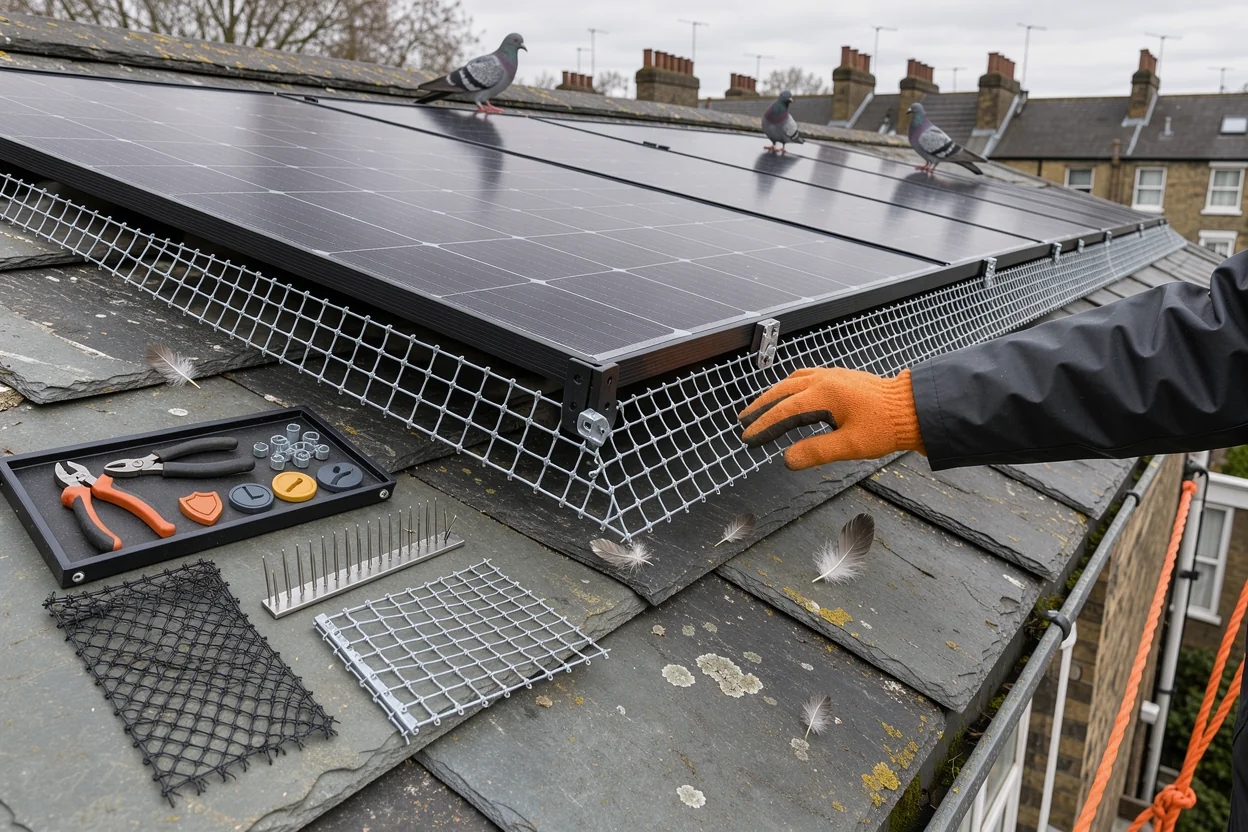
For most UK homes, perimeter mesh clipped around the edge of the array is the method that works best, because it seals the gap pigeons actually use without drilling into your panels or touching the warranty. That's the short answer. The longer answer is that bird control solar panel proofing methods aren't interchangeable: netting, spikes, mesh and solar skirts each suit a different roof, a different level of pigeon pressure, and a different budget. Pick the wrong one and you'll be back up a ladder within a year, usually with a nest you legally can't touch until the chicks have fledged.
Below are the questions homeowners across East London and Essex ask our technicians most often, answered the way we'd answer them on a survey visit.
Why do pigeons nest under solar panels in the first place?
Because the gap between your panels and the roof is the closest thing a feral pigeon gets to a natural cliff ledge: warm, dry, shaded from above, and sheltered from foxes, cats and weather.
Solar panels sit roughly 100–150mm off the roof surface on their mounting rails. That cavity traps warmth from the panels above and the roof below, which makes it an ideal nesting microclimate almost year-round. Feral pigeons in London don't observe a tidy breeding season the way garden birds do; given food and shelter, a pair can raise several broods a year, and they return to successful nest sites. Once one pair settles, the guano and nesting smell attract more.
The consequences go further than noise at dawn. Droppings on the panel surface create shading hotspots that drag down output across the whole string, nesting material packed around cabling is a genuine fire risk, and guano washing into gutters blocks them within a season or two. As Solar Info's guide to pigeon proofing costs and methods notes, pigeons, starlings and sparrows all exploit the space, but feral pigeons are the persistent offenders on urban roofs.
One legal point worth knowing before you act: under the Wildlife and Countryside Act 1981, you cannot disturb an active nest containing eggs or chicks. If pigeons are already breeding under your array, the humane and lawful route is to wait for the brood to fledge, clear the debris, then proof immediately before the pair re-lays. Proofing an empty roof is always easier and cheaper than proofing an occupied one.
Which proofing method actually works best on a pitched roof?
Mesh wins on a standard pitched roof. It's the method most UK installers and pest technicians reach for first because it's the least invasive option that fully closes the gap.
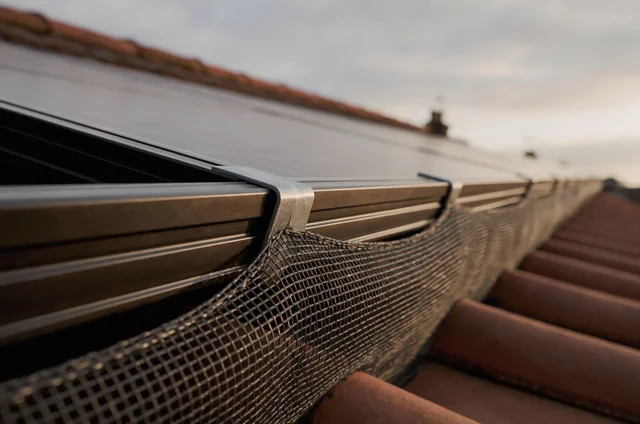
A proper solar panel mesh system is a roll of weather-resistant steel or coated wire mesh fitted around the full perimeter of the array. Strips fasten under the lip of each panel with purpose-made clips, and the mesh curves down onto the roof tiles, sealing the cavity on all four sides. Critically, the clips grip the frame rather than puncturing it. Any drilling into a panel frame can void the manufacturer's warranty, so a clip-on system matters more than most people realise. The PestFix technical specification for solar exclusion systems sets out exactly this kind of clip-fixed, non-penetrating installation, and it's the standard I'd hold any installer to.
Done properly, mesh is close to a fit-and-forget solution. Expect a well-installed stainless or galvanised system to last ten years or more with nothing more than a visual check when the gutters are cleared. The failure points are almost always workmanship, not materials: corners left open, gaps around mounting rails, or mesh that stops at the array edge but ignores a change in roof level where birds simply walk around it. Pigeons are methodical. If you close 95% of the perimeter, they will find the other 5%.
This is the method we fit most often at BuzzKill Pest Control on Victorian and 1930s terraces across Newham, Waltham Forest and Barking, where arrays are typically retrofitted onto slate or concrete tile and pigeon pressure from nearby railway arches and shop parades is high. On those roofs, mesh copes well with the uneven tile surface because the skirt flexes into the profile of the tiles.
Is netting a good alternative to mesh?
Netting works, but it's a different job. Where mesh seals the panel perimeter, netting closes off a larger area: the whole roof slope, a flat roof, or a courtyard. That makes it the right answer in specific situations and the wrong answer in most domestic ones.
Netting makes sense when the bird pressure extends well beyond the panels. If pigeons are roosting across an entire flat roof on a commercial unit, or nesting on girders, ledges and air-conditioning plant as well as under an array, sealing just the panels moves the problem two metres to the left. A tensioned 50mm knotted polyethylene net, fixed to a perimeter wire system, denies access to the whole zone. This is standard practice on commercial premises, and it's the sort of work that needs proper access equipment and anchor points.
For a typical semi-detached house with panels on one pitched slope, netting is overkill and introduces problems of its own. It's visible from the street, it needs re-tensioning over time, leaves and debris catch in it, and a sagging net with a gap at a corner is worse than nothing because birds get in and can't get out. I've seen more than one DIY net job where the homeowner effectively built a pigeon aviary on their own roof.
Cost is the other trade-off. Netting a whole slope runs well beyond the price of perimeter mesh, and on a domestic roof it rarely buys you anything mesh doesn't already deliver. If a contractor quotes you netting for a simple residential array, ask them what specific access points the net addresses that mesh wouldn't. A good answer exists for flat roofs and mixed-use commercial buildings. For most houses, there isn't one.
Do bird spikes keep pigeons away from solar panels?
Spikes move pigeons off a specific landing spot. They do not stop pigeons nesting under your panels, because the nesting space isn't the landing spot.
That distinction is the whole answer. Spikes are a roosting deterrent: they make a ledge, ridge line, chimney pot or gutter edge uncomfortable to sit on. On the right surface they're excellent, humane and long-lasting. But the cavity beneath a solar array is protected from above, so pigeons approach it from the roof slope below or hop straight in from a ridge, and they can nest happily inches from a spiked ledge. Fitting spikes around panel edges and calling it proofing is one of the most common half-jobs we get called in to correct.
Where spikes genuinely earn their place is as part of a combined approach. A typical setup on a London terrace might be mesh around the array plus spikes on the ridge tiles above it and on any nearby TV aerial or soil pipe where birds queue up before dropping down to the panels. A&H Pest Control's solar panel bird proofing page describes this kind of combined mesh-and-deterrent approach, and it reflects what works in practice: exclude them from the cavity, then make the staging areas unattractive.
Two cautions. First, cheap plastic spikes on adhesive pads fail within a couple of winters; UV makes the bases brittle and the adhesive lets go on frosty tiles. Stainless steel spikes on a proper silicone or clip fixing last far longer. Second, spikes on gutters interfere with gutter cleaning and can trap moss, so they need a clean every year or so. Treat spikes as supporting cast, never the lead.
What is a solar skirt, and when is it worth the money?
A solar skirt is a rigid or semi-rigid trim, usually powder-coated metal or UV-stable plastic, that clips or screws to the outer frame of the array and hangs down to the roof surface. Think of it as mesh's tidier-looking cousin.
Functionally it does the same job as mesh: it closes the perimeter gap. The differences are appearance, rigidity and price. Skirts look neater from ground level, which matters if your array faces the street and you care about kerb appeal. Because they're solid rather than woven, nothing can catch in them and there's no tension to maintain. Some installers prefer them on new builds where the panels are fitted at the same time, because the trim goes on cleanly before scaffolding comes down.
The trade-offs are cost and fit. Skirt systems typically cost more per metre than mesh, and on older roofs with uneven handmade tiles or weathered slate, a rigid trim doesn't bed into the roof profile the way a flexible mesh skirt does. Small gaps open up along the bottom edge, and small gaps are all a determined pigeon needs. On a modern interlocking tile roof with a new array, a skirt is a clean, durable choice. On a Victorian slate roof in East Ham, mesh is the more forgiving fit.
If you're pricing up a new installation, ask for proofing to be included in the original quote. One UK homeowner's account reported by The Cool Down described being quoted £400 as an afterthought for bird protection the installer hadn't mentioned upfront, with the company admitting it only discussed proofing when customers asked. Retrofitting after scaffolding is gone always costs more, so raise it before you sign anything.
Can repellent gel or decoys do the job on their own?
No. Gels, decoys, audio deterrents and reflective tape all share the same weakness: pigeons habituate. What startles or repels them in week one is furniture by week six.
Repellent gel is the most credible of the group. It's a non-toxic compound applied in dishes to ledges, and it works on sight and smell: the gel appears to birds as something like a shimmering fire and puts off an odour they avoid. PEST UK describes gel as a humane deterrent alongside professionally clipped mesh, which is the honest framing: gel as one tool in a kit, not a standalone fix for an active nesting site. Gel also needs replacing as it weathers and collects dust, so it suits low-pressure roosting spots rather than an established colony.
Plastic owls, hawk kites and spinners have their place in gardens for protecting seed beds. On a roof, London's streetwise feral pigeons work out within days that the owl hasn't moved, and after that it's decoration. If anything, a static decoy near the panels gives them a perch.
The pattern is consistent: deterrents reduce comfort, exclusion removes access. Against a nesting drive as strong as a feral pigeon's, only exclusion holds. Use deterrents to protect secondary spots after the main cavity is sealed, or as a stopgap while you wait for a professional booking, but don't spend decoy money twice when mesh money would have solved it once.
What does each method cost, and is DIY worth it?
Expect professional mesh proofing on a typical domestic array in London to sit in the region of £400–£700 depending on access, array size and roof condition, with commercial systems higher. The Eco Experts' breakdown of pigeon proofing costs puts domestic pricing in that sort of range, and our own guide to pigeon proofing prices covers what drives a quote up or down locally.
Here's how the options compare on the things homeowners actually ask about:
| Method | Typical lifespan | Warranty-safe? | Best suited to |
|---|---|---|---|
| Perimeter mesh (clip-on) | 10+ years | Yes, if clip-fixed | Most pitched domestic roofs |
| Whole-area netting | 5–10 years (needs re-tensioning) | Yes | Flat and commercial roofs, heavy pressure |
| Spikes (as support) | 5–10 years (stainless) | Yes | Ridges, ledges, staging areas |
| Solar skirt | 10+ years | Check system terms | New arrays, modern tiles |
| Gel / decoys | Months to 2 years | Yes | Low-pressure spots, stopgaps |
On DIY: the materials are buyable, and a competent person on a single-storey extension roof with a clip-on mesh kit can do a decent job. The honest problems are access, safety and coverage. Most arrays are on two-storey pitches, working at height from a ladder against guttering is how DIY jobs go wrong, and a missed corner undoes the whole install. There's also the debris problem. Clearing years of guano and nesting material is proper contamination-control work: droppings carry pathogens including psittacosis, so dry-sweeping it without a mask is a bad idea. If the roof is high, the nest is active, or the mess is established, that's the point where professional bird control earns its fee.
Will proofing damage my panels or void the warranty?
It shouldn't, and this is exactly the question to put to any installer before work starts. The safe rule is simple: nothing should be drilled into, screwed through or adhered to the panel frames or the roof covering.
Clip-on systems exist precisely because of warranty risk. The clips grip the inner lip of the panel frame, the mesh or skirt hangs from them, and the manufacturer's seal on the frame is never broken. Any warranty small print tends to exclude damage from unauthorised modifications, so a drilled hole is the one thing that turns a £500 proofing job into a £3,000 argument. Ask the installer to confirm in writing that their fixing method is non-penetrating, and keep that with your panel paperwork.
The same care applies to the roof itself. Mesh that curves onto the tiles should sit on the surface, not be nailed through it. On slate roofs this matters doubly, because cracked slates around the array lead to leaks that get blamed on whoever was up there last. A technician who proofing-surveys properly will photograph the roof condition before starting, partly for your protection and partly for theirs.
If you're comparing contractors, credentials are a useful filter. Our piece on how to check your pest controller's credentials explains what NPTA and BPCA membership actually tell you about training and insurance, and it's a five-minute check worth doing before anyone goes up a ladder.
When should I get panels proofed, and what if birds are already there?
The best time is the day the panels go up; the second-best time is before spring nesting starts; the worst time is after you've heard scratching in the ceiling void for a month.
If you're mid-quote on a new installation, fold proofing into the scaffolding window and the job adds little to the total. If your panels are already up and quiet, late winter is the smart moment: proof in February or early March and you beat the main nesting push. If birds are already in residence, the sequence is fixed by law and biology. Confirm whether nests are active (eggs or chicks present), wait for fledging if they are, then have the cavity cleared, sanitised and proofed in one visit so the pair can't re-lay in the gap. Invicta's pigeon proofing guidance makes the same point about timing: prevention before nesting is always the cheaper, cleaner route.
Signs that mean it's time to stop researching and book someone: birds seen entering and leaving the same point daily, twigs protruding from under the array, droppings streaking the panels or pooling on the ground below, and cooing or scrabbling audible from the loft. One pair this spring is four or five birds by autumn, and each season's debris makes the eventual clear-out bigger.
If you're weighing up whether your situation has crossed the line from minor nuisance to job-for-a-pro, the five warning signs in our guide to professional bird control signs will help you call it. And if you'd rather have a technician look at the roof and tell you straight, BuzzKill's team covers East London and Essex with same-day surveys and no call-out charge: we'll tell you whether mesh alone will do it, or whether the ridges and ledges need attention too.
A final practical tip: if you're comparing quotes, a simple decision checklist helps. Note your roof type (slate, concrete tile, flat), array size in panels, whether birds are already present, and whether scaffolding is already planned. Those four answers determine the right method and roughly 80% of the price, and they're the first four things any competent surveyor will ask you.

Need professional help? BuzzKill offers fast, reliable pest control services across London and Essex.