
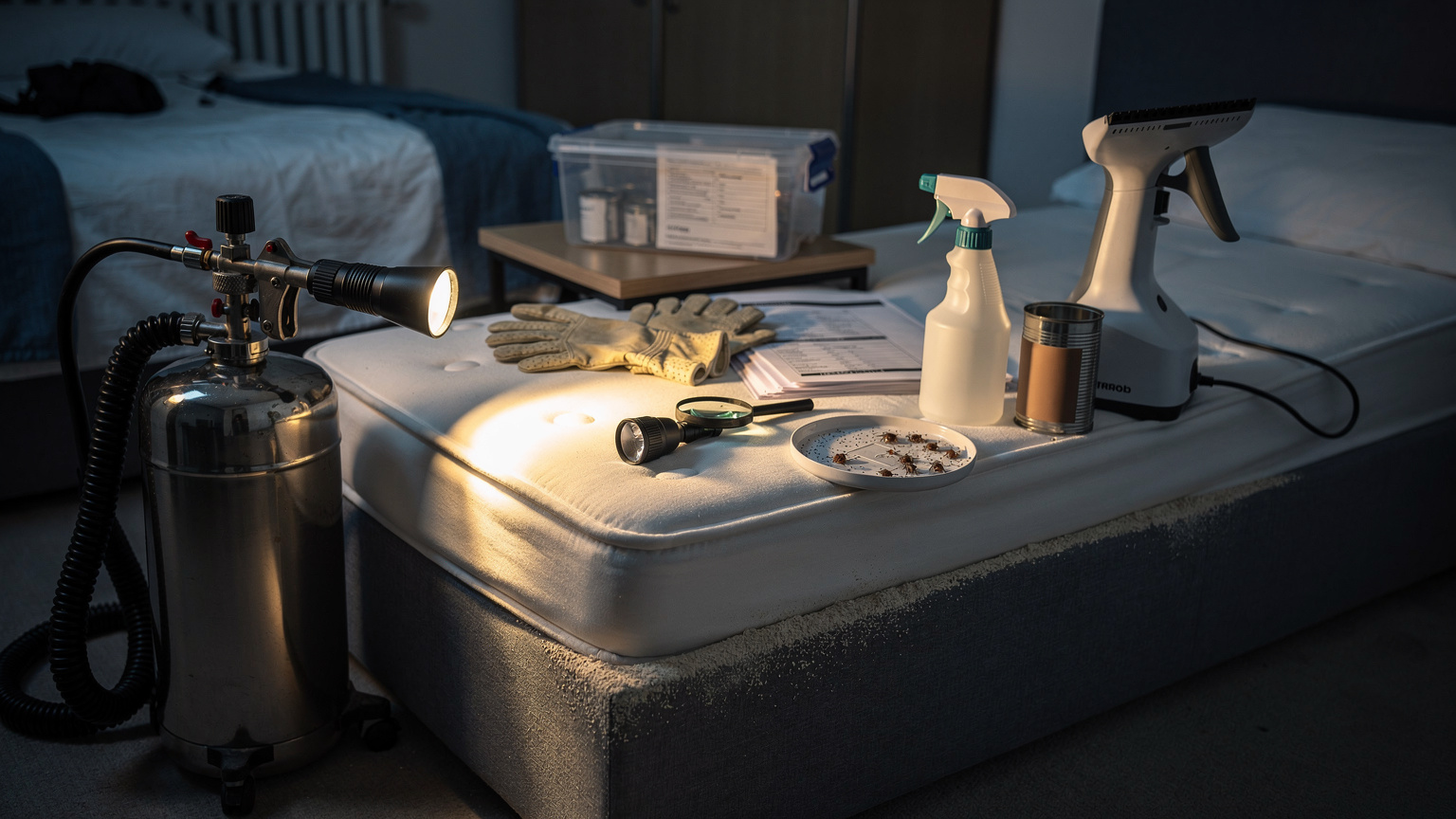
Choosing between professional and DIY bed bug treatment options means understanding the biology, risks, and realistic outcomes before you spend money or waste time on methods that fail.
Bed bug treatment options range from supermarket sprays to whole-room heat systems, yet most homeowners discover the hard way that not all approaches deliver what they promise. These insects hide in millimetre-wide cracks, survive months without feeding, and rapidly develop resistance to common insecticides. This guide maps the real landscape of eradication methods, explains why some treatments succeed where others collapse, and shows you how to match the right approach to your specific situation.
Table of Contents
- Topic Map
- Core Concepts
- How It Works
- Main Layers
- Maturity Path
- Real-World Scenarios
- Common Mistakes
- What to Read Next
Topic Map
This guide organises bed bug treatment options around a single principle: effective eradication depends on matching the method to the infestation's scale, location, and resistance profile. The topic breaks into six interconnected areas. First, understanding bed bug biology and behaviour explains why superficial treatments fail. Second, chemical treatments reveal the gap between consumer products and professional-grade formulations. Third, heat treatment explores the physics of thermal death and its practical constraints. Fourth, integrated pest management shows how professionals combine multiple tactics. Fifth, the DIY versus professional decision framework helps you assess your own situation honestly. Sixth, prevention and monitoring ensures elimination becomes permanent rather than temporary.
These layers build sequentially. You cannot evaluate whether to hire a professional until you understand why bed bugs resist simple spraying. You cannot judge heat treatment quotes until you grasp why temperature distribution matters more than peak readings. Each section adds a decision-making lens that sharpens your choices.
What Is Bed Bug Treatment?
Bed bug treatment is the systematic elimination of Cimex lectularius and related species from human-occupied spaces through chemical, thermal, physical, or biological interventions. The modern challenge emerged after the 1990s global resurgence, when widespread insecticide resistance, increased international travel, and changes in pest control practices allowed populations to rebound after decades of effective suppression.
Today, treatment sits at an uncomfortable intersection. Consumer products promise convenience but often deliver partial control that drives bugs deeper into hiding. Professional services offer comprehensive approaches but vary enormously in methodology and technician competence. Understanding this landscape matters because bed bugs reproduce quickly—a single fertilised female can establish a detectable population within weeks—and delayed or incomplete treatment typically increases both cost and psychological burden.
Core Concepts
Thermal Death Point. Bed bugs die when their body temperature reaches approximately 45°C maintained for sustained periods, or more rapidly at higher temperatures. This threshold explains heat treatment's appeal but also its complexity: achieving uniform heat throughout cluttered rooms requires specialised equipment and monitoring, not merely turning up central heating.
Insecticide Resistance. Populations across the UK and globally have developed resistance to pyrethroids, neonicotinoids, and other common active ingredients. This resistance means that a product effective in one property may fail in an adjacent flat, making product selection and rotation critical for professionals and largely unpredictable for DIY users.
Harbourage Behaviour. Bed bugs aggregate in dark, narrow spaces near sleeping areas—mattress seams, bed frame joints, electrical outlets, skirting board cracks. This behaviour means surface-visible bugs typically represent a fraction of the population, and treatments targeting only obvious locations miss the reservoirs that drive reinfestation.
Dispersal Pressure. Aggressive treatment in one area can push bed bugs to adjacent rooms or neighbouring properties through wall voids and service ducts. This phenomenon, well-documented in multi-unit housing research, means poorly planned DIY attempts in flats or terraced houses may simply relocate rather than eliminate the problem.
Monitoring and Verification. True treatment success requires confirming elimination, not merely observing fewer bites. Bed bugs feed irregularly, individual reactions vary, and visual inspection misses low-level populations. Professional monitoring uses interceptors, attractant traps, and sometimes canine detection; DIY approaches rarely include equivalent verification.
How It Works
Effective bed bug treatment operates through three interconnected mechanisms: direct mortality, harbourage elimination, and residual prevention. Understanding how each method addresses these mechanisms explains why combinations outperform single-tactic approaches.
Chemical treatments achieve direct mortality through contact and ingestion, but their effectiveness depends on formulation, application technique, and resistance status. Professional-grade products include insect growth regulators that disrupt development, synergists that overcome resistance mechanisms, and microencapsulated formulations that extend residual activity. Consumer products typically lack these refinements. Application technique matters equally: professionals use targeted crack-and-crevice application, void injection, and strategic placement that DIY users rarely replicate accurately.
Heat treatment achieves direct mortality through protein denaturation and membrane disruption at cellular level. Industrial systems raise room temperatures to 50-60°C with high-velocity air circulation and remote temperature monitoring. The critical challenge is thermal penetration: dense objects like mattresses, books, and wardrobes create cold spots where bugs survive. Professional systems address this through equipment placement, pre-treatment preparation protocols, and real-time sensor feedback that consumer space heaters cannot provide.
Physical removal through vacuuming, steam application, and encasement supports both approaches by reducing population pressure and eliminating harbourages. However, these methods alone rarely achieve complete control because they cannot access all hiding places or eliminate eggs protected in crevices.
The most reliable professional approaches combine these mechanisms sequentially: initial reduction through physical methods, comprehensive chemical or thermal treatment, then monitoring to detect and eliminate survivors before they reproduce.
Main Layer 1: Chemical Treatment Realities
Chemical treatments dominate both DIY and professional bed bug control, yet the gap between these categories is vast. Consumer products available in UK supermarkets and hardware stores typically contain pyrethroids such as permethrin or tetramethrin, sometimes combined with piperonyl butoxide as a synergist. These formulations target the insect's nervous system but face well-documented resistance issues.
Research published in the Journal of Medical Entomology has documented widespread pyrethroid resistance in UK bed bug populations, with some strains showing over 100-fold reduced susceptibility. This resistance means that a product killing laboratory-susceptible bugs may have minimal effect on field-collected populations. Consumer products rarely indicate resistance status or provide guidance on product rotation, leaving DIY users without critical information for effective selection.
Professional chemical treatments access broader active ingredient classes: neonicotinoids, pyrroles, pyrazoles, and insect growth regulators such as hydroprene. More importantly, professionals can assess resistance patterns through treatment response, rotate chemistry based on local knowledge, and apply formulations in ways that maximise contact while minimising human exposure. The application equipment itself matters: professional-grade sprayers produce appropriate droplet sizes for crack-and-crevice treatment, while consumer trigger sprays create coarser deposits that poorly penetrate harbourages.
For isolated, early-stage infestations in single rooms, carefully applied consumer products may contribute to control. For established populations, multi-room spread, or properties with complicating factors (clutter, vulnerable occupants, adjacent units), professional chemical treatment offers substantially higher success probability. The signs of bed bugs page helps assess whether your situation likely exceeds DIY scope.
Main Layer 2: Heat Treatment Physics and Practicality
Heat treatment represents the most significant advance in bed bug control since the resurgence began. The approach eliminates resistance concerns—thermal death operates through physical mechanisms that insects cannot evolve to escape—and can treat entire rooms or properties in single sessions.
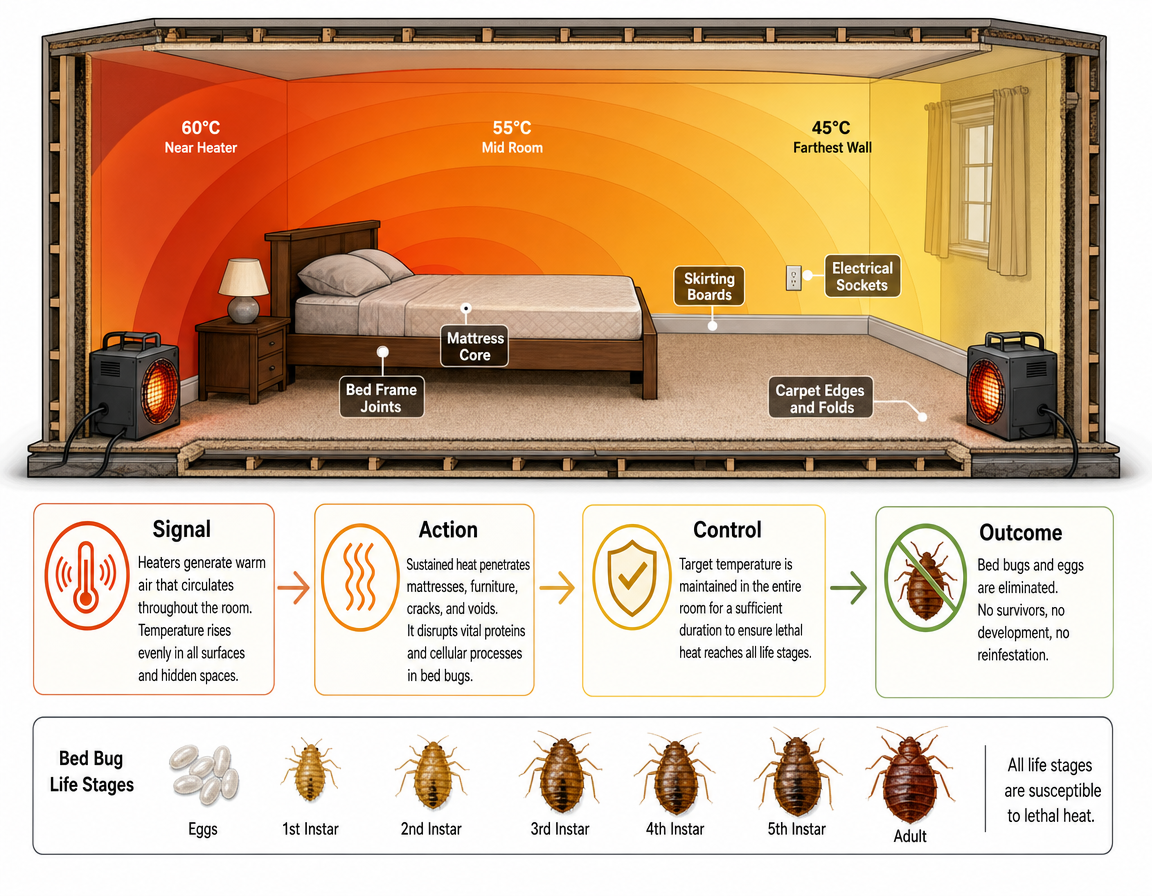
The physics is straightforward: bed bugs die when core temperatures reach 45°C for approximately 90 minutes, or more rapidly at higher temperatures. Professional systems typically target 50-60°C throughout treated spaces, with treatment durations of 4-8 hours depending on property size and construction. High-velocity fans ensure air circulation that prevents thermal stratification and penetrates dense materials.
Practical constraints are equally important. Heat treatment requires substantial preparation: heat-sensitive items must be removed or protected, sprinkler systems may need temporary modification, and certain furnishings can be damaged. The equipment—industrial heaters, generators, temperature monitoring systems—cannot be replicated with domestic appliances. Attempted DIY heat treatment using domestic heaters or improvised methods has caused property fires and consistently fails to achieve lethal temperatures throughout treated spaces.
Cost reflects this capability: whole-property heat treatment typically ranges from several hundred to over a thousand pounds depending on property size. However, single-session elimination, absence of chemical residues, and reduced preparation compared with repeated chemical visits can make heat treatment cost-effective for suitable properties.
Success depends critically on technician competence: proper equipment configuration, thorough preparation guidance, and post-treatment verification. Not all providers offering "heat treatment" use equivalent equipment or protocols, making qualification verification important.
Main Layer 3: Integrated Pest Management Approaches
Integrated Pest Management (IPM) represents the professional standard for complex or persistent infestations. Rather than relying on single methods, IPM combines multiple tactics selected and sequenced based on site-specific assessment.
A typical IPM programme begins with thorough inspection and monitoring to map infestation extent and identify contributing factors. Treatment then combines appropriate methods: insecticide application to harbourages, heat treatment for high-value or sensitive areas, physical removal through vacuuming, and encasement of mattresses and box springs to eliminate harbourages and trap remaining bugs. Post-treatment monitoring confirms elimination and detects any reintroduction.
This approach addresses the limitations of single methods. Chemical-only treatments may miss resistant populations or fail to penetrate all harbourages. Heat-only treatments may struggle with certain construction types or allow rapid reintroduction if source identification is incomplete. IPM's flexibility allows adaptation to specific property characteristics, occupant needs, and infestation dynamics.
For commercial settings—hotels, care homes, multi-occupancy residential—IPM is typically essential both for effectiveness and for compliance with due diligence requirements. The systematic documentation and monitoring components support regulatory defence if occupant complaints arise.
The complexity of effective IPM explains why genuinely integrated programmes require trained, experienced technicians rather than formulaic service delivery. When evaluating providers, ask specifically about their IPM components: do they include monitoring, multiple methods, and verification, or simply scheduled chemical applications?
Main Layer 4: The DIY Versus Professional Decision Framework
Choosing between DIY and professional treatment requires honest assessment across five dimensions: infestation scale, property type, occupant vulnerabilities, time pressure, and budget reality.
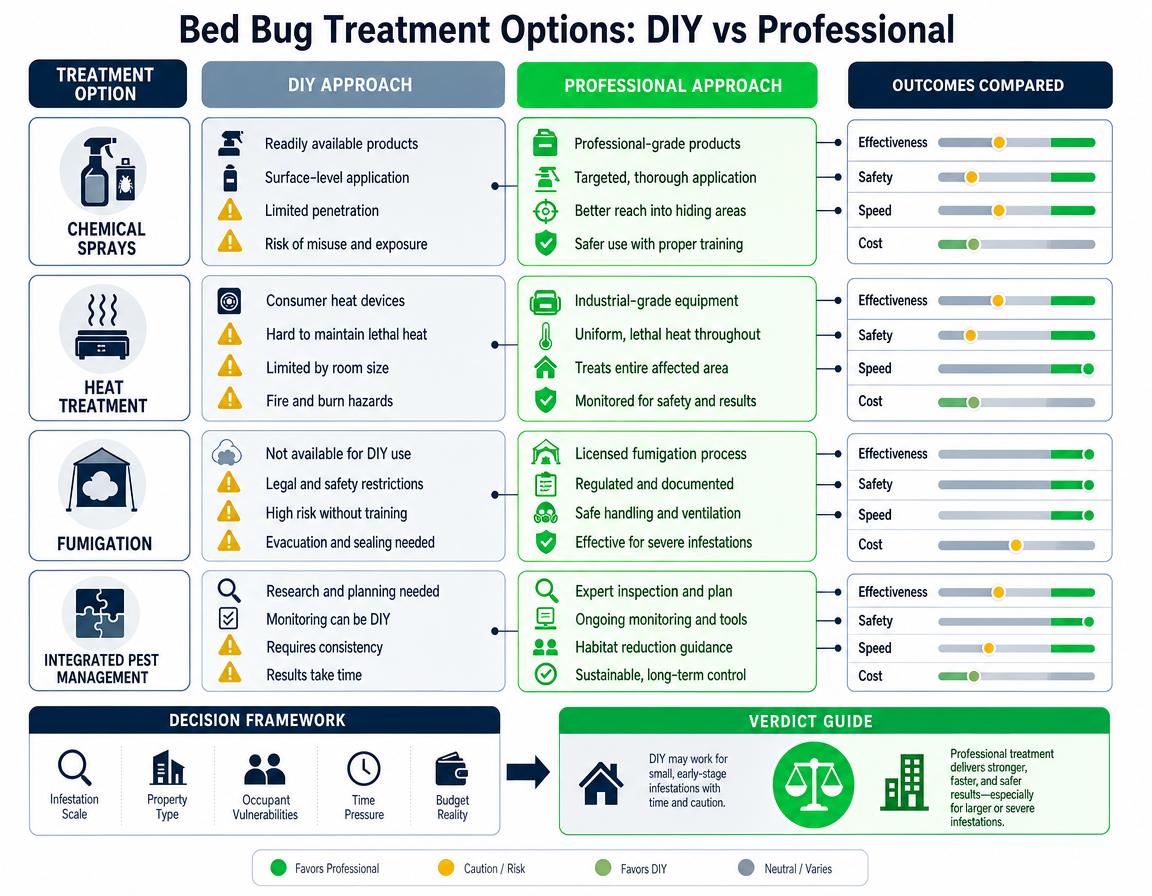
Infestation scale is often underestimated. Early-stage infestations—single room, recent introduction, visible bugs limited to bed area—may respond to thorough DIY approaches combining vacuuming, steam, encasement, and careful insecticide application. Multiple rooms, widespread harbourages, or bugs present for weeks or months typically exceed DIY capability. The how to get rid of bed bugs guide provides detailed assessment criteria.
Property type significantly affects treatment complexity. Single-occupancy houses with straightforward construction allow simpler approaches than flats with shared walls, listed buildings with restricted modification, or properties with extensive clutter that creates harbourage abundance.
Occupant vulnerabilities—young children, elderly residents, respiratory conditions, pregnancy—may preclude certain chemical approaches or make professional expertise in product selection and application essential.
Time pressure favours professionals when rapid resolution is needed: before travel, property sale, or tenant changeover. DIY approaches typically require repeated applications over weeks with uncertain outcomes.
Budget reality must include total cost, not just initial outlay. Failed DIY attempts that ultimately require professional intervention represent common false economy. However, for genuinely limited infestations with appropriate occupant capacity, methodical DIY can succeed.
Maturity Path
Beginner stage: Recognition and initial response. At this stage, the homeowner has identified possible bed bug presence through bites, visual observation, or faecal spotting. The appropriate response is confirmation and containment: verify identification through reliable sources or professional inspection, isolate the affected area, and avoid sleep location changes that would spread bugs. DIY treatment at this stage is defensible if methodical and combined with monitoring, but professional inspection provides valuable baseline assessment.
Intermediate stage: Active treatment selection and implementation. The homeowner understands infestation extent and is implementing chosen methods. For DIY, this means systematic application of combined tactics with careful documentation and scheduled follow-up. For professional engagement, this involves selecting appropriate provider and method, completing preparation requirements, and understanding treatment limitations. Good practice at this stage includes mattress encasement, interceptor installation under bed legs, and continued monitoring regardless of treatment approach.
Advanced stage: Verification and prevention. Treatment is complete, and the focus shifts to confirming elimination and preventing reintroduction. This stage requires sustained monitoring—typically 6-8 weeks minimum—travel protocol development, and understanding of how introductions occur. Professional programmes typically include structured monitoring; DIY approaches often neglect this critical phase, leading to late rediscovery of persistent or reintroduced populations.
What good looks like: elimination confirmed through sustained absence of bugs in monitoring devices, coupled with practices that reduce reintroduction risk. What failure looks like: premature declaration of success based on reduced biting, followed by population rebound from undetected survivors.
Real-World Scenarios
Scenario 1: The Early Interception. Maria noticed three bites in a line on her forearm and, on inspection, found two small bugs in her mattress seam. She acted within days: vacuumed thoroughly, applied steam to the mattress and frame, installed encasements, and placed interceptors under bed legs. She monitored for six weeks, finding no further bugs. Her early recognition, limited scale, and methodical combined approach achieved elimination without professional involvement. This represents DIY success at its most achievable.
Scenario 2: The Escalating Attempt. James discovered bed bugs in his rented flat and purchased aerosol sprays from a hardware store. He treated his bedroom repeatedly over three weeks, observing fewer bugs and assuming success. He then noticed bites resuming and found bugs in his living room sofa—likely dispersed by his treatments. By the time he contacted professionals, the infestation had spread to two additional rooms, and his partial chemical applications had contributed to resistance development. Professional heat treatment eventually resolved the situation, but at substantially higher cost than early professional intervention would have required.
Scenario 3: The Commercial Pressure. A small East London hotel received a guest complaint about bites, with the guest posting a review before management could respond. The duty manager needed immediate, discreet, guaranteed resolution to protect reputation and trading. Professional heat treatment of the affected room, combined with systematic inspection of adjacent rooms and interceptor installation for ongoing monitoring, provided same-day resolution with documentation for insurance and regulatory purposes. The speed, certainty, and accountability of professional service addressed needs that no DIY approach could satisfy.
Common Mistakes to Avoid
Treating based on bites alone. Bed bug bites resemble reactions to fleas, mosquitoes, and various skin conditions. Treatment without confirmed identification wastes resources and may target the wrong pest entirely. Visual confirmation, interceptor capture, or professional identification should precede significant expenditure.
Relying on single methods. Whether professional or DIY, single-tactic approaches—spraying alone, heat without monitoring, encasement without other measures—consistently underperform against established populations. Effective treatment combines multiple mechanisms appropriate to the situation.
Moving sleeping locations. Sleeping in a different room or on the sofa seems intuitive but typically spreads infestation to new areas. Bed bugs follow carbon dioxide and body heat; they will find you, and in doing so, expand their territory.
Neglecting adjacent spaces. In multi-unit buildings, treating only the visibly affected room ignores potential reservoir populations in neighbouring units or common areas. Professional assessment of spread risk is particularly important in flats, terraced housing, and commercial settings.
Declaring success too early. Absence of visible bugs or bites for a week or two does not indicate elimination. Survivors in protected harbourages, eggs that hatch after treatment, and reintroduction from untreated adjacent spaces can all restart population growth. Sustained monitoring over 6-8 weeks provides more reliable confirmation.
How BuzzKill Pest Control Helps
BuzzKill Pest Control provides NPTA-accredited, BASIS PROMPT-registered bed bug treatment across East London and Essex, with RSPH Level 2 qualified technicians and £5 million public liability insurance. Our approach combines thorough inspection, method-appropriate treatment selection, and structured monitoring to confirm elimination rather than assume it.
For situations where DIY approaches may be appropriate, we offer inspection and consultation services that provide accurate assessment without committing to full treatment. For complex or urgent situations, our same-day response and guaranteed results provide the certainty that bed bug infestations demand. We explain our recommended approach, its limitations, and what you can do to support success—no call-out charge, no pressure, just clear information from local specialists who understand the specific challenges of properties across East London and Essex.
Learn more: Call 0203 468 1999 or request a callback to book a same-day inspection.
What to Read Next
If you're still assessing whether you're dealing with bed bugs or another pest, the signs of bed bugs guide provides detailed identification criteria with photographs and behavioural indicators. For confirmed infestations where you're evaluating treatment scope, our how to get rid of bed bugs article offers room-by-room preparation guidance and method selection frameworks.
For broader pest awareness, the signs of mice and signs of rats guides help distinguish rodent activity from insect concerns—relevant because droppings and gnawing sometimes prompt initial bed bug concerns, and because effective pest management often addresses multiple species simultaneously.
Related Blog Posts
- How to Get Rid of Bed Bugs — Step-by-step preparation and treatment guidance for confirmed infestations
- Signs of Bed Bugs — Identification criteria to confirm you're dealing with bed bugs before choosing treatment
- How to Get Rid of Cockroaches — Related pest control approaches for properties dealing with multiple insect species
Need professional help? BuzzKill offers fast, reliable pest control services across London and Essex.