
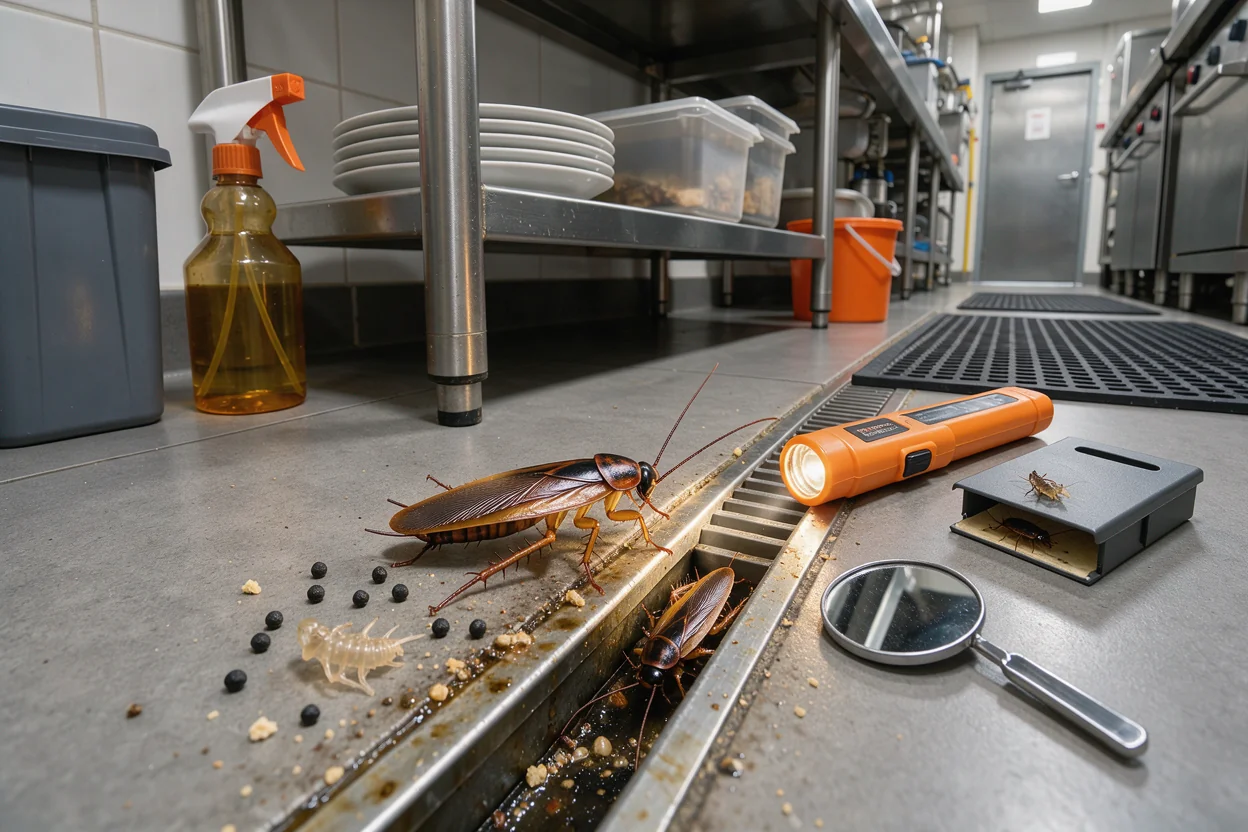
Here's the thing most restaurant owners get wrong about cockroach control and restaurant closure risk: it's rarely the insect itself that shuts you down. It's what the finding proves about your kitchen. An Environmental Health Officer (EHO) who spots a single German cockroach nymph behind a fridge isn't counting legs. They're reading evidence — how long the problem has been there, whether you knew, and whether your food safety system caught it before they did.
That distinction decides everything. Some findings earn you a hygiene-rating knock and a to-do list. Others earn a Hygiene Emergency Prohibition Notice taped to your door before lunch service. In 2026 alone, a Birmingham restaurant was closed by magistrates after officers judged an active cockroach problem an "imminent risk of injury to health," a Derby Subway branch landed a zero food hygiene rating over live and dead cockroaches, and a Cardiff owner was fined more than £3,500 after trading through an infestation reported by a member of the public.
This list ranks the nine cockroach findings that escalate a food business from "improvement needed" to "closed until further notice" — ordered by how fast inspectors act on each one, and what each trigger means for you in practice.
How a cockroach finding becomes a closure order
Before the ranking, you need the mechanics, because the same finding can end three different ways.
In England, EHOs work under the Food Safety Act 1990 and the Food Hygiene Regulations. When they judge that a food business poses an imminent risk to health, they have two routes. They can serve a Hygiene Emergency Prohibition Notice on the spot, which closes you immediately but must be confirmed by a magistrates' court as a Hygiene Emergency Prohibition Order within days. Or, if you cooperate, they can agree a voluntary closure — which is what happened at the Derby Subway branch, where the council accepted a voluntary shutdown because of the outlet's good trading history.
The Food Hygiene Rating Scheme runs in parallel. Pest evidence found during an inspection routinely collapses a rating to zero or one, and that score is public. Other countries run the same logic with different paperwork. Under Massachusetts health code 105 CMR 590.014, for example, the board of health can Pest Services MA the moment an inspector decides an imminent health hazard exists — the order takes effect when it's posted on the door, and the business stays closed until a reinspection confirms the fix. The UK version is just as fast.
What reopening actually demands
Closure isn't the end of the process; it's the start of an expensive one. Guidance from the Riverside County Department of Environmental Health on reopening after a cockroach closure reads almost identically to what UK officers expect: licensed pest treatment, removal of every egg casing and dropping (eggs left behind mean the problem returns), sealed cracks and crevices, deep-cleaned food-contact surfaces, and — the one that catches operators out — don't request your reinspection before the work is genuinely complete, because a failed revisit costs you more time. Sheffield Moor Market needed two full weeks of treatment, deep cleaning and monitoring, with no pest activity for two consecutive days, before the council let it reopen in 2026.
The three findings that shut kitchens on the spot
These are the triggers where an inspector stops writing a report and starts writing a prohibition notice. Industry specialists who work with London food businesses put it bluntly: cockroaches are London Pest Control Co on the spot, with German cockroaches the usual species behind it.
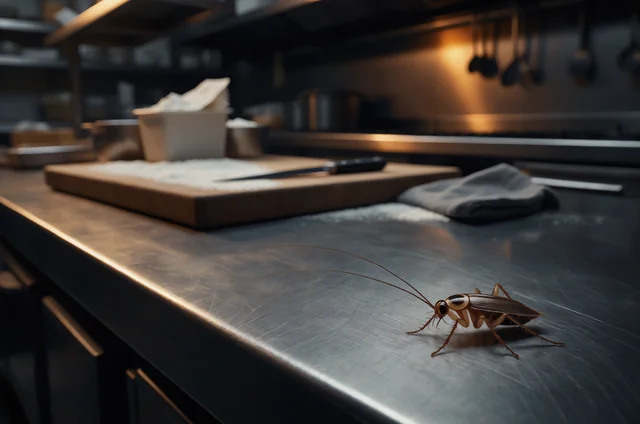
1. Live cockroaches moving in a prep or cooking area
This is the fastest route to closure there is. A live sighting during service hours tells the officer three things at once: the population is established, it's comfortable around people and light, and it's active exactly where food is handled. The Birmingham restaurant closed by magistrates in July 2026 was shut on precisely this basis — officers found active cockroaches during an inspection and the court agreed the premises posed an imminent risk.
The common mistake is assuming one roach equals one roach. Inspectors don't. German cockroaches are nocturnal and avoid open space, so one adult walking across a prep counter at 11am implies a harbourage under pressure nearby. If you see this today, you don't wait for your next scheduled visit. You treat it as a same-day emergency, document what you did, and pull every open food item in the affected zone.
2. Droppings and smear marks near stored food
Here's a finding operators consistently under-rate. Fresh cockroach droppings — small dark specks like ground pepper, often along wall-floor junctions and inside dry-goods shelving — are treated by inspectors as evidence of active infestation, full stop. California's health code makes the logic explicit: pest evidence such as droppings in a prep area is Bay Pest Solution, because it proves current activity rather than a historic problem. UK officers apply the same reasoning, and it was part of the evidence behind the Birmingham café closure in October 2026, where mouse, rat and cockroach evidence was found together during a routine inspection.
Why it ranks second: unlike a live sighting, droppings can occasionally be old. But the burden of proof is on you, and "we cleaned last week" doesn't survive a finding of fresh faecal spots beside the flour bins. The practical verdict: if your team is wiping droppings each morning without a treatment programme running, you're generating daily evidence against yourself.
3. Cockroaches on food-contact surfaces, utensils or packaging
A roach in a dry store is a serious finding. A roach inside a plate stack, a chopping board rack or a box of takeaway containers is worse, because the contamination route to the customer is direct and immediate. Cockroaches carry organisms including E. coli and salmonella on their bodies, and inspectors treat contact with anything that touches food as an imminent-risk scenario rather than a hygiene-rating deduction.
This is also the finding that destroys the "it's only in the back corridor" defence. Officers map where activity sits relative to food flow, and once it crosses into contact surfaces, the escalation is automatic. Your move: quarantine and rewash everything in the affected storage run, and treat the harbourage, not the corridor.
The signs that tell inspectors the problem is established
The next three triggers rarely close you alone, but they convert a borderline visit into enforcement because they prove duration. A one-off intruder is bad luck. Breeding evidence is a system failure.
4. Egg cases and nymphs behind equipment
German cockroach egg cases (oothecae) are small, brown, purse-shaped capsules, each holding dozens of eggs. Finding them glued behind fridges, under hot-holding units or inside motor housings tells an officer the population is breeding on site — which means weeks of undetected activity, minimum. Nymphs confirm it, since they don't travel far from where they hatched.
This is where treatment method starts to matter to your compliance position, not just your pest problem. Specialists in Golden Pest Control note that a single sighting can become a hygiene issue, a staff morale problem and a reputational risk within days, and that the right response depends on species, access and hygiene conditions — gel baiting in some cases, monitoring plus targeted insecticide and follow-up visits in others, not a quick spray-and-go. Inspectors know the difference. A site with egg cases and no treatment records reads as neglect; the same site with a dated baiting and monitoring programme in progress reads as a business managing a problem.
5. Daytime activity anywhere in the building
Cockroaches seen during the day are a population-pressure signal. When harbourages fill up, the weaker individuals get pushed out into daylight and open floor space. An officer who sees daytime movement assumes the hidden population is many times larger than what's visible.
The trap here is staff normalisation. Kitchen teams working around low-level activity for months stop reporting it, and the first time management hears about the scale is when an inspector does. Build a simple rule: every sighting gets logged with time, location and a photo. A log that shows three sightings in six months, each followed by a recorded action, protects you. A log that's empty while the officer watches a roach cross the floor does the opposite.
6. Activity that survives your own treatment attempts
Repeat activity after DIY treatment is a specific red flag, because it demonstrates both knowledge and inadequacy. You knew about the problem, and your response was a supermarket spray rather than professional control. Officers read that as a due-diligence failure, which is the legal standard you have to meet.
There's a technical reason the DIY route fails, and it matters for your defence. Effective control starts with identifying the species correctly, treating the source harbourage, and closing off the conditions sustaining it, as the compliance-focused guidance from Elite Pest & Termite puts it. Surface sprays kill the roaches you can see and scatter the rest deeper into the building fabric, which is why activity "bounces back" two weeks later. If your records show three failed self-treatments, the inspector's file shows a business that chose the cheap option three times.
The paper-trail triggers that turn a warning into enforcement
The final three triggers are administrative, and they're the ones that surprise experienced operators. You can have zero visible roaches and still fail here.
7. No pest control contract, monitoring or records
Under the Food Safety Act 1990 and the hygiene regulations, you must be able to demonstrate a proactive pest management system — not just assert that you don't have pests. The Food Standards Agency's UK Food Standards Agency exists precisely to give small catering businesses a documented structure: opening and closing checks, safe methods, and a diary that proves you run them. An officer who asks for your pest control documentation and gets a shrug has grounds to act even without a live sighting, because you can't evidence the legal minimum.
This is the cheapest trigger to fix and the most expensive to ignore. A contract with documented visits, monitor check records and a sightings log is your due-diligence defence in a folder. London operators increasingly treat kitchens out of hours as the default and produce a written sign-off sheet per visit that drops straight into the food safety management system — that paper trail is what an EHO wants to see first.
8. Ignored technician recommendations
If your pest contractor's reports have recommended a bristle strip on the rear door, sealing around pipe entries, or replacing a damaged drain cover — and the work hasn't been done — an EHO treats that as a known, unmanaged risk. Repeat reports with the same outstanding actions are worse than no reports at all, because they document your decision not to act.
The same logic applies to housekeeping findings. Strong sanitation practices both prevent cockroach problems and reveal them early, as Excel Pest Services notes, so when an officer finds grease build-up behind the fryer line alongside pest activity, the two findings compound. Each one proves the other wasn't an accident.
9. Repeat findings after an improvement notice
The final trigger is the point of no return. A Hygiene Improvement Notice gives you a legal deadline to fix specified problems. If the follow-up visit finds the same cockroach evidence — or evidence that cleared and came back — you've moved from hygiene management into prosecution territory. That's where the Cardiff case landed: the owner traded through a known infestation, and the result was a court fine above £3,500 rather than another notice.
Repeat non-compliance also removes the voluntary-closure option. Officers extend cooperation to businesses with good trading history; they don't extend it twice. If you've had one notice, the correct response is a documented professional treatment programme with follow-up monitoring — and if you're weighing up contractors, it's worth knowing how to check a pest controller's credentials before you sign, because an inspector will ask who did the work and whether they were qualified. Treatment cost is usually the hesitation at this stage, so it helps to look at real figures for same-day cockroach treatment costs in London rather than guessing. Whatever the number, it's a fraction of a two-week closure.
For London operators, the practical baseline is a commercial contract with a local, accredited firm that documents every visit. BuzzKill Pest Control runs commercial cockroach programmes across East London and Essex with written visit records and out-of-hours treatments, and there are other accredited London contractors doing similar work — the point is the paper trail, not the logo on the van. Professional products used in food premises also have their own legal rules, so it's worth understanding pest control regulations before anyone treats your kitchen.
One tool worth building into your routine: a monthly closure-risk self-check. Score your kitchen against the nine triggers above — live activity, droppings near food, contact-surface findings, egg cases, daytime sightings, failed DIY attempts, missing records, outstanding recommendations, and any previous notices. Anything scoring red gets a dated action the same week. It takes twenty minutes and it's the closest thing to reading your own inspection report in advance.
What restaurant managers ask about cockroach closure risk
Can one cockroach really close my restaurant? One live cockroach in a prep area during an inspection can be enough, because officers treat it as evidence of an established hidden population. One cockroach found by your own team, logged and acted on immediately, is a very different position. The sighting matters less than your response to it.
Is a voluntary closure better than a prohibition notice? Usually, yes. A voluntary closure agreed with the EHO avoids a court order and signals cooperation, which is why Derby City Council accepted one from the Subway branch with a good trading history. You still can't reopen until the officer confirms the imminent risk is removed, and your hygiene rating still reflects the findings.
How long does a cockroach closure typically last? It depends on treatment and verification, not on a fixed sentence. Sheffield Moor Market was closed for a fortnight because reopening required a full treatment programme plus two consecutive days of zero activity. Premises that request reinspection before the work is done fail the revisit and wait longer.
Does a zero food hygiene rating mean I'm closed? Not automatically. The rating reflects the inspection findings; closure is a separate enforcement decision based on imminent risk. But the two often arrive together, and a published zero rating does its own commercial damage even if your doors stay open.
What's the single most useful thing to do this week? Get your documentation in order. A current pest control contract, monitor records and a sightings log are the difference between an inspector seeing a managed risk and an unmanaged one. Most closures on this list were decided by what the business couldn't prove, not just what the officer found.
The trigger to act on today is number 7 — the paperwork — because it's the one you can fix before anything crawls. The one operators overreact to is a single sighting in a customer area: log it, act on it, and let the record show you did.

Need professional help? BuzzKill offers fast, reliable pest control services across London and Essex.