
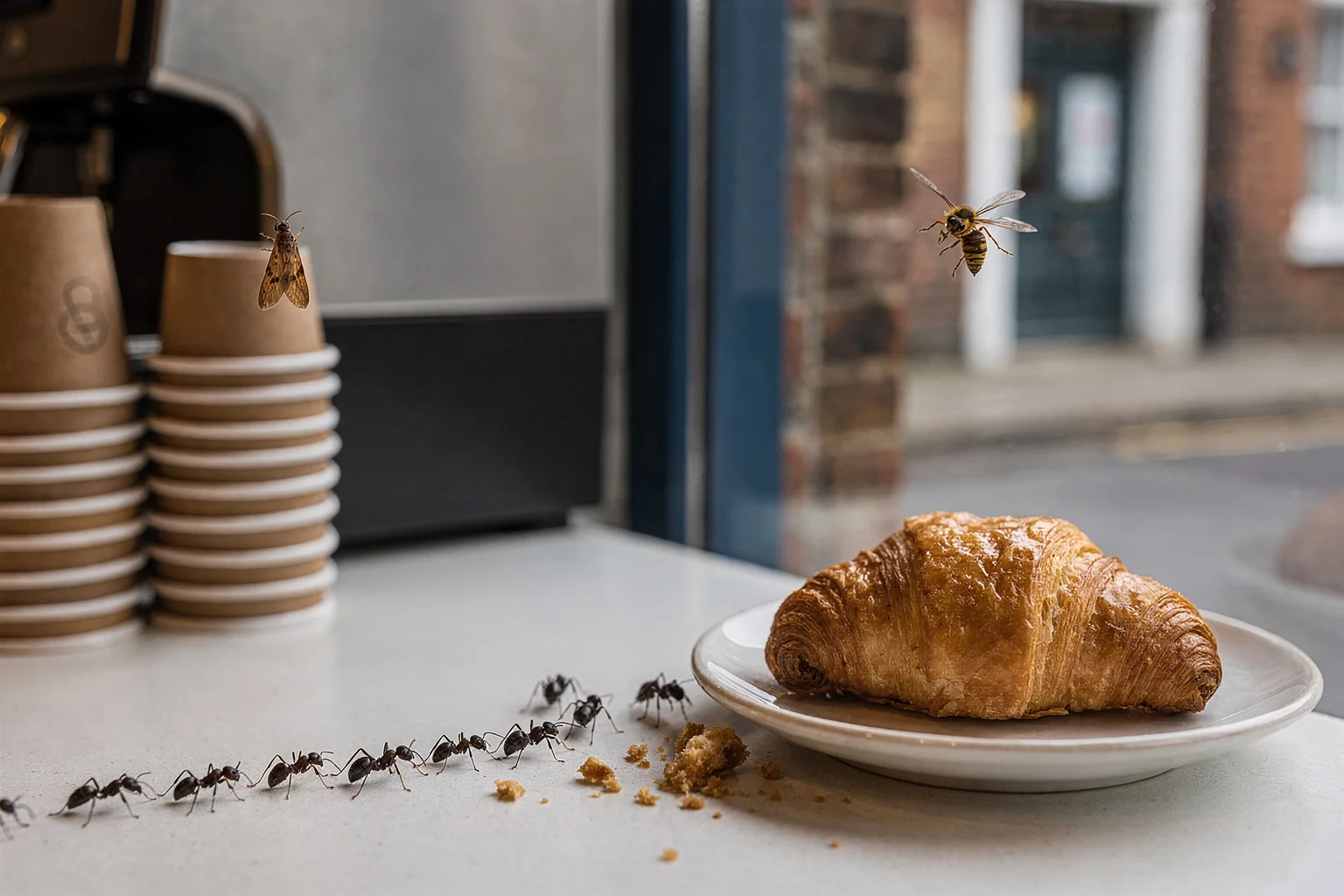
April brings a sharp shift in pest pressure across London and the South East. After months of relative quiet, three species in particular start moving into commercial premises with purpose: rats and mice seeking stable food sources, wasps building their first nests in sheltered voids, and ants establishing trails into kitchens, storerooms, and service corridors. The question business owners ask most often is simple — which pest arrives first, and how do I stop it before customers or inspectors notice?
The answer depends on your building type, your waste routines, and how well your premises survived the winter. This guide answers the practical questions we hear every spring, from early warning signs to the point where DIY ends and professional treatment becomes necessary.
Which pest shows up first in April — rats, wasps, or ants?
Rodents usually arrive first. Rats and mice have been active all winter, but their behaviour changes in April. Breeding cycles accelerate, daylight extends, and food waste from outdoor dining, construction sites, and park areas becomes easier to find. A business that seemed quiet in March can find droppings in the stockroom by mid-April.
Wasps follow closely behind. Queen wasps emerge from hibernation in April, often in the first warm week. They look for sheltered voids — loft spaces, wall cavities, roof soffits, and even extractor fan housings. A single queen can establish a nest that grows to 5,000 workers by late summer if left undisturbed.
Ants trail in third, but with volume. The common black garden ant (Lasius niger) sends out foraging workers as soil temperatures rise. In commercial kitchens and cafés, a single food source can anchor a trail that brings thousands of workers through gaps in pointing, under doors, and along pipe runs.
"As temperatures rise across the UK, Q2 brings a surge in pest activity that can seriously disrupt commercial operations."
Why do rats and mice suddenly appear inside in spring?
They were probably nearby all winter. Urban rats in London rarely travel far from their harbourage — typically 50 to 100 metres. During cold months they stay close to warmth and consistent food, often in sewers, bin stores, or under decking. Spring changes their calculus: more daylight means more foraging time, breeding pressure forces younger rats to disperse, and the sudden availability of food waste from reopened terraces and outdoor service areas pulls them toward buildings.
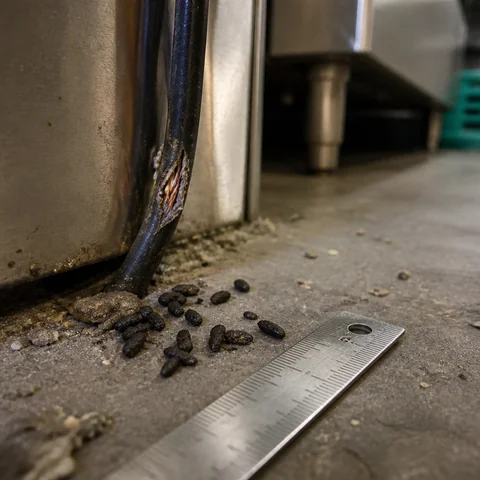
Mice behave differently. A house mouse needs only a 6mm gap to enter — roughly the width of a pencil. In spring, they move vertically through buildings more actively, following pipe runs and cable trays. A ground-floor café might see mice in the ceiling void above the kitchen, or in first-floor offices that seemed secure in winter.
The critical trigger is food accessibility. A restaurant with loose bin lids, a hotel with bird-feeding stations near the entrance, or an office with staff eating at desks creates predictable routes. Rats and mice remember these routes. Once established, the route becomes a habit.
What are the first signs to check for?
Look for these in sequence:
- Droppings — rat droppings are 12–18mm, spindle-shaped; mouse droppings are 3–8mm, rod-shaped. Fresh droppings are dark and soft; old ones turn grey and crumble
- Smear marks — dark grease along walls, pipes, and corners where rodents brush repeatedly
- Gnawing — on packaging, wiring, wood, and even soft metal; the marks are rough-edged, not clean-cut
- Footprints and tail drags — visible in dusty areas, especially near walls
If you see any of these, the pest is already inside. The question is how many, and how long they've had to establish.
When does a wasp nest become a business problem?
The moment a queen chooses your building. In April, queen wasps are solitary and vulnerable. They have no workers yet, no nest structure beyond the first few paper cells, and no defensive swarm. This is the cheapest point of intervention. A technician can remove a single queen and her starter nest in minutes.
By late May, that same nest may hold 100–200 workers. By July, 5,000. The wasps' defensive threshold drops as the colony grows. A nest near a loading bay, outdoor seating area, or staff breakout space becomes a liability issue — especially if anyone on site has a sting allergy.
Where do wasps nest in commercial buildings?
Common April locations include:
- Roof voids and eaves
- Wall cavities behind external cladding
- Extractor fan ducts and air bricks
- False ceilings in retail and hospitality spaces
- Sheds, bin stores, and outbuildings
The nest itself looks like grey paper — wood fibres chewed and mixed with saliva. Early nests are golf-ball sized. By June, they can fill a football.
Can I remove a wasp nest myself in April?
A single queen on a visible surface can sometimes be dealt with cautiously. But nests in voids, ducts, or cavities require professional access equipment and protective clothing. More importantly, misidentification is common. Solitary bees, honeybee swarms, and even hornets use similar spaces. The British Pest Control Association notes that correct identification determines both the treatment and the legal protections that may apply, particularly for bee species.
If you find a nest in April, photograph it from a safe distance and call for identification. Early removal costs a fraction of late-summer treatment, and the disruption to your operation is minimal.
Why do ants form trails into my kitchen every spring?
Ant colonies overwinter underground. In April, as soil temperatures reach 10–12°C consistently, worker ants begin foraging. Their targets are predictable: sugary residues, protein traces, and water. A commercial kitchen with poor cleaning behind equipment, a staff room with unwashed mugs, or a storeroom with damaged packaging provides everything a colony needs.
The trail you see is not random. Ants lay pheromone trails that other workers follow precisely. Killing the visible workers with spray breaks the trail temporarily, but the colony simply sends more. The nest — which may be under paving, in a wall cavity, or beneath the foundation — remains untouched.
What's the difference between garden ants and Pharaoh ants?
This distinction matters for treatment. The common black garden ant (Lasius niger) is the species most businesses see in April. They enter from outside, follow predictable routes, and respond well to baiting and barrier treatments.
Pharaoh ants (Monomorium phararaonis) are different. They are smaller, yellowish, and establish nests inside buildings — in wall voids, under floors, inside equipment. They are common in hospitals, care homes, and food manufacturing. Crucially, they scatter when disturbed, a behaviour called "budding" that can create multiple new nests from one colony. Standard sprays make Pharaoh ant problems worse.
If your ants are tiny, pale, and appear in multiple locations without a clear outdoor trail, assume Pharaoh ants and call a professional. Identification determines whether baiting, insect growth regulators, or targeted residual treatments are appropriate.
What attracts all three pests to the same building?
Three factors overlap: structure, waste management, and neighbouring land use.
Structure matters because pests need access. A Victorian building with original air bricks, a modern unit with poorly sealed service penetrations, or any premises with uncapped drains offers entry points. Rats swim well — they can enter through damaged sewer lines and emerge in basements or under sinks. Mice climb. Wasps fly. Ants squeeze through gaps invisible to casual inspection.
Waste management is the second factor. Overflowing bins, loose lids, early morning bagged waste left overnight, and grease accumulation in drain gullies all signal food availability. The Food Standards Agency's guidance for caterers emphasises that bins with close-fitting lids, regular cleaning, and tidy external areas are basic but essential defences.
Neighbouring land use is harder to control. A construction site with disturbed earth and temporary bin storage, a park with bird feeding, or a neighbouring business with poor waste practices can all source pests that then investigate your building. You cannot control the neighbour, but you can control how attractive and accessible your own premises are by comparison.
How do I know if my April pest issue is a one-off or an established problem?
Frequency and location of evidence tell the story.
A single mouse dropping in a storeroom that backs onto a garden might indicate a recent exploratory visit. Fresh droppings on three consecutive days, in multiple locations, or near food preparation areas suggest established activity. The same principle applies to ants: a few workers on one day is weather-related exploration; a consistent trail for a week means the colony has mapped your building as a resource.
For wasps, the timeline is clearer. One or two queen wasps in early April, killed or removed, ends the risk for that year from that individual. A nest visible in May means the queen survived and bred successfully. By June, the colony is committed for the season.
What records should I keep?
A simple dated log helps enormously: location of evidence, type, quantity, and any action taken. This serves three purposes. It reveals patterns — the same corner every Tuesday, which might correlate with bin collection day. It supports any food safety inspection by showing due diligence. And it gives a professional technician accurate history to work from, reducing diagnosis time and cost.
When does DIY pest control stop being enough for a business?
The threshold is lower than many owners assume. For a domestic property, DIY has more latitude. For a commercial premises — especially food service, hospitality, or healthcare — the regulatory and reputational risks change the calculation.
Consider professional intervention when:
- Evidence appears in food preparation, storage, or service areas
- Customers or staff could see pests or evidence
- You operate under a food safety management system that requires documented pest control
- The pest is inside building voids, ducts, or other inaccessible spaces
- You have tried DIY measures and evidence persists beyond 7–10 days
- The species might be protected or require specialist identification (bees, certain birds)
The Food Standards Agency's safer food guidance notes that employing a pest control contractor is one valid option, particularly where persistent problems exist or where staff lack training in pest recognition.
What does a professional spring treatment involve?
For rodents, a technician surveys the building perimeter, identifies entry points, places tamper-resistant bait stations or traps in secure locations, and recommends proofing measures. Follow-up visits check activity and adjust placement.
For wasps, early-season treatment targets the queen and starter nest directly. Later in the season, the nest is located and treated with insecticide, then removed if accessible.
For ants, treatment depends on species. Garden ants typically receive baiting along trails plus barrier treatment at entry points. Pharaoh ants require more complex baiting programmes with insect growth regulators to prevent colony budding.
In all cases, a professional should provide a report suitable for food safety records, with treatment details, risk assessments, and recommendations for prevention.
What proofing measures actually work in spring?
Proofing is the permanent solution that treatment alone cannot provide. For each pest:
Rodents: seal gaps over 6mm with rodent-proof materials — wire mesh, concrete, or metal flashing, not foam or plastic that gnaws through. Fit bristle strips to door bases. Check and repair drain covers and sewer connections. Remove climbing aids like overhanging vegetation and unsecured pipework.
Wasps: seal eaves, soffits, and vents with fine mesh. Ensure extractor fans have backdraught shutters. Check annually before April, as winter weather degrades seals.
Ants: seal cracks in external pointing and around pipe entries. Maintain door seals and window frames. Reduce ground-level vegetation touching walls. Fix leaks — ants need water as much as food.
These measures cost more upfront than a single treatment, but they reduce repeat callouts and protect against the reputational damage of a visible pest during trading hours.
How does spring pest pressure vary across London boroughs?
Local geography and land use create distinct patterns. Inner London boroughs with dense Victorian housing stock — Hackney, Islington, Tower Hamlets — see high rodent pressure from interconnected sewer systems and abundant food waste from hospitality density. Newham and Barking and Dagenham, with more industrial and riverside land, experience rat movement from derelict sites into commercial units as development disturbs harbourage.
Greenwich and Lewisham, with parkland and river frontage, see significant wasp activity from nesting sites in trees and buildings near open space. Ant pressure is fairly uniform but peaks in areas with garden-backed commercial premises — think cafés with rear yards, pubs with beer gardens, or retail with delivery bays opening onto planted areas.
For businesses in East London and Essex, the combination of older building stock, high hospitality density, and ongoing development makes April a critical month for preventive inspection.
What should I ask a pest control technician before booking?
These questions separate competent operators from the rest:
- Are you NPTA registered or BASIS PROMPT certified? These are the recognised UK credentials for pest management professionals.
- Do you carry RSPH Level 2 or equivalent? This covers safe use of biocides.
- Will you provide a written report for my food safety records?
- What is your response time for commercial premises? Same-day or next-day matters in spring when colonies grow fast.
- Do you charge a call-out fee, or is the inspection costed toward treatment?
- What follow-up is included? Rodent treatments often need two or three visits; wasp treatments should include nest removal where accessible.
A technician who cannot answer clearly on credentials and documentation may not meet the standards that food safety inspections expect.
Can I prevent all three spring pests with one action plan?
No single action prevents every pest, but a spring inspection protocol catches all three early. Schedule this for late March or early April:
- Walk the building perimeter. Check drains, vents, door seals, and waste storage. Note any new gaps, damage, or vegetation growth.
- Inspect internally for evidence — droppings, gnawing, insect wings, or nesting material. Pay attention to ceiling voids, under sinks, behind equipment, and in seldom-used storerooms.
- Review waste routines. Are bins sealed? Is grease waste managed? Is there overnight bagged waste?
- Check previous treatment records. Did last year's wasp nest location get sealed? Was the ant entry point proofed?
- Book a professional survey if any evidence is found, or if your premises operate under food safety regulations requiring documented pest control.
This protocol takes an hour for a small premises, half a day for a larger site. The cost of prevention is always lower than the cost of a failed environmental health inspection, a customer complaint, or a social media post showing a pest on your premises.
Questions business owners ask when spring pests first appear
Do I need to close my business if I find a rat?
Not automatically, but you must assess the risk to food safety. If the rat has accessed food storage or preparation areas, you may need to close temporarily for cleaning, treatment, and inspection. Document everything. The Food Standards Agency's guidance on safer food better business caterers sets out the decision framework.
Are wasp stings really a legal risk for employers?
Yes, if you knew or should have known about a nest and failed to act. Employers have a duty of care to provide a safe workplace. A nest near a staff entrance, outdoor seating, or delivery area that results in stings can lead to personal injury claims and HSE interest.
Why do ants disappear some days and return others?
Ant foraging responds to temperature, humidity, and colony needs. Cool or wet days reduce activity. It does not mean the colony has gone. Consistent baiting and barrier treatment are needed to eliminate the nest, not just the visible workers.
How quickly can a spring pest problem become serious?
Rodents: a pair of rats can produce 2,000 descendants in a year under ideal conditions. Wasps: a single queen in April becomes a colony of thousands by July. Ants: a garden ant colony can number 10,000 workers, with multiple nests linked across a site. The common factor is exponential growth from a small April starting point.
What does East London pest control cost in 2026 for spring treatments?
Costs vary by pest, premises size, and access difficulty. A single wasp nest removal in April is typically at the lower end of the range. Rodent treatments requiring multiple visits and proofing work cost more. Ant treatments fall between, with Pharaoh ant programmes at the higher end due to complexity. Transparent pricing with no call-out charge helps businesses budget accurately.
What happens if I ignore early spring signs?
The pests do not resolve themselves. Rats and mice breed continuously. Wasps build colonies that become more defensive and harder to treat. Ant colonies expand and establish satellite nests. Meanwhile, the evidence accumulates — droppings, damage, smells, and the increasing probability that a customer, inspector, or staff member will notice.
For food businesses, the City of London's pest control guidance makes clear that owners and occupiers of commercial premises are responsible for dealing with pest problems. Environmental health officers can require action, issue improvement notices, or in serious cases prohibit trading.
The cost of delayed action is never just the treatment bill. It is the lost revenue from closure, the reputational damage from online reviews, and the staff time diverted to managing a problem that a March inspection could have prevented.
How do I choose between pest control companies for a spring emergency?
Look for local knowledge, proper accreditation, and clear documentation. An operator who knows East London's building types, sewer layouts, and seasonal patterns will diagnose faster than one routing calls through a national call centre. Finding a reliable pest controller in Havering or any neighbouring borough means checking credentials first, then response time, then transparency on follow-up and guarantees.
Ask specifically about their experience with commercial premises like yours. A technician who treats mostly domestic properties may not understand the documentation requirements of a food safety audit, or the operational constraints of a 24-hour hospitality business.
If you are seeing droppings, trails, or nesting activity this April, the time to act is before the colony establishes or the litter breeds. A same-day inspection identifies the species, locates the access point, and sets out a treatment and proofing plan that protects your business through the season.

Need professional help? BuzzKill offers fast, reliable pest control services across London and Essex.