
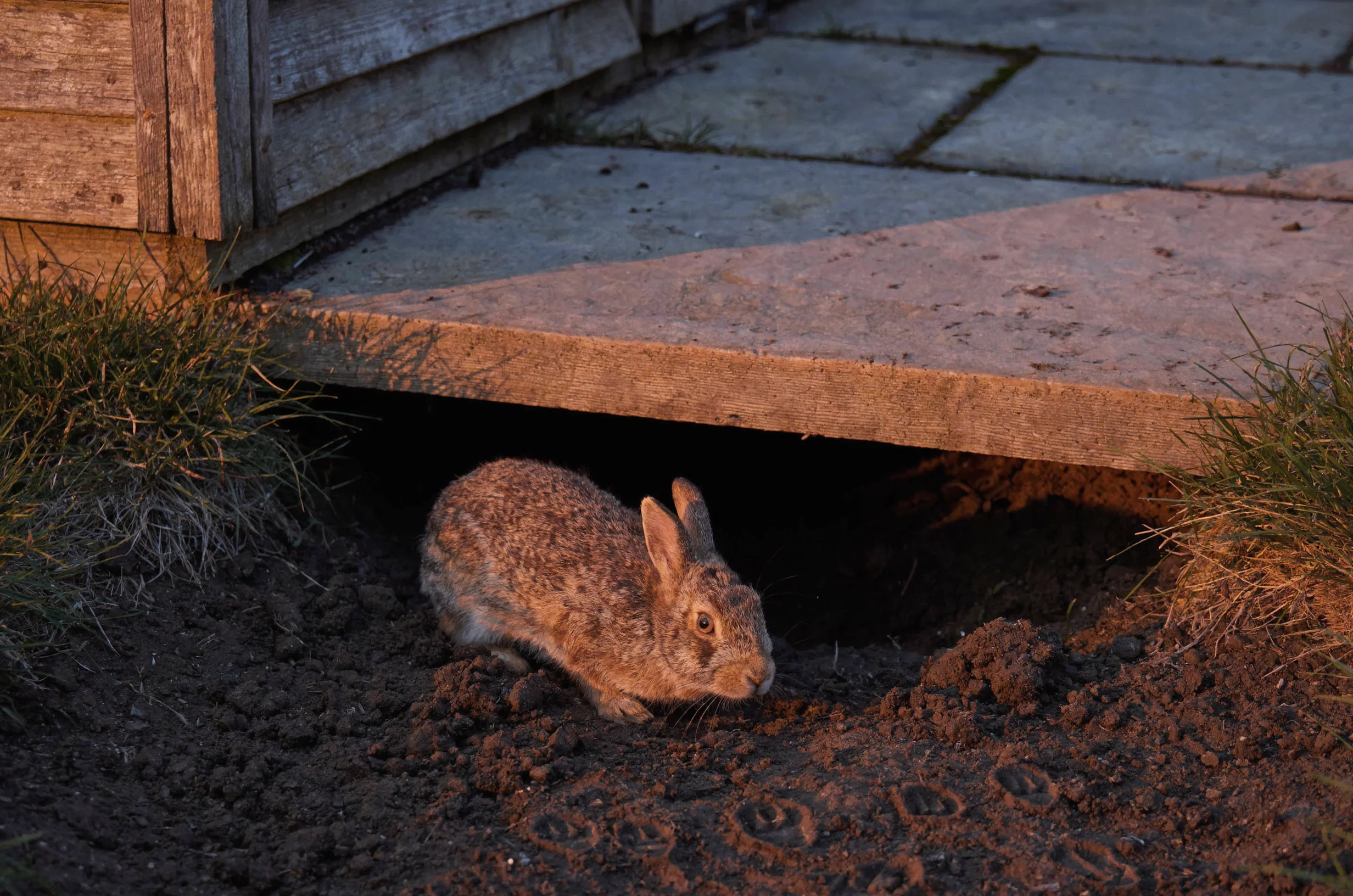
Finding rabbits burrowing under sheds and patios can leave you wondering whether to fill the hole, fit mesh or lift the paving. Start by checking what is using the space and whether animals are still inside. A permanent barrier belongs around an empty area. Blocking an occupied entrance can trap animals beneath the structure.
I’d choose between the six options below by looking at access, ground condition, animal welfare and maintenance. Buried mesh, an outward-facing mesh skirt and a sound hard perimeter address the physical route beneath a shed. One-way gates are a possible exclusion stage, scent products are temporary supporting measures, and professional proofing brings inspection and installation together.
Those differences matter: the six options do different jobs, and none should carry a blanket promise of success. Costs are compared qualitatively because perimeter length, access and repairs can change the bill considerably.
Check the burrow before changing the shed perimeter
The right shed barrier depends on identifying the animal and understanding where the opening leads. A hole beside a building is a reason to investigate, rather than proof that rabbits are responsible.
Match the signs to the animal
Look from outside the opening. Round pellets, clipped low-growing plants and a rabbit seen entering the same hole can support identification. One sign alone may be misleading.
Photograph the entrance, nearby soil and the whole shed edge. Record where you have seen animals enter or leave. A short video from a safe position can help clarify an uncertain sighting without disturbing the opening.
Walk around every accessible side of the shed. Check the rear fence line, corners and the junction with any patio. In a narrow London garden, the visible entrance may be on one side while the only practical installation access is on another.
Also note loose slabs, exposed shed supports and soil that appears to have washed away. These observations help separate an access problem from a repair problem. Avoid standing on paving that rocks or has an exposed void beneath it.
Keep active entrances open
Seeing a rabbit leave does not establish that the space is empty. Other animals or dependent young may remain out of view.
Do not probe the tunnel, push materials into it or attempt to flush animals out with water, smoke or chemicals. Keep children and pets away from the opening while you work out what is happening.
Where occupancy remains uncertain, arrange an assessment before exclusion or sealing. An inactive-looking entrance is also insufficient evidence on its own; confirmation should reflect the whole site.
Before any digging, identify buried services and assess whether excavation could disturb shed supports or paving. If the proposed trench runs beside an unstable base, stop and get appropriate advice before removing more soil.
Two mesh barriers for an empty shed base
Mesh can protect the gap beneath a shed while allowing air through, provided the installation closes the actual access route. The choice between buried mesh and an outward-facing skirt usually comes down to the ground and the available working space.
1. Buried galvanised mesh where a trench is practical
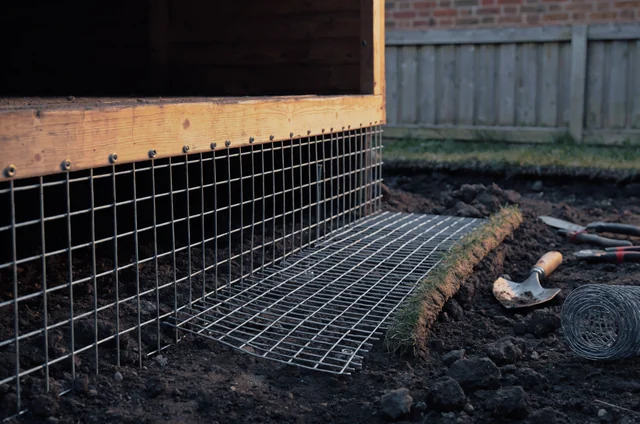
Buried mesh suits an empty shed base with accessible soil around its perimeter. Galvanised mesh is steel mesh with a zinc coating intended to resist corrosion.
Its reason for inclusion is straightforward: a continuous sheet places a physical obstruction across the route beneath the shed edge. That protection depends on the finished installation, including corners, joins and attachments.
Material cost is only part of the expense. Digging, clearing obstructions, fixing the upper edge and restoring the surface can take more effort than expected. DIY difficulty rises sharply where the shed backs onto a fence or sits among established roots.
The specification should explain the mesh openings, wire strength, fixing method and below-ground detail. Avoid choosing material simply because its packaging includes a picture of a rabbit. The rabbit-proof fencing guide provides further context for choosing mesh and planning its position.
A buried barrier can remain useful while its mesh, fixings and surrounding ground stay intact. Check accessible attachments and investigate any fresh digging beside the perimeter.
It tends to fail where a section is missing, a join opens or an animal can go around an unfinished end. A neat front edge achieves little if the rear gap remains accessible.
I’d choose buried mesh where the ground permits a continuous installation without disturbing the structure. Confirm the full route before buying the roll, including the difficult corner behind the shed.
2. L-shaped mesh skirting where surface access is better
An L-shaped skirt has a vertical section beside the shed and a horizontal section extending outwards across the ground. That horizontal section is often called an apron.
This arrangement deserves consideration where a deep trench is awkward but the ground beside the shed is accessible. The apron places mesh in the area where an animal approaching the edge would start digging.
DIY difficulty is generally more manageable on clear, reasonably level ground. Roots, steps and uneven surfaces complicate the work because they make close contact and secure fixing harder.
Budget for fixings, joins and finishing the surface as well as the mesh itself. An apron that needs substantial ground preparation may lose its apparent cost advantage.
Durability depends on keeping it secured and protected from damage. Loose edges can lift, exposed wire can catch feet, and garden work can disturb attachments. Finish the installation so people and pets cannot contact sharp cut ends.
Its main limitation is space. An apron may be impractical beside a narrow path, against a neighbouring boundary or across a route needed for maintenance.
I’d favour this option for an empty raised shed with usable ground around it. Ask for a drawing showing which way the apron extends and how each corner will close before installation begins.
Hard edges where a shed meets a patio
A hard perimeter can address exposed soil beside a shed or patio, but loose decorative material and a properly constructed edge perform different jobs.
3. A continuous paved or concrete perimeter
This option fits properties where damaged edging already needs repair, or where landscaping work gives access to the shed boundary. The aim is to remove an accessible strip of digging ground with a continuous, sound construction.
Its value comes from continuity and support. A small patch over the visible hole leaves other routes available and may conceal a void that still needs assessment.
Costs can be higher than a straightforward mesh installation because the work may involve excavation, suitable support beneath the paving, materials and reinstatement. DIY difficulty also increases where levels, drainage or existing structures need attention.
A sound hard edge may require little routine attention, but its condition still matters. Open joints, loose edges and disturbed ground can create fresh access points.
Before choosing concrete, consider how water will drain and how the shed will retain necessary ventilation. Do not pour material into an active tunnel or use it to hide an unexplained hollow.
Although it focuses on rats, the guide to burrowing beneath concrete slabs explains why the ground supporting the surface matters.
I’d choose a hard perimeter when it forms part of a properly assessed repair. Where the patio is already moving, establish the cause before covering the edge.
Why gravel needs a different expectation
Loose gravel is easier to move and replace than concrete or paving. That can make it useful as a surface finish, including over a suitable barrier design.
It should not be treated as an equivalent substitute. A decorative gravel strip does not establish that the route below it is closed.
The same caution applies to placing a few bricks beside the opening. Weight on the surface cannot confirm what is happening beneath it.
If a quotation includes gravel, ask which part of the construction provides exclusion. Keep the surface finish and the barrier detail separate in the specification.
Getting rabbits out without trapping them
An occupied space beneath a shed needs an animal-management decision before permanent proofing. Gates and scent deterrents belong in this discussion because they are often considered alongside barriers, though their limitations are substantial.
4. One-way exclusion gates with professional oversight
A one-way exclusion gate is intended to let an animal leave through a controlled opening while preventing its return. It is a possible stage in an exclusion plan, rather than a permanent replacement for a secure perimeter.
The apparent simplicity can be misleading. Someone must establish the animal involved, assess occupancy and decide whether exclusion is appropriate. Dependent young are a particular reason to pause.
I would not recommend buying a gate and fitting it over the first visible hole. An unseen entrance can defeat the plan, while an unsuitable installation can create welfare problems.
Cost includes more than hardware. Assessment, fitting, monitoring and the eventual permanent closure all belong in the budget. DIY difficulty is high because the decision about suitability matters as much as attaching the device.
Its useful life is tied to the exclusion task. Leaving a temporary device indefinitely creates another component that can become obstructed, damaged or poorly fitted.
Failure can occur if the animal uses another opening, the gate does not operate properly or occupancy has been misunderstood. A quiet-looking entrance does not resolve those questions.
I’d reserve this option for a competent professional who can explain why it fits the site. Agree who will monitor it, what would stop the process and who will complete the permanent proofing afterwards.
5. Scent deterrents as limited supporting measures
Scent products appeal when digging is new and a homeowner wants a quick, inexpensive response. Their place in this roundup is limited: they may be considered as supporting measures while the access problem is assessed.
They do not physically close a gap. Without product-specific evidence, I would not describe a scent as dependable protection for an established burrow.
The initial purchase may cost less than construction work, but repeated applications add expense and effort. Any claimed duration should come from the particular product’s instructions rather than a general estimate.
Applying a product may look like easy DIY. Safe use still requires reading the label, checking the permitted location and following directions around children, pets and edible plants.
Avoid improvised chemical mixtures or strong household substances around burrow entrances. These introduce risks without establishing that the shed is protected.
The practical failure is often delayed action: the product is applied repeatedly while the physical route remains open. Treat fresh digging as a reason to reassess the plan.
I’d put a limited budget towards identification and a suitable barrier first. If a deterrent is used, keep an inspection routine and follow its label exactly.
When a shed needs a professional proofing plan
Professional input becomes more useful when rabbit activity, difficult access and building condition overlap. The extra value should be a clear plan that resolves those uncertainties.
6. Survey-led proofing for awkward or recurring burrows
This option fits a shed with inaccessible rear edges, repeated digging after repairs, uncertain occupancy or paving that needs assessment.
A survey should identify the likely animal, map accessible openings and explain which areas could not be inspected. The proposed work should then connect those findings to an exclusion and repair sequence.
Costs depend on the job. A short accessible edge and a partly dismantled patio are different projects, so a general price comparison can mislead. Ask for an itemised scope before comparing quotations.
The homeowner’s DIY burden is lower, but choosing a service still requires questions. Establish whether the work includes animal assessment, barrier installation, surface repairs and follow-up checks.
Professional proofing can fail when the agreed scope leaves an access route unfinished. It can also disappoint when the homeowner expects paving repairs but the quotation covers mesh alone.
BuzzKill Pest Control is one local inspection option for London homeowners. Confirm whether rabbit assessment and the required proofing work are within scope before arranging a visit.
I’d choose this route when uncertainty could lead to trapped animals or unnecessary excavation. Ask for a written explanation of what will be inspected, closed, repaired and checked afterwards.
Make the proposed barrier visible on paper
A useful quotation should include a simple sketch of the shed, patio edge and proposed barrier. Mark inaccessible areas and any work that depends on first confirming the space is empty.
A useful online barrier selector would ask about occupancy, soil access, narrow boundaries and loose paving, then suggest a suitable inspection or barrier route. It should stop short of declaring a burrow empty.
Keep the plan with dated photographs so later digging can be compared with the completed work.
Questions about burrows, repairs and repeat digging
The remaining decisions usually concern timing: when to fill an opening, when to repair the surface and what to change if rabbits return.
Can I fill the hole after seeing a rabbit leave?
A single departure is insufficient evidence that the space is empty. Avoid filling or sealing until occupancy has been properly assessed.
Once the area is confirmed clear, closure and any necessary ground repair should follow an agreed plan. Loose material pushed into the entrance does not address every possible access route.
If you cannot see where the opening leads, leave it undisturbed and seek an assessment.
Does a hole mean the patio is structurally damaged?
A visible hole cannot establish the extent of damage. The condition of the paving and the support beneath it need separate consideration.
Rocking slabs, exposed hollows or movement beside a shed support justify keeping people away from that spot until it is assessed. Avoid lifting heavy slabs yourself beside an uncertain void.
Photograph the affected area from a safe position and identify it clearly for whoever inspects the property.
What should I do if a rabbit looks unwell?
Pause proofing around the animal and keep children and pets back. Contact a wildlife rescue or veterinary professional for advice about the individual rabbit.
The guide to rabbits with myxomatosis provides relevant background, but appearance alone cannot confirm a diagnosis.
Avoid attempting to move or handle the rabbit without appropriate advice.
Why does digging return beside a new barrier?
Check the completed perimeter against the original plan. Fresh digging may be beside an unfinished end, an open join or a section disturbed during later garden work.
It may also show that the original assessment missed another route. Photograph the new activity before changing the installation, and keep occupied entrances open.
Where a contractor completed the work, provide the photographs and ask them to compare the activity with the agreed scope.
Which option suits my garden?
For a confirmed empty shed surrounded by accessible soil, I’d compare buried mesh with an L-shaped apron first. Choose according to where a continuous installation is practical.
Where paving already needs repair, consider a properly constructed hard edge as part of that work. Occupancy uncertainty, inaccessible boundaries or moving slabs favour a professional assessment before construction.
The overlooked alternative is exclusion at the wider garden boundary. If rabbits are visiting to feed and there is no occupied burrow beneath the shed, a planned boundary fence may address access earlier. Its suitability depends on gates, neighbouring boundaries and other openings.
Sketch both routes before committing: the shed perimeter and the garden boundary. Mark every opening and the space needed to install and maintain the barrier.

Need professional help? BuzzKill offers fast, reliable pest control services across London and Essex.