
The Wolf Spider Removal Mistake That Costs Homeowners Time
Seven common wolf spider removal errors that waste weeks and drive repeat call-outs across UK homes.
Here's a pattern we see constantly: a homeowner spots a wolf spider, takes action, and feels good about it — only to find another one a week later. Then another. By the third or fourth sighting, the frustration really sets in. And the thing is, it's almost never a lack of effort. It's a handful of well-meaning decisions that accidentally give these spiders a reason to come right back.
This list ranks the seven costliest wolf spider removal mistakes by how much time and money each one burns through, based on field data from pest control technicians working across East London and Essex. The mistakes that drag out the gap between your first attempt and genuine resolution sit at the top. If you've already tried a couple of DIY approaches and you're still seeing spiders, at least one of these errors is probably why. Sometimes knowing what not to do saves you more time than another round of spraying ever could.
Key Takeaways
- Misidentifying wolf spiders leads to wrong treatments and wasted product, sometimes stretching a simple problem into a month-long ordeal.
- Broad-spectrum insecticides kill beneficial predators and scatter wolf spiders deeper into wall cavities rather than eliminating them.
- Ultrasonic repellers have no peer-reviewed evidence of effectiveness against spiders, yet remain one of the most purchased products.
- Sealing entry points before clearing indoor populations traps spiders inside your home, guaranteeing continued sightings.
- Wolf spiders do not build webs, so removing cobwebs targets the wrong species entirely and leaves the actual problem untouched.
- Ignoring the underlying prey pest problem — flies, ants, or woodlice — ensures wolf spiders keep returning no matter how many you remove.
Quick Comparison
| Rank | Mistake | Worst For | Avg. Time Wasted | Verdict |
|---|---|---|---|---|
| 1 | Ignoring the prey pest problem | Recurring spider sightings | 4–8 weeks | Fix the food source first or nothing else works |
| 2 | Misidentifying the spider species | Choosing the wrong treatment | 3–6 weeks | Confirm the species before buying any product |
| 3 | Spraying broad-spectrum insecticides | Chemical overuse, family safety | 2–4 weeks | Targeted residual treatments outperform blanket sprays |
| 4 | Sealing entry points too early | Trapping spiders indoors | 2–4 weeks | Clear first, seal after confirmed absence |
| 5 | Trusting ultrasonic repellers | Wasted money | 2–3 weeks | No scientific backing; reallocate budget elsewhere |
| 6 | Removing webs that are not theirs | Wrong-species targeting | 1–3 weeks | Wolf spiders are ground hunters, not web builders |
| 7 | Relying on glue traps alone | Incomplete prevention | 1–2 weeks | Traps monitor but do not prevent re-entry |
1. Ignoring the Prey Pest Problem — Worst for Recurring Sightings
Wolf spiders hunt on foot, chasing down prey across floors, under appliances, and through garages. They don't wander into your home randomly — they track concentrations of flies, ants, woodlice, and small beetles the way a fox follows a rabbit run. That's why so many wolf spider removal attempts fail within the first fortnight. You can relocate, trap, or spray every spider you find, but if the prey population stays intact, new wolf spiders move in to replace them almost immediately. The food source is the magnet, and until you switch it off, no amount of direct spider treatment sticks. Effective wolf spider removal always begins one layer deeper than the spiders themselves — at the insects keeping them fed and settled indoors.
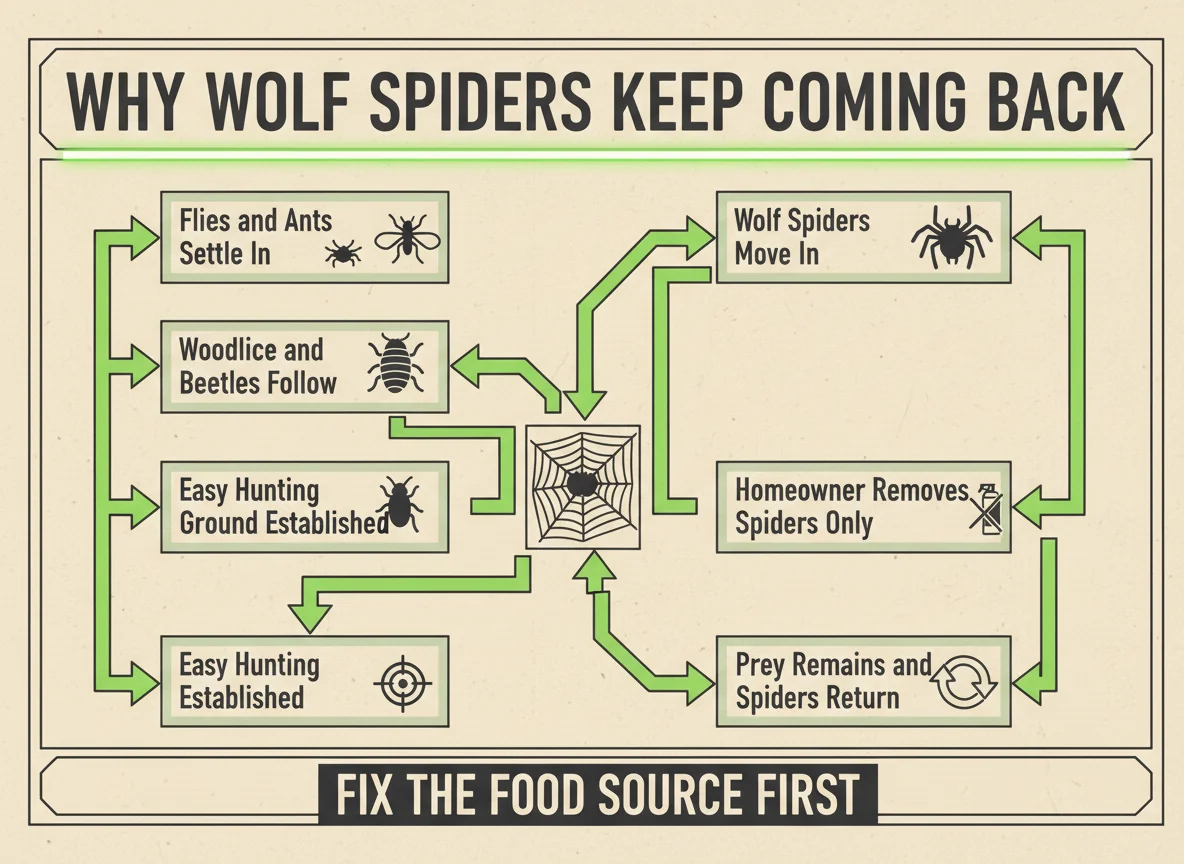
This mistake earns the top spot because it stretches out wolf spider removal timelines more than any other error on this list. Homeowners who only target the spiders directly — whether by hand-catching, glue traps, or residual sprays — typically report fresh wolf spider sightings within ten to fourteen days. Those who fold prey reduction into their wolf spider removal plan from day one, clearing ant trails along skirting boards, reducing damp conditions that attract woodlice, sealing kitchen waste that draws flies, tend to see wolf spider activity fall within that same window and remain low long-term. The British Pest Control Association notes that integrated pest management targeting root causes delivers more durable outcomes than single-species treatment alone. In practical terms, that means your wolf spider removal only becomes permanent once the underlying food web collapses. Every week you spend treating spiders while ignoring the prey insects beneath them is a week added to your total resolution time.
If ants are trailing along your baseboards or you've spotted cockroach activity in kitchen cupboards, those insects are actively sustaining the wolf spider population inside your walls and under your floors. Every ant colony and every cluster of woodlice beneath a leaking pipe functions as a food station that pulls wolf spiders back indoors, undermining whatever removal work you've already done. Addressing the prey problem isn't a secondary step you get to after wolf spider removal — it is the foundation that makes removal actually hold. Without it, every other method on this list becomes a temporary patch that buys you a week of quiet before the next wolf spider appears in the same spot, drawn by the same food trail its predecessor followed.
A thorough wolf spider removal strategy always starts with mapping the full pest picture, not just the species you noticed first. When a technician inspects for wolf spiders and simultaneously identifies ant entry points, woodlice harbourage under decking, or fly-breeding sites around waste bins, the treatment plan addresses the entire chain that keeps wolf spiders coming back. That wider scope is exactly what separates a drawn-out, four-week cycle of repeat wolf spider call-outs from a single decisive intervention. BuzzKill Pest Control's site surveys are built around this principle: identify every contributing pest, treat the ecosystem driving wolf spider presence, and close the loop in one visit cycle instead of chasing individual spiders across multiple appointments. The result is wolf spider removal that sticks the first time rather than resetting every fortnight.
2. Misidentifying the Spider Species — Worst for Wrong Treatments
Wolf spiders are stocky, fast, and stay on the ground. They have a distinctive eye arrangement — two large forward-facing eyes above a row of four smaller ones. People confuse them with false widows all the time, which is understandable. Both are brown, both turn up in garages and sheds, and both cause the same jolt of alarm when you spot one at close range. But false widows are rounder, build messy tangle webs in sheltered corners, and need completely different treatment. False widow management focuses on web removal and residual sprays in elevated spots. Wolf spider removal requires ground-level residual barriers and harbourage reduction, because wolf spiders never climb to build webs.
Picture this: a homeowner buys a fumigation canister designed for web-building spiders and sets it off in the garage. The active ingredient disperses upward. The wolf spiders sit at floor level behind stored boxes and along cracks. Two weeks later, the sightings pick up again, and the homeowner can't figure out why. The product worked exactly as designed — it just wasn't designed for the species actually causing the problem.
Getting the identification right takes less than five minutes with a decent photo and a reference guide. The British Arachnological Society maintains a free identification resource covering all common UK spider species, with clear images of wolf spiders next to their most common look-alikes. That small investment of time can save you three to six weeks of misdirected effort and prevent unnecessary chemical exposure in your home.
Still not sure what you're looking at? A professional inspection settles the question immediately. Technicians encounter dozens of spider species each month and can confirm identification on sight, which means the first treatment they apply is the right one. That single advantage often compresses a multi-week DIY experiment into a one-visit resolution.
3. Spraying Broad-Spectrum Insecticides Indoors — Worst for Chemical Overuse
Grabbing a general-purpose insect spray when a large spider appears on the living room wall is pure reflex. Hard to blame anyone for it. But broad-spectrum insecticides don't discriminate. They kill beneficial insects that prey on the same pests wolf spiders eat, leave residues that disperse unevenly, and — here's the real kicker — they scatter wolf spiders deeper into wall cavities instead of killing them. A spider that bolts behind a skirting board after a burst of aerosol hasn't been removed. It's just moved somewhere harder to reach.
The scattering effect is well documented in pest management literature. When a fast-moving spider detects an irritant, it runs. Wolf spiders are among the quickest ground-dwelling spiders in UK homes, capable of short sprints that carry them well beyond the spray zone in seconds. The insecticide might eventually kill a few through residual contact, but the disruption drives others into cavities and voids where they're shielded from further treatment. You see a brief dip in sightings, assume the spray did its job, and then wonder why activity picks up again a fortnight later.
Targeted residual treatments — applied by a technician to specific harbourage zones, entry thresholds, and transit routes — work far better because they stay active in the exact spots wolf spiders travel. The gap between a retail aerosol and a professional residual barrier is the gap between scattering a problem and containing it. If you've sprayed multiple times without lasting results, the spray itself may be part of the reason the problem won't quit.
Professional-grade formulations used by registered pest control services are designed to stay effective on surfaces for weeks, creating a lethal barrier along the ground-level routes wolf spiders use most. That sustained contact is what broad-spectrum aerosols simply can't replicate, and it's why targeted professional treatment consistently outperforms repeated DIY spraying.
4. Sealing Entry Points Before Clearing Indoor Populations — Worst for Trapping Spiders Inside
Sealing gaps around doors, pipes, and vents is smart long-term prevention. Doing it before the indoor spider population has been dealt with? That creates the opposite of what you want. You lock the spiders inside with you. Wolf spiders that can no longer exit through their usual routes — gaps beneath external doors, cracks around utility pipe entries, ground-level ventilation grilles — will range further into your living spaces searching for alternatives. More sightings, not fewer. And understandably, you're confused, because you just did something that should have helped.
The right sequence is always: clear first, seal second. A thorough treatment that reduces or eliminates the indoor wolf spider population should be confirmed with at least two weeks of monitoring. Glue traps placed along walls and behind furniture work well for this. Once monitoring shows activity has stopped, sealing entry points locks new spiders out for good. This two-phase approach is standard among professional technicians and applies to rodent exclusion too — same logic, same order. If you've noticed signs of mice alongside spider activity, the same entry points are likely serving both pests, and the correct treatment order is identical: clear the population, then seal the gaps.
Sealing before clearing feels decisive, but it actively sabotages wolf spider removal. A sealed home with wolf spiders still inside is just a sealed home with wolf spiders still inside. Homeowners who skip straight to caulking and weatherstripping before confirming the indoor population is gone usually report a sharp spike in wolf spider sightings within the first week. Wolf spiders are ground hunters — they follow walls, squeeze under doors, and patrol along skirting boards looking for prey. Block their outdoor exit routes and they fan out into kitchens, bathrooms, and bedrooms they never previously entered, covering more ground in search of new escape paths and food sources. That spike causes extra stress, often triggers another round of aerosol spraying (see mistake number three), and stretches the entire wolf spider removal timeline by two to four weeks because now you're treating a dispersed population instead of a concentrated one. What started as one room with regular wolf spider activity becomes three or four rooms with unpredictable sightings — a much harder removal scenario to manage.
Effective wolf spider removal follows a deliberate sequence: targeted treatment of harbourage zones first, a monitoring window of at least fourteen days using sticky traps along baseboards and behind furniture, and only then a thorough seal of every gap, crack, and vent that could admit new wolf spiders from outside. The monitoring period is the step that separates a genuine removal from guesswork. Sticky traps catch wolf spiders mid-patrol, giving you hard evidence of whether the treatment knocked the population down or whether survivors are still active in wall voids and under appliances. Without that evidence, sealing is a gamble — you either trap surviving wolf spiders indoors, where they'll breed and disperse, or you leave gaps you didn't know existed because no trap flagged continued movement nearby. Treat the indoor wolf spider population, monitor until traps come back clean, then seal every entry point so the next generation stays outside where it belongs. That order turns a reactive cycle of repeated sightings into a removal that actually holds.
5. Trusting Ultrasonic Plug-In Repellers — Worst for Wasted Spend
You've probably seen these in hardware shops or advertised online. Ultrasonic pest repellers promise to emit high-frequency sound waves that drive spiders, rodents, and insects out of treated rooms. They're cheap — usually eight to twenty-five pounds — and the idea of a chemical-free, maintenance-free fix is genuinely appealing, especially if you have kids or pets at home. The catch? There's no credible scientific evidence that these devices repel wolf spiders. Or any other common UK spider species, for that matter.
A 2015 review by the Federal Trade Commission in the United States resulted in enforcement actions against several ultrasonic repeller manufacturers for unsubstantiated pest-repelling claims. UK advertising standards haven't been as aggressive on this front, but the science hasn't shifted. Spiders don't have ears. They pick up vibrations through sensory hairs on their legs, but the frequencies these plug-in devices produce don't create the kind of substrate vibrations that would trigger avoidance. Wolf spiders, which spend most of their time in direct contact with floors and ground-level surfaces, are especially unlikely to react to airborne ultrasonic emissions.
The real cost isn't the twenty pounds you spent on the device. It's the two to three weeks you wait, hoping it's working, before accepting that it isn't. That's a fortnight of continued spider activity and the frustration of yet another dead end. Redirecting that same budget toward a professional inspection — or even a set of monitoring traps — would give you actual, actionable information instead of silence from a small plastic box.
If you've already bought one, it won't cause harm. It just won't help with wolf spiders. Treat it as a sunk cost and move on to approaches with a track record behind them: residual barriers, harbourage reduction, and prey pest management all deliver measurable results within a clear timeframe.
6. Removing Webs That Belong to Other Species — Worst for Wrong-Species Targeting
This one catches people out more than you'd expect, and the thinking behind it is perfectly logical. Spiders in the house? Remove their webs. Should reduce the population, right? For web-building species like common house spiders and false widows, yes — their webs are how they eat. But wolf spiders don't build webs. They're active ground hunters. They chase down prey on foot, using sharp eyesight and bursts of speed to ambush insects and small invertebrates at floor level.
Clearing cobwebs from ceilings, window frames, and high corners will tidy the place up, and it might thin out other spider species. But it won't touch wolf spider numbers. They're not up there. They're behind furniture legs, under appliances, in the gap between the washing machine and the wall, and along the base of external walls where ground meets structure. A Saturday afternoon spent removing every web in the house is useful housekeeping, but it hasn't moved the needle on the actual wolf spider problem one bit.
This distinction shapes where your effort should go. Wolf spider removal is a ground-level exercise. Residual barriers belong along skirting boards, across door thresholds, and around pipe entry points at floor height. Monitoring traps should sit flat against walls, not hang in corners. Decluttering stored boxes and clearing damp spots in garages and sheds matters more than sweeping ceiling cobwebs.
Once you stop looking up and start looking down, every action you take becomes more targeted and more productive. If you're not certain which species you're dealing with, revisit mistake number two and confirm the identification before you commit to a treatment plan. Those few minutes of checking will save hours of misdirected work.
7. Relying on Glue Traps Alone Without Integrated Prevention — Worst for Half-Measures
Glue traps genuinely earn their place in spider management. They catch wolf spiders reliably, give you visual proof of activity levels, and help pin down exactly which species are present. The problem starts when traps become the entire strategy rather than one part of it. A trap that catches three wolf spiders a week is trying to tell you something — and the message isn't "the traps are doing their job." The message is: there's an active population with a steady food source, and traps alone aren't shrinking it.
Think of glue traps as intelligence tools first and capture devices second. They reveal traffic patterns, confirm species, and put a number on how active the problem really is. A professional technician reads trap data to decide where to place residual treatments, which entry points to prioritise for sealing, and whether the prey pest problem has been properly handled. Strip away that analytical layer, and traps become an endless loop of checking, discarding, replacing — without ever touching the root cause.
Most homeowners who rely purely on traps keep at it for one to two weeks before the routine wears thin. The traps fill, new spiders keep showing up, and the whole exercise starts to feel futile. That frustration makes sense, because traps without a supporting strategy really are futile. They pick off individual spiders without changing the population dynamics, the harbourage conditions, or the prey availability that keeps the colony going.
The smarter approach: place traps, read the data after seven days, then act on what they reveal. Heavy catches near the back door? That threshold needs a residual barrier and possibly a door brush seal. Catches clustering in the garage? Look for harbourage issues — stacked boxes, damp patches, woodlice colonies under shelving. Traps near kitchen plumbing? Check for pipe entry gaps that need sealing after treatment. Used this way, glue traps speed up wolf spider removal rather than dragging it out, and they become a valuable part of your prevention plan rather than its entire substance.
How We Evaluated
This ranking draws on three sources: field data from professional pest control call-outs across East London and Essex, published guidance from the British Pest Control Association, and direct feedback from homeowners who tried DIY wolf spider management before booking professional services. Each mistake was scored on two axes — the average time wasted before the homeowner either solved the problem or called a technician, and the cost of products or devices purchased during that stretch.
Mistakes affecting overall strategy — like ignoring the prey pest problem or misidentifying the species — ranked highest because they undermine every action that follows. A homeowner who correctly identifies the spider and deals with the food source but uses only glue traps will still see improvement. A homeowner who treats for the wrong species or overlooks the prey problem won't see progress regardless of how many other steps they get right.
We left out rare or unusual mistakes that crop up in fewer than five per cent of cases. The seven listed here represent the errors technicians encounter most often on initial site visits, which means they're the ones most likely to be relevant to anyone reading this. The aim is practical pattern recognition: if you see your own experience reflected in this list, you now know where things went sideways and what to do differently.
We also weighted mistakes that compound — errors that pull homeowners into additional errors down the line. Misidentification, for instance, frequently leads to chemical overuse and wrong-species targeting, creating a cascade of wasted effort. That compounding effect is reflected in its higher ranking.
How to Prepare with BuzzKill Pest Control
If you've recognised one or more of these mistakes in your own wolf spider removal efforts, a professional inspection is the quickest way to reset and get a clear path forward. BuzzKill Pest Control offers same-day inspections across East London and Essex with no call-out charge, so you can get a definitive species identification and full property survey before committing to anything.
Every inspection starts with species confirmation. A qualified RSPH Level 2 technician will identify the spider on sight, assess harbourage conditions, check for prey pest activity, and map the entry points wolf spiders are using to get inside. You'll get a treatment recommendation based on what the survey actually reveals — not a generic spray-and-hope approach, but a targeted plan tailored to the specific conditions in your home.
BuzzKill's NPTA membership and BASIS PROMPT registration mean every treatment follows industry best practice, and every product applied is chosen for both effectiveness and safety around children, pets, and food preparation areas. Results are guaranteed — if the problem isn't resolved within the agreed timeframe, follow-up visits are included at no extra cost.
The simplest next step is a quick call. Ring 0203 468 1999 or request a callback through the website to book a same-day inspection. Most wolf spider problems that have dragged on through weeks of DIY effort are resolved within a single professional visit cycle. Getting expert eyes on the situation early is the one decision that consistently saves the most time — and it often costs less than the accumulated spend on retail products that never delivered lasting results.
Frequently Asked Questions
Are wolf spiders dangerous to humans in the UK?
Wolf spiders can bite if handled or pressed against skin, but their venom poses no medical risk to humans. A bite typically produces mild, localised discomfort — similar to a bee sting — with redness and slight swelling that clears up within a few days on its own. They aren't aggressive and will always choose to run rather than confront a person. The real concern with wolf spiders in UK homes is the stress caused by repeated sightings, not any genuine health threat.
Why do wolf spiders come inside UK homes?
Prey. Wolf spiders follow their food — flies, ants, woodlice, and small beetles that have already set up indoors. They're also drawn to warmth and shelter during autumn and winter, especially in ground-floor rooms, garages, and outbuildings. Properties with damp conditions, ground-level gaps around doors and pipes, and cluttered floor-level storage create ideal wolf spider harbourage. Tackling those conditions is the most reliable way to prevent recurring ant and spider entry into living spaces.
How long does professional wolf spider treatment take to work?
Targeted professional treatment typically shows results within forty-eight to seventy-two hours. The full effect of residual barriers develops over seven to fourteen days as spiders contact treated surfaces during their normal ground-level movement. Most single-property treatments take one visit lasting forty-five to ninety minutes, followed by a monitoring period to confirm clearance before any entry-point sealing is done. Larger properties or cases with significant prey pest populations may need a second treatment visit.
Can I use conkers or peppermint oil to repel wolf spiders?
Conkers and peppermint oil are among the most popular home remedies for spiders, but neither has scientific backing for wolf spider deterrence. A 2018 study published in the Journal of Economic Entomology found that essential oil-based repellents showed limited and short-lived effects on spider behaviour, with no evidence of area-wide repellency. Conkers contain a compound called triterpenoid saponin, but the concentrations in whole horse chestnuts are far too low to produce any measurable deterrent effect. Your time and money are better spent reducing prey pest populations and sealing entry points — those two steps alone outperform any essential oil or folk remedy on the market.
What is the difference between wolf spiders and false widow spiders?
Wolf spiders are ground-dwelling hunters with a distinctive two-row eye arrangement and stocky, hairy bodies. They don't build webs and are most often spotted running across floors. False widows build messy, tangled webs in sheltered corners, window frames, and outbuildings. They have a bulbous abdomen with pale markings and tend to stay at height rather than ground level. Because the treatment approach for each species is quite different, correct identification — covered in mistake number two above — is essential before you start any wolf spider removal work.
Should I kill wolf spiders or relocate them?
Wolf spiders are beneficial predators that eat large numbers of pest insects. Where possible, relocating them outdoors with a glass and card is the kinder option, especially during warmer months when outdoor prey is plentiful. But if you're seeing spiders regularly enough to suggest an established population rather than the odd wanderer, relocation alone won't fix things. In those situations, a professional treatment that addresses the population, prey pests, and entry points all at once is the most effective and humane long-term approach.
Do wolf spiders carry their babies, and does that mean I have an infestation?
Female wolf spiders carry their egg sac attached to their spinnerets, and once the spiderlings hatch, dozens of them ride on the mother's back for several days. Spotting a wolf spider covered in tiny offspring is alarming, but it doesn't automatically signal an infestation — it may be a single female that wandered in from outside. What it does mean is that if she's been living indoors long enough to produce young, conditions are favourable, and you'll likely see more spiders in the weeks ahead unless the harbourage and prey sources are dealt with. If you spot a mother carrying spiderlings indoors, treat it as an early warning and check for the underlying conditions — ground-level clutter, damp, and active prey pests — rather than focusing on the individual spider.
Conclusion
Wolf spider removal turns into a drawn-out, exhausting process when any of these seven mistakes are in play. The thread running through all of them is the same: treating symptoms instead of causes. Spraying the spiders without addressing the food source. Sealing gaps without clearing the population. Buying devices that promise results but have nothing behind them. Each mistake costs a few weeks on its own. Stack several together and a straightforward pest issue stretches into months of recurring sightings and growing spend on products that don't deliver.
The path to lasting resolution is shorter than most people expect — provided the approach is right from the start. Confirm the species. Address the prey pest problem. Apply targeted ground-level treatments. Monitor before sealing. And resist the pull of broad-spectrum sprays or gadgets with no evidence behind them. If you've already worked through several DIY attempts without success, a single professional pest control inspection will pinpoint exactly which of these mistakes tripped you up and lay out a clear, guaranteed path to resolution.
Wolf spiders are a manageable problem in UK homes. The challenge has never been the spiders themselves — it's always been the approach. Get the approach right, and the problem resolves itself faster than you'd think.
Frequently Asked Questions
Are wolf spiders in UK homes dangerous to people or pets?
Wolf spiders found in UK properties — primarily Pardosa and Trochosa species — are not medically significant. They can bite if handled roughly or trapped against skin, but reactions are mild, comparable to a minor bee sting, and resolve within a day or two without treatment. They pose no meaningful risk to cats or dogs either. The real concern with wolf spiders is what their presence signals: a thriving prey pest population somewhere in or around the building. Addressing that underlying issue matters far more than worrying about the spiders themselves.
Why do wolf spiders keep coming back after I spray?
Residual sprays kill individual spiders on contact or shortly after crossing a treated surface, but they do nothing about the reason those spiders entered in the first place. Wolf spiders are ground-hunting predators that follow prey — ants, beetles, woodlice, earwigs — through gaps at floor level. If the prey population stays intact, new spiders move in along the same routes within weeks. Repeated spraying without tackling the food source creates a cycle where you kill the current batch, the prey rebounds, and fresh spiders arrive to replace them. Breaking that cycle requires dealing with the prey pest issue first, then applying targeted treatments second.
What time of year are wolf spiders most likely to enter UK homes?
Wolf spider activity inside homes peaks during two windows. The first runs from late September through November, when dropping temperatures drive prey insects toward heated interiors and wolf spiders follow them in. The second, less obvious window falls in late spring and early summer — roughly May through June — when juvenile spiders disperse from egg sacs and spread out looking for territory. Planning your prevention work ahead of these windows, rather than reacting after sightings start, makes a significant difference. Sealing entry points in August and addressing prey pest issues in April gives you the strongest chance of a quiet autumn and summer.
Should I call a professional or handle wolf spiders myself?
Most wolf spider situations in UK homes are manageable as a DIY project, provided you follow the right sequence: confirm the species, resolve the prey pest issue, apply ground-level treatments, and then seal entry points. Where professional help genuinely pays off is when you've already tried two or three rounds of DIY treatment without lasting results. At that point, something in the approach is off — usually a missed prey source or unsealed entry route — and a qualified pest controller can identify the gap in a single visit. A professional inspection also makes sense if you're seeing large numbers of spiders across multiple rooms, which can indicate a more established prey pest problem that needs commercial-grade treatment to clear efficiently.
Do ultrasonic pest repellers actually work against wolf spiders?
No. Ultrasonic repellers have been tested repeatedly in independent laboratory and field studies, and the consistent finding is that they produce no measurable deterrent effect on spiders. Wolf spiders rely on ground vibrations and direct tactile feedback from their leg hairs to detect prey and navigate, not airborne sound waves in the ultrasonic range. Marketing claims for these devices are not supported by peer-reviewed research. Money spent on plug-in repellers is better redirected toward sticky monitoring traps, perimeter residual treatments, or a professional inspection — interventions with actual evidence behind them.
Related Blog Posts
- How to Get Rid of Fleas: A Complete UK Homeowner's Guide — Fleas are one of the most common indoor prey pests that pull wolf spiders into your home. Getting flea numbers under control removes a major food source and fits directly into an integrated approach to keeping ground-level hunters out of your living spaces.
- How to Get Rid of Cockroaches in Your Home — Cockroach activity at ground level creates exactly the prey conditions wolf spiders follow indoors. Sorting out a roach problem is often the single most effective first step toward reducing spider sightings in kitchens and utility rooms.
- Signs of Mice in Your Home: What to Look For — Mice and wolf spiders exploit the same ground-level entry points around pipes, vents, and door frames. If spiders keep turning up, checking those same access routes for rodent signs is a practical next move during your inspection.
- How to Get Rid of Ants in Your House — Ant colonies rank among the most reliable food sources that draw wolf spiders indoors through the warmer months. Clearing ant trails near skirting boards and doorframes cuts off a steady prey supply that keeps spiders returning season after season.
- Wasp Nest Removal: What Every UK Homeowner Needs to Know — Ground-nesting wasps and the insects they attract create hunting opportunities for wolf spiders in gardens and outbuildings. Dealing with wasp activity close to your property reduces the broader insect population that spiders depend on near exterior walls and entry points.
- Bed Bug Bites: Identification, Treatment, and Prevention — While bed bugs and wolf spiders occupy different niches, a thorough pest inspection that turns up one species often reveals harbourage conditions favouring others. Understanding how bed bugs establish themselves indoors sharpens your eye for the cracks, crevices, and clutter that ground-hunting spiders also use to move through a property undetected.
Need professional help? BuzzKill offers fast, reliable pest control services across London and Essex.