
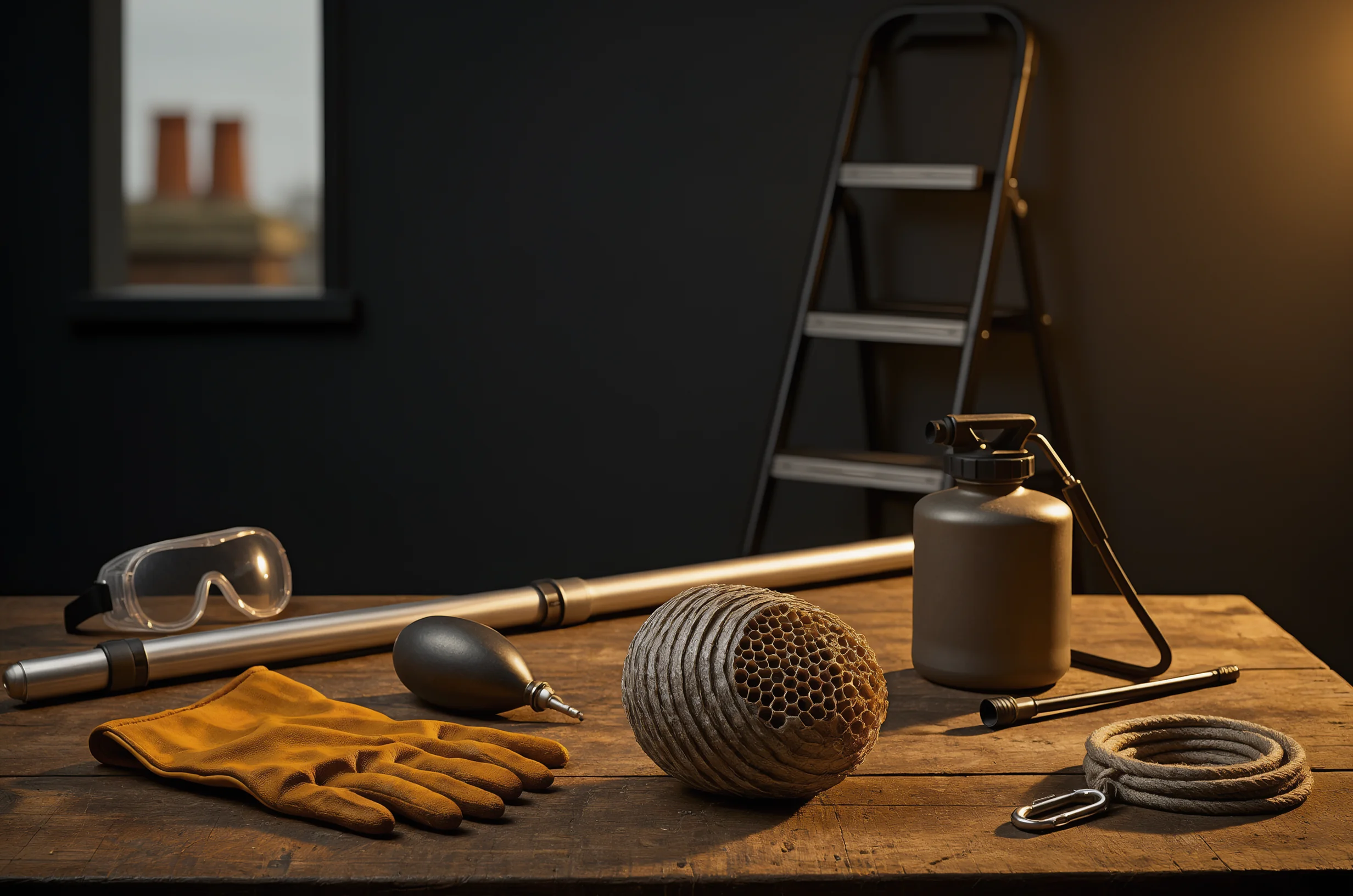
Most quotes for wasp nest removal land somewhere between £65 and £150, but the number only makes sense once you know where the nest sits. A ground-level nest in a hedge is a twenty-minute job with an insecticidal dust. The same colony tucked under a second-storey soffit is a different job entirely: ladders or access equipment, sting-rated PPE, a risk assessment, and often a second visit. This roundup ranks the realistic ways a nest gets removed — DIY kit, council service, fixed-price specialist, full professional treatment — by what each one actually costs at ground level, at ladder reach, and at roofline, so you can match the price tier to the nest you've got rather than paying roofline money for a hedge-level problem.
Height, access and safety regulations are the three things that move wasp nest removal pricing more than anything else, so they're the ranking logic throughout. Everything below is priced in pounds, reflects UK providers publishing rates in 2026, and excludes anything we couldn't verify from a stated price page.
How this roundup is ordered and what was left out
The list runs from the cheapest scenario (a small, visible nest you can treat from the ground) to the most expensive (a roofline or cavity nest that needs a professional with working-at-height equipment). Each entry covers who it suits, the evidence behind the price, where it falls down, and a straight verdict.
A few things were excluded deliberately. US pricing guides, like Airtasker's wasp removal cost data and Angi's 2026 wasp removal figures, are useful for showing how access drives price in principle, but their dollar figures don't translate to London call-out economics, so they inform the analysis rather than set the benchmarks. Providers with no published price were also left out — a roundup about cost is only honest if every number on it can be checked.
One UK-wide anchor point before the tiers: PGM Pest Control puts typical professional removal for a single nest at £65 to £150, with an average around £83. Treat that as the centre of gravity. Anything dramatically below it usually excludes something; anything far above it usually includes access equipment or multiple nests.
Ground level: the DIY kit, £15 to £30
At the bottom of the price ladder is the shop-bought wasp nest killer — an aerosol foam or insecticidal powder from a hardware shop or garden centre. For a nest the size of a tennis ball or smaller, in the open, at arm's reach, this can genuinely work, and it's the only tier where doing it yourself is a defensible choice.
The conditions matter more than the product. The nest should be clearly visible (not inside a wall cavity or underground), small, and treatable early in the morning or late in the evening when the colony is inside and calm. Wasps react to vibration and carbon dioxide, so a slow approach at dusk beats a confident approach at midday every time.
Where it fails is size and concealment. Once a nest grows past roughly grapefruit size, a single aerosol rarely reaches the queen deep in the combs, and a half-treated colony is worse than an untreated one — you get days of agitated foragers with the flight path now pointed at you. Ground nests in lawns are a particular trap: they look easy because they're at ankle height, but the colony is underground and the entrance is a funnel of defending workers.
There's also the sting maths. A disturbed nest can send dozens of wasps at the person holding the can, and if anyone in the household has a sting allergy, the £50 you save isn't a saving at all. Our guide to spotting when a wasp sting reaction turns dangerous is worth reading before you decide, not after.
Verdict: right tool for a nest smaller than a tennis ball in an open, reachable spot. Anything bigger, hidden, or near doors and play areas has already outgrown this tier.
Council pest services: low cost, with hard access limits
The next rung up is your local authority. Some councils still run subsidised pest services, and as Invicta Environmental notes, a few local authorities offer free or low-cost treatment. Where a council service exists, it can be the cheapest professional option on this list.
The trade-off is scope, and height is where it bites. Council services typically work to strict safety limits. Manchester City Council, for example, publishes that it will only treat nests up to a maximum of five metres from the ground — roughly gutter height — and states that it no longer treats nests from ladders for health and safety reasons. That's a reasonable policy, but it means a nest in a loft, under high eaves, or inside a wall cavity above the first floor is outside the service entirely.
Availability is the other limit. Council pest teams carry long waiting lists in peak season (July to September, when nests are at full size and demand spikes), and many London boroughs have scaled back or closed their wasp services altogether, signposting residents to private contractors instead. If you can wait a fortnight and your nest is at ground level, check your council first. If the nest is beside a nursery window or above a shop entrance, the wait usually decides for you.
Verdict: the budget pick when it exists, the nest is below gutter height, and time isn't pressing. Not an option for roofline work.
Fixed-price single-nest specialists: £60 to £70 at easy access
The middle of the market is the fixed-fee wasp specialist, and it's where most single-nest jobs at reasonable access should land. Two published examples show the shape of this tier.
Hampshire Wasp Control is refreshingly plain: one nest treatment at £65, two nests for £80, three for £95, with four or more negotiable. That sliding scale tells you something useful about the economics — the first nest carries the travel and setup cost, and each additional nest on the same visit is nearly marginal. In the West Midlands, Wasp Control Services advertises a £70 fixed price that includes the call-out fee and a guarantee.
Who it suits: a homeowner with one accessible nest — shed, hedge, low eaves, air brick — who wants it dead today and doesn't want to think about it again. The fixed fee removes the meter-watching anxiety of hourly rates, and the guarantee matters because roughly one treatment in ten needs a revisit when returning foragers find residual activity.
The honest limit is the small print. Fixed prices assume standard access: a technician on foot or a short ladder, treating through the entrance or a visible nest face. A nest inside a cavity wall, a loft with boarded flooring, or anywhere requiring roof access moves you out of the fixed tier and into quoted work. Ask before booking what "standard access" means to that specific company, because at £65 the definition is usually narrow.
Verdict: the best value on this list for the classic single nest at reachable height. If your nest matches that description, stop reading here and book one.
London same-day treatment: around £70, priced for speed
London pricing deserves its own entry because the capital's market works differently. Wasp Exterminator London is £70 for a nest removal seven days a week, with additional nests on the same property at £10 each. That £10 marginal nest price is the most aggressive in this roundup and reflects dense routing — a technician doing six jobs in E3 spends less on petrol than one driving across Hampshire.
Who it fits: anyone in London who needs the nest gone now. Same-day and seven-day availability is the whole product. When a nest sits beside a café terrace, a school gate, or a tenanted flat with a complaining resident, speed is worth more than the theoretical £15 you might save shopping around for a day and a half.
The limit is the same as the tier below: the headline price covers a standard-access nest. London's housing stock is full of the opposite — Victorian eaves, mansard roofs, parapet gutters, nests inside rendered wall cavities four floors up. Those jobs get quoted individually, and the quote will reflect access equipment, not the £70 advert. A reputable operator will tell you on the phone, from a photo of the nest location, whether the fixed rate applies. If they won't commit either way until they've "had a look", treat that as a soft warning sign.
This is also where BuzzKill fits the picture, for transparency: we're a London and Essex operator ourselves, and our own wasp work follows the same pattern — same-day where routing allows, fixed for standard access, quoted where height or cavity work is involved. We mention it so you know where this roundup is written from, not to jump our own queue.
Verdict: the right call when urgency is the deciding factor and the nest is at normal working height.
Ladder reach and roofline: £100 to £150+, and why the price jumps
Above gutter height, the pricing model changes from "per nest" to "per job", and the reasons are regulatory, not opportunistic. Anyone charging for wasp nest removal where height access is a factor is working under the Work at Height Regulations 2005, which apply to any work where a fall could cause injury. That triggers a chain of costs the ground-level tiers don't carry: a documented risk assessment, appropriate access equipment (compliant ladders with stand-offs, a scaffold tower, or occasionally a cherry picker), sting-rated full-body PPE, and usually a second person or at least a managed lone-worker protocol.
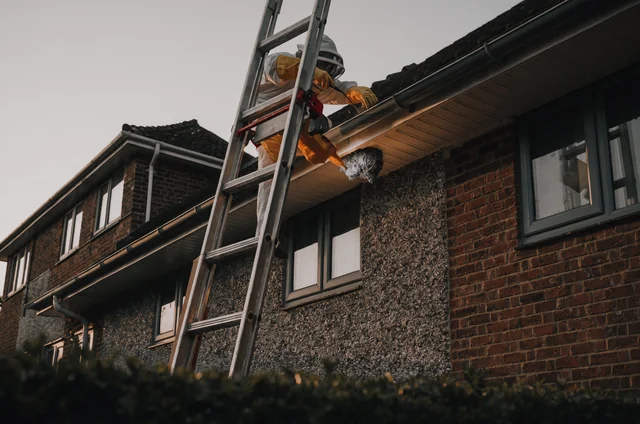
The wasp risk and the height risk compound each other. A technician treating a nest in a fascia from a ladder is balancing three hazards at once — falling, being stung, and dropping insecticide. Apex Pest Control's technical guidance on safety equipment describes exactly this: a professional assesses the wasp risk (nest size, colony activity, confined space) and the height risk (access route, working surface, emergency egress) together before treatment begins. That assessment time is in your quote.
Loft nests are the other expensive shape. A large nest in a roof void means crawling in low headroom in a bee suit, in summer heat, next to a colony that treats the loft hatch as the only exit. Expect £100 to £150 for awkward ladder-reach work and more where a tower or platform is needed. Wasp Expert's 2026 homeowner cost data shows the same pattern internationally: access difficulty, not nest size alone, is what pushes quotes to the top of their range.
Second visits are worth budgeting for at this tier. Industry guidance on low-chemical and vacuum methods notes that physical removal techniques often mean returning foragers and a planned follow-up, and even insecticidal dust treatments on big cavity nests sometimes need a re-treat a few days later. A good quote states whether the revisit is included; a £120 job with a free revisit beats a £95 job that charges £60 to come back.
One more regulation worth knowing: professional-grade insecticides aren't retail products. Only approved products may be used, and applying them is trained, certificated work — our explainer on UK insecticide use regulations covers the legal side. It's why the "mate with a ladder and a can of foam" option isn't just risky, it's often not lawful at this tier.
Verdict: unavoidable for roofline, loft and cavity nests, and the tier where a guarantee and a stated revisit policy matter most. Get two quotes; they should be within about 20% of each other.
What actually moves a wasp nest removal quote
Strip the tiers back and five variables do almost all the work:
- Height and access. Ground level to three metres is the cheap band. Gutter height to roofline roughly doubles the price because of the working-at-height compliance described above. Anything needing a scaffold tower or MEWP is quoted like building work.
- Nest position, not just nest height. A nest inside a wall cavity costs more than the same nest exposed on a fence at the same height, because the treatment has to reach the core through an entrance hole and you can't see whether it worked.
- Number of nests. Every provider on this list prices the second nest far below the first — £10 to £15 extra against £65 to £70. If you've got two, treat them in one visit.
- Timing and urgency. Same-day and weekend slots carry a premium outside fixed-price models. A nest that can wait until Tuesday is cheaper than one that can't wait until tonight.
- Season. Early-season nests (May, June) are small and quick. By August a mature nest holds thousands of workers, takes longer to treat, and is more likely to need a revisit.
A quick way to use this before you phone anyone: take a photo of the nest area from the ground, note the approximate height (first floor, gutter, roof ridge), and count how many entrance points you can see. Any competent company can ballpark a quote from that, and the ones who won't quote from a photo are telling you the price will grow on site.
If you're comparing quotes at the higher tiers, spend two minutes checking the company holds real trade credentials — our piece on checking pest controller credentials walks through what NPTA and BPCA membership actually verifies. At £120-plus for roofline work, that check is the cheapest insurance on this page.
Picking your tier by situation
If your nest is small, visible, and at arm's reach, the £20 DIY kit is honest value and this article's only self-treatment endorsement. One accessible nest you want gone today: a fixed-price specialist at £65 to £70, or your council if it still runs a service and the nest is below their height limit. In London with an urgent nest near people, the £70 same-day rate is the benchmark to beat.
Roofline, loft, or cavity nests: professional quoted work, £100 to £150 and up, chosen on guarantee and revisit policy rather than the headline number.
The most-overlooked option, though, is doing nothing at all. A nest high in a tree at the far end of a large garden, away from doors, windows, and play areas, will die naturally with the first hard frosts, and wasps never reuse an old nest. Treatment is proportionate when the entrance sits beside somewhere people have to be — a doorway, a school area, a terrace, a loft you need to enter. If yours doesn't, the cheapest tier on this list is patience, and it costs nothing.
A small tool idea while you decide: a simple estimator that takes nest height (ground, first floor, gutter, roofline), position (exposed or cavity), and nest count, then returns a realistic price band using the tiers above, would answer most "how much will this cost me" searches in three taps.
Questions readers ask about wasp removal pricing
Is it illegal to remove a wasp nest yourself? No. Wasps aren't a protected species in the UK, and treating a nest on your own property with retail products is legal. The legal limits bite at the professional end: only approved insecticide products may be used commercially, and applying them is certificated work. The bigger DIY risks are stings and falls, not the law.
Why do some quotes include a guarantee and others don't? A guarantee usually means one free revisit if activity continues after a set period, typically a few days to a few weeks. Fixed-price providers build the revisit risk into the fee; cheaper quotes sometimes exclude it. Always ask what happens if the nest is still active after a week.
Does the nest need to be physically removed after treatment? Usually not. Once the colony is dead, the nest is inert paper and can stay in place — it won't be reused. Physical removal adds cost and is really only worth it where the nest is visible and bothers you, or where it's blocking a vent.
Will wasps come back to the same spot next year? Not to the same nest, but a property that suited one queen often suits another. New queens find their own sites each spring, so proofing obvious entry points in the eaves after treatment is the sensible follow-up.
If your nest is above gutter height, inside a wall, or anywhere you'd need a ladder to reach, that's the point where the safety regulations and the pricing on this page stop being academic — get a quote from a technician with the equipment and the insurance before you get the ladder out.

Need professional help? BuzzKill offers fast, reliable pest control services across London and Essex.