
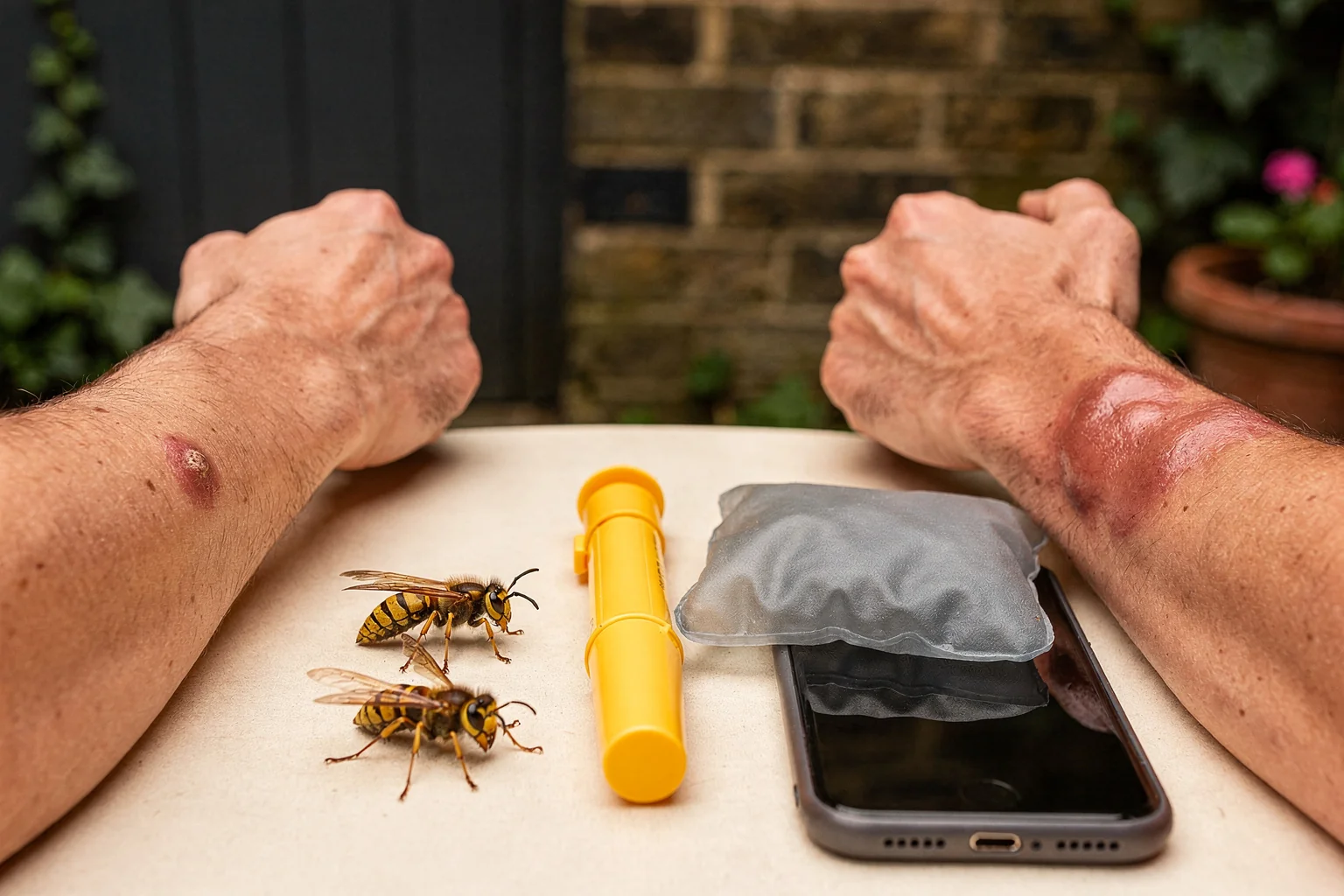
Most wasp stings hurt for a few hours and then fade. A small number do something far worse, and the difference between the two is visible within minutes if you know what you are looking at. This companion piece to the NHS guidance on treating wasp stings walks through the reaction that stays local, the reaction that goes systemic, and the point at which a nest on your property stops being a DIY job and becomes a medical risk. If someone in your household has a known sting allergy, the wasp removal allergic reaction emergency protocol below is worth reading before you ever need it.
Video: How to treat wasp stings at home | NHS - YouTube
The video above shows what a normal sting looks like next to a progressing allergic reaction, which is the part text struggles to carry. Swelling that creeps from a hand towards the wrist, a face that puffs while the sting site stays small, breathing that turns noisy — these are visual signals. Once you have seen them side by side, you will recognise them faster on a real person. What follows adds the context the clip cannot fit in: how wasp venom differs from bee venom, why a second sting can behave differently from the first, and why a nest on a balcony in Tower Hamlets or a loft in Havering needs a different plan entirely when an allergic person lives there.
Why wasp venom behaves differently from bee venom
People often use "bee sting allergy" and "wasp sting allergy" as if they were the same thing. They are not, and the difference matters for both treatment and prevention.
Bee venom and wasp venom contain different major allergens. Phospholipase A2 and melittin appear only in bee venom, while wasp venoms carry their own distinct proteins. That is why a person can react badly to a wasp and be completely fine with a bee, or the reverse. If you have been told you are allergic to one, it does not automatically follow that you are allergic to the other, and it does not automatically follow that you are safe either. Allergy testing is the only way to know which venom you are sensitised to.
The mechanics of the sting differ too. A honeybee leaves its barbed stinger and venom sac behind, so it stings once and dies. A wasp keeps its stinger and can sting repeatedly, which is one reason a disturbed nest produces multiple stings rather than one. The NHS advice on treating wasp stings notes that because wasps do not leave a stinger behind, there is usually nothing to scrape out of the skin — you go straight to washing the area with soap and water or an antiseptic to lower the risk of infection.
That repeated-sting capability is the practical heart of the problem. A single wasp away from its nest is a nuisance. A nest is a delivery system for dozens of stings at once, and the more stings a person takes, the higher the dose of venom and the greater the chance of a serious reaction — including in people who have never reacted before.
The first sting is not always the warning
One of the most common assumptions I hear is "I've been stung before and I was fine, so I'm not allergic." That logic does not hold. Sensitisation can build over repeated exposure, which is exactly why pest control technicians treat wasp nests with full protective equipment rather than a can of spray and confidence. The professional guidance on wasp control is blunt about this: repeated stings can increase sensitivity over time, so past tolerance is not proof of future safety.
If you work outdoors, garden regularly, or live in a property with a recurring wasp problem, treat each sting as information rather than reassurance.
Reading the reaction: local swelling versus a body-wide response
The single most useful skill in a sting emergency is telling a big local reaction apart from a systemic one. They can look similar at the skin and behave completely differently underneath.
A normal reaction is confined to the sting site. You get a painful, swollen lump, redness, and itching. It might swell to the size of a 50p coin, or in a large local reaction it can spread across a whole forearm or calf over 24 to 48 hours. Uncomfortable, sometimes dramatic-looking, but the person's breathing, blood pressure, and consciousness stay normal.
A systemic reaction travels. The venom has triggered a body-wide immune response, and the signs appear away from the sting. Allergy UK's guidance gives a clear example: if you are stung on the hand and your face begins to swell, or hives break out across your body, that is a systemic reaction and it can become serious.
Signs that mean call 999 now
Anaphylaxis is a medical emergency. The signs to act on, drawn from UK allergy and pest control guidance, include:
- Difficulty breathing, wheezing, or a feeling that the throat is tightening
- Swelling of the face, lips, tongue, or around the eyes
- Dizziness, feeling faint, or collapse
- A rapid heartbeat
- Nausea, vomiting, or stomach cramps
- A widespread rash, hives, or flushing across the body
If you see any of these after a sting, dial 999 immediately. Do not wait to see whether it settles. Do not drive the person to A&E yourself unless there is genuinely no alternative and someone else is driving.
If the person has been prescribed an adrenaline auto-injector, use it straight away into the outer thigh, then call 999. Lay them down with their legs raised unless breathing is easier sitting up. A second dose can be given after five minutes if symptoms have not improved and a second device is available. The World Allergy Organization's 2026 guidance on anaphylaxis supports repeating the dose at that interval when symptoms persist.
What to do when the reaction stays local
For a sting that is painful but not systemic, the NHS first aid steps for wasp stings are straightforward. Wash the area with soap and water or an antiseptic. Take paracetamol or ibuprofen for the pain. Use a pharmacist-recommended cream or antihistamine for the itching and swelling, and try not to scratch, because broken skin is how a sting turns into an infection.
Watch the site for the next day or two. Increasing redness, heat, pus, or a fever suggests infection rather than allergy, and that needs a GP rather than an emergency call.
The nest decision: when DIY removal becomes the wrong call
Here is where the medical picture and the pest control picture meet. A wasp nest in a shed that nobody uses is a different problem from a wasp nest beside a front door where a child with a known sting allergy lives.
The British Pest Control Association's advice is clear that treating a nest yourself is dangerous. Wasps inside a nest feel threatened when disturbed and defend it aggressively, which means the person holding the spray is the person taking the stings — often several at once, often at close range, often on a ladder.
Professional removal guidance sets out why this is not a job for a domestic can of foam. Removing a nest safely needs the right tools, personal protective equipment, and training: industrial vacuums with filters, water sprays to calm activity, digging tools for ground nests, secure containers, and full-body suits rated for wasp stings. Timing matters too — removal is safest early in the morning or late in the evening, when the colony is quiet and most foragers are inside.
When a nest has to go, not just be tolerated
Some nests can be left alone. If it is high in a tree, well away from doors and windows, and nobody in the household reacts badly to stings, monitoring it until the colony dies off at the end of the season is a reasonable choice.
Others cannot. The professional consensus is that DIY treatment is unsuitable for nests larger than a tennis ball, nests in confined or hard-to-reach spaces, nests at height, and any situation where someone in the household has a wasp sting allergy. In that last case, even a single sting carries unacceptable risk, and the nest needs to be dealt with by someone equipped for it.
That is the line I would draw for any London household. If a nest is in a loft hatch, an air brick, a balcony soffit, or anywhere within a few metres of a doorway, and someone on the property carries an adrenaline auto-injector, the calculation is simple. The cost of professional removal is trivial next to the cost of an ambulance.
If you are weighing up whether a nest near your home is a bee colony or a wasp colony — they need different handling, and bees have legal protection — the distinction between bee relocation and extermination is worth understanding before you book anything.
What professional wasp removal actually involves
If you have never watched a technician work a nest, the process can look surprisingly calm. That calm is the point.
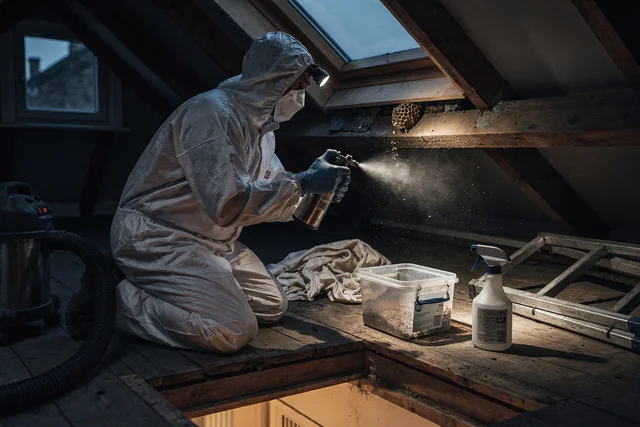
The first step is identification and access. A technician confirms it is a wasp nest rather than a bee colony, hornet nest, or an old, inactive nest that no longer needs treating. Then they assess the access route: loft, eaves, ground bank, wall cavity, or a hanging nest under a gutter. Each one needs a different approach, and the risk assessment changes with it.
Treatment is usually a targeted insecticidal dust or spray applied directly to the nest entrance, often in the evening when activity is lowest. The technician wears a full sting-rated suit, gloves, and eye protection. The nest is not normally removed unless it is accessible and safe to do so — the treatment does the work, and returning foragers are dealt with as they come back.
Then there is the follow-up. A technician will tell you what to expect over the next 24 to 48 hours: continued activity at first, then a steady decline as the colony dies out. They will also tell you what not to do, which is stand underneath the nest watching it, or block the entrance and trap wasps inside a wall cavity.
For a household with an allergic resident, the practical details matter more than usual. Ask about timing so the allergic person can be out of the property or well away from the treatment area. Ask what protective steps the technician takes. And ask what happens if activity continues past the expected window.
Checking who you are letting near the nest
Anyone can buy a ladder and a can of spray. Not everyone carries insurance, training, or accreditation, and a wasp nest is a bad place to find out.
In the UK, look for membership of a recognised trade body and evidence of certified training. The credentials a pest controller should hold are checkable before you book, and a legitimate operator will answer those questions without hesitation. If someone quotes a price over the phone without asking where the nest is or who lives in the property, that is a warning sign.
Emergency response when someone in the house is allergic
If a household member has a diagnosed wasp sting allergy, the plan needs to exist before the sting happens. Anaphylaxis UK's position is that people who have had a systemic reaction to a sting should carry two in-date adrenaline auto-injectors at all times, and that family members and anyone else regularly present should be trained to use them with a trainer device.
That training is not a formality. In a real reaction you have minutes, not hours, and the person most likely to need the injection may be too unwell to administer it themselves.
A household plan you can write down today
A few concrete steps turn a vague worry into something usable:
- Confirm where the auto-injectors are kept, and check the expiry dates every few months.
- Make sure at least two people in the household know the injection technique, including a neighbour if the allergic person is often alone.
- Keep a written action plan somewhere visible — the fridge door works — with the signs of anaphylaxis and the instruction to call 999.
- Identify the nest risk on your property now, before wasp season peaks, rather than after a sting.
- Have a removal appointment booked or a number saved for same-day response if a nest appears near a doorway or window.
For anyone in East London or Essex, that last point is where a local operator helps. A same-day visit means a nest near a front door can be dealt with before a child walks past it on the way to school. If you are not sure whether a nest is active, whether it is wasps or bees, or whether it needs treating at all, a quick inspection answers the question without anyone getting stung finding out.
A simple risk check before you go near a nest
If you want a practical tool rather than a paragraph, a short checklist works well here. Score each line yes or no:
- Is the nest within three metres of a door, window, or regular footpath?
- Does anyone on the property have a diagnosed sting allergy or carry an auto-injector?
- Is the nest bigger than a tennis ball?
- Is it in a loft, wall cavity, or other confined space?
- Is it at height, or somewhere you would need a ladder to reach?
Any single yes moves the nest out of DIY territory. Two or more, and it needs a professional visit rather than a Saturday afternoon project.
Stings that are not the first, and reactions that escalate
A sting is not always a one-off event. Late summer is when wasp behaviour changes, and it changes in ways that catch people out.
By late summer, worker wasps have finished rearing larvae and leave the nest to feed on sugary and fermented food — fallen fruit, pub gardens, bins. The British Pest Control Association has described these as "tipsy wasps": inebriated on fermented fruit, more aggressive, and more likely to sting. They are also more likely to be away from the nest, which means encounters happen in beer gardens, parks, and around outdoor bins rather than only at the nest itself.
For someone with a sting allergy, that shifts the risk from the property to the everyday. A wasp at a picnic table is not defending a nest, but it can still sting, and it can sting more than once.
Why the second sting can be worse than the first
Immune sensitisation is cumulative. A first sting may produce nothing more than a sore lump while the immune system quietly registers the venom. A later sting can then trigger a much stronger response, which is why allergy specialists do not treat a mild first reaction as proof of lifelong safety.
The clinical guidance for sting emergencies makes the same point from the treatment side: the critical error in managing anaphylaxis is failing to recognise impending airway compromise and withholding adrenaline when it is indicated. In other words, the danger is usually hesitation, not overreaction. If you are unsure whether a reaction is systemic, treat it as one and call 999. A false alarm costs an ambulance crew a wasted trip. The alternative costs far more.
The same principle applies to venom dose. A single sting in a sensitised person can cause anaphylaxis. Multiple stings from a disturbed nest can cause systemic toxicity even in someone who is not allergic at all, simply because of the volume of venom. That is the scenario a professional suit and a calm evening treatment are designed to prevent.
If you want to understand how UK venomous bites and stings are graded by medical significance, the comparison of UK bite danger and medical significance is a useful companion read — the same logic of local versus systemic harm runs through it.
Questions people ask after a sting
How quickly does anaphylaxis start after a wasp sting? Usually within minutes, often within 10 to 20. That is why observation matters immediately after a sting, and why anyone with a known allergy should not be left alone for the first half hour.
Can you be allergic to wasps but not bees? Yes. Bee and wasp venoms contain different major allergens, so sensitivity to one does not automatically mean sensitivity to the other. Testing identifies which venom you react to.
Should I remove a wasp nest myself if nobody is allergic? Only if it is small, accessible, and away from regular foot traffic. Nests larger than a tennis ball, nests at height, nests in confined spaces, and any nest near someone with a sting allergy should be handled professionally.
Does antihistamine stop anaphylaxis? No. Antihistamines help with itching and hives but do nothing for airway swelling or a drop in blood pressure. Adrenaline is the treatment for anaphylaxis, followed by 999.
What if the nest is still active after treatment? Some activity for 24 to 48 hours is normal as returning foragers die off. If wasps are still coming and going in numbers after that window, call the technician back rather than treating it again yourself.
Is a wasp sting dangerous for pets? Yes, and pets are among the groups more sensitive to stings. Swelling around the face or throat, difficulty breathing, or collapse after a sting needs a vet urgently.
Where this leaves a London household
The pattern across all of it is the same. A sting that stays local is a bad afternoon. A sting that travels is a 999 call. And a nest on a property where someone carries an auto-injector is a risk that should not be managed with a can of spray and a steady nerve.
If you have found a nest near a doorway, in a loft, or anywhere a child or an allergic adult passes daily, the sensible move is to have it looked at before the season peaks. Same-day inspections across East London and Essex mean the nest can be assessed, identified, and treated without anyone in the household going near it. Call 0203 468 1999 or request a callback to book a same-day inspection.

Need professional help? BuzzKill offers fast, reliable pest control services across London and Essex.