
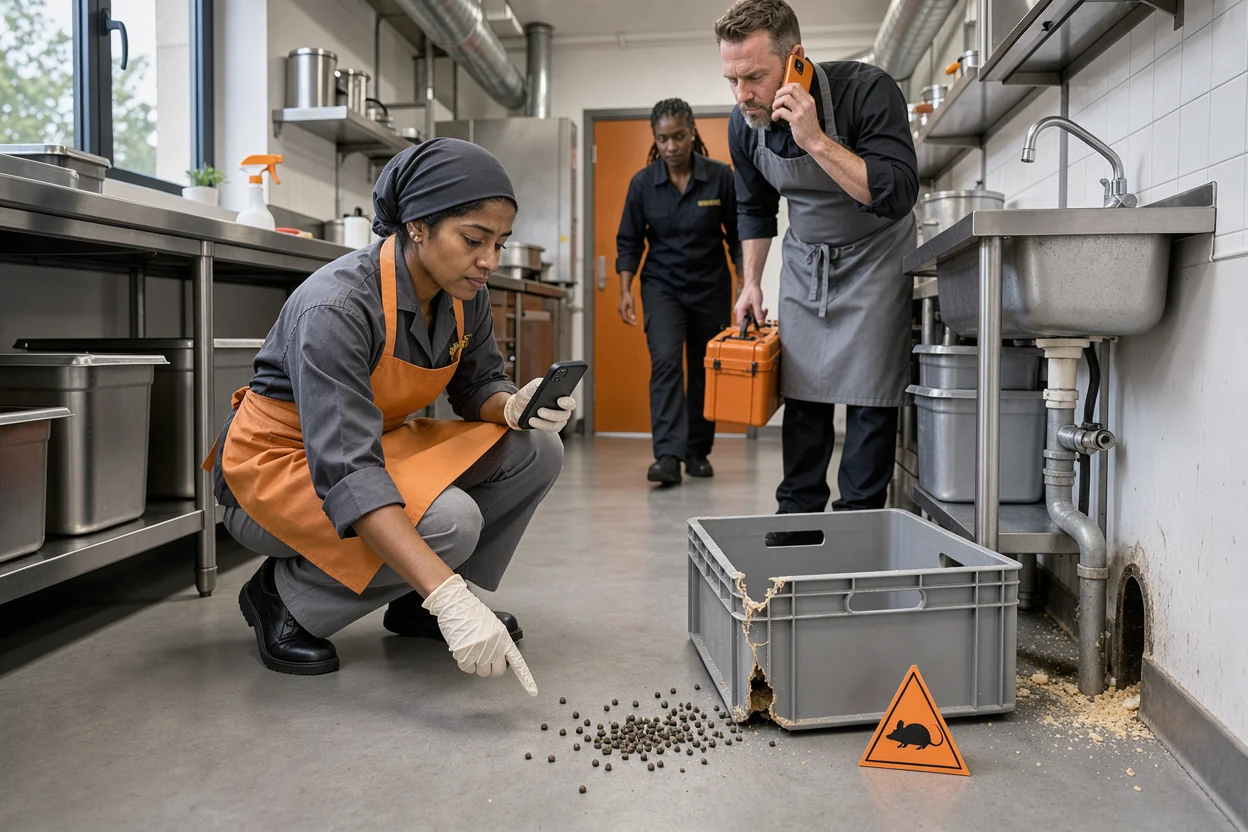
Report a pest sighting to your line manager, shift supervisor or the named facilities contact straight away. Your workplace’s staff pest sighting reporting procedure should identify the first contact, a backup and a route for urgent concerns.
You don’t need to identify the species or prove there’s an infestation before raising a concern. Describe what you saw and where it happened. The person responsible can then assess the area, protect affected activities and arrange an inspection. If that person is unavailable, use the backup contact rather than leaving the report until their next shift.
Who should you tell first when you spot a pest at work?
Tell the person named in your workplace procedure, or your immediate supervisor if no reporting contact is clear.
In a small shop, that might be the owner or duty manager. In an office, it may be the facilities team, which manages the building and its maintenance. A hotel might route reports through the duty manager, while a warehouse may use a site manager or maintenance helpdesk.
We recommend a reporting route that staff can follow without having to work out who owns the building or holds the pest contract.
A useful arrangement identifies:
- A main contact who receives sightings and decides what happens next.
- A backup for absences, evenings and weekends.
- A reporting channel, such as a dedicated form, telephone extension or incident log.
- A person who can authorise an inspection and arrange access.
If you’re agency staff, a cleaner or a visiting contractor, tell your on-site supervisor or host. Follow your own employer’s reporting process too, where applicable.
Saying something to a colleague doesn’t establish that the responsible person knows. Ask for acknowledgement, particularly if the sighting affects a kitchen, stockroom or occupied room. If the first contact cannot act, ask who is taking responsibility for the report.
Should you report a pest if you cannot identify it?
Yes, report an uncertain sighting as an observation and leave identification open.
A small dark object beneath shelving might be a dropping, a seed or packaging debris. An insect seen briefly beside a sink may be difficult to identify. You can still report its position, approximate size, movement and the time you noticed it.
Use ordinary descriptions. “Small brown insect beside the dishwasher” gives a manager something to investigate. Calling it a cockroach without enough evidence may send the inspection in the wrong direction.
If a photograph is practical, take it from a safe position. Include a wider view that shows the location, as well as a closer image if you can obtain one without touching anything or moving equipment.
Don’t delay the report while comparing pictures online. Identification can follow the initial notification.
Keep observations separate from guesses about where the pest came from. A sighting beside a delivery doesn’t establish that the delivery brought it inside. Record the delivery details if relevant, but let the inspection establish the cause.
If similar evidence appears elsewhere, add each location to the report rather than assuming every sighting has the same explanation.
What details should a pest sighting report contain?
Record enough detail for someone else to find the location, understand what happened and contact you with questions.
“Mouse downstairs” leaves too much uncertainty. A room name, shelf position and time give the person investigating a usable starting point.
Include:
- The date and approximate time of the sighting.
- The building, floor, room and exact position within that room.
- What you saw, heard or found, with uncertainty stated clearly.
- The number observed, if you could count them.
- Any direction of movement or nearby gap you noticed.
- Whether food, packaging, equipment or an occupied area may be affected.
- Photographs taken without disturbing the area.
- Your name, contact details and any immediate action already taken.
For example, a hypothetical report might record one mouse crossing behind the ground-floor drinks fridge at 07:40. It could add that the duty manager was told immediately, the photograph shows the fridge position, and nobody moved the appliance.
That description is more useful than a confident species identification without a location.
Use consistent room names. If staff call the same space “back store”, “dry store” and “room three”, add a door number or plan reference.
Keep the initial observation intact when later findings are added. If inspection identifies something different, record the correction separately so the sequence remains clear.
How quickly should staff report a pest sighting?
Report it promptly during the same shift, and alert the duty manager immediately when an activity or occupied area may be affected.
A routine maintenance inbox may be suitable for a damaged door seal. It is a poor sole channel for a live pest beside food preparation or inside an occupied guest room.
For an urgent concern, speak to the responsible person or use the designated urgent contact, then create the written record. An unread form cannot confirm that someone has assessed the situation.
Explain what makes the report time-sensitive. Useful details include exposed food nearby, repeated sightings, a pest inside equipment, or staff needing to enter the affected area.
An isolated insect beside an open office window may receive a different response from repeated activity beneath kitchen shelving. Staff should report both accurately and let the responsible manager assess the circumstances.
If the sighting happens near the end of your shift, hand it over explicitly. Record who accepted it and what remains outstanding.
Managers should set response expectations within their own procedure, including out-of-hours arrangements. Those expectations need to distinguish acknowledgement, assessment and attendance. Receiving an automated email is only confirmation that a message entered the system.
Who should food handlers tell about pests in a kitchen?
Food handlers should tell the duty manager, kitchen manager or person responsible for food safety immediately.

The report should identify the working area and any food, utensils, packaging or preparation surfaces that may have been affected. Be specific about what you observed rather than guessing how far the issue extends.
Pause the affected task and ask the responsible manager how to protect nearby food and restrict access. Don’t move suspect items into another preparation area simply to clear the workspace.
The manager can arrange an assessment, decide how affected items should be handled and contact the appointed pest contractor. Those decisions should follow the business’s food safety procedures.
Our guide to food premises pest regulations provides a separate starting point for managers reviewing their wider arrangements. A staff reporting procedure should still make the immediate contact obvious.
If the usual kitchen manager is absent, tell the duty manager or business owner. Avoid leaving the report solely in a cleaning diary that nobody will review until later.
Record any action already taken, including which task stopped and which area was kept out of use. If deliveries or service are continuing nearby, make sure the manager knows.
Repeated activity, suspected contact with food or evidence across several kitchen areas should prompt the manager to arrange professional assessment without waiting for the next routine visit.
Who handles pest reports in rented or shared workplaces?
Staff should report through their employer’s management route, while the designated manager coordinates with the landlord or building management team.
A shared London building may have several separate contacts: the employer, a managing agent, a reception team and individual tenants. Staff shouldn’t have to resolve those arrangements before raising a sighting.
Tell your manager where the evidence is, including whether it sits inside your workplace or in a shared corridor, bin store or loading bay.
The manager should establish who will arrange inspection, provide access and approve any building repairs. Payment and maintenance responsibilities need checking against the relevant agreement; they cannot be settled from the sighting alone.
If you are the tenant business owner, notify the managing agent or landlord in writing where shared areas or building defects may be involved. Keep a record of the notification and any response.
A reception report can help alert building management, but ask whether your employer’s responsible manager has also received it.
Where another tenant may be affected, use the agreed building contact to coordinate communication. Avoid presenting an unconfirmed cause as a fact about a neighbouring business.
If different parties keep referring the report to each other, ask them to confirm a named person who will coordinate the immediate assessment. Responsibility for costs can be clarified alongside the response.
Should employees contact a pest control company directly?
Employees should normally use the authorised workplace contact, unless the procedure specifically allows them to call the appointed contractor.
A technician may need permission to enter restricted rooms, inspect equipment or discuss findings with management. The business also needs someone available to explain the sighting and approve the agreed work.
If the business already uses BuzzKill Pest Control for commercial pest management, its designated contact can pass on the report and arrange access. Staff should continue recording observations through the workplace system so management has the same information.
Direct contractor contact can make sense for an authorised night manager or site supervisor. The procedure should name that role and explain who must be informed afterwards.
Avoid booking a separate company or purchasing treatment on behalf of the business without authority. First establish who can approve the inspection.
Whoever appoints the contractor can check pest control contractor credentials and confirm who will receive the written findings.
Before attendance, supply the exact location, access arrangements, photographs and any restrictions on moving equipment. Mention earlier reports even if the previous inspection found no activity.
If staff cannot reach the authorised contact, use the management escalation route. A contractor booking should not become a substitute for alerting the person responsible for the workplace.
What should you do while waiting for an assessment?
Keep people away from the immediate concern where practical, preserve the report details and follow your manager’s instructions.
You do not need to catch the pest, move machinery or dismantle shelving to make the report useful. Point out the location and let the responsible person decide how it should be inspected.
Leave existing traps, bait stations and monitoring devices in place. If one appears damaged or has moved, report that too.
Avoid bringing household sprays, powders or improvised traps into the workplace. Any treatment decision should go through the business’s authorised process.
If there are droppings, damaged packaging or an affected surface, photograph the location if safe and ask how the area should be managed. Don’t begin an unfamiliar clean-up simply to remove visible evidence.
Where bird fouling is involved, identify the affected entrance, walkway or access point. The separate guide to pigeon droppings health risks gives managers context for reviewing that task.
Staff may be asked to secure nearby stock, keep a door closed or redirect access. Record those actions and avoid blocking emergency exits.
If the pest moves, update the report with its new position. Don’t pursue it through occupied areas. When the manager or technician arrives, show them the original location and explain what changed after the sighting.
What if your manager does not respond to the report?
Escalate through the next named management or safety contact and keep a written record of the unanswered report.
Start by checking whether the first message reached the intended person. A manager away from the site may not have seen an email, and a helpdesk ticket may need an urgent flag.
Use a second approved channel where the situation warrants it. State the original report time, the location, the concern and whether anything has changed.
If there is still no response, contact the duty manager, facilities lead, site manager or health and safety representative, according to your workplace arrangements. For a shared building, the responsible manager may also need to involve building management.
A useful escalation asks for something concrete: acknowledgement, an assessment, a named person responsible, and instructions for the affected activity.
Avoid repeatedly sending the same vague message to a growing list of people. Add the information needed to make a decision.
If you are being asked to continue a task you believe may be unsafe, raise that specific concern through the workplace’s urgent safety reporting route. Explain the task and the observed condition.
Keep copies of reports and responses within the approved system. Before your shift ends, confirm who has accepted the issue and what staff should do while it remains unresolved.
When should you contact environmental health about a workplace pest concern?
Contact the relevant council team when you need independent advice about an unresolved concern or want to raise a food hygiene complaint.
For a London food business, look for the food safety or environmental health team at the borough council covering the premises. Describe the location, what you observed and when it happened.
This is a separate route from arranging the business’s pest contractor. A council enquiry does not replace the immediate need to tell the responsible manager about an affected working area.
If you are unsure which team handles the issue, describe the type of premises and concern to the council and ask for the appropriate department.
Keep any account factual. Include your own observations and distinguish them from information someone else supplied. Retain the dates of earlier internal reports where relevant.
One sighting alone does not tell staff what an inspection outcome will be. Avoid promising colleagues that a business will close or assuring them that no further action is possible.
Managers considering that question can review restaurant roach closure rules separately from recording the incident.
If you are already speaking with a council officer, ask what information they need and how to submit it. Continue updating the workplace report when new evidence appears.
What should a manager do after receiving a sighting report?
A manager should acknowledge the report, assess the immediate situation and assign someone to coordinate the response.
Start with the location and the affected activity. Confirm whether staff need instructions about access, food handling, stock movement or use of equipment.
Then check the reporting history. Earlier sightings in the same room, repeated damage beside one doorway or several reports from a shared loading area should all be included in the inspection request.
A manager arranging a BuzzKill Pest Control inspection can provide the sighting log, photographs and a simple plan of affected rooms. Include access restrictions and the contact who can accompany the technician.
Keep separate records of the original observation, inspection findings and agreed actions. A booked visit does not show that the issue has been assessed or resolved.
Assign any cleaning, maintenance or repair work to named people. Record who will check completion and when staff will receive an update.
For teams with frequent shift changes, a simple interactive reporting checklist could help. It could require a location, time, description, urgent-contact confirmation and a named manager before submission.
The reporting system also needs an alternative for staff without access to it. Display a telephone extension or identify the duty contact.
Tell the person who raised the concern that it has been received, and give affected staff clear instructions for their next shift.
How should repeat sightings and shift handovers be recorded?
Add repeat sightings to the existing incident and hand over the outstanding actions to a named person.
Each new observation needs its own time and location, even when it appears connected to an earlier report. Avoid replacing several sightings with “still happening”, which loses useful detail.
Record whether the new evidence appeared before or after an inspection, cleaning task or repair. The sequence helps the person investigating understand what has changed.
At shift handover, explain which areas remain under review, what staff have been told, whether attendance is booked and who can authorise further action. Confirm that the incoming person has accepted responsibility.
Managers should define what is needed before closing the incident. That may include reviewing inspection findings, completing repairs and confirming any follow-up arrangements.
Keep the record available after closure. A later report from the same stockroom or service cupboard may need that history.
If a technician has given monitoring instructions, pass them on using the wording supplied. Staff should know what to observe and where to record it.
If fresh evidence appears while the incident is open, add it and alert the responsible manager again. If it appears after closure, raise a new report and link the earlier record so the next assessment starts with the full history.

Need professional help? BuzzKill offers fast, reliable pest control services across London and Essex.