
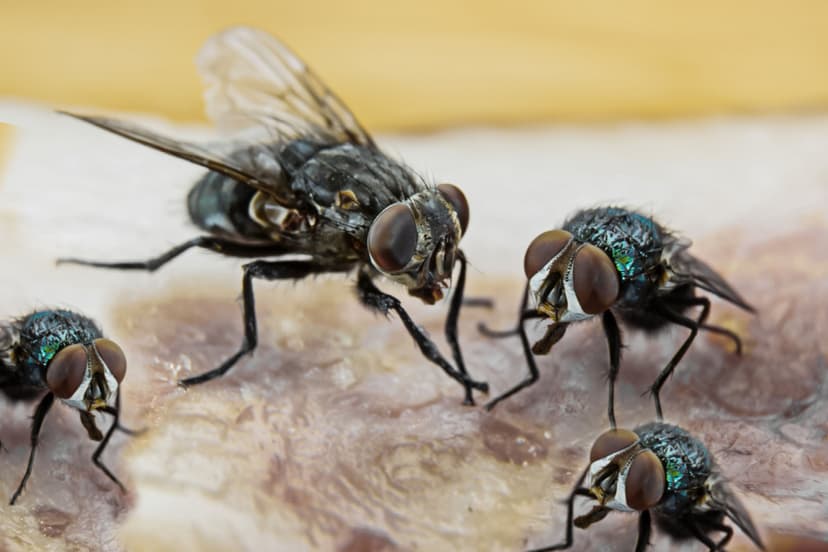
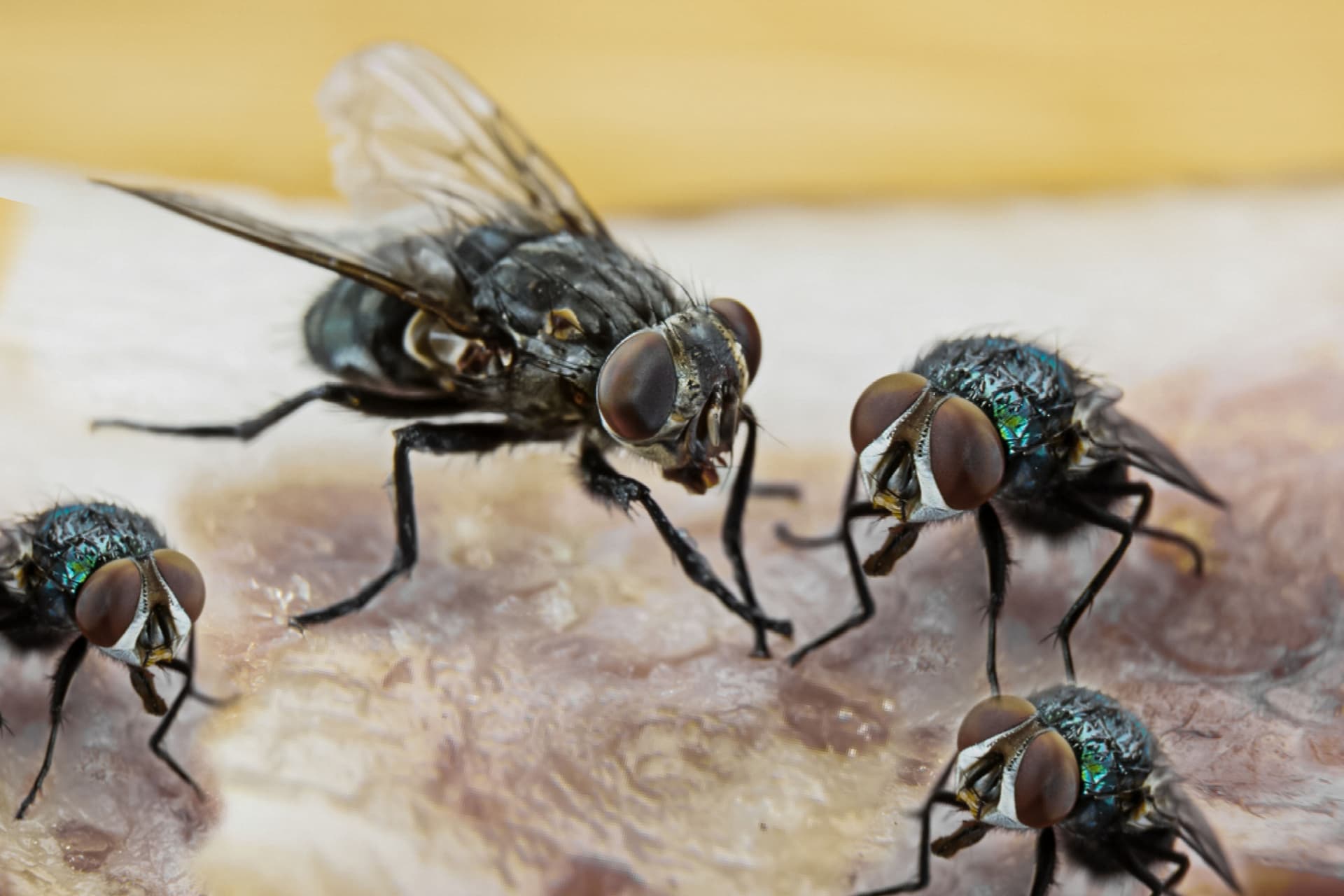
Not all flies are the same — and knowing which species you have tells you the cause, the risk, and the correct treatment. A house fly in your kitchen is a health hazard. A cluster fly in your loft is a nuisance. A bluebottle indoors usually means something is dead nearby.
This guide covers the six fly species most commonly encountered in UK homes and businesses.
Published:
House Fly (Musca domestica)
The most common fly species worldwide and a significant health pest.
Size: 6 to 8mm.
Appearance: Grey thorax with four dark longitudinal stripes. Pale yellowish underside. Large reddish-brown compound eyes. A single pair of wings.
Breeding: Lays 400 to 600 eggs in batches of 75 to 150 on rotting organic matter — food waste, animal faeces, compost, and drains. Eggs hatch into maggots within 8 to 20 hours. Full lifecycle in 7 to 10 days in warm weather.
Behaviour: Active during the day. Feeds by regurgitating digestive fluid onto food surfaces before sucking it back up — this is how they transfer bacteria. Attracted by smell, not light.
Risks: Carries over 100 pathogens including Salmonella, E. coli, Campylobacter, and Shigella. A major food contamination risk in kitchens and food businesses.
Treatment: Residual sprays, UV fly killers, and — critically — source removal. Without eliminating the breeding source, treatment is temporary.
Cluster Fly (Pollenia rudis)
A seasonal nuisance pest that hibernates in buildings but does not breed indoors.
Size: 8 to 10mm — slightly larger than a house fly.
Appearance: Dark grey to olive-grey body. Golden hairs on the thorax (visible under close inspection). Wings overlap at rest (house fly wings remain apart).
Breeding: Cluster flies are parasites of earthworms. They lay eggs in soil in spring and summer. Larvae hatch, burrow into earthworms, and develop inside them. Adults emerge and seek sheltered buildings to hibernate in autumn.
Behaviour: Sluggish and slow-moving compared to house flies. Gather in large numbers on south-facing windows and in loft spaces from September onwards. They release a pheromone that attracts more cluster flies to the same building year after year.
Risks: No health risk. Cluster flies do not breed in food or waste and do not carry disease. They are purely a nuisance due to their numbers — thousands can accumulate in a single loft.
Treatment: ULV fogging for loft spaces. Residual spray on window frames. Annual preventative treatment recommended.
Bluebottle / Blowfly (Calliphora vomitoria)
A large, noisy fly that almost always indicates rotting material nearby.
Size: 10 to 14mm — noticeably larger than house flies.
Appearance: Bright metallic blue body. Large red compound eyes. Loud, distinctive buzzing flight.
Breeding: Lays eggs on dead animals, rotting meat, pet food, and animal faeces. Maggots develop rapidly — hatching within hours in warm conditions.
Behaviour: Strong fliers attracted to the smell of decay. They can detect rotting material from considerable distances. Often the first sign that a dead animal (mouse, rat, bird) is present in a wall cavity or loft.
Risks: Carries bacteria from rotting material to food surfaces. A significant food hygiene risk.
Treatment: Find and remove the source. A sudden appearance of bluebottles indoors means something is decomposing nearby — check for dead animals in lofts, behind walls, and under floors.
Green Bottle Fly (Lucilia sericata)
Similar to bluebottles but with a distinctive green metallic sheen.
Size: 8 to 10mm.
Appearance: Bright metallic green body. Slightly smaller than bluebottles.
Breeding: Lays eggs on animal carcasses, faeces, and rotting vegetation. Also associated with wound infestations in livestock (flystrike).
Behaviour: More commonly found outdoors than bluebottles. Attracted to pet faeces in gardens and food waste in bins.
Risks: Similar health risks to bluebottles — carries bacteria from waste to food.
Treatment: Same approach as bluebottles — source removal is essential. Secure bins, clear pet waste, and check for dead animals.
Need professional help with cluster fly pest control? BuzzKill Pest Control offers fast, effective treatment with no call-out charge.
Fruit Fly (Drosophila melanogaster)
A tiny fly that appears in swarms around fermenting food and drink.
Size: 2 to 3mm — very small.
Appearance: Tan or yellowish-brown body. Bright red eyes (distinctive under close inspection). Wings held flat over the body at rest.
Breeding: Lays eggs on overripe fruit, vegetable matter, fermenting liquids (beer, wine, vinegar), and drain residue. Lifecycle as short as 7 days in warm conditions. A single female lays up to 500 eggs.
Behaviour: Appears in swarms around fruit bowls, bins, drains, and bar areas. Most active in warm weather but can persist year-round in heated kitchens.
Risks: Low health risk to humans but a significant nuisance and hygiene concern in food businesses. Can carry bacteria between surfaces.
Treatment: Remove fermenting sources — overripe fruit, spilled liquids, drain residue. Clean drains with enzyme cleaner. Vinegar traps can reduce numbers. Professional treatment for persistent problems.
Drain Fly / Moth Fly (Psychodidae)
A small, fuzzy fly that breeds in the organic biofilm inside drains.
Size: 2 to 5mm.
Appearance: Grey or brown. Broad, leaf-shaped wings covered in fine hairs — giving them a moth-like appearance. Held roof-like over the body at rest.
Breeding: Lays eggs in the organic slime that accumulates inside drains, pipes, and sewage systems. Larvae feed on the biofilm. Lifecycle 8 to 24 days.
Behaviour: Poor fliers — they tend to hop and flutter rather than fly strongly. Found near sinks, showers, and floor drains. Most active in the evening.
Risks: Not a significant health risk but indicate poor drain hygiene. Their presence in large numbers is a nuisance and a sign of organic buildup in pipes.
Treatment: Clean drains with enzyme-based cleaner or drain brush to remove the biofilm. Boiling water provides temporary relief. Professional drain cleaning for persistent problems.
Frequently Asked Questions
How do I tell a house fly from a cluster fly?
Cluster flies are slightly larger, darker grey, move sluggishly, and cluster in large numbers on windows. House flies are lighter grey with stripes, move quickly, and buzz rapidly around food. Cluster flies overlap their wings at rest; house fly wings stay apart.
Are big blue flies dangerous?
Bluebottles carry bacteria from rotting material and are a food hygiene risk. Their main significance is as an indicator — a sudden appearance of bluebottles indoors almost always means a dead animal or rotting source is nearby.
Why do I have tiny flies near my sink?
Tiny flies near sinks are usually fruit flies or drain flies. Fruit flies are attracted to fermenting food; drain flies breed in the organic biofilm inside the drain. Clean the drain thoroughly with an enzyme cleaner and remove any nearby fermenting food sources.
Do all flies carry disease?
House flies and bluebottles are significant disease carriers — they transfer bacteria from waste to food surfaces. Cluster flies, fruit flies, and drain flies are primarily nuisance pests and pose a much lower health risk.
Professional Cluster Fly Pest Control Service
Learn more about our cluster fly pest control service, pricing, treatment methods, and customer reviews.
View Cluster Fly Pest Control Service