
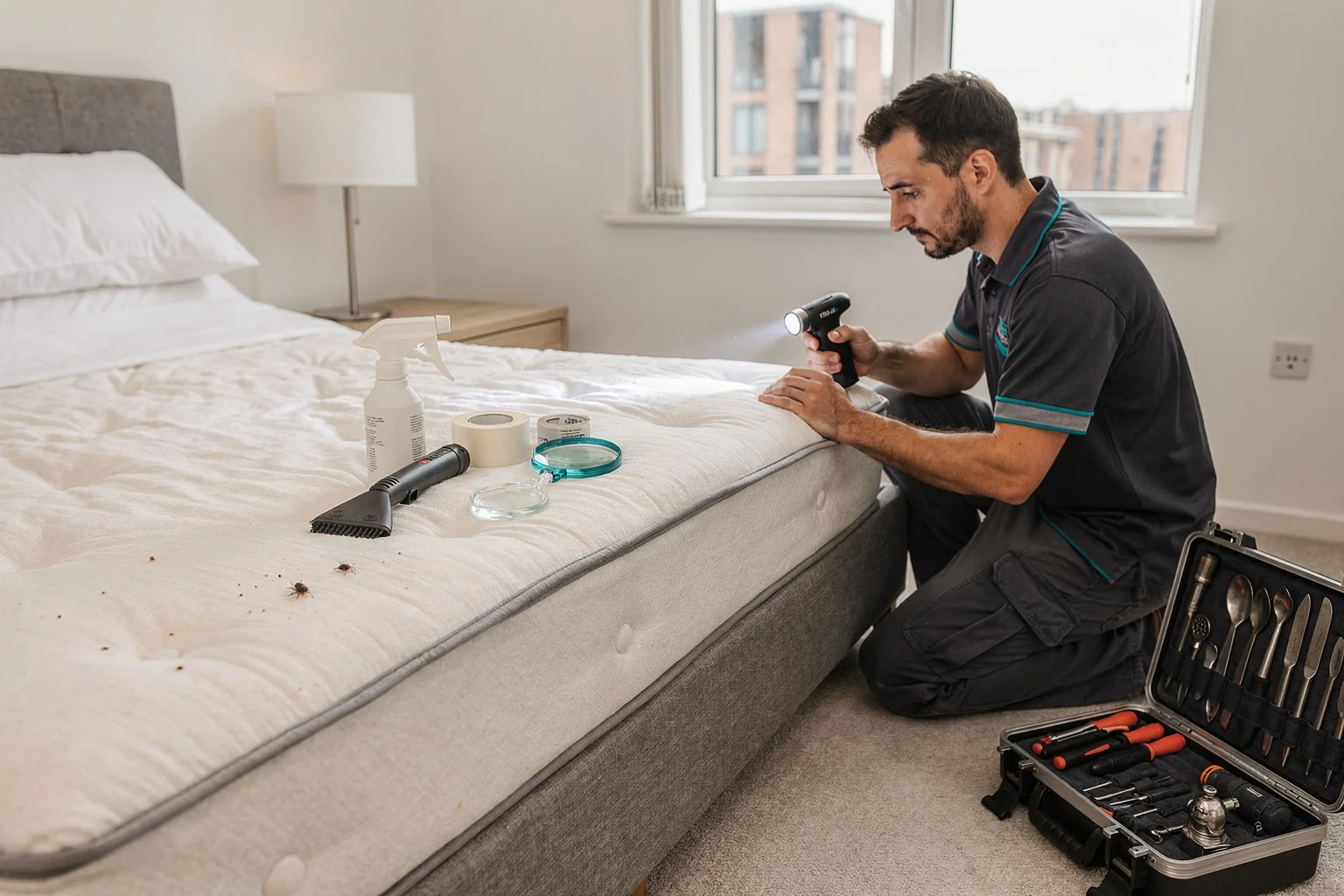
Sarah noticed the itching first. Three small red marks in a neat row across her forearm, appearing after a night in her Whitechapel flat. She'd changed the sheets, hoovered the mattress, and told herself it was a spider. Two weeks later, her neighbour in the adjoining terraced house mentioned similar marks. By then, the bed bugs had travelled through the party wall's electrical conduit and established themselves in both properties.
This pattern repeats across Tower Hamlets more often than most residents realise. The borough's dense housing stock — Victorian terraces subdivided into flats, post-war council blocks, and the steady churn of short-term lets — creates ideal conditions for Cimex lectularius to spread quietly. The question isn't whether you might encounter them. It's whether you'll spot the signs before they've moved from one room to several, or from your flat to next door's.
What You're Actually Looking For
Bed bugs are small, flat, oval insects roughly the size of an apple seed when fully grown. They hide in cracks and crevices during daylight, emerging to feed on human blood at night. Their bites are painless at the moment — the itching and swelling come from an allergic reaction to their saliva, which typically develops hours after feeding.
The early signs are easy to dismiss. A single blood spot on a pillowcase. A faint, musty odour near the headboard. Tiny black dots along mattress seams that look like felt-tip pen marks. These are faecal spots, digested blood excreted by feeding bugs. You might also find shed skins or tiny white eggs, about 1mm long, glued into hiding places.
In Tower Hamlets properties, the most productive inspection sites follow predictable patterns. In flats, check the junction where the mattress meets the bed frame, the backs of headboards fixed to walls, and any gaps in skirting boards near sleeping areas. In terraced houses with original floorboards, the gaps between boards and the perimeter of fitted carpets harbour bugs travelling between rooms. The Tower Hamlets council guidance notes they feed at night or anytime a room is dark — so shift workers sleeping during daylight are equally vulnerable.
Heat and carbon dioxide draw bed bugs to sleeping humans. This means the bed itself is ground zero, but not the only zone. Sofas used for napping, armchairs near radiators, and even curtain folds close to warm pipes can harbour them. In shared houses and HMOs common in Stepney and Bethnal Green, bugs move along service risers and through gaps around pipework — so a problem starting in one room can colonise others within weeks.
The DIY Inspection: What Homeowners Can Realistically Check
A thorough homeowner inspection takes roughly 30-45 minutes per room and requires decent light, a torch, and a credit card or thin plastic spatula for probing crevices. Work methodically: strip the bed completely, examine the mattress tag and seams with the torch held at a low angle to cast shadows that reveal eggs and faecal spotting. Run the card along headboard joints, bed frame corners, and any cracks in painted wood.
For flats in converted Victorian houses — common around Bow and Mile End — pay particular attention to original features: picture rails with gaps behind them, fireplace surrounds no longer in use, and the junction between original plaster and later partition walls. These heritage details create harbourage that modern new-builds simply don't have.
A simple interceptor trap placed under bed legs can confirm activity over 7-10 nights. These shallow plastic dishes trap bugs attempting to climb up from the floor. They're inexpensive, passive, and provide objective evidence when you're unsure whether that spot was a bed bug or a carpet beetle.
However, DIY inspection has hard limits. Low-level infestations — below roughly ten bugs — may produce no visible signs for weeks. Eggs are pale and easily missed against light fabrics. Bugs inside box springs, behind fixed fitted wardrobes, or within wall voids are simply inaccessible without disassembly. And critically, misidentification is common: carpet beetle larvae, booklice, and even lint can trigger false alarms while genuine early infestations get dismissed.
The bed bug warning signs page offers a more detailed visual guide for homeowners who want to deepen their inspection skills. But recognise when you're reaching the edge of what untrained observation can reliably achieve.
When Professional Surveys Catch What DIY Misses
Professional bed bug surveys bring trained observation, magnification tools, and experience with Tower Hamlets housing stock. A technician knows that post-war system-built blocks in Poplar often have service ducts running vertically between floors — a highway for bugs that homeowners never inspect. They understand that the shallow floor voids in ex-local authority flats create different harbourage patterns than solid concrete new-builds.
Detection tools extend beyond visual inspection. Specially trained dogs can identify the distinct scent profile of bed bug colonies with high accuracy, though handler skill matters enormously. Portable heaters used for monitoring can flush bugs from deep harbourage. Most valuably, a professional survey contextualises findings: distinguishing old evidence from active infestation, estimating colony age from developmental stages present, and identifying the likely introduction route.
This matters for treatment planning. A recent introduction via second-hand furniture requires different management than a long-established colony spreading through a terrace's party wall. The Tower Hamlets council pest control service charges £213.60 for three-room treatment (as of current published rates), with additional rooms at £73.80 each — but they require proper room preparation first, including hot-washing bedding over 60°C and emptying wardrobes. Their officers need to confirm bed bugs before treatment begins, which means an initial inspection visit is mandatory.
Private services like Tower Hamlets bed bug removal typically offer same-day response, which matters when you're managing sleep disruption or have vulnerable residents. The trade-off is cost against speed and flexibility — council services may have booking delays during peak periods, while independent operators can often inspect within hours.
Comparing Detection Routes for Different Situations
The choice between DIY monitoring and professional inspection isn't binary. It depends on your evidence level, property type, and tolerance for uncertainty.
Low suspicion, no visible signs: Start with interceptor traps and systematic visual checks. Document anything you find with dated photographs. Review after two weeks. This suits single occupants in stable situations with no recent travel, furniture purchases, or visitor patterns that would introduce bugs.
Some signs, uncertain identification: A professional survey resolves ambiguity quickly. Misidentification wastes money on wrong treatments and allows genuine infestations to establish. This is particularly important in rented flats where landlord-tenant responsibilities for proofing that landowners must do may apply — the council notes that structural repairs and proofing are normally the building manager or landlord's responsibility, not the pest control service's.
Clear signs, multiple rooms, or shared housing: Professional inspection is essential. The risk of spread to adjoining properties creates both ethical and legal considerations. In Tower Hamlets social housing, East End Homes residents have access to council pest control without direct charge for certain pests, though bed bug treatment arrangements vary by landlord. Private tenants should notify landlords promptly, as delayed reporting can complicate responsibility for treatment costs.
Recurrent problems after previous treatment: This demands professional investigation into why treatment failed. Resistance to certain insecticides is documented in UK bed bug populations. Incomplete preparation before treatment — failing to empty wardrobes or wash bedding properly — is another common cause. The preparation requirements are extensive: rooms must be completely emptied of clothes, electrical goods and personal items, with bedding hot-washed and stored sealed in unaffected rooms.
How Tower Hamlets Housing Shapes Bed Bug Risk
The borough's architectural diversity creates distinct risk profiles. Victorian and Edwardian terraced houses, converted to flats or kept as multi-occupancy dwellings, offer numerous harbourage sites in original features and the gaps created by successive alterations. Shared walls mean bugs move laterally between properties — a problem starting at number 42 can reach number 46 via the loft space or underfloor voids without either household noticing.
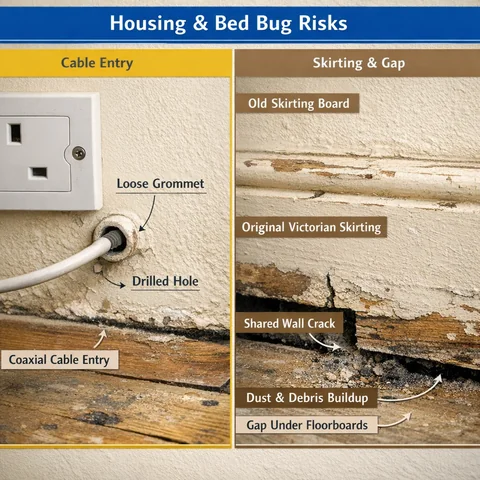
Post-war estates and system-built blocks present different challenges. Concrete construction with service ducts and uniform flat layouts allows vertical spread. The 2024 Housing Ombudsman case involving Tower Hamlets Community Housing illustrates how pest complaints can escalate when landlord response delays allow infestations to establish across multiple properties.
Newer developments, including the high-rise residential towers around Canary Wharf and Blackwall, have tighter construction but higher turnover. Short-term lets, frequent tenant changeover, and furnished rentals create introduction pressure that can overcome even good building standards. The London bed bug resurgence since 2023 has been partly driven by travel patterns and the second-hand furniture market — both prominent in Tower Hamlets life.
Temperature trends matter too. The 2026 London pest forecast notes that mild winters reduce the natural "winter kill" that would otherwise suppress insect populations. For bed bugs, which live indoors year-round, this effect is indirect — more relevant to overall pest pressure and technician availability than to bed bug biology directly. But it contributes to the broader context of rising case numbers that pest professionals report across the UK.
Who to Call and What They Offer
ThermoPest
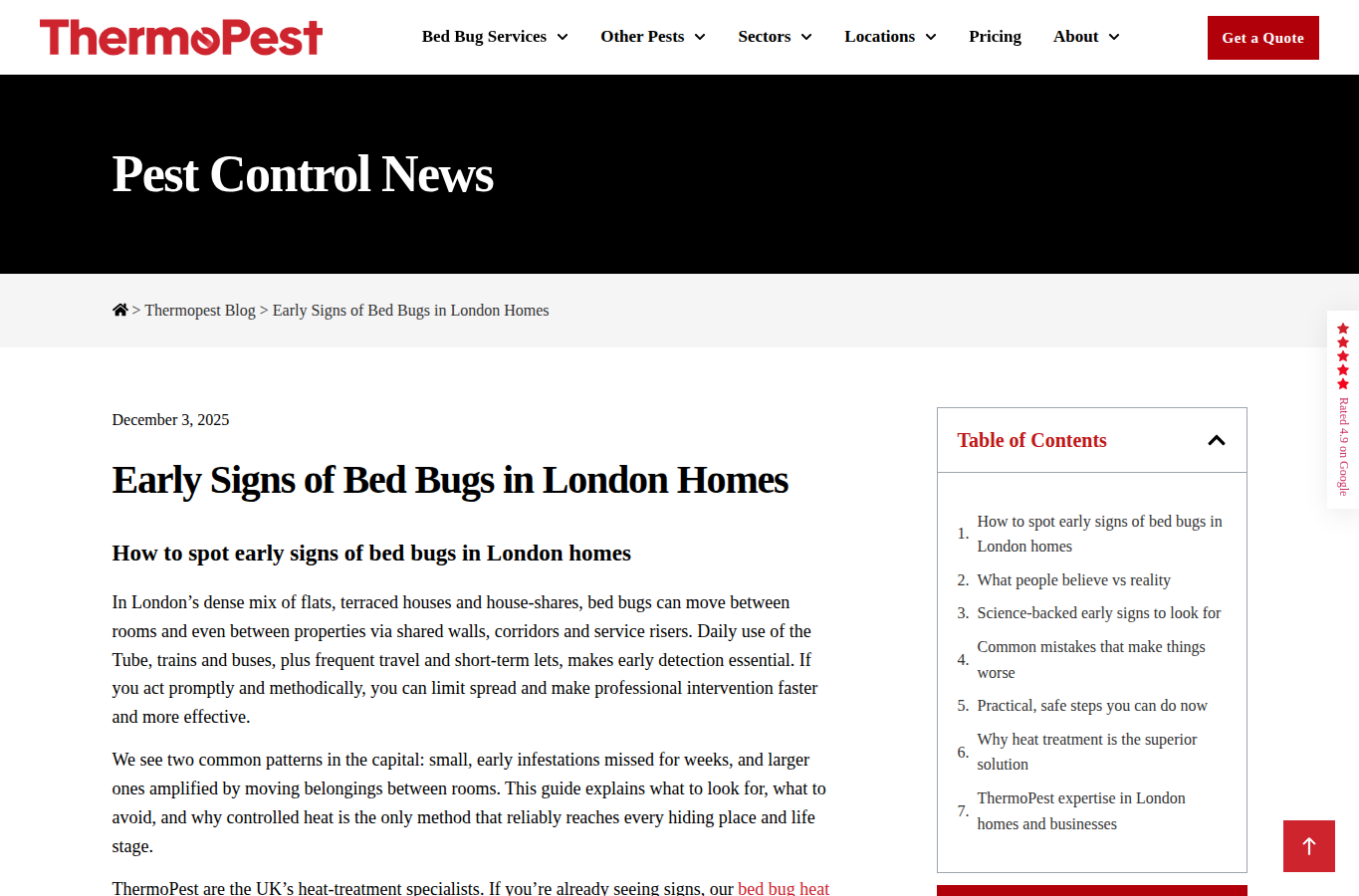
ThermoPest positions itself as the UK's heat-treatment specialist, with services designed for London housing stock from studio flats to multi-floor HMOs. Their published guidance emphasises controlled heat as the only method reliably reaching every hiding place and life stage. They note common capital patterns: small early infestations missed for weeks, and larger ones amplified by moving belongings between rooms.
London Loves Property

London Loves Property provides guidance aimed at landlords, property managers, and homeowners, stressing that mishandling bed bug issues leads to widespread infestations, tenant complaints, and costly repeat treatments. Their practical step-by-step guide covers identification, containment, and resolution based on current industry best practices.
Bed Bug Treatment Pros

Bed Bug Treatment Pros operates across London and the South & South West of England, offering survey, detailed hoover and UV treatment, and insecticidal spray for Tower Hamlets properties. Their process involves removing headboards and checking plug sockets during survey, then treating all life stages — egg, nymph, and adult — before applying residual insecticide.
Tower Hamlets Council Pest Control
The council's pest control service offers affordable treatment with experienced officers who know the borough. Charges apply for most residents, though some social housing tenants receive services at no direct cost. They advise on preventing recurrence but do not carry out proofing or repairs — these remain landlord or landowner responsibilities.
East End Homes

East End Homes has an agreement with Tower Hamlets Pest Control Service for residents of their properties, covering bed bugs among other pests. Their arrangement removes direct cost barriers for eligible tenants, though residents must contact the pest control team directly to arrange appointments.
Making the Call: Evidence, Urgency, and Next Steps
The decision matrix is straightforward in principle, nuanced in practice. If you've found live bugs, multiple signs across rooms, or bites persisting over a week, professional inspection is warranted. The cost of delay — in sleep loss, spread to neighbours, and more extensive treatment — typically exceeds early intervention.
If signs are ambiguous and your situation is stable, a two-week monitoring period with interceptor traps and careful documentation is reasonable. But set a clear threshold: persistent new signs, spreading locations, or any appearance of live bugs triggers professional contact that day.
For renters, notify your landlord or housing association promptly and keep written records. For leaseholders in converted terraces, consider whether the issue might originate from or spread to adjoining properties — coordination with neighbours can prevent circular reinfestation. For homeowners, the full responsibility is yours, but so is the full control over timing and method.
The bed bug removal service you choose should explain their inspection method, treatment options, preparation requirements, and guarantee terms clearly. Heat treatment, chemical treatment, and integrated approaches each suit different situations — there's no universal best method, only the right method for your property, infestation level, and household constraints.
If you're facing an active infestation with significant disruption or vulnerable residents — elderly, immunocompromised, or very young children — emergency pest control Tower Hamlets services offer rapid response outside standard hours. The stress of bed bugs is genuine and measurable; addressing it promptly protects both physical health and mental wellbeing.
For those who want to explore DIY options alongside professional assessment, the bed bug home remedies page examines what works and what doesn't — useful context for informed conversations with any service provider you engage.
Questions Tower Hamlets Residents Often Ask
How quickly do bed bugs spread between flats in the same building?
Bed bugs can travel through wall voids, electrical conduits, and underfloor spaces at roughly 20-30 feet per week when actively seeking new harbourage. In Victorian conversions with shared services, movement between adjoining properties can occur within days if a colony is stressed or overcrowded.
Can I treat bed bugs myself with shop-bought products?
Over-the-counter insecticides can kill visible bugs but rarely reach hidden harbourage or eggs. Incomplete treatment often drives bugs deeper into voids, making professional intervention more complex and costly. The bed bug elimination guide covers why professional treatment typically outperforms DIY for established infestations.
Does the council treat bed bugs for free?
Tower Hamlets council charges most residents for bed bug treatment. Some social housing tenants receive services without direct cost through arrangements like the East End Homes agreement. Check your tenancy or lease terms, and contact your landlord if unsure.
How do I prepare my flat for professional treatment?
Preparation is extensive: empty wardrobes and bedside tables, remove bedding for hot washing over 60°C, vacuum thoroughly, and ensure furniture can be moved. The council's preparation guidance details full requirements — failing to prepare properly means treatment cannot proceed.
Will bed bugs come back after treatment?
Reinfestation is possible if the original introduction route remains open — second-hand furniture, travel, or adjoining properties with ongoing problems. Good bed bug prevention tips include mattress encasements, careful inspection of used items, and prompt response to any new signs.
How long does professional treatment take?
Heat treatment typically resolves active infestations in a single day, with follow-up inspection a week later. Chemical treatments usually require 2-3 visits spaced 2-3 weeks apart to catch eggs hatching after initial application. Your technician should explain the expected timeline for your specific situation.
If you're seeing signs now and uncertainty is keeping you awake, a same-day inspection removes the guesswork. Call 0203 468 1999 or request a callback to book a technician visit — early clarity beats anxious speculation every time.
Need professional help? BuzzKill offers fast, reliable pest control services across London and Essex.