
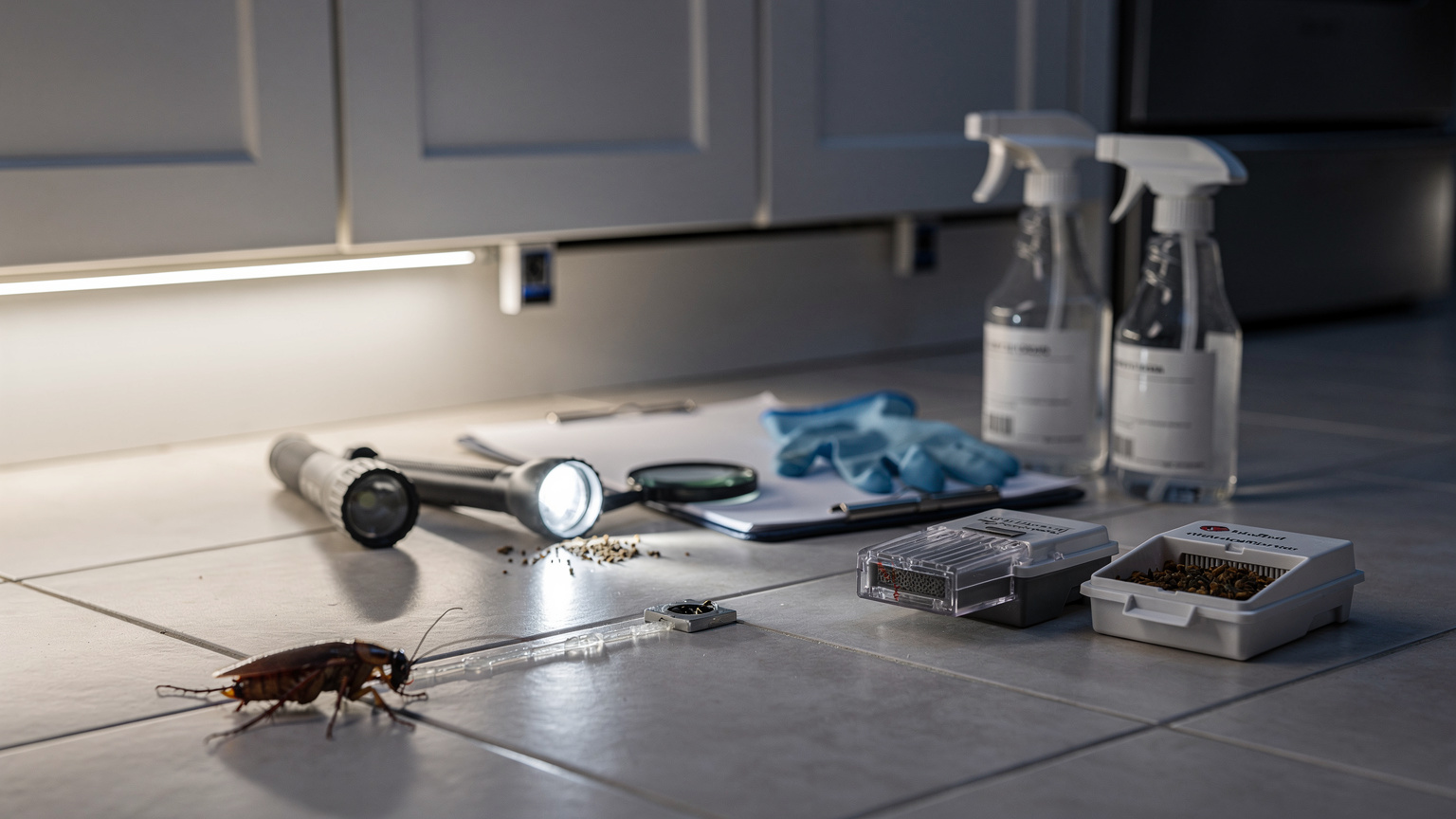
A decision framework for UK homeowners who need to contain a cockroach problem rapidly and choose between immediate self-treatment and professional intervention.
A single cockroach in your kitchen at 9:00 PM is never just one. German cockroaches (Blattella germanica), the species most frequently found in UK homes, drop egg cases holding 30-40 nymphs every 4-6 weeks when conditions suit them. Oriental cockroaches (Blatta orientalis) breed more slowly but endure colder conditions, colonising basements and drainage runs with stubborn persistence. The question is not if you should respond, but how to arrange identification, containment, and treatment inside a window tight enough to stop exponential growth. This whitepaper sets out a 48-hour operational framework for that exact purpose.
Executive Brief
This paper examines the decisive first 48 hours after cockroach detection in a UK residential property. The scope encompasses species identification, immediate containment measures, evidence-based self-treatment options, and clear criteria for escalating to professional pest control services. The evidence base draws on entomological research, regulatory guidance from the Health and Safety Executive (HSE), and field protocols employed by BASIS PROMPT-registered technicians. Analysis demonstrates that homeowner success hinges on three factors: accurate species identification within the first 6 hours, concurrent deployment of multiple control mechanisms rather than sequential attempts, and honest appraisal of property-specific harbourage conditions. The recommended path foregrounds rapid containment, targeted treatment of identified harbourage zones, and predetermined decision criteria for professional escalation at the 24-hour mark should visual evidence persist. Risks include misidentification leading to ineffective treatment, inappropriate pesticide application in food preparation areas, and delayed escalation that allows population rebound.
Table of Contents
- Scope
- Evidence Base
- Analysis
- Decision Criteria
- Recommended Path
- Risks and Assumptions
- References
Scope
Audience. This framework addresses owner-occupiers and landlords of residential properties in England, particularly those in urban and suburban settings where German and Oriental cockroach pressure runs high. The primary reader has spotted one or more cockroaches and must act before a professional inspection can be arranged.
Decision. Whether to attempt self-contained control within 48 hours or escalate immediately to professional cockroach control services, and what sequence of actions maximises containment regardless of that choice.
In-scope. Species identification guidance for the two most common UK domestic cockroaches; immediate environmental modification to reduce harbourage and food availability; evaluation of over-the-counter control products available in the UK market; criteria for professional escalation; timeline and verification methods.
Out-of-scope. Commercial food premises (subject to separate Food Standards Agency regulations); species beyond German and Oriental cockroaches; chronic infestation remediation exceeding 48 hours; fumigation protocols requiring specialist certification; detailed pesticide chemistry beyond application safety.
Assumptions. The reader possesses basic domestic maintenance skills and can obtain common retail pest control products. Property construction permits at least partial visual inspection of pipework, appliance voids, and kitchen cabinetry. No occupant has known severe insecticide sensitivity.
Evidence Base
| Source Type | Use in This Paper | Confidence |
|---|---|---|
| University of Kentucky Entomology extension publications | Species biology, harbourage preferences, bait efficacy data | High — peer-reviewed agricultural extension |
| Illinois Department of Public Health structural pest control guidance | Safer application methods, vacuum and steam protocols | High — state regulatory authority |
| HSE Code of Practice for using plant protection products | Legal constraints on amateur pesticide use in UK | High — statutory guidance |
| British Pest Control Association (BPCA) technical datasheets | Professional treatment standards, resistance management | High — industry body with membership audit |
| Field observation protocols from BASIS PROMPT-registered technicians | Practical sequencing, realistic timelines, common failure modes | Moderate-High — practitioner-derived, less formally published |
| PETA humane control guidance | Non-chemical environmental modification | Moderate — advocacy organisation, methods independently verifiable |
The evidence base deliberately omits manufacturer-specific product claims and unverified home remedy recommendations circulating on social media platforms. Where commercial product categories are discussed, reference is to active ingredient classes rather than brand names.
Analysis
Finding 1: Species Identification Determines Treatment Geometry
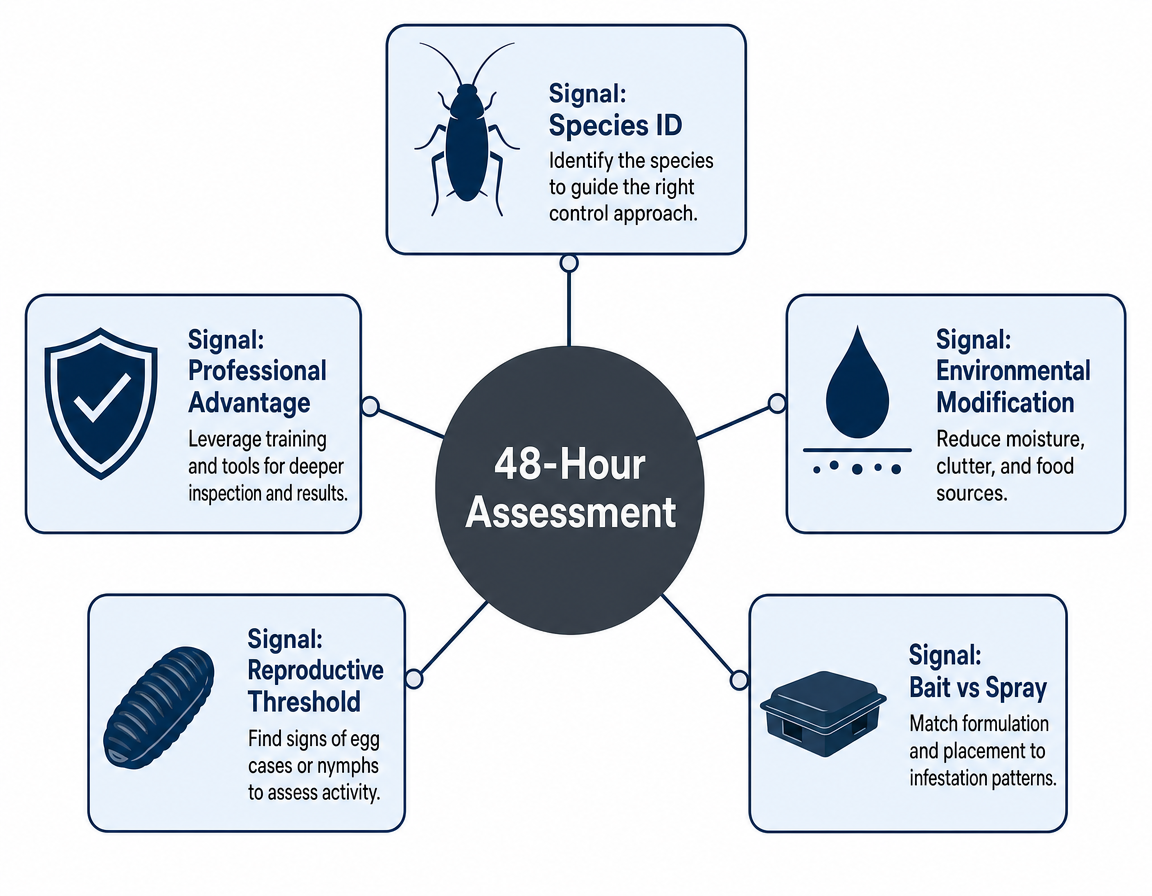
German and Oriental cockroaches occupy markedly different ecological niches, and this dictates where control efforts must concentrate. German cockroaches gravitate toward warm, humid microclimates near food preparation areas, with prime harbourage in refrigerator motor compartments, beneath dishwashers, and behind wall-mounted cabinetry. Oriental cockroaches accept cooler, damper conditions and typically associate with drainage systems, boiler rooms, and subfloor voids.
A homeowner in Hackney watched cockroaches emerge from beneath her kitchen sink at 11:00 PM and initially assumed German cockroaches based on online photographs. Closer inspection revealed the glossy dark colouration and reduced wing development characteristic of Oriental cockroaches. This shifted her treatment focus from cabinet interiors to the drainage trap and adjacent pipework, where a cracked waste pipe was providing harbourage. Had the misidentification persisted, bait stations would have sat in the wrong locations while the population expanded.
Accurate identification within the first 6 hours is therefore essential. Key distinguishing features: German cockroaches measure 13-16mm, are light brown with two dark longitudinal stripes on the pronotum; Oriental cockroaches measure 25-30mm, are dark brown to black, with males bearing reduced wings and females virtually wingless. Nymphs of both species lack wings entirely, complicating field identification.
Finding 2: Environmental Modification Produces Immediate but Temporary Population Suppression
Cockroach populations are fundamentally limited by three resources: harbourage, food, and water. Rapid modification of all three can achieve measurable suppression within 24-48 hours, yet elimination without concurrent chemical or biological control remains uncommon.
The Illinois Department of Public Health guidance stresses vacuum removal of visible cockroaches and egg cases, followed immediately by disposal of the vacuum bag or canister contents in an exterior bin. This mechanical removal reduces the active breeding population and can eliminate a substantial proportion of eggs before hatching. Steam application to harbourage cracks at temperatures above 60°C kills all life stages, though penetration depth restricts efficacy in wall voids.
Environmental modification alone fails because it cannot reach cockroaches in inaccessible harbourage. A landlord in Tower Hamlets implemented thorough cleaning and sealing after tenant complaints, seeing no live cockroaches for 72 hours. The population rebounded on day 5, emerging from an undetected void behind a built-in oven housing. The initial suppression generated a false confidence interval that delayed professional intervention.
Finding 3: Bait Formulations Outperform Residual Sprays for Amateur Use
University of Kentucky entomology research demonstrates that gel bait formulations containing hydramethylnon, fipronil, or indoxacarb achieve greater population reduction in domestic settings than aerosol or residual spray applications by amateur operators. Three mechanisms explain this: bait transfer through social grooming and cannibalism of dead cockroaches extends control to harbourage not directly treated; precise placement in cracks and crevices reduces human and pet exposure; and cockroach avoidance behaviour (thigmotaxis) limits spray contact in preferred harbourage zones.
Aerosol sprays carry particular risks in UK domestic kitchens. HSE guidance restricts amateur use of certain pyrethroid formulations in food preparation areas, and misapplication can drive cockroaches deeper into harbourage rather than killing them. The "flushing" effect of aerosols — scattering cockroaches from treated surfaces — often spreads the population into previously uninfested areas.
Bait placement geometry matters considerably. For German cockroaches, concentrate placements at 1-2 metre intervals along cabinet back panels, beneath sink units, and adjacent to refrigerator compressors. For Oriental cockroaches, target floor drains, boiler pipe entries, and subfloor access points. Avoid placing bait stations where routine cleaning will dislodge or contaminate them.
Finding 4: The 24-Hour Escalation Threshold Is Supported by Reproductive Biology
German cockroach oothecae hatch in 28-30 days at 25°C, with females carrying the egg case until 1-2 days before hatching. This means visible adult populations represent breeding stock established through at least one generation cycle — typically 6-12 weeks under domestic conditions. Oriental cockroaches show longer development times, with nymphal development extending to 6-12 months in cool conditions.
The practical implication: any visible cockroach population has already undergone substantial undetected growth. A homeowner spotting 3-5 cockroaches in one evening is likely seeing 10-20% of the actual population, based on nocturnal activity patterns and thigmotactic sheltering behaviour. The 24-hour mark after initial treatment constitutes a critical evaluation point: if live cockroaches remain visible, the population has demonstrated resilience to the chosen control measures, and professional intervention is warranted before the next reproductive cycle consolidates the infestation.
Finding 5: Professional Intervention Offers Advantages Beyond Product Access
BPCA-registered technicians can deploy professional-use insecticides unavailable to amateur operators, including microencapsulated formulations and insect growth regulators (IGRs) such as pyriproxyfen and hydroprene. More importantly, professional assessment incorporates harbourage detection using fibreoptic inspection equipment, thermal imaging for moisture-associated populations, and structural recommendations for proofing that prevent reinfestation.
The cockroach control for businesses protocols employed by commercial operators emphasise integrated pest management (IPM) principles: monitoring, threshold-based intervention, and documentation. These same principles apply to domestic situations, though homeowner implementation tends to be less systematic.
Decision Criteria
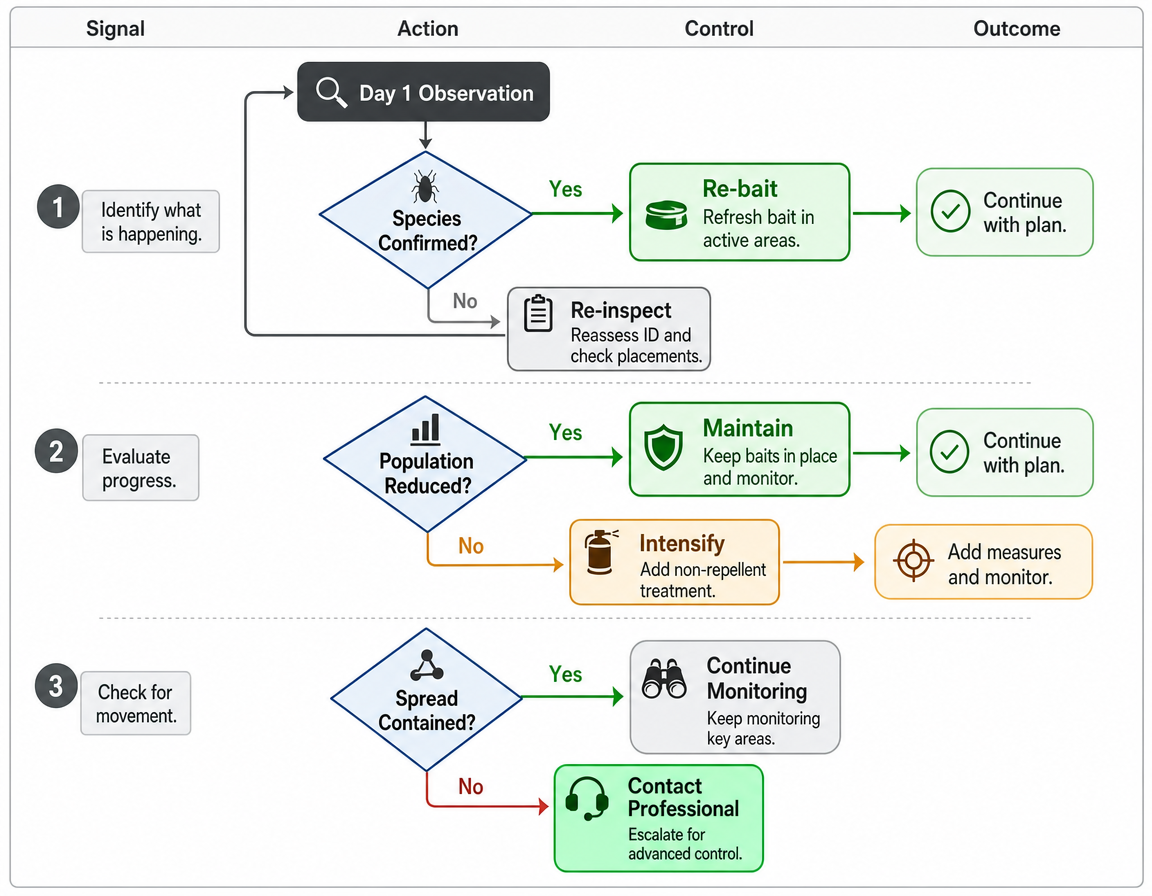
Homeowners should assess the following criteria at the 6-hour, 24-hour, and 48-hour decision points:
| Criterion | 6-Hour Assessment | 24-Hour Assessment | 48-Hour Assessment |
|---|---|---|---|
| Species confidence | Visual confirmation against reference images; note size, colour, location | Reconfirm if initial identification uncertain; adjust treatment geometry if revised | Final confirmation; informs professional briefing if escalated |
| Population extent | Single sighting vs. multiple individuals; nymphs present (indicates breeding) | Post-treatment observation count; note life stages | Population trend: increasing, stable, or decreasing |
| Harbourage access | Visible cracks, pipe entries, appliance voids accessible for treatment | Treatment coverage completeness; newly discovered harbourage | Assessment of inaccessible voids requiring professional equipment |
| Environmental control feasibility | Ability to implement cleaning, sealing, moisture reduction within 24 hours | Maintenance of environmental modifications; tenant/occupant compliance | Sustainability of modified conditions long-term |
| Chemical treatment confidence | Appropriate product selected; placement locations identified | Bait consumption evidence; no adverse effects on occupants | Efficacy assessment; resistance suspected if population persists |
| Professional availability | Same-day inspection availability in local area | 24-48 hour booking secured if needed | Confirmed professional appointment or completed treatment verification |
Escalation triggers at 24 hours: Any of the following indicates professional intervention should proceed: observation of nymphs (confirming active breeding); cockroaches observed in multiple rooms; bait stations showing no consumption after 18 hours (suggesting alternative food sources or bait aversion); occupant health concerns (asthma, pregnancy, infant presence); or property type with complex harbourage (basement flats, period conversions with extensive voids).
Escalation triggers at 48 hours: Any live cockroach observation after 48 hours of correctly implemented combined treatment indicates population resilience requiring professional assessment. This threshold is conservative yet appropriate given reproductive biology and the costs of delayed escalation.
Recommended Path
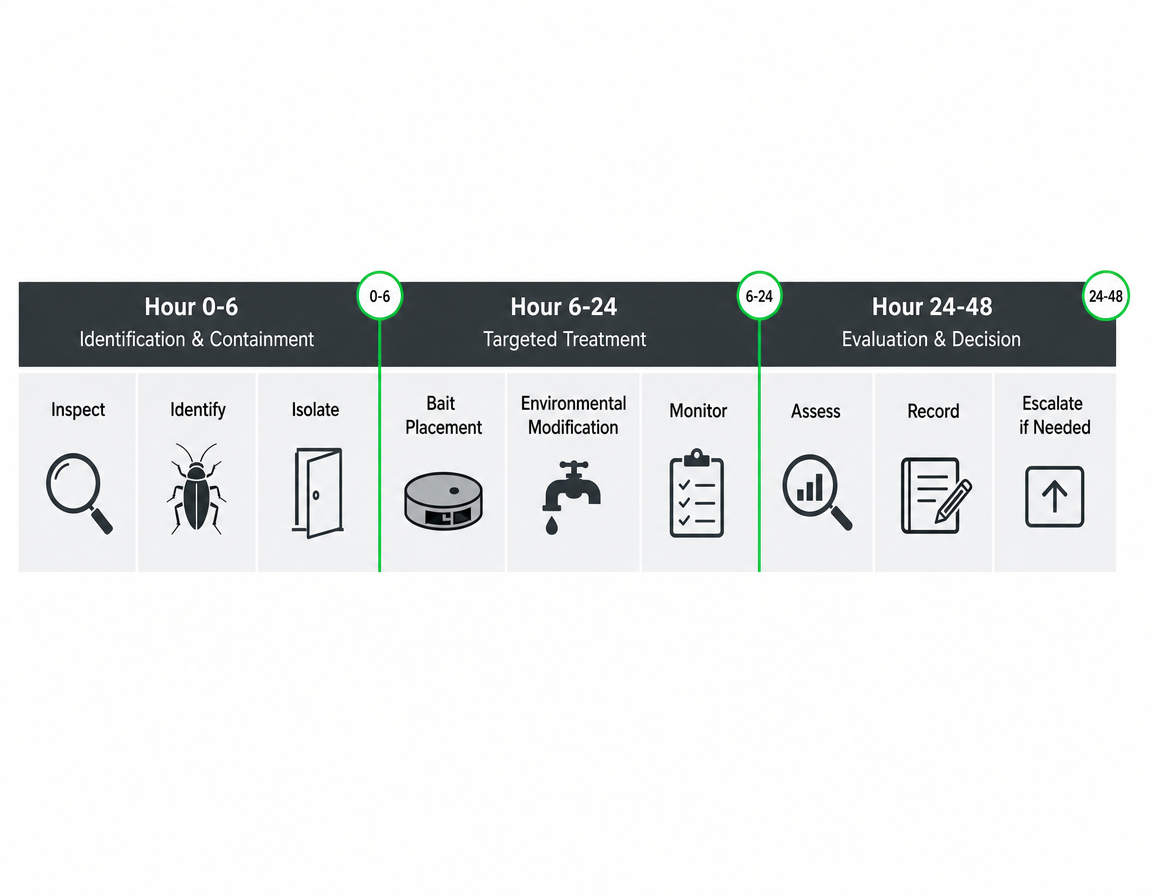
Hour 0-6: Identification and Containment
- Photograph any observed cockroaches for identification reference; note location, time, and behaviour (flying capability, speed of movement).
- Inspect kitchen and bathroom cabinetry, refrigerator and dishwasher voids, sink pipe entries, and floor drains with torch; document harbourage indicators (faecal spotting, egg cases, shed skins).
- Implement immediate environmental modification: remove all accessible food sources into sealed containers; fix dripping taps; vacuum visible cockroaches and egg cases with immediate exterior disposal; apply steam to accessible cracks if equipment available.
- Purchase gel bait formulation and bait stations appropriate for identified species; avoid aerosol "foggers" or broadcast sprays.
Hour 6-24: Targeted Treatment
- Place bait according to species-specific geometry: German cockroach — cabinet back panels, appliance voids, drawer slides; Oriental cockroach — floor drains, pipe entries, subfloor access, boiler room.
- Seal accessible cracks with appropriate sealant; install drain covers if Oriental cockroaches suspected.
- Maintain environmental modifications; monitor bait consumption.
- Secure professional inspection booking if any escalation triggers present; same-day or next-day availability is achievable in East London and Essex through independent operators.
Hour 24-48: Evaluation and Decision
- Assess population trend against decision criteria table.
- If population suppressed: continue monitoring, refresh bait at 14-day intervals, schedule follow-up inspection at 30 days to confirm elimination.
- If population persists: proceed with professional inspection; provide technician with identification notes, treatment history, and harbourage documentation.
- If professional treatment implemented: coordinate access for follow-up visits; typical protocols require 2-3 visits at 14-day intervals for German cockroach elimination.
Risks and Assumptions
Misidentification risk. Brown-banded cockroaches (Supella longipalpa), though less common in the UK, require different treatment geometry due to their preference for elevated, drier harbourage. Misidentification as German cockroaches leads to misplaced bait and continued population growth. The UK cockroach species identification guide provides additional diagnostic features.
Pesticide misuse risk. Amateur application of professional-use products, or application of amateur products beyond label rates, creates health hazards and potential regulatory liability. HSE guidance prohibits certain application methods in domestic settings; homeowners should not extrapolate from commercial or agricultural pesticide information.
Resistance risk. German cockroach populations in some UK urban areas have shown reduced susceptibility to certain pyrethroid insecticides. Bait aversion, distinct from physiological resistance, develops when populations acquire behavioural avoidance of specific bait matrices. Both phenomena may explain treatment failure despite correct implementation.
Structural limitation risk. Properties with extensive shared voids, particularly period conversions and mansion block flats, may experience reinfestation from adjacent units regardless of individual treatment efficacy. In such cases, coordinated treatment of the entire building is typically necessary, requiring landlord or managing agent engagement.
Occupant health assumptions. This framework assumes no occupant has severe asthma or insecticide sensitivity that would preclude bait or limited spray application. Where such conditions exist, professional assessment for non-chemical or reduced-chemical protocols is indicated from hour 0.
Seasonal variation assumption. Cockroach activity and reproductive rates vary with ambient temperature. The 48-hour framework assumes typical UK domestic heating conditions (18-24°C). Properties with intermittent heating or cold spots may show slower treatment response, extending the evaluation timeline proportionally.
How BuzzKill Pest Control Applies This
BuzzKill Pest Control operates across East London and Essex with NPTA membership, BASIS PROMPT registration, and RSPH Level 2 qualified technicians. The company's cockroach control service follows the IPM principles outlined in this framework: systematic harbourage inspection using fibreoptic equipment, species-confident treatment selection, and documented follow-up protocols with guaranteed results.
For homeowners who reach the 24-hour escalation threshold, BuzzKill offers same-day response with no call-out charge, enabling professional intervention before the next reproductive cycle. Technicians carry professional-use insect growth regulators and microencapsulated formulations unavailable through retail channels, and can implement structural proofing recommendations that prevent reinfestation.
The preventing cockroach infestations guidance on the company's website complements this 48-hour framework with longer-term prevention strategies for properties that have achieved elimination or wish to avoid initial infestation.
Homeowners uncertain about species identification or harbourage extent can contact BuzzKill on 0203 468 1999 or request a callback through buzzkillpestcontrol.co.uk to arrange inspection and treatment planning.
References
- University of Kentucky, College of Agriculture, Food and Environment. "Cockroach Elimination in Homes and Apartments." Entomology Extension Publication ENTFACT-614. Lexington, KY.
- Illinois Department of Public Health. "Tips for Safer Roach Control." Structural Pest Control Program Consumer Guidance. Springfield, IL.
- Health and Safety Executive. "Code of Practice for Using Plant Protection Products." HSE Guidance Document. Bootle, UK.
- British Pest Control Association. "Cockroach Control: Technical Guidance for Members." BPCA Technical Datasheet. Derby, UK.
- PETA. "Humane Cockroach Control." Lifestyle and Home Guidance. Norfolk, VA.
- North Carolina Department of Agriculture and Consumer Services. "Cockroach Control and Prevention." Structural Pest Control and Pesticides Division Consumer Information. Raleigh, NC.
- Rust, M.K., Owens, J.M., and Reierson, D.A. "Understanding and Controlling the German Cockroach." Oxford University Press, 1995.
- Cochran, D.G. "Cockroaches: Biology and Control." World Health Organization Vector Control Series. Geneva, 1982.
Related Blog Posts
- How to Get Rid of Cockroaches Fast — Expert UK guide covering identification, DIY methods, professional treatment, and prevention tips for persistent infestations.
- How to Prevent Cockroaches at Home — Practical steps to stop cockroaches before they establish, including hygiene protocols and structural proofing measures.
- Cockroach Home Remedies: What Actually Works? — Evidence-based assessment of boric acid, baking soda, essential oils, and other common domestic treatments.
- Cockroach Control Articles And Guides | BuzzKill Pest Control Blog | BuzzKill Pest Control
- Blog
Need professional help? BuzzKill offers fast, reliable pest control services across London and Essex.