
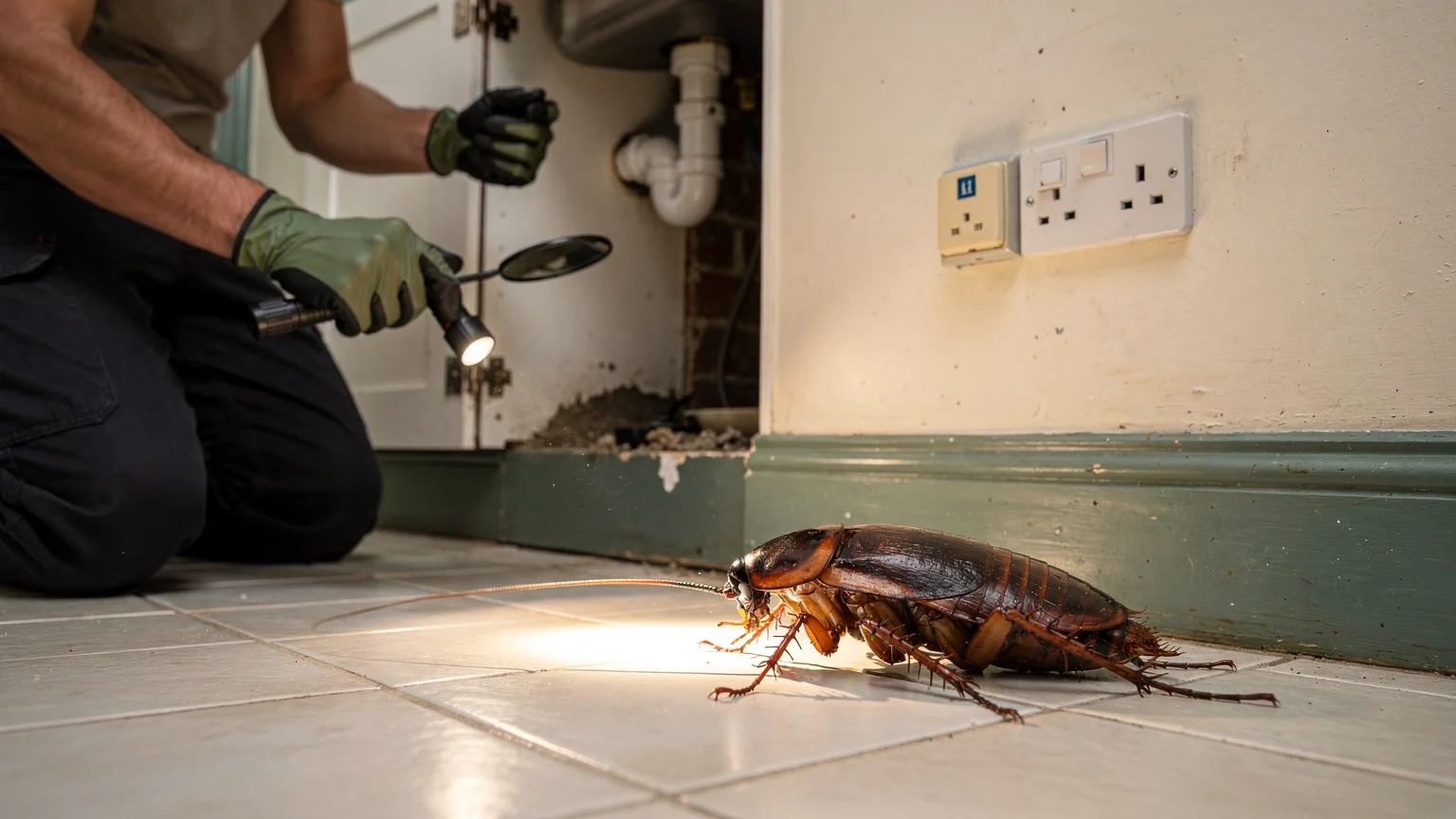
The World's Largest Cockroach and Why It Matters for Your Home
A 20-centimetre wingspan sounds like the stuff of nightmares, but the species that holds the record will never turn up in a London kitchen.
The biggest cockroach in the world is Megaloblatta longipennis, a rainforest dweller native to Colombia, Ecuador, and Peru. The largest documented specimen measured 9.7 cm in body length with a wingspan of 20 cm, according to Wikipedia's entry on the species. That is roughly the span of a dinner plate. If you have just spotted something large and brown scuttling behind your fridge, it is not this insect. What you are seeing is almost certainly a much smaller, far more troublesome species that demands a different response entirely. This guide shows you how to tell the difference, what the evidence means, and what to do in the first 48 hours.
What to do in the first 10 minutes
Do not reach for aerosol spray. Blasting a cockroach with over-the-counter insecticide often scatters the insect into deeper harbourage, contaminates food preparation surfaces, and leaves you with a toxic residue that complicates professional treatment later. The safest immediate action is simple observation. Note exactly where the insect was heading, what time you saw it, and whether it moved quickly or slowly. German cockroaches (Blattella germanica) dart away rapidly and prefer warm, humid areas near water sources. Oriental cockroaches (Blatta orientalis) move more sluggishly and favour cooler, damp zones such as basements, drains, and external bin stores. If you can photograph the insect without disturbing the area, do so. Flash photography in a dark cupboard often yields a clear enough image for species identification. Do not seal cracks or block suspected entry points yet. A trapped cockroach will simply find another route, and blocked harbourage makes professional inspection harder.
If you have children or pets in the property, keep them away from the area where you spotted the insect. Do not attempt to catch or handle the specimen with bare hands. Cockroaches can carry pathogens including Salmonella, E. coli, and various parasitic worms on their bodies and legs. While the risk of direct transmission from a single brief contact is low, unnecessary exposure is easily avoided. Wash your hands thoroughly after any suspected contact with surfaces the insect may have traversed.
Confirm the evidence and rule out false alarms
Accurate identification determines everything that follows: treatment choice, harbourage location, and long-term prevention strategy. The two pest species responsible for virtually all UK domestic and commercial infestations are dramatically smaller than the tropical giants that generate online fascination.
The German cockroach grows to roughly 1.3–1.6 cm in length. It is light brown with two dark parallel stripes running from behind the head to the base of the wings. Both sexes have wings, though they rarely fly in confined indoor spaces. Nymphs are darker, almost black, and lack wings entirely. Egg cases (oothecae) are small, brown, and roughly 8 mm long. A female carries the ootheca until shortly before hatching, which is why you may never see the egg cases even during an established infestation.
The Oriental cockroach is larger, reaching 2.0–2.9 cm, and appears shiny dark brown to black. Females have only vestigial wing pads; males have wings that cover about two-thirds of the abdomen. Neither sex can fly. This species produces a strong, musty odour that intensifies as numbers increase. Oothecae are dark reddish-brown and often deposited in sheltered crevices rather than carried.
Other large cockroach species occasionally appear in UK contexts but rarely establish indoors. The American cockroach (Periplaneta americana) reaches 3.5–4.0 cm and prefers warm, humid environments such as boiler rooms and bakeries. The brown-banded cockroach (Supella longipalpa) is smaller, at 1.0–1.5 cm, and favours drier, warmer locations such as upper cupboards and behind picture frames. Understanding which species you are dealing with is not merely an academic exercise, as the PestPro Index cockroach guide emphasises: it directly affects harbourage sites and treatment approach.
False alarms are common. The darkling beetle (Tenebrio molitor), often found in stored grain or bird seed, is similarly dark and shiny but has a more rounded, compact body and distinctly clubbed antennae. The ground beetle family (Carabidae) includes many black, fast-moving species that enter homes through open doors or gaps in window frames. These beetles have prominent, forward-jutting mandibles and thread-like antennae, unlike the long, filamentous antennae of cockroaches. Woodlice, which many Londoners encounter in damp basements, have segmented, oval bodies and seven pairs of legs, making identification straightforward once you look closely. Earwigs, with their distinctive pincer-like cerci at the rear, are frequently mistaken for small cockroaches but have shorter antennae and a more elongated, flattened body shape.
Photograph any insect from directly above and, if possible, from the side. Include a coin or ruler for scale. Note the location, time of day, and any nearby moisture source or food debris. This information is invaluable if you later need to show a pest controller or use our UK cockroach species identification guide to confirm your own assessment.
The field route: where to inspect inside your property
A systematic inspection follows the biology of the pest, not guesswork. Cockroaches require warmth, moisture, and food. Your inspection should trace these three requirements through the rooms where they converge.
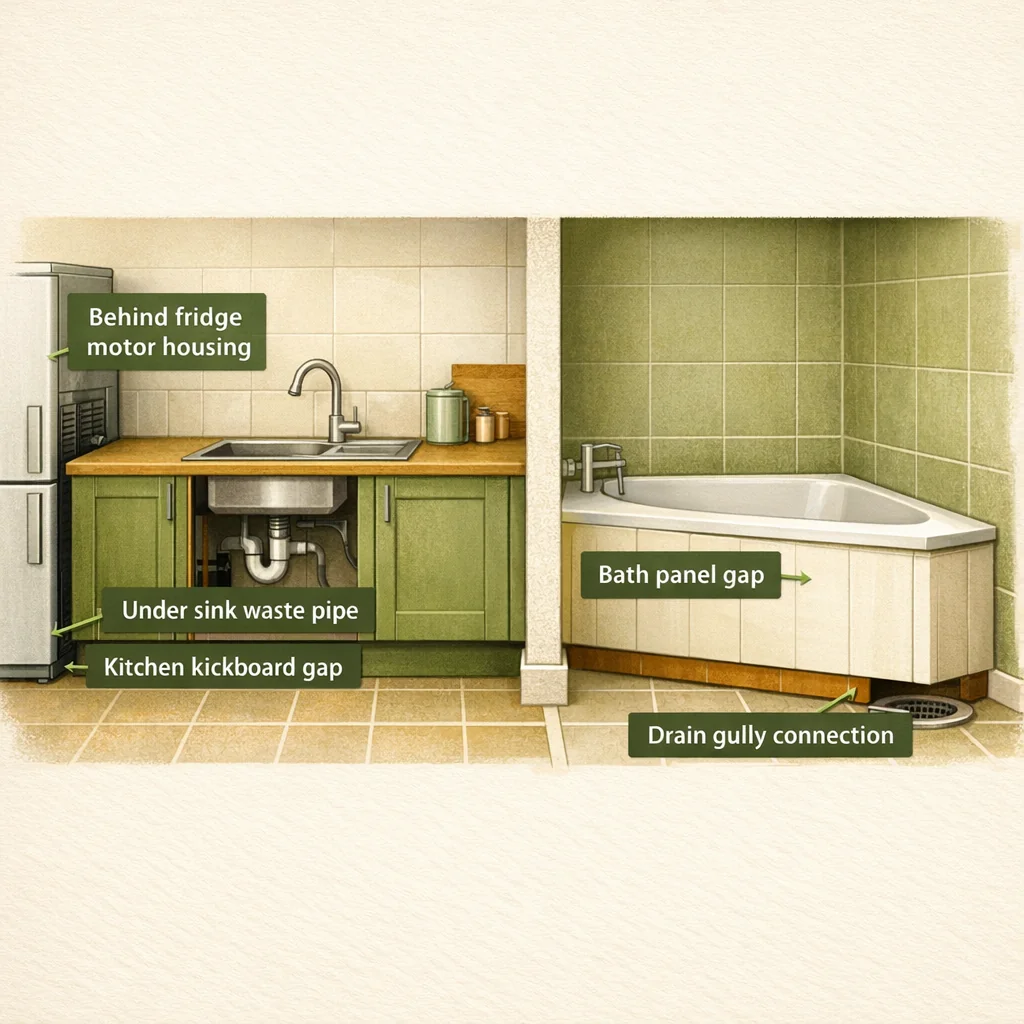
Kitchen: the primary zone. Pull the refrigerator away from the wall and examine the compressor area with a torch. German cockroaches frequently establish harbourage here because the motor provides constant warmth and condensation. Check beneath the sink, paying particular attention to the gap between the cabinet base and the floor. Remove the kick plate beneath dishwashers and inspect the void with a mirror on an extending handle. Open the boiler cupboard and examine pipe entries, especially where copper pipes pass through plasterboard. Look for live insects, cast skins, egg cases, and small black faecal pellets that resemble coarse ground pepper. Examine the back of wall-mounted cabinets, particularly those above kettles or toasters where warmth rises. Check inside the toaster itself, as crumbs and residual heat create an attractive microhabitat.
Bathroom: the secondary zone. Inspect behind the toilet cistern, under the bath panel, and inside vanity units. Check around extractor fan housings, where warm, moist air creates ideal conditions. German cockroaches will exploit any crack wider than 1.5 mm. Look for faecal spotting along tile grout lines and in the corners of shower trays where silicone sealant has degraded.
Utility room and bin storage. Oriental cockroaches often originate from external drains and bin areas, then migrate indoors through utility rooms. Examine the washing machine standpipe, floor drains, and any gaps where waste pipes exit the building. Check the seal around external doors and the threshold gap. Inspect the area beneath freezers in external garages or outbuildings, as these can support satellite populations that later move indoors.
Basement and sub-floor voids. In older London properties, especially Victorian and Edwardian terraces, Oriental cockroaches thrive in damp sub-floor spaces. Look for them near air bricks, damp-proof course breaches, and areas where soil pipes show signs of leakage. Check beneath floorboards where accessible, particularly in properties with suspended timber floors and inadequate ventilation. The musty odour associated with Oriental cockroaches often becomes apparent in these confined spaces before it is detectable at ground level.
Loft and water tank spaces. Less common, but worth checking if your property has a traditional cold water tank in the loft. Insulation around pipes can provide the warmth and humidity that supports a small population. Look for evidence near the tank base where condensation forms, and around any redundant pipework that still carries warm water from central heating systems.
Record every finding with a photograph and brief note. A single live insect during daylight hours usually indicates a well-established population, as cockroaches are primarily nocturnal. The presence of multiple life stages, from nymphs to adults, confirms active breeding rather than transient entry.
Decision fork: what the evidence tells you
The inspection results determine your next move. Be honest about what you have found.
If you found live insects, cast skins, egg cases, or faecal pellets: you have an active infestation that requires professional treatment. DIY methods rarely succeed against established German cockroach populations because of rapid reproduction (a single female can produce over 30,000 descendants in a year under ideal conditions) and growing resistance to common insecticides. Our cockroach control service provides same-day assessment and treatment planning across London and Essex.
If you found only one insect and no further evidence: monitor for 7–10 days before concluding. Place sticky monitoring traps in the locations described above, checking them every 48 hours. A single Oriental cockroach in a ground-floor flat near external drains may represent a transient individual rather than an established population. However, a single German cockroach in a heated kitchen is far more likely to signal a hidden harbourage. The biology of the species matters enormously here: German cockroaches rarely travel far from established harbourage, so a single sighting usually means others are nearby.
If you found no insects but have persistent signs: the infestation may be in an inaccessible void, or the species may be active only at night. Increase monitoring with traps and consider a professional inspection with fibre-optic cameras and thermal imaging. Some harbourages, particularly within cavity walls or beneath fixed kitchen units, are virtually impossible to detect without specialised equipment.
What changes the risk level: multiple species present simultaneously; evidence in food preparation areas of commercial premises; sightings during daylight; presence of egg cases; or any sign in healthcare, childcare, or food manufacturing settings. These situations escalate the public health risk and may trigger enforcement action under food safety regulations. Properties with vulnerable occupants, including elderly residents, immunocompromised individuals, or young children, also warrant more urgent professional attention. The stress and anxiety of knowing cockroaches are present should not be underestimated, particularly for those with existing health conditions that poor sleep or heightened stress may exacerbate.
Tonight, tomorrow, and the next 48 hours
Tonight: reduce available resources without disturbing harbourage. Clean all food preparation surfaces with hot soapy water. Store food in sealed containers. Fix any dripping taps. Empty kitchen bins and clean the bin interior. Do not use aerosol sprays, foggers, or boric acid dust at this stage, as these can spread the population and complicate professional baiting programmes. Remove pet food bowls after feeding and do not leave standing water overnight. If you have a compost caddy in the kitchen, empty it and store it in the freezer temporarily to eliminate odour trails.
Tomorrow: contact a pest control professional for same-day or next-day inspection if you have confirmed evidence. If you are monitoring only, check traps and photograph any captures. Review our guide to preventing cockroach infestations for proofing measures you can implement once the situation is clarified. Seal obvious food sources, but do not undertake extensive proofing until the species and entry route are confirmed, as premature sealing can trap insects inside and redirect them to new areas.
Next 48 hours: if professional treatment is underway, follow the technician's instructions regarding preparation, evacuation times, and follow-up visits. German cockroach treatments typically require two or three visits at 10–14 day intervals to break the reproductive cycle. Oriental cockroach treatments may focus more on harbourage proofing and drain investigation. Do not clean away gel baits or dust applications prematurely. These formulations often work through delayed action, allowing exposed insects to return to harbourage and transfer the active ingredient to others through grooming and cannibalism. Disrupting this process reduces treatment efficacy significantly.
During this period, maintain detailed records of any further sightings, including time, location, and insect size or appearance. This information helps technicians assess treatment progress and identify any surviving harbourages that require additional attention.
Escalation signal: when to stop and call a technician
The single sign that demands immediate professional intervention is a daylight sighting combined with a musty, oily odour in a food preparation area. This combination indicates a large, established population that has outgrown its harbourage and is actively foraging in conditions that present direct contamination risk. At this stage, DIY treatment is not merely ineffective; it is potentially hazardous, as disturbed cockroaches can spread pathogens across food contact surfaces while evading control. Our emergency pest control team responds same-day across East London and Essex with NPTA-accredited technicians, no call-out charge, and guaranteed follow-through until the infestation is resolved.
The fascination with record-breaking species like Megaloblatta longipennis or the Central American giant cave cockroach, Blaberus giganteus, serves a useful purpose: it reminds us how diverse and adaptable this insect order truly is. The ITIS report on Blaberus giganteus classifies it within the family Blaberidae, the giant cockroaches, yet even this impressive species poses no threat to UK homes. The real challenge lies not in tropical giants but in the small, secretive German and Oriental cockroaches that have adapted to human environments over millennia. Understanding this distinction, and responding appropriately to the species actually present in your property, is the first step toward effective control.
Need professional help? BuzzKill offers fast, reliable pest control services across London and Essex.