
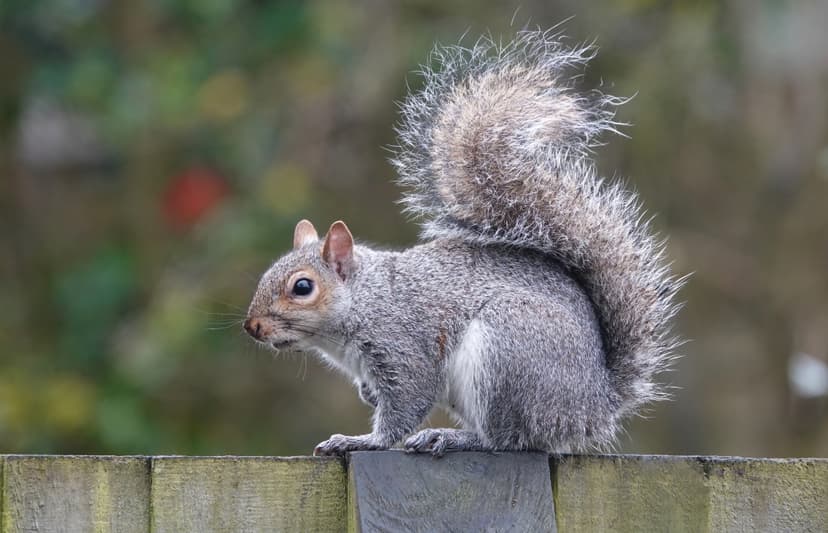
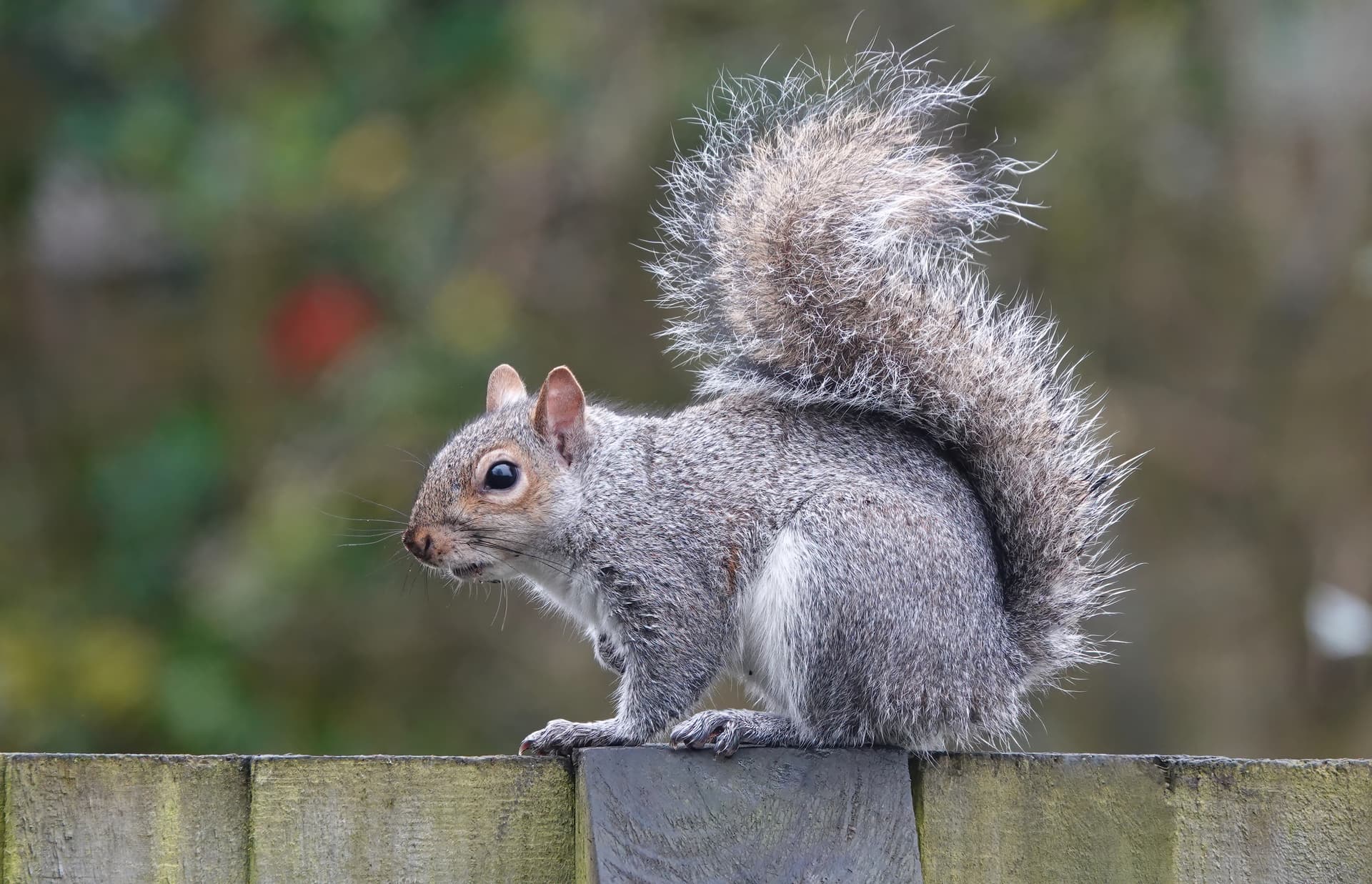
Two squirrel species live in the UK — the grey squirrel and the red squirrel. Grey squirrels are by far the most common and are the species responsible for virtually all squirrel-related pest problems in London and Essex. They are classified as an invasive non-native species and are not protected under UK law.
Red squirrels are native to the UK but are now critically endangered, with an estimated population of only 140,000 compared to over 2.5 million grey squirrels. Red squirrels are fully protected under the Wildlife and Countryside Act 1981 and are almost never encountered in London or the South East. This guide covers both species so you can identify which you are dealing with.
Published:
Grey Squirrels
Appearance — The grey squirrel (Sciurus carolinensis) is the species you will encounter in London, Essex, and the vast majority of England. They were introduced from North America in the 1870s and have since spread across almost the entire UK, displacing the native red squirrel from most of its former range.
Grey squirrels have a silver-grey coat with brownish tones along the back and flanks, and a pale white or cream belly. Their tail is large, bushy, and distinctly grey with a white fringe — this is their most recognisable feature. Adults measure 24 to 26cm in body length with a tail of similar length, and weigh between 400 and 600 grams. Their ears are rounded and do not have tufts.
Despite their name, grey squirrels can appear quite brown in summer, which sometimes causes confusion with red squirrels. The key distinguishing features are body size (grey squirrels are noticeably larger), the lack of ear tufts, and the grey-white tail fringe.
Life Cycle — Grey squirrels breed twice a year — once in late winter (January to February) and again in early summer (May to June). After a gestation period of around 44 days, females produce litters of 2 to 5 young, known as kittens. The kittens are born blind and hairless in the nest (called a drey) and are weaned at around 10 weeks.
Young grey squirrels become independent at approximately 12 to 14 weeks and reach sexual maturity at around 10 to 12 months. In the wild, grey squirrels live for up to 9 years, though most urban squirrels live 3 to 5 years due to predation by cats, dogs, and road traffic. A single breeding pair can produce up to 10 offspring per year.
Habitat — Grey squirrels are highly adaptable and thrive in both woodland and urban environments. In London and Essex, they are extremely common in parks, gardens, cemeteries, and any area with mature trees. They build dreys — large nests made of twigs, leaves, bark, and moss — high in the forks of tree branches.
In urban areas, grey squirrels frequently move into loft spaces, particularly during autumn and winter when they seek warm, sheltered nesting sites. They access roofs by climbing walls, drainpipes, and overhanging tree branches, and enter through gaps under eaves, damaged soffits, loose roof tiles, and ventilation openings. A gap of just 50mm is enough for a squirrel to squeeze through.
Once inside a loft, grey squirrels cause significant damage — shredding insulation for nesting material, gnawing through electrical cables and water pipes, and contaminating the space with droppings and urine. They are diurnal (active during the day), so homeowners typically hear loud scratching and thumping noises in the morning and late afternoon.
Red Squirrels
Appearance — The red squirrel (Sciurus vulgaris) is the UK's only native squirrel species. They are considerably smaller than grey squirrels, with a body length of 19 to 23cm and a weight of 250 to 350 grams — roughly half the size of an adult grey squirrel.
Their coat colour varies from bright ginger-red to dark brown, and can appear almost black in winter. The most distinctive feature is their prominent ear tufts — long tufts of fur that extend from the tips of the ears, particularly visible in winter. Their tail is smaller and less bushy than a grey squirrel's, and is typically red-brown without the white fringe seen on grey squirrels.
Red squirrels have a more slender build and a lighter, more agile movement compared to the heavier, more robust grey squirrel. If you see a squirrel in London or Essex, it is almost certainly a grey squirrel — red squirrel sightings in the South East are extremely rare.
Life Cycle — Red squirrels breed once or twice a year, depending on food availability. The first breeding season is February to March, with a possible second litter in May to June if conditions are favourable. Gestation lasts around 38 to 39 days — slightly shorter than grey squirrels — and litters typically contain 3 to 4 kittens.
Kittens are weaned at 8 to 10 weeks and become independent at around 12 weeks. Red squirrels reach sexual maturity at approximately 9 to 11 months. In the wild, they can live up to 6 years, though average lifespan is around 3 years.
Red squirrel populations have declined dramatically since the introduction of grey squirrels. Grey squirrels outcompete reds for food, are larger and more dominant, and — crucially — carry squirrelpox virus, which is fatal to red squirrels but does not affect greys. Conservation efforts are focused on maintaining red squirrel strongholds in Scotland, Northumberland, and parts of Wales and the Lake District.
Habitat — Red squirrels prefer coniferous and mixed woodland habitats where they can feed on pine seeds, hazelnuts, and fungi. Unlike grey squirrels, they are less adapted to urban environments and rarely enter buildings or loft spaces.
In the UK, red squirrels are now primarily found in Scotland (which holds around 75% of the remaining UK population), Northumberland, parts of Wales, the Lake District, and on islands such as the Isle of Wight, Brownsea Island, and Anglesey. There are no established red squirrel populations in London or Essex.
Red squirrels build dreys similar to grey squirrels but tend to nest higher in conifer trees. They are solitary animals outside the breeding season and are more shy and elusive than grey squirrels. If you encounter a squirrel causing problems in your loft or garden in the South East, it will be a grey squirrel.
Need professional help with squirrel pest control? BuzzKill Pest Control offers fast, effective treatment with no call-out charge.
Why This Matters for Pest Control
The legal distinction between the two species is critical. Grey squirrels are classified as an invasive non-native species — it is legal to trap and humanely dispatch them, and it is actually illegal to release a trapped grey squirrel back into the wild under the Invasive Alien Species (Enforcement and Permitting) Order 2019.
Red squirrels are fully protected under the Wildlife and Countryside Act 1981 — it is illegal to intentionally kill, injure, or take a red squirrel, or to damage or destroy its drey. In the extremely unlikely event that you encounter a red squirrel, contact your local wildlife trust for advice.
All pest control work carried out by BuzzKill targets grey squirrels only. Our technicians are trained to positively identify the species before any trapping begins. If you are unsure what species is in your loft, our squirrel control service page explains the full survey and removal process.
Frequently Asked Questions
How do I tell the difference between a grey and red squirrel?
Grey squirrels are larger (400-600g vs 250-350g), have a grey coat with a white-fringed tail, and no ear tufts. Red squirrels are smaller, have a red-brown coat, and distinctive long ear tufts — especially visible in winter. In London and Essex, any squirrel you see will almost certainly be a grey.
Are grey squirrels protected in the UK?
No. Grey squirrels are classified as an invasive non-native species. It is legal to trap and humanely dispatch them. It is actually illegal to release a trapped grey squirrel back into the wild.
Can grey squirrels breed all year round?
Grey squirrels breed twice a year — in late winter and early summer. They do not breed continuously, but with up to 10 offspring per year from a single pair, populations grow rapidly.
Why are red squirrels so rare?
Grey squirrels outcompete reds for food, are larger and more dominant, and carry squirrelpox virus — which is fatal to red squirrels but harmless to greys. Since their introduction in the 1870s, grey squirrels have displaced reds from most of England and Wales.
Do red squirrels enter lofts?
Very rarely. Red squirrels prefer coniferous woodland and are much less adapted to urban environments than grey squirrels. If a squirrel is in your loft in London or Essex, it is a grey squirrel.
Professional Squirrel Pest Control Service
Learn more about our squirrel pest control service, pricing, treatment methods, and customer reviews.
View Squirrel Pest Control Service